




12 alternatives to practice English on your own in 2026
12 alternatives to practice English on your own in 2026
12 alternatives to practice English on your own in 2026
Written by: Luan Cavallaro, Founder & CMO, BeConfident
Key takeaways from this article
AI apps like BeConfident offer 24/7 conversation with instant pronunciation and grammar feedback, reducing dependency on human partners.
Solo techniques like shadowing, audio recording, and series without subtitles build muscle fluency and boost confidence without social exposure.
The 4 pillars of English (listening, speaking, reading, writing) need to work together, with 40% to 50% of the focus on speaking to generate practical results.
Shame and perfectionism block progress, which is why practicing in stress-free environments with AI helps unlock the brain faster.
To accelerate fluency, take BeConfident's free test and start unlocking conversation in a few days.
12 alternatives to practice English without a partner
1. BeConfident: AI app for 24/7 conversation without embarrassment
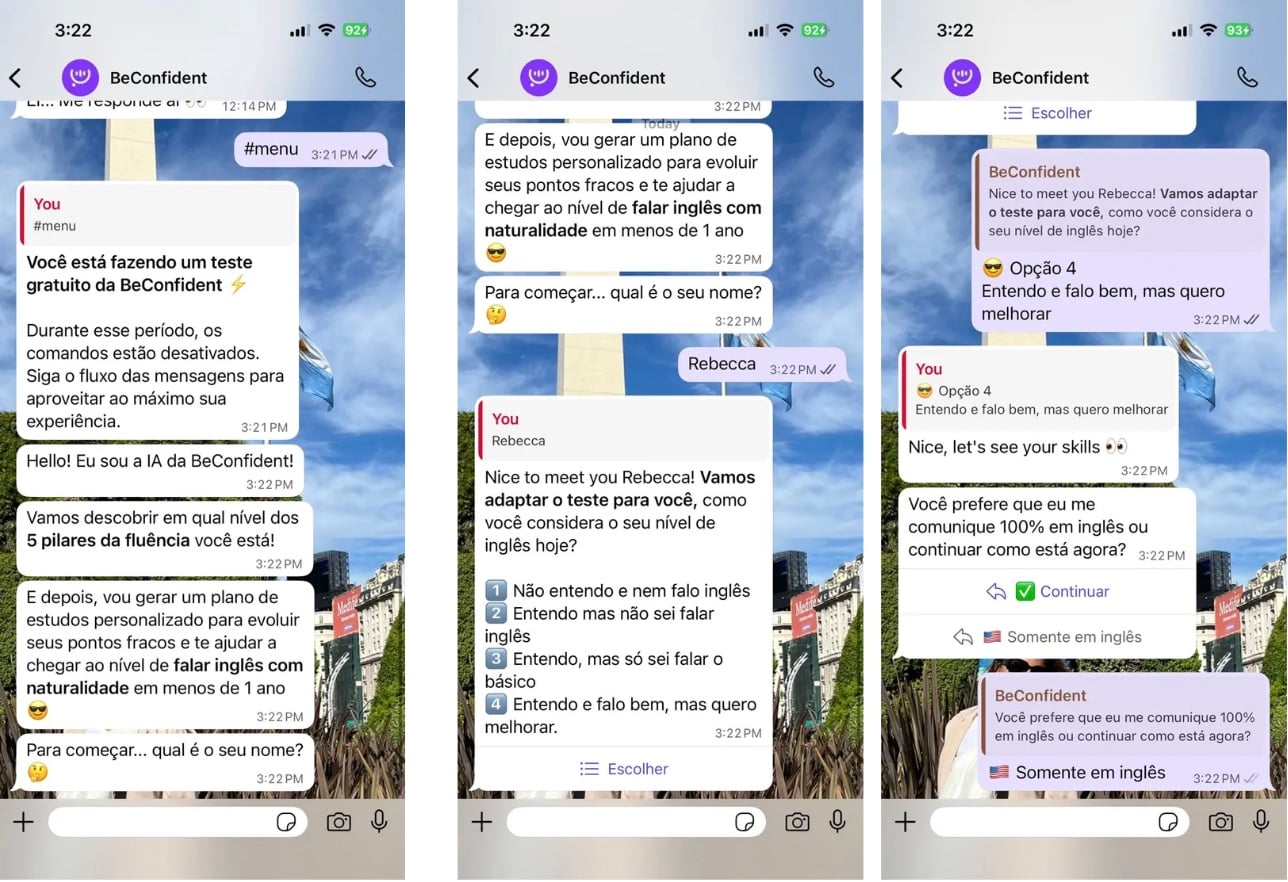
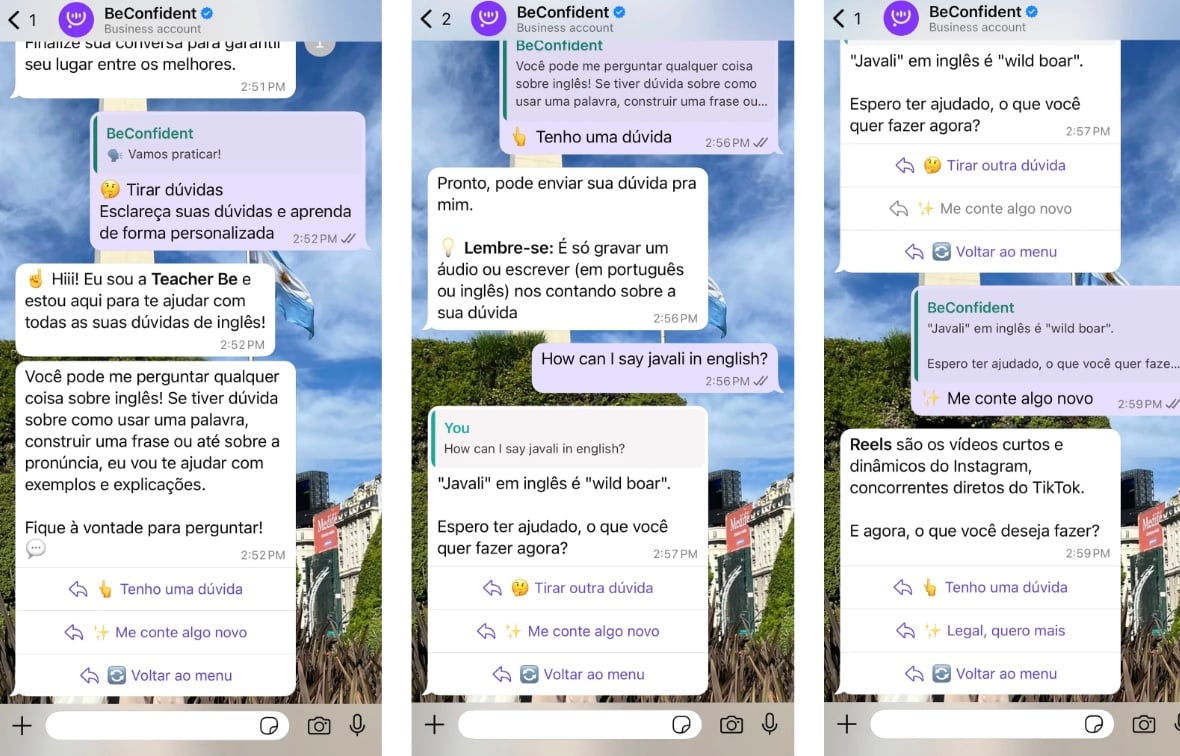
BeConfident transforms your free time into conversation practice with personality-driven AI tutors. The platform serves over 200,000 paying students, has an RA1000 reputation on Reclame Aqui, and offers unlimited practice via app, WhatsApp, or smartwatch.
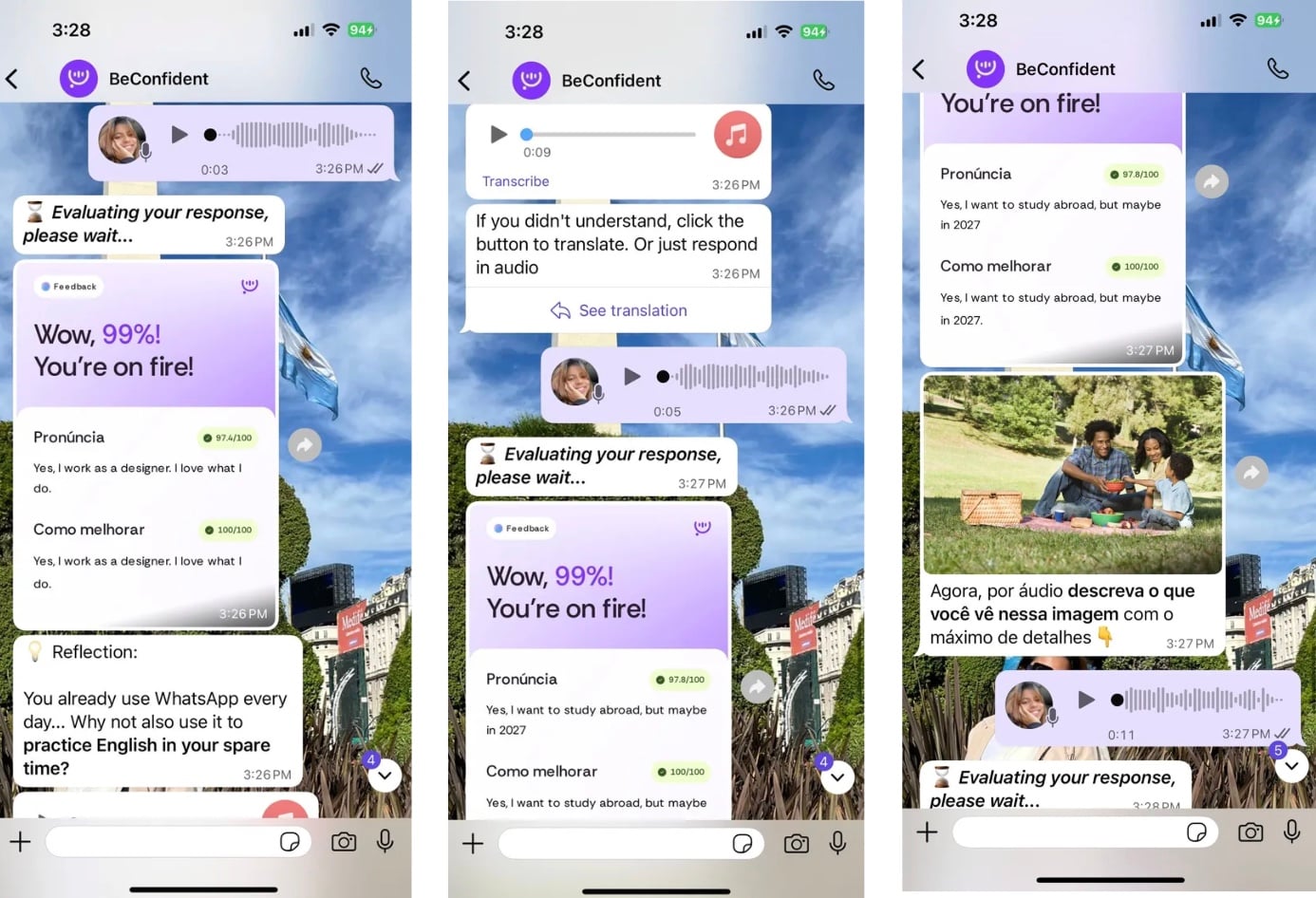
How to use in 5 steps:
Choose an AI tutor, such as a photographer, lawyer, or writer.
Select an accent, such as American, British, South African, Canadian, or Indian.
Chat via text, audio, or in a simulated call.
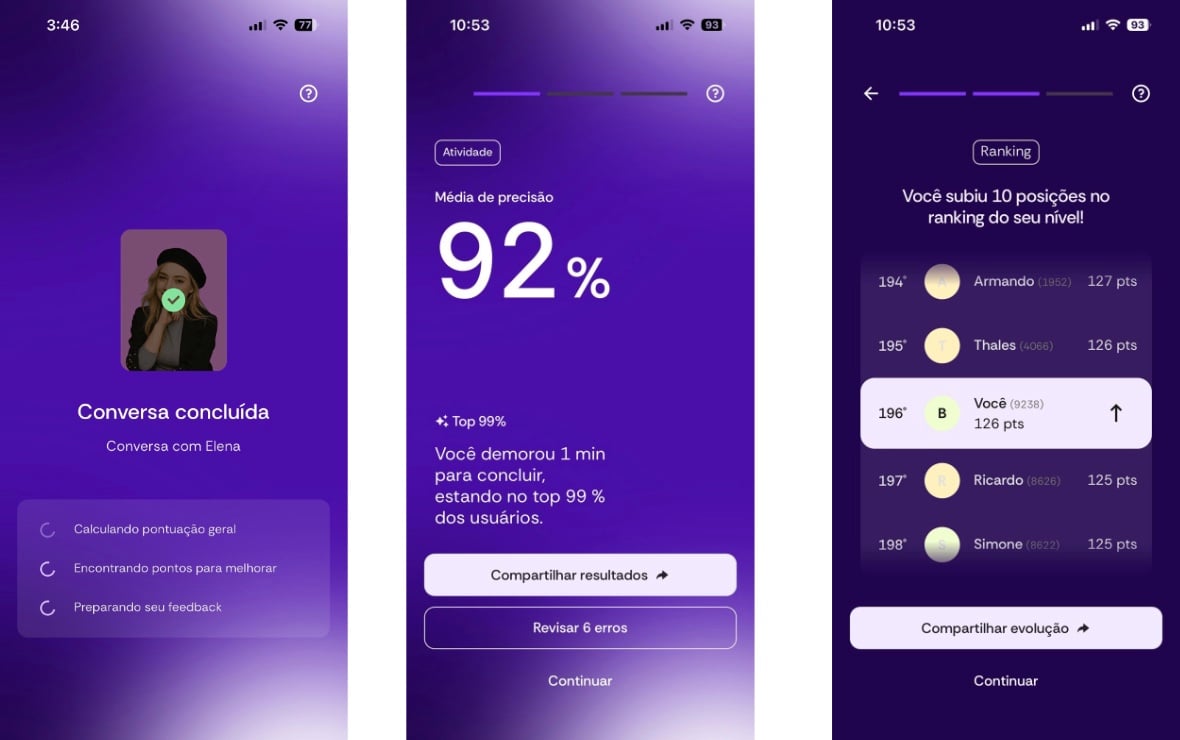
Receive instant pronunciation and grammar feedback.
Track progress in the "My Progress" menu.
BeConfident prioritizes practical fluency with structured tracks, personalized correction, and contextualized practice for professionals, travelers, and enthusiasts. Take the free test and start unlocking conversation in just a few days.
2. ELSA Speak: real-time pronunciation feedback
ELSA Speak uses speech recognition to analyze pronunciation and suggest changes to intonation and stress. This app works well as a complement to BeConfident to work on specific sounds with focused exercises.
3. TalkPal and Speak: dialogues with AI in different contexts
TalkPal allows unlimited conversations with AI by voice or text using GPT technology, while Speak prioritizes pronunciation practice with quick corrections and a personalized curriculum. Both offer useful roleplays, with a lower level of personalization than BeConfident.
4. ChatGPT voice: low-cost simulation of native speakers
ChatGPT is useful for speaking practice, grammar correction, and test simulations like IELTS and TOEFL. Use prompts like: "Act as a native English speaker from New York. Let's have a casual conversation about travel plans."
5. Shadowing: precise imitation of native speakers
Shadowing is a technique where you repeat what you hear at the same time, without pausing the audio. Choose podcasts like BBC Learning English, keep the speed normal, and imitate pronunciation, rhythm, and intonation. Practice for 15 to 20 minutes a day to develop conversational muscle memory.
6. Audio recording: objective self-assessment
Use your phone's recorder to talk about your day for 5 to 10 minutes. Then, listen to the audio and identify pronunciation mistakes, long pauses, and vocabulary limitations. Record the same topic after a week to compare and measure your progress.
7. Series without subtitles: immersion with a focus on listening
Watch Netflix series in English without subtitles, starting with episodes you already know. Series like Friends and The Office use everyday language suitable for intermediate levels. Pause on useful phrases and repeat them out loud.
8. Journaling in English: writing that turns into speaking
Write 5 to 10 lines about your day in English and read the text out loud. This routine connects writing and speaking and expands active vocabulary. You can use an app like Day One or your phone's notepad.
9. Podcasts with repetition: active listening
Listen to short 5 to 10-minute podcasts, such as BBC 6 Minute English or ESL Pod. Pause after each sentence and repeat out loud. Prioritize understanding and production, not just passive listening.
10. Thinking out loud: practice in the routine
Narrate your daily actions in English, using phrases like "I'm making coffee", "I need to check emails", and "The weather looks cloudy". This practice transforms common tasks into constant everyday vocabulary training.
11. Reading out loud: muscle fluency training
Read news from the BBC, CNN, or articles from Wikipedia out loud for 10 to 15 minutes. Focus on a natural rhythm and clear articulation. This practice strengthens the connection between reading and speaking and increases confidence with new words.
12. Singing songs: rhythm and expressions
Use YouTube videos to sing songs in English. Artists like Ed Sheeran and Taylor Swift have clear pronunciation. Singing helps internalize rhythm, intonation, and idiomatic expressions.
App | Focus on conversation | Price | Pronunciation feedback |
BeConfident | ★★★★★ | Affordable | Instant and personalized |
ELSA Speak | ★★★☆☆ | Paid | Detailed |
TalkPal | ★★★★☆ | Medium | Advanced |
ChatGPT | ★★★☆☆ | Free or Plus | Limited |
Criterion | BeConfident | Duolingo | Cambly |
Unlimited conversation | Yes, 24/7 | No, limited | No, hourly |
Personalization | Yes, adaptive AI | No, focus on game | Partial, depends on the tutor |
Value for money | Yes, affordable | Yes, free basic version | No, higher price |
Instant feedback | Yes, automatic | Partial, basic | Partial, manual |
The 4 pillars of fluent English with a focus on solo speaking
Practical fluency depends on a balance between four core skills.
Listening: podcasts, series, and shadowing.
Speaking: conversational AI, recording, and narration.
Reading: reading out loud and vocabulary in context.
Writing: journaling and oral reading of what was written.
BeConfident integrates these pillars through conversations with AI, structured tracks, and feedback across different dimensions, which reduces the need to use multiple separate tools.
How to unlock the brain to speak with more freedom
Embarrassment is usually the main block for intermediate students.
Judgment-free environment: AI corrects without personal criticism.
Gradual practice: start by talking to yourself and advance to AI.
Focus on communication: clarity comes before perfection.
Valuing small steps: every conversation counts as valuable practice.
BeConfident reduces social anxiety by offering patient AI tutors, available 24/7, who correct without embarrassment and adapt to each person's pace.
Solutions for professionals, travelers, and enthusiasts
Rising professionals
Professionals like engineers, lawyers, and managers need technical vocabulary and confidence during presentations. BeConfident offers tutors focused on professional themes and simulations of international negotiations and meetings.
International travelers
Travelers need fluency in situations like airports, hotels, restaurants, and casual conversations. Practicing with various accents, such as American, British, and Australian, and with real travel scenarios on the AI prepares them better for these situations.
Cultural enthusiasts
People who enjoy series, movies, and pop culture seek to understand slang and idiomatic expressions. Conversations on topics of interest with tutors simulating these contexts help consolidate this type of vocabulary.
30-day plan for solo fluency with free resources and BeConfident
Week | Focus | Daily activity (15 min) | Goal |
1 | Foundation and confidence | BeConfident (10 min) and shadowing (5 min) | Reduce embarrassment |
2 | Vocabulary | Conversational AI and journaling | Learn 50 new words |
3 | Pronunciation | ELSA and self-recording | Sound more natural |
4 | Fluency | Long conversations and series | Speak for 5 minutes without long pauses |
Tracking results: use BeConfident's "My Progress" menu to monitor daily streak, practice hours, and certificates. Take the free test and start learning English today.
FAQ: common questions about practicing English alone
What is the best AI app for English in 2026?
BeConfident stands out for intermediate Brazilian students by offering unlimited 24/7 conversation, personality-driven tutors, immediate pronunciation and grammar feedback, and integration with WhatsApp and smartwatch. The base of over 200,000 students and the RA1000 reputation indicate good value for money and personalization for professionals, travelers, and cultural enthusiasts.
How to practice pronunciation alone?
Combine shadowing with native podcasts, audio recording for self-assessment, reading news out loud, and AI feedback on apps like BeConfident or ELSA Speak. Keep a daily routine of 15 to 20 minutes focusing on natural rhythm and clarity. Singing songs in English also helps consolidate sound patterns and intonation.
What are the 4 pillars of English?
The four pillars are listening, speaking, reading, and writing. To achieve practical fluency, speaking needs to receive more study time, as it is usually the least trained skill in traditional methods. Activities that combine skills, like listening and repeating, reading out loud, and writing and narrating, accelerate progress.
How to unlock the brain to learn English?
Mental blocking usually comes from embarrassment and perfectionism. A judgment-free environment, such as contacting AI instead of humans, reduces this barrier. Focusing on communication, starting with solo practice, valuing small steps, and maintaining constant exposure to the language strengthens neuroplasticity. Therefore, AI apps like BeConfident tend to be more efficient than traditional classes for those who need to speak more freely.
Is it possible to achieve fluency in 3 months studying alone?
For those already at an intermediate level (B1 or B2), conversational fluency in 3 months can be achieved with 1 to 2 hours of daily dedication focused on speaking. The focal point is intensive conversation practice with immediate feedback, not the accumulation of theory. The combination of conversational AI, shadowing, immersion in authentic content, and reducing embarrassment increases the chances of progress, provided there is consistency.
Conclusion: choose an alternative and start today
The digital English learning market is growing at around 16.52% per year, driven by AI solutions that complement or replace traditional methods. Among the 12 alternatives presented, AI apps like BeConfident offer a combination of unlimited conversation, personalization, and rapid feedback that serves intermediate Brazilian students well.
Free techniques like shadowing, recording, and immersion in English content reinforce practice with AI and form a complete solo study system. The decisive point is to start today, maintain 15 to 30 minutes daily, and prioritize real communication over theoretical perfection.
You no longer depend on a regular partner to practice. Your next stage of fluency is just a click away. Take BeConfident's free test and start learning English today.
Written by: Luan Cavallaro, Founder & CMO, BeConfident
Key takeaways from this article
AI apps like BeConfident offer 24/7 conversation with instant pronunciation and grammar feedback, reducing dependency on human partners.
Solo techniques like shadowing, audio recording, and series without subtitles build muscle fluency and boost confidence without social exposure.
The 4 pillars of English (listening, speaking, reading, writing) need to work together, with 40% to 50% of the focus on speaking to generate practical results.
Shame and perfectionism block progress, which is why practicing in stress-free environments with AI helps unlock the brain faster.
To accelerate fluency, take BeConfident's free test and start unlocking conversation in a few days.
12 alternatives to practice English without a partner
1. BeConfident: AI app for 24/7 conversation without embarrassment
BeConfident transforms your free time into conversation practice with personality-driven AI tutors. The platform serves over 200,000 paying students, has an RA1000 reputation on Reclame Aqui, and offers unlimited practice via app, WhatsApp, or smartwatch.
How to use in 5 steps:
Choose an AI tutor, such as a photographer, lawyer, or writer.
Select an accent, such as American, British, South African, Canadian, or Indian.
Chat via text, audio, or in a simulated call.
Receive instant pronunciation and grammar feedback.
Track progress in the "My Progress" menu.
BeConfident prioritizes practical fluency with structured tracks, personalized correction, and contextualized practice for professionals, travelers, and enthusiasts. Take the free test and start unlocking conversation in just a few days.
2. ELSA Speak: real-time pronunciation feedback
ELSA Speak uses speech recognition to analyze pronunciation and suggest changes to intonation and stress. This app works well as a complement to BeConfident to work on specific sounds with focused exercises.
3. TalkPal and Speak: dialogues with AI in different contexts
TalkPal allows unlimited conversations with AI by voice or text using GPT technology, while Speak prioritizes pronunciation practice with quick corrections and a personalized curriculum. Both offer useful roleplays, with a lower level of personalization than BeConfident.
4. ChatGPT voice: low-cost simulation of native speakers
ChatGPT is useful for speaking practice, grammar correction, and test simulations like IELTS and TOEFL. Use prompts like: "Act as a native English speaker from New York. Let's have a casual conversation about travel plans."
5. Shadowing: precise imitation of native speakers
Shadowing is a technique where you repeat what you hear at the same time, without pausing the audio. Choose podcasts like BBC Learning English, keep the speed normal, and imitate pronunciation, rhythm, and intonation. Practice for 15 to 20 minutes a day to develop conversational muscle memory.
6. Audio recording: objective self-assessment
Use your phone's recorder to talk about your day for 5 to 10 minutes. Then, listen to the audio and identify pronunciation mistakes, long pauses, and vocabulary limitations. Record the same topic after a week to compare and measure your progress.
7. Series without subtitles: immersion with a focus on listening
Watch Netflix series in English without subtitles, starting with episodes you already know. Series like Friends and The Office use everyday language suitable for intermediate levels. Pause on useful phrases and repeat them out loud.
8. Journaling in English: writing that turns into speaking
Write 5 to 10 lines about your day in English and read the text out loud. This routine connects writing and speaking and expands active vocabulary. You can use an app like Day One or your phone's notepad.
9. Podcasts with repetition: active listening
Listen to short 5 to 10-minute podcasts, such as BBC 6 Minute English or ESL Pod. Pause after each sentence and repeat out loud. Prioritize understanding and production, not just passive listening.
10. Thinking out loud: practice in the routine
Narrate your daily actions in English, using phrases like "I'm making coffee", "I need to check emails", and "The weather looks cloudy". This practice transforms common tasks into constant everyday vocabulary training.
11. Reading out loud: muscle fluency training
Read news from the BBC, CNN, or articles from Wikipedia out loud for 10 to 15 minutes. Focus on a natural rhythm and clear articulation. This practice strengthens the connection between reading and speaking and increases confidence with new words.
12. Singing songs: rhythm and expressions
Use YouTube videos to sing songs in English. Artists like Ed Sheeran and Taylor Swift have clear pronunciation. Singing helps internalize rhythm, intonation, and idiomatic expressions.
App | Focus on conversation | Price | Pronunciation feedback |
BeConfident | ★★★★★ | Affordable | Instant and personalized |
ELSA Speak | ★★★☆☆ | Paid | Detailed |
TalkPal | ★★★★☆ | Medium | Advanced |
ChatGPT | ★★★☆☆ | Free or Plus | Limited |
Criterion | BeConfident | Duolingo | Cambly |
Unlimited conversation | Yes, 24/7 | No, limited | No, hourly |
Personalization | Yes, adaptive AI | No, focus on game | Partial, depends on the tutor |
Value for money | Yes, affordable | Yes, free basic version | No, higher price |
Instant feedback | Yes, automatic | Partial, basic | Partial, manual |
The 4 pillars of fluent English with a focus on solo speaking
Practical fluency depends on a balance between four core skills.
Listening: podcasts, series, and shadowing.
Speaking: conversational AI, recording, and narration.
Reading: reading out loud and vocabulary in context.
Writing: journaling and oral reading of what was written.
BeConfident integrates these pillars through conversations with AI, structured tracks, and feedback across different dimensions, which reduces the need to use multiple separate tools.
How to unlock the brain to speak with more freedom
Embarrassment is usually the main block for intermediate students.
Judgment-free environment: AI corrects without personal criticism.
Gradual practice: start by talking to yourself and advance to AI.
Focus on communication: clarity comes before perfection.
Valuing small steps: every conversation counts as valuable practice.
BeConfident reduces social anxiety by offering patient AI tutors, available 24/7, who correct without embarrassment and adapt to each person's pace.
Solutions for professionals, travelers, and enthusiasts
Rising professionals
Professionals like engineers, lawyers, and managers need technical vocabulary and confidence during presentations. BeConfident offers tutors focused on professional themes and simulations of international negotiations and meetings.
International travelers
Travelers need fluency in situations like airports, hotels, restaurants, and casual conversations. Practicing with various accents, such as American, British, and Australian, and with real travel scenarios on the AI prepares them better for these situations.
Cultural enthusiasts
People who enjoy series, movies, and pop culture seek to understand slang and idiomatic expressions. Conversations on topics of interest with tutors simulating these contexts help consolidate this type of vocabulary.
30-day plan for solo fluency with free resources and BeConfident
Week | Focus | Daily activity (15 min) | Goal |
1 | Foundation and confidence | BeConfident (10 min) and shadowing (5 min) | Reduce embarrassment |
2 | Vocabulary | Conversational AI and journaling | Learn 50 new words |
3 | Pronunciation | ELSA and self-recording | Sound more natural |
4 | Fluency | Long conversations and series | Speak for 5 minutes without long pauses |
Tracking results: use BeConfident's "My Progress" menu to monitor daily streak, practice hours, and certificates. Take the free test and start learning English today.
FAQ: common questions about practicing English alone
What is the best AI app for English in 2026?
BeConfident stands out for intermediate Brazilian students by offering unlimited 24/7 conversation, personality-driven tutors, immediate pronunciation and grammar feedback, and integration with WhatsApp and smartwatch. The base of over 200,000 students and the RA1000 reputation indicate good value for money and personalization for professionals, travelers, and cultural enthusiasts.
How to practice pronunciation alone?
Combine shadowing with native podcasts, audio recording for self-assessment, reading news out loud, and AI feedback on apps like BeConfident or ELSA Speak. Keep a daily routine of 15 to 20 minutes focusing on natural rhythm and clarity. Singing songs in English also helps consolidate sound patterns and intonation.
What are the 4 pillars of English?
The four pillars are listening, speaking, reading, and writing. To achieve practical fluency, speaking needs to receive more study time, as it is usually the least trained skill in traditional methods. Activities that combine skills, like listening and repeating, reading out loud, and writing and narrating, accelerate progress.
How to unlock the brain to learn English?
Mental blocking usually comes from embarrassment and perfectionism. A judgment-free environment, such as contacting AI instead of humans, reduces this barrier. Focusing on communication, starting with solo practice, valuing small steps, and maintaining constant exposure to the language strengthens neuroplasticity. Therefore, AI apps like BeConfident tend to be more efficient than traditional classes for those who need to speak more freely.
Is it possible to achieve fluency in 3 months studying alone?
For those already at an intermediate level (B1 or B2), conversational fluency in 3 months can be achieved with 1 to 2 hours of daily dedication focused on speaking. The focal point is intensive conversation practice with immediate feedback, not the accumulation of theory. The combination of conversational AI, shadowing, immersion in authentic content, and reducing embarrassment increases the chances of progress, provided there is consistency.
Conclusion: choose an alternative and start today
The digital English learning market is growing at around 16.52% per year, driven by AI solutions that complement or replace traditional methods. Among the 12 alternatives presented, AI apps like BeConfident offer a combination of unlimited conversation, personalization, and rapid feedback that serves intermediate Brazilian students well.
Free techniques like shadowing, recording, and immersion in English content reinforce practice with AI and form a complete solo study system. The decisive point is to start today, maintain 15 to 30 minutes daily, and prioritize real communication over theoretical perfection.
You no longer depend on a regular partner to practice. Your next stage of fluency is just a click away. Take BeConfident's free test and start learning English today.