




9 strategies to learn English grammar fast
9 strategies to learn English grammar fast
9 strategies to learn English grammar fast
Written by: Luan Cavallaro, Founder & CMO, BeConfident
Key takeaways from this article
Learn grammar in real contexts with immersion in Graded Readers and daily journals to absorb structures naturally without memorizing rules.
Use personalized AI like BeConfident to practice verb tenses in real dialogues with immediate correction and 24/7 feedback.
Apply spaced repetition and practice speaking in the mirror to fix correct patterns and reduce common mistakes made by Brazilians, such as prepositions and age.
Integrate extensive reading, teaching others, and error tables to consolidate knowledge and gain oral and written fluency.
Follow a daily 30-45 minute plan with BeConfident to master grammar in weeks: take the free test now and unlock your English.
How correct English grammar impacts your life
Correct grammar increases your fluency and clarity in professional, academic, and personal situations. Communication improves when you integrate the 4 fundamental pillars of English: Listening, Speaking, Reading, and Writing with applied grammatical knowledge.
Practical immersion connects grammar rules to real situations. When you practice grammar in context, you gain the confidence to negotiate, present, and hold natural conversations in English.
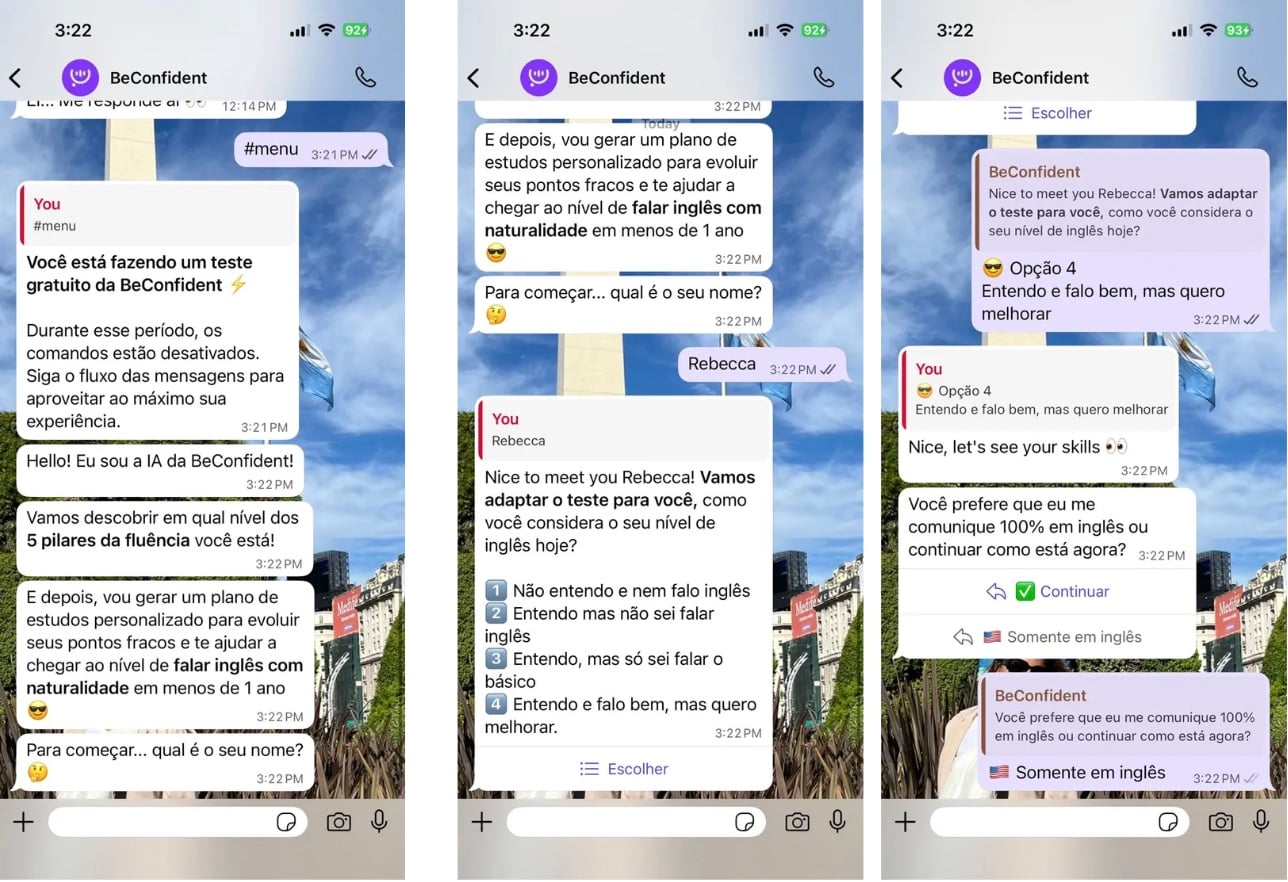
Try it for free and start learning English today with personalized 24/7 feedback.
9 proven strategies to learn correct English grammar fast
1. Use immersion with graded content
Using Graded Readers like Oxford Bookworms Library, with a vocabulary of 250 to 1000 words, builds a solid grammar foundation at an appropriate level. These books present structures progressively in simple, engaging stories.
Read 15 minutes a day from titles like “The Enormous Crocodile” (Roald Dahl) to absorb present simple and past simple in context. Write down three grammatical structures per chapter and create variations based on your own routine.
Benefit: you master basic verb tenses in just a few days with contextual exposure, without relying on memorized tables.
2. Write a short journal in English every day
A journal in English fixes structures in practice. Write five to ten sentences a day about your routine, focusing on one grammatical structure per week. Week 1: present simple (“I wake up at 7 am”). Week 2: present continuous (“I’m writing in English”).
Review your texts and identify common error patterns. Frequent examples from Brazilians: “I go to work of car” (correct: “I go to work by car”) and “I have 25 years old” (correct: “I am 25 years old”).
Benefit: you build muscle memory for writing and speaking, making the use of structures more automatic.
3. Master verb tenses with personalized AI
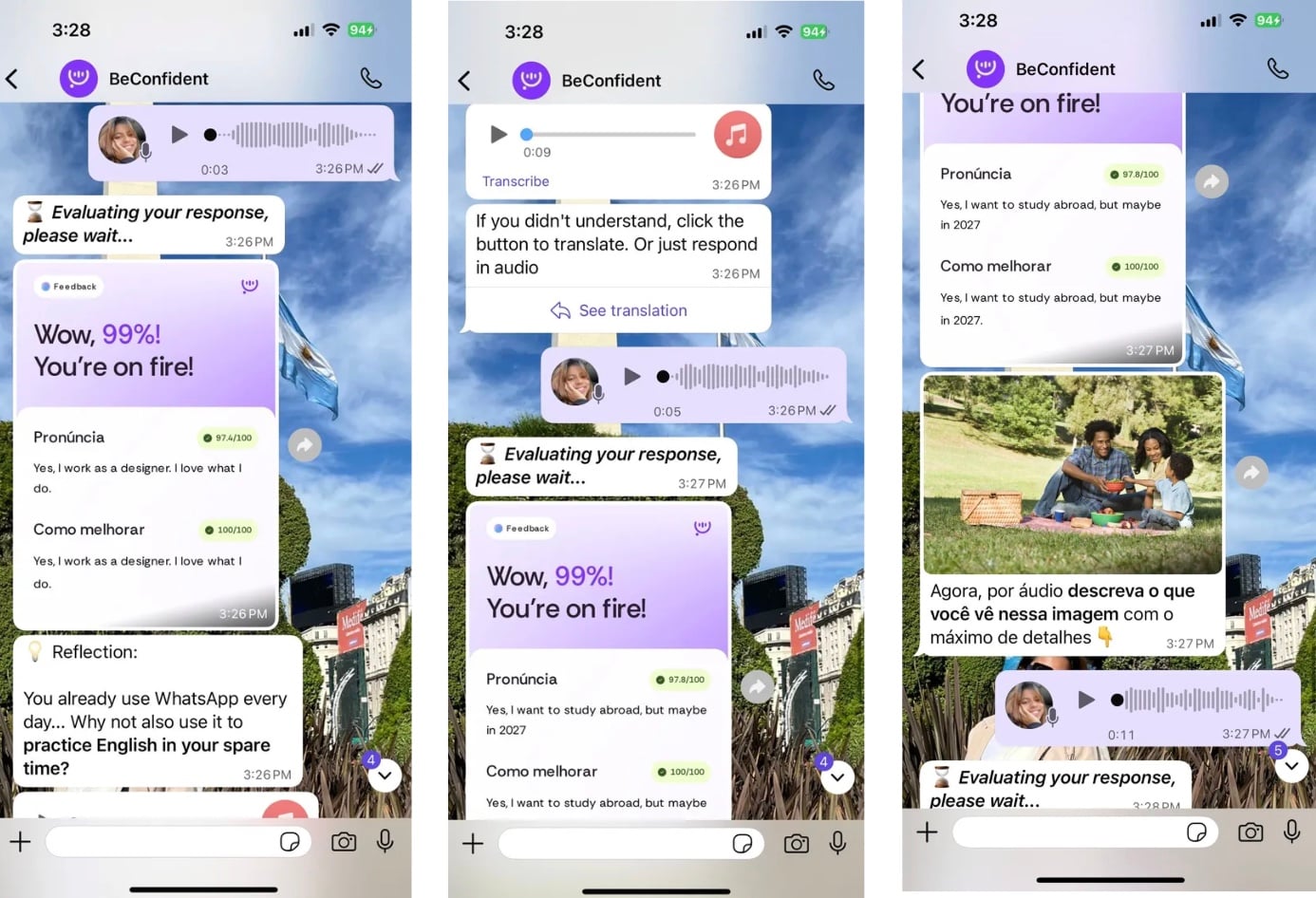
BeConfident offers structured tracks that present each verb tense in real dialogues. You practice present perfect with everyday Brazilian situations, such as “I have lived in São Paulo for 10 years,” in contrast to “I live in São Paulo for 10 years,” which is a common mistake.
AI tutors correct your mistakes on the spot and explain why. For example: “Use ‘have lived’ for actions that started in the past and continue now.” Set aside 15 minutes daily for a specific verb tense.
Benefit: you master present perfect, past simple, and future tenses in a few weeks with immediate and targeted feedback.
4. Apply the spaced repetition technique
Spaced repetition locks structures into your long-term memory. Review the same sentences at increasing intervals, such as 1 day, 3 days, 1 week, and 2 weeks. Prioritize memorizing full sentences rather than isolated rules, rewriting examples within your own context.
Use sentences like “I have been working here for 5 years” and create variations: “I have been studying English for 2 months” and “She has been living in Brazil since 2020.”
Benefit: you reduce forgetting and keep important structures active in your memory.
5. Learn grammar in the context of real sentences
Grammar in context accelerates fluency. BeConfident presents prepositions, articles, and connectors in themed conversations. For travel, for example, you practice “I’m going to the airport by taxi” instead of “I’m going to airport of taxi.”
Simulate real situations like ordering food (“I’d like a coffee with milk”), giving directions (“Turn right at the traffic light”), and talking about work (“I work in marketing”).
Benefit: you internalize correct patterns naturally and reduce recurring errors in a few weeks.
6. Practice speaking in the mirror with self-correction
Narrating daily activities in English trains vocabulary and grammar at the same time. Describing what you are doing out loud, such as “I’m making coffee” or “I’m feeding the dog,” creates spontaneous practice.
Record short 30-second videos describing your day. When you notice a mistake like “I go to work of car,” stop, correct it to “I go to work by car,” and repeat the correct form three times.
Benefit: you develop oral fluency, self-awareness of your mistakes, and more confidence for real conversations.
7. Use a table of common mistakes made by Brazilians
Brazilian Mistake | Correction | Context | BeConfident Tip |
I have 25 years old | I am 25 years old | Age | Use “be” for permanent characteristics |
I go to work of car | I go to work by car | Transportation | Use “by” for mode of transport |
I am agree | I agree | Opinion | “Agree” functions as a verb, not an adjective |
I will to travel | I will travel | Future | Use “will” + base verb, without “to” |
BeConfident identifies your most frequent mistakes and generates personalized exercises. Repeat each correction in at least ten different sentences until the correct form becomes automatic.
8. Read extensively with graded readers
Extensive reading exposes you to various structures in simple texts. Collections like Pearson’s Graded Readers and Oxford Reading Tree present natural English with a clear progression of vocabulary and grammar.
Read about 20 pages a day and write down five new structures. An example is “She had been waiting for hours,” which presents past perfect continuous in a story context.
Benefit: you absorb more complex grammar gradually, without excessive analytical effort.
9. Teach others to consolidate your knowledge
The act of teaching organizes knowledge and reveals gaps. Explain grammar rules to friends or family using examples close to Brazilian reality. For present perfect, compare “Eu morei em SP” with “I have lived in SP.”
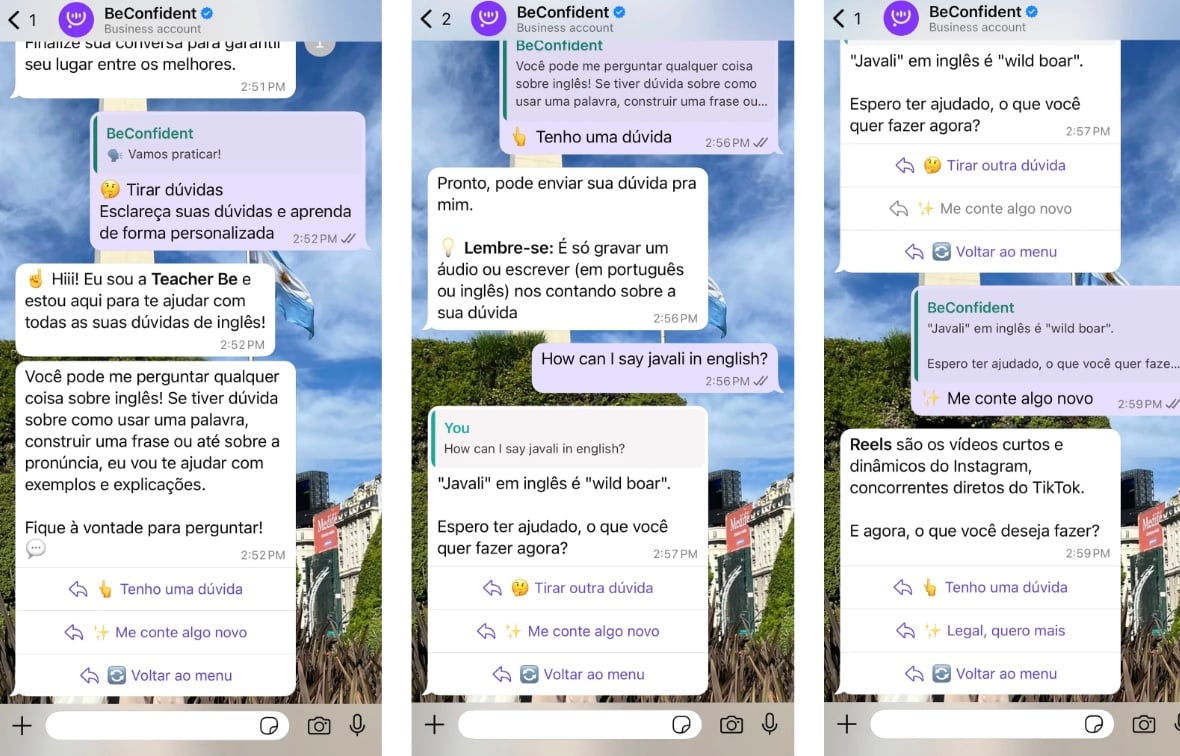
Use BeConfident to clear up doubts with Teacher Be before explaining. Also, practice explaining in English to expand your grammatical vocabulary.
Benefit: you consolidate what you learned, gain clarity, and boost your confidence when using grammar in conversations.
Daily action plan in 30 to 45 minutes
Morning (15 min): read Graded Readers for 5 minutes during your commute and do 10 minutes of BeConfident's grammar track during breakfast.
Lunch (15 min): chat for 10 minutes with the AI about professional topics and spend 5 minutes reviewing highlighted mistakes.
Evening (15 min): write in your English journal for 10 minutes and practice speaking in the mirror for 5 minutes, narrating your day.
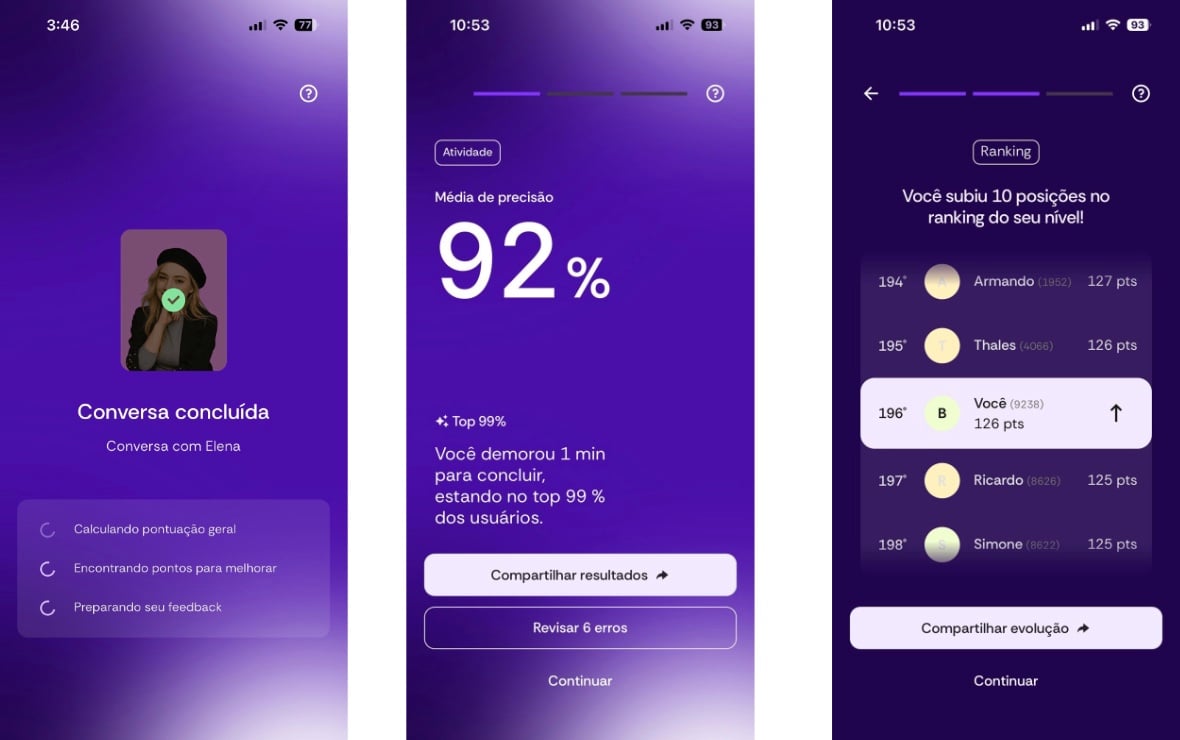
Adapt this routine to your reality. Use time on the bus, during work breaks, or while cooking. Maintaining a daily streak builds a habit and makes progress visible.
Frequently Asked Questions (FAQ)
What are the 4 pillars of English?
The 4 fundamental pillars are Listening, Speaking, Reading, and Writing. These pillars connect with grammar and vocabulary to shape real communication. Grammar works best when practiced within these pillars in concrete situations of use.
What is the best grammar to study?
The book Essential Grammar in Use by Raymond Murphy offers a clear theoretical foundation. Combining it with Graded Readers like Oxford Bookworms Library builds practice in context. Collections like Pearson’s Graded Readers and Oxford Reading Tree complement this with graded texts and natural language.
The key is to join the formal study of rules with practical immersion in conversation and extensive reading.
How to memorize words quickly?
Memorization works best with full sentences in a real context. Use spaced repetition with reviews at 1 day, 3 days, 1 week, and 2 weeks. Apps like Memrise combine memorization techniques with videos of native speakers.
BeConfident accelerates this process with themed conversations where vocabulary appears in real-world situations, making retention easier.
How to improve English grammar quickly?
Fast progress comes from combining practical immersion with instant feedback. Study grammar in context, through conversations and texts, rather than lists of isolated rules. Set aside 30 to 45 minutes a day, focusing on one structure per week.
Use immediate feedback to identify error patterns and adjust your usage. BeConfident combines applied theory, conversational practice, and personalized feedback 24 hours a day.
How long does it take to master English grammar?
With focused practice and constant correction, basic structures like present simple, past simple, and future forms can be mastered in about 3 to 4 weeks. More complex tenses, such as present perfect and conditionals, usually require 2 to 3 months of daily practice.
Daily consistency of 30 to 45 minutes yield better results than long, sporadic sessions.
Conclusion: use BeConfident to unlock your fluency
These 9 strategies make studying English grammar more practical and objective. The combination of contextual immersion, conversational practice, and personalized AI feedback accelerates results compared to methods based solely on rules.
BeConfident integrates these approaches into an accessible platform, available 24 hours a day on the app, WhatsApp, or smartwatch. With over 140,000 paying students and an RA1000 reputation on Reclame Aqui, the platform offers conversational practice with real-time feedback.
Written by: Luan Cavallaro, Founder & CMO, BeConfident
Key takeaways from this article
Learn grammar in real contexts with immersion in Graded Readers and daily journals to absorb structures naturally without memorizing rules.
Use personalized AI like BeConfident to practice verb tenses in real dialogues with immediate correction and 24/7 feedback.
Apply spaced repetition and practice speaking in the mirror to fix correct patterns and reduce common mistakes made by Brazilians, such as prepositions and age.
Integrate extensive reading, teaching others, and error tables to consolidate knowledge and gain oral and written fluency.
Follow a daily 30-45 minute plan with BeConfident to master grammar in weeks: take the free test now and unlock your English.
How correct English grammar impacts your life
Correct grammar increases your fluency and clarity in professional, academic, and personal situations. Communication improves when you integrate the 4 fundamental pillars of English: Listening, Speaking, Reading, and Writing with applied grammatical knowledge.
Practical immersion connects grammar rules to real situations. When you practice grammar in context, you gain the confidence to negotiate, present, and hold natural conversations in English.
Try it for free and start learning English today with personalized 24/7 feedback.
9 proven strategies to learn correct English grammar fast
1. Use immersion with graded content
Using Graded Readers like Oxford Bookworms Library, with a vocabulary of 250 to 1000 words, builds a solid grammar foundation at an appropriate level. These books present structures progressively in simple, engaging stories.
Read 15 minutes a day from titles like “The Enormous Crocodile” (Roald Dahl) to absorb present simple and past simple in context. Write down three grammatical structures per chapter and create variations based on your own routine.
Benefit: you master basic verb tenses in just a few days with contextual exposure, without relying on memorized tables.
2. Write a short journal in English every day
A journal in English fixes structures in practice. Write five to ten sentences a day about your routine, focusing on one grammatical structure per week. Week 1: present simple (“I wake up at 7 am”). Week 2: present continuous (“I’m writing in English”).
Review your texts and identify common error patterns. Frequent examples from Brazilians: “I go to work of car” (correct: “I go to work by car”) and “I have 25 years old” (correct: “I am 25 years old”).
Benefit: you build muscle memory for writing and speaking, making the use of structures more automatic.
3. Master verb tenses with personalized AI
BeConfident offers structured tracks that present each verb tense in real dialogues. You practice present perfect with everyday Brazilian situations, such as “I have lived in São Paulo for 10 years,” in contrast to “I live in São Paulo for 10 years,” which is a common mistake.
AI tutors correct your mistakes on the spot and explain why. For example: “Use ‘have lived’ for actions that started in the past and continue now.” Set aside 15 minutes daily for a specific verb tense.
Benefit: you master present perfect, past simple, and future tenses in a few weeks with immediate and targeted feedback.
4. Apply the spaced repetition technique
Spaced repetition locks structures into your long-term memory. Review the same sentences at increasing intervals, such as 1 day, 3 days, 1 week, and 2 weeks. Prioritize memorizing full sentences rather than isolated rules, rewriting examples within your own context.
Use sentences like “I have been working here for 5 years” and create variations: “I have been studying English for 2 months” and “She has been living in Brazil since 2020.”
Benefit: you reduce forgetting and keep important structures active in your memory.
5. Learn grammar in the context of real sentences
Grammar in context accelerates fluency. BeConfident presents prepositions, articles, and connectors in themed conversations. For travel, for example, you practice “I’m going to the airport by taxi” instead of “I’m going to airport of taxi.”
Simulate real situations like ordering food (“I’d like a coffee with milk”), giving directions (“Turn right at the traffic light”), and talking about work (“I work in marketing”).
Benefit: you internalize correct patterns naturally and reduce recurring errors in a few weeks.
6. Practice speaking in the mirror with self-correction
Narrating daily activities in English trains vocabulary and grammar at the same time. Describing what you are doing out loud, such as “I’m making coffee” or “I’m feeding the dog,” creates spontaneous practice.
Record short 30-second videos describing your day. When you notice a mistake like “I go to work of car,” stop, correct it to “I go to work by car,” and repeat the correct form three times.
Benefit: you develop oral fluency, self-awareness of your mistakes, and more confidence for real conversations.
7. Use a table of common mistakes made by Brazilians
Brazilian Mistake | Correction | Context | BeConfident Tip |
I have 25 years old | I am 25 years old | Age | Use “be” for permanent characteristics |
I go to work of car | I go to work by car | Transportation | Use “by” for mode of transport |
I am agree | I agree | Opinion | “Agree” functions as a verb, not an adjective |
I will to travel | I will travel | Future | Use “will” + base verb, without “to” |
BeConfident identifies your most frequent mistakes and generates personalized exercises. Repeat each correction in at least ten different sentences until the correct form becomes automatic.
8. Read extensively with graded readers
Extensive reading exposes you to various structures in simple texts. Collections like Pearson’s Graded Readers and Oxford Reading Tree present natural English with a clear progression of vocabulary and grammar.
Read about 20 pages a day and write down five new structures. An example is “She had been waiting for hours,” which presents past perfect continuous in a story context.
Benefit: you absorb more complex grammar gradually, without excessive analytical effort.
9. Teach others to consolidate your knowledge
The act of teaching organizes knowledge and reveals gaps. Explain grammar rules to friends or family using examples close to Brazilian reality. For present perfect, compare “Eu morei em SP” with “I have lived in SP.”
Use BeConfident to clear up doubts with Teacher Be before explaining. Also, practice explaining in English to expand your grammatical vocabulary.
Benefit: you consolidate what you learned, gain clarity, and boost your confidence when using grammar in conversations.
Daily action plan in 30 to 45 minutes
Morning (15 min): read Graded Readers for 5 minutes during your commute and do 10 minutes of BeConfident's grammar track during breakfast.
Lunch (15 min): chat for 10 minutes with the AI about professional topics and spend 5 minutes reviewing highlighted mistakes.
Evening (15 min): write in your English journal for 10 minutes and practice speaking in the mirror for 5 minutes, narrating your day.
Adapt this routine to your reality. Use time on the bus, during work breaks, or while cooking. Maintaining a daily streak builds a habit and makes progress visible.
Frequently Asked Questions (FAQ)
What are the 4 pillars of English?
The 4 fundamental pillars are Listening, Speaking, Reading, and Writing. These pillars connect with grammar and vocabulary to shape real communication. Grammar works best when practiced within these pillars in concrete situations of use.
What is the best grammar to study?
The book Essential Grammar in Use by Raymond Murphy offers a clear theoretical foundation. Combining it with Graded Readers like Oxford Bookworms Library builds practice in context. Collections like Pearson’s Graded Readers and Oxford Reading Tree complement this with graded texts and natural language.
The key is to join the formal study of rules with practical immersion in conversation and extensive reading.
How to memorize words quickly?
Memorization works best with full sentences in a real context. Use spaced repetition with reviews at 1 day, 3 days, 1 week, and 2 weeks. Apps like Memrise combine memorization techniques with videos of native speakers.
BeConfident accelerates this process with themed conversations where vocabulary appears in real-world situations, making retention easier.
How to improve English grammar quickly?
Fast progress comes from combining practical immersion with instant feedback. Study grammar in context, through conversations and texts, rather than lists of isolated rules. Set aside 30 to 45 minutes a day, focusing on one structure per week.
Use immediate feedback to identify error patterns and adjust your usage. BeConfident combines applied theory, conversational practice, and personalized feedback 24 hours a day.
How long does it take to master English grammar?
With focused practice and constant correction, basic structures like present simple, past simple, and future forms can be mastered in about 3 to 4 weeks. More complex tenses, such as present perfect and conditionals, usually require 2 to 3 months of daily practice.
Daily consistency of 30 to 45 minutes yield better results than long, sporadic sessions.
Conclusion: use BeConfident to unlock your fluency
These 9 strategies make studying English grammar more practical and objective. The combination of contextual immersion, conversational practice, and personalized AI feedback accelerates results compared to methods based solely on rules.
BeConfident integrates these approaches into an accessible platform, available 24 hours a day on the app, WhatsApp, or smartwatch. With over 140,000 paying students and an RA1000 reputation on Reclame Aqui, the platform offers conversational practice with real-time feedback.