




How to become fluent in English to have natural discussions
How to become fluent in English to have natural discussions
How to become fluent in English to have natural discussions
Written by: Luan Cavallaro, Founder & CMO, BeConfident
Key Takeaways from This Article
Fluency in natural discussions requires four pillars: connected speech with reductions, shadowing for pronunciation, thinking in English, and spontaneous reactions with ready-made phrases.
Daily practice of 15 to 30 minutes with comprehensible input, such as podcasts and series, and output with shadowing and conversations, accelerates speech automation.
Conversing with AI reduces the fear of making mistakes and allows for frequent practice on professional topics, travel, and with varied accents.
Recording conversations, analyzing errors, and tracking progress with metrics like streaks and response time leads to measurable improvement in four weeks.
BeConfident integrates all tips with personalized AI tutors. Start your free trial to apply the four pillars in guided conversations.
Before You Start: Prerequisites and Expectations
This method requires an intermediate level (B1-B2), 15 to 30 minutes of daily availability, and a smartphone or computer. The most common mistake is studying only theory without practicing real conversation.
Stephen Krashen's input hypothesis, presented in this guide about comprehensible input, indicates that conversational fluency depends on large volumes of input at the i+1 level, where "i" represents your current proficiency and "+1" is language slightly beyond that level. Consistency in practice sustains measurable results.
4 Pillars of Fluency in Natural Discussions
Conversational fluency relies on four clear pillars.
1. Connected speech: mastery of reductions like "gonna" (going to) and linking between words. This study by Shuhei Kadota on shadowing shows that the technique strengthens the phonological loop and improves comprehension of fast native speech.
2. Shadowing technique: immediate repetition of audio to train pronunciation and rhythm. Research on shadowing points to consistent gains when the student practices regularly.
3. Thinking in English: daily mental narration of everyday activities to automate the language. This habit reduces mental translation time during conversations.
4. Spontaneous reactions: development of automatic phrases for debates and discussions, such as "That’s an interesting point" or "I see what you mean."
Now that you know the four theoretical pillars, there is a need to train them all at the same time without relying on multiple tools. BeConfident integrates these pillars with AI tutors with native accents, such as American, British, and Australian, who lead contextualized conversations on professional and personal topics.
Process Overview
The method follows 10 sequential steps: preparation of the study environment, immersion in authentic content, practice with AI, application in real situations, and constant review of errors. Each step builds on the previous one and forms a solid foundation for natural discussions.
The essential checklist ensures consistent progress: first, maintain a daily practice streak to build the habit; second, choose topics relevant to your goals, because motivation increases when the content makes sense for your routine; third, record your progress to see improvements that might go unnoticed in daily life; and fourth, seek immediate feedback to correct mistakes before they become speech habits. When you combine these four elements, progression occurs through structured repetition and gradual exposure to more complex situations.
10 Step-by-Step Tips for Natural Fluency
Tip 1: Establish a comprehensible input routine
Set aside 15 minutes daily for podcasts, series, or news at your level. Krashen's theory of comprehensible input shows that large amounts of content suitable for your level produce more results than intensive study of very difficult texts.
Tip 2: Practice shadowing with connected speech
Use YouTube videos or podcasts to repeat immediately after the speaker, paying special attention to reductions like "wanna," "gotta," and word links, which native speakers use naturally and which rarely appear in textbooks. After practicing each segment, record yourself repeating the same sentences to compare your pronunciation with the original audio and identify where differences still exist.
Tip 3: Chat daily with AI
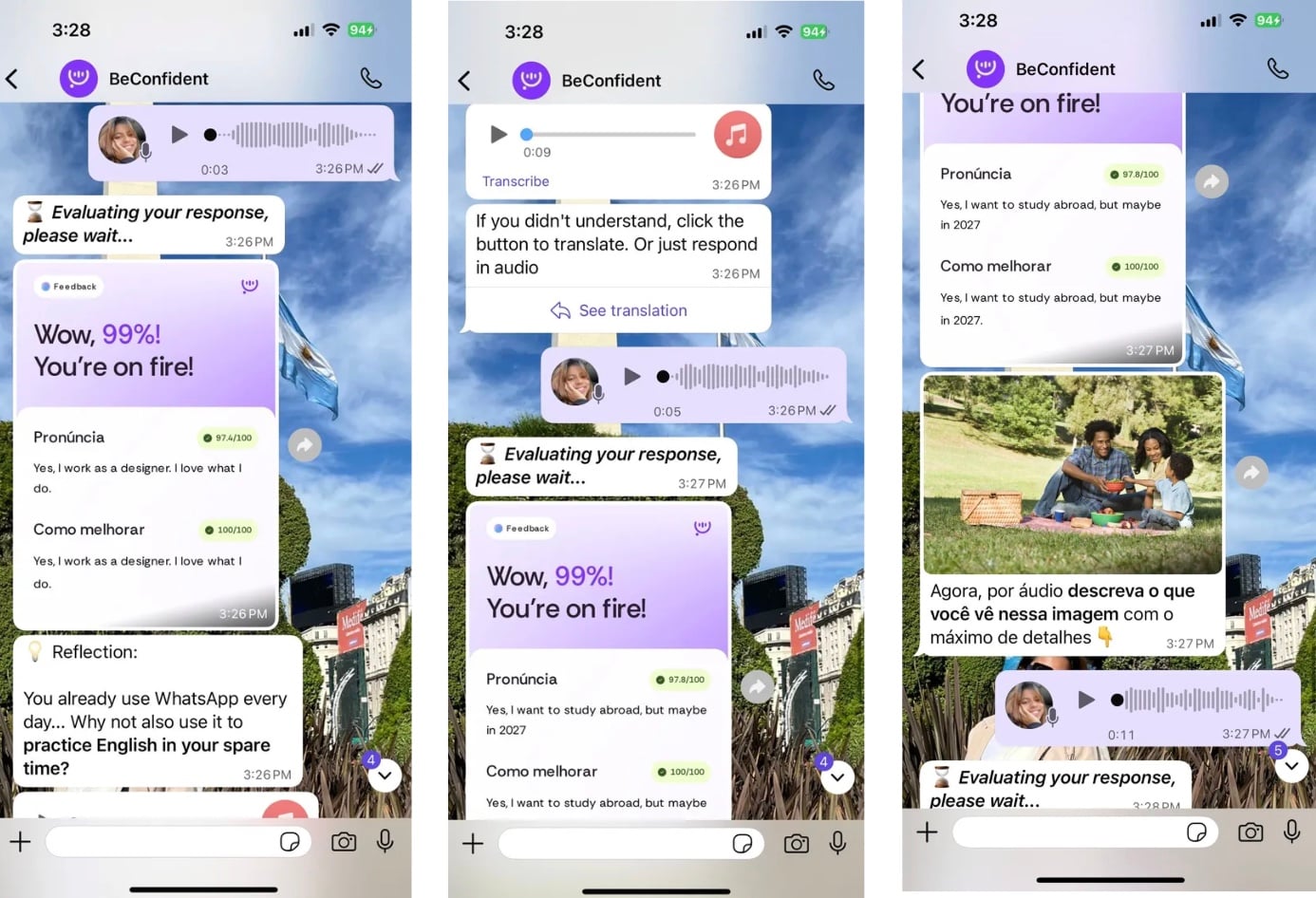
BeConfident offers AI tutors on the app, on WhatsApp, or on your smartwatch. Choose professional, travel, or hobby topics to practice contextualized conversations without feeling embarrassed, at any time of the day.
Tip 4: Develop a phrase bank for debates
Memorize expressions like "I’d like to add that...", "From my perspective...", and "That raises an important question". Use these phrases in conversations with BeConfident's AI until they become automatic answers in discussions.
Tip 5: Narrate your day in English
Mentally describe your activities, for example: "Now I’m making coffee", "I need to check my emails". When you repeat this mental narration frequently, your brain begins to formulate sentences in English without translating from Portuguese first. This automation reduces response time and allows spontaneous reactions in real conversations, where there is no room for mental translation.
Tip 6: Use the "Tell me something new" feature
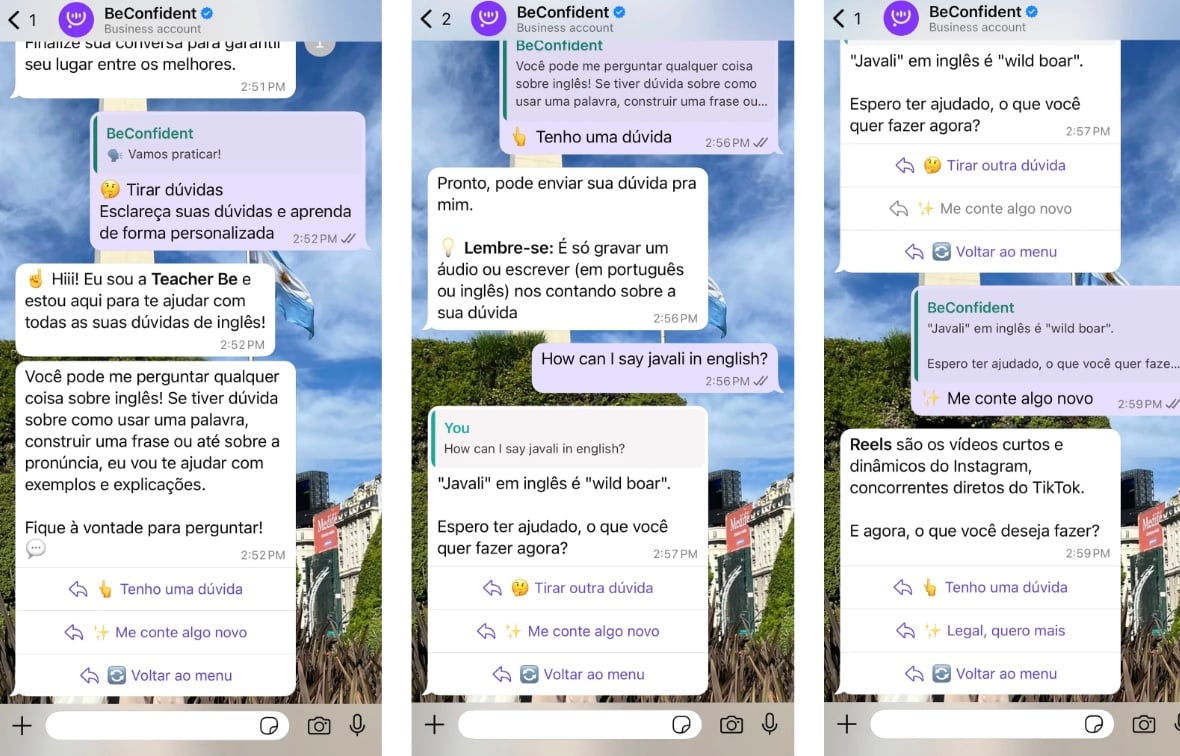
BeConfident sends daily trivia that expands vocabulary and connects the language to unexpected topics. This practice strengthens your ability to discuss various subjects without getting stuck.
Tip 7: Record conversations and analyze errors
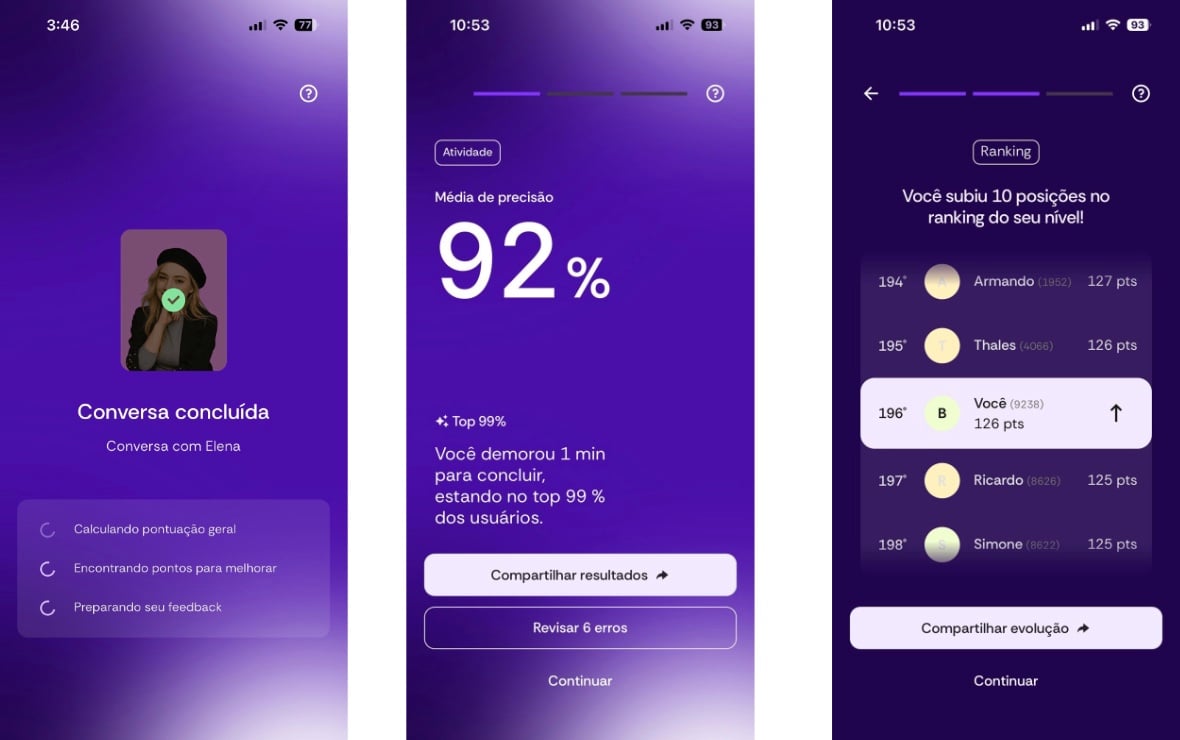
Log your practice sessions and use BeConfident's "Review errors" menu to correct grammar, pronunciation, and the use of natural expressions. Systematic review turns recurring mistakes into areas for improvement.
Tip 8: Practice different accents
Exposure to diverse accents improves comprehension in real situations. BeConfident offers tutors with American, British, South African, and other accents, making it easier to adapt gradually to different ways of speaking.
Tip 9: Simulate professional situations
Use the AI tutors to practice presentations, negotiations, and meetings. The 2026 trends in language teaching highlight the importance of communication skills in real professional contexts.
Tip 10: Monitor progress with metrics
Use the "My progress" menu to track streak days, practice hours, and certificates. Set weekly goals and record each achievement to maintain motivation. Start tracking your progress with BeConfident's free trial and monitor your metrics in real time.
Start your free trial to apply these tips with personalized feedback and continuous tracking.
4-Week Plan with BeConfident
Week 1: Fundamentals and Diagnosis
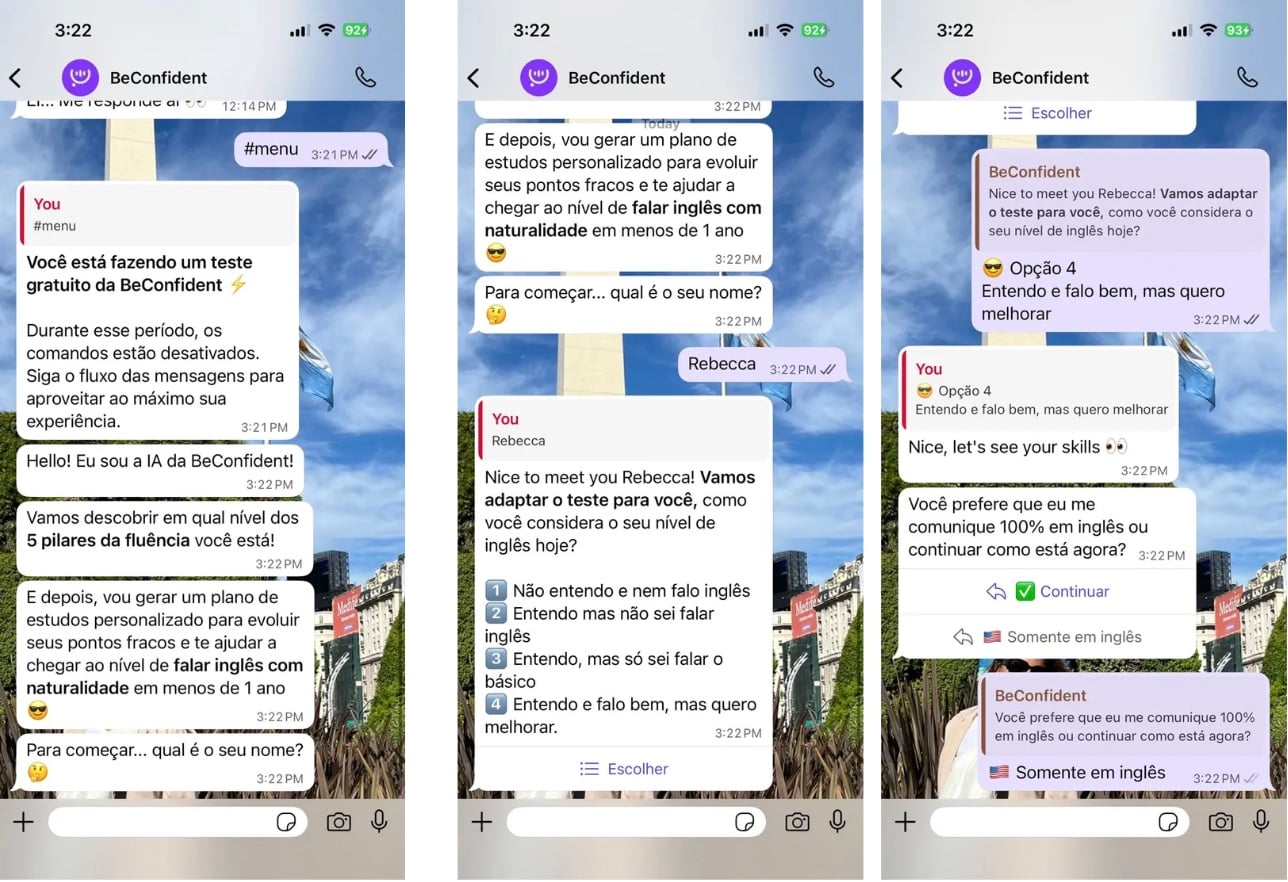
Take BeConfident's free trial to identify your CEFR level and main areas for improvement. Practice 15 minutes daily with basic shadowing and conversations on familiar topics.
Week 2: Professional Debates
Focus on technical vocabulary in your area. Use specialized AI tutors to simulate meetings, presentations, and negotiations, increasing practice time to 20 minutes daily.
Week 3: Slang and Travel Contexts
Practice idioms and situations in airports, restaurants, and tourism. Explore different accents to broaden your listening comprehension.
Week 4: Consolidation and Evaluation
Review accumulated errors, practice more complex discussions, and establish a maintenance routine. Reach 30 minutes daily to consolidate long-term results.
How to Measure Your Progress
Key fluency indicators include shorter response time in conversations, natural use of connected speech, ability to maintain discussions for more than five minutes, and confidence in unexpected situations.
BeConfident offers deep conversation with detailed feedback, which differs from apps like Duolingo, which prioritize basic exercises without real oral practice, and traditional schools with fixed hours and high costs. The "My progress" menu records practice hours, streak, and position on the list for objective tracking.
Common Problems and Solutions
The four obstacles below represent frequent barriers that prevent intermediate students from advancing in conversational fluency. Each of them can be addressed with specific BeConfident features.
Problem | Solution with BeConfident |
Fear of making mistakes in public | AI creates a judgment-free environment for frequent practice |
Lack of consistency in studies | Flexible streaks and practice via WhatsApp and smartwatch |
Difficulty with native accents | Tutors with six different accents for gradual adaptation |
Limited vocabulary for debates | Structured paths by professional and personal topic |
In addition to technological solutions, studies on language exchanges show that conversation practice reduces speech anxiety and increases willingness to communicate in a new language. This reinforces that constant practice, with humans or AI, is the proven path to overcoming psychological barriers.
FAQ
How to become fluent in English quickly?
Faster fluency requires daily consistency of 15 to 30 minutes with a focus on real conversation. Combine comprehensible input, like podcasts and series, with structured output through AI that offers immediate feedback. BeConfident accelerates this process with guided practice and personalized corrections.
Does practicing English with AI really work?
Practicing with AI works when there is simulation of real situations and immediate feedback. The 2026 trends in language teaching point to generative AI as a tool for this type of practice. Analysis of language learning trends indicates that AI apps are evolving to act as personalized coaches that correct pronunciation and simulate natural interactions.
What are the 4 pillars of English fluency?
The pillars are connected speech with reductions, shadowing with immediate repetition for pronunciation, thinking in English with mental automation, and spontaneous reactions with ready-made phrases for debates. BeConfident's methodology integrates these four elements into conversation activities.
Is it possible to become fluent alone without a teacher?
It is possible to achieve fluency without a teacher when the student has access to guided practice, feedback, and consistency. BeConfident offers AI tutors with total availability, detailed feedback, and embarrassment-free practice. BeConfident's methodology has already helped thousands of students achieve conversational fluency without depending on traditional classes.
How long does it take to see results in conversation?
With structured daily practice, many students notice improvements in two to four weeks. Shadowing studies show noticeable changes when training is consistent over time.
Conclusion
Mastering natural discussions in English requires structured practice of the four pillars: connected speech, shadowing, thinking in English, and spontaneous reactions. The 10 tips presented, combined with the four-week plan, form a clear path to achieving conversational fluency.
BeConfident, with an RA 1000 reputation on Reclame Aqui, more than 200,000 paying students, and 3 million total users, expands access to conversation practice with AI. Put the four-week plan into practice with your free trial and strive for measurable conversational fluency.
Written by: Luan Cavallaro, Founder & CMO, BeConfident
Key Takeaways from This Article
Fluency in natural discussions requires four pillars: connected speech with reductions, shadowing for pronunciation, thinking in English, and spontaneous reactions with ready-made phrases.
Daily practice of 15 to 30 minutes with comprehensible input, such as podcasts and series, and output with shadowing and conversations, accelerates speech automation.
Conversing with AI reduces the fear of making mistakes and allows for frequent practice on professional topics, travel, and with varied accents.
Recording conversations, analyzing errors, and tracking progress with metrics like streaks and response time leads to measurable improvement in four weeks.
BeConfident integrates all tips with personalized AI tutors. Start your free trial to apply the four pillars in guided conversations.
Before You Start: Prerequisites and Expectations
This method requires an intermediate level (B1-B2), 15 to 30 minutes of daily availability, and a smartphone or computer. The most common mistake is studying only theory without practicing real conversation.
Stephen Krashen's input hypothesis, presented in this guide about comprehensible input, indicates that conversational fluency depends on large volumes of input at the i+1 level, where "i" represents your current proficiency and "+1" is language slightly beyond that level. Consistency in practice sustains measurable results.
4 Pillars of Fluency in Natural Discussions
Conversational fluency relies on four clear pillars.
1. Connected speech: mastery of reductions like "gonna" (going to) and linking between words. This study by Shuhei Kadota on shadowing shows that the technique strengthens the phonological loop and improves comprehension of fast native speech.
2. Shadowing technique: immediate repetition of audio to train pronunciation and rhythm. Research on shadowing points to consistent gains when the student practices regularly.
3. Thinking in English: daily mental narration of everyday activities to automate the language. This habit reduces mental translation time during conversations.
4. Spontaneous reactions: development of automatic phrases for debates and discussions, such as "That’s an interesting point" or "I see what you mean."
Now that you know the four theoretical pillars, there is a need to train them all at the same time without relying on multiple tools. BeConfident integrates these pillars with AI tutors with native accents, such as American, British, and Australian, who lead contextualized conversations on professional and personal topics.
Process Overview
The method follows 10 sequential steps: preparation of the study environment, immersion in authentic content, practice with AI, application in real situations, and constant review of errors. Each step builds on the previous one and forms a solid foundation for natural discussions.
The essential checklist ensures consistent progress: first, maintain a daily practice streak to build the habit; second, choose topics relevant to your goals, because motivation increases when the content makes sense for your routine; third, record your progress to see improvements that might go unnoticed in daily life; and fourth, seek immediate feedback to correct mistakes before they become speech habits. When you combine these four elements, progression occurs through structured repetition and gradual exposure to more complex situations.
10 Step-by-Step Tips for Natural Fluency
Tip 1: Establish a comprehensible input routine
Set aside 15 minutes daily for podcasts, series, or news at your level. Krashen's theory of comprehensible input shows that large amounts of content suitable for your level produce more results than intensive study of very difficult texts.
Tip 2: Practice shadowing with connected speech
Use YouTube videos or podcasts to repeat immediately after the speaker, paying special attention to reductions like "wanna," "gotta," and word links, which native speakers use naturally and which rarely appear in textbooks. After practicing each segment, record yourself repeating the same sentences to compare your pronunciation with the original audio and identify where differences still exist.
Tip 3: Chat daily with AI
BeConfident offers AI tutors on the app, on WhatsApp, or on your smartwatch. Choose professional, travel, or hobby topics to practice contextualized conversations without feeling embarrassed, at any time of the day.
Tip 4: Develop a phrase bank for debates
Memorize expressions like "I’d like to add that...", "From my perspective...", and "That raises an important question". Use these phrases in conversations with BeConfident's AI until they become automatic answers in discussions.
Tip 5: Narrate your day in English
Mentally describe your activities, for example: "Now I’m making coffee", "I need to check my emails". When you repeat this mental narration frequently, your brain begins to formulate sentences in English without translating from Portuguese first. This automation reduces response time and allows spontaneous reactions in real conversations, where there is no room for mental translation.
Tip 6: Use the "Tell me something new" feature
BeConfident sends daily trivia that expands vocabulary and connects the language to unexpected topics. This practice strengthens your ability to discuss various subjects without getting stuck.
Tip 7: Record conversations and analyze errors
Log your practice sessions and use BeConfident's "Review errors" menu to correct grammar, pronunciation, and the use of natural expressions. Systematic review turns recurring mistakes into areas for improvement.
Tip 8: Practice different accents
Exposure to diverse accents improves comprehension in real situations. BeConfident offers tutors with American, British, South African, and other accents, making it easier to adapt gradually to different ways of speaking.
Tip 9: Simulate professional situations
Use the AI tutors to practice presentations, negotiations, and meetings. The 2026 trends in language teaching highlight the importance of communication skills in real professional contexts.
Tip 10: Monitor progress with metrics
Use the "My progress" menu to track streak days, practice hours, and certificates. Set weekly goals and record each achievement to maintain motivation. Start tracking your progress with BeConfident's free trial and monitor your metrics in real time.
Start your free trial to apply these tips with personalized feedback and continuous tracking.
4-Week Plan with BeConfident
Week 1: Fundamentals and Diagnosis
Take BeConfident's free trial to identify your CEFR level and main areas for improvement. Practice 15 minutes daily with basic shadowing and conversations on familiar topics.
Week 2: Professional Debates
Focus on technical vocabulary in your area. Use specialized AI tutors to simulate meetings, presentations, and negotiations, increasing practice time to 20 minutes daily.
Week 3: Slang and Travel Contexts
Practice idioms and situations in airports, restaurants, and tourism. Explore different accents to broaden your listening comprehension.
Week 4: Consolidation and Evaluation
Review accumulated errors, practice more complex discussions, and establish a maintenance routine. Reach 30 minutes daily to consolidate long-term results.
How to Measure Your Progress
Key fluency indicators include shorter response time in conversations, natural use of connected speech, ability to maintain discussions for more than five minutes, and confidence in unexpected situations.
BeConfident offers deep conversation with detailed feedback, which differs from apps like Duolingo, which prioritize basic exercises without real oral practice, and traditional schools with fixed hours and high costs. The "My progress" menu records practice hours, streak, and position on the list for objective tracking.
Common Problems and Solutions
The four obstacles below represent frequent barriers that prevent intermediate students from advancing in conversational fluency. Each of them can be addressed with specific BeConfident features.
Problem | Solution with BeConfident |
Fear of making mistakes in public | AI creates a judgment-free environment for frequent practice |
Lack of consistency in studies | Flexible streaks and practice via WhatsApp and smartwatch |
Difficulty with native accents | Tutors with six different accents for gradual adaptation |
Limited vocabulary for debates | Structured paths by professional and personal topic |
In addition to technological solutions, studies on language exchanges show that conversation practice reduces speech anxiety and increases willingness to communicate in a new language. This reinforces that constant practice, with humans or AI, is the proven path to overcoming psychological barriers.
FAQ
How to become fluent in English quickly?
Faster fluency requires daily consistency of 15 to 30 minutes with a focus on real conversation. Combine comprehensible input, like podcasts and series, with structured output through AI that offers immediate feedback. BeConfident accelerates this process with guided practice and personalized corrections.
Does practicing English with AI really work?
Practicing with AI works when there is simulation of real situations and immediate feedback. The 2026 trends in language teaching point to generative AI as a tool for this type of practice. Analysis of language learning trends indicates that AI apps are evolving to act as personalized coaches that correct pronunciation and simulate natural interactions.
What are the 4 pillars of English fluency?
The pillars are connected speech with reductions, shadowing with immediate repetition for pronunciation, thinking in English with mental automation, and spontaneous reactions with ready-made phrases for debates. BeConfident's methodology integrates these four elements into conversation activities.
Is it possible to become fluent alone without a teacher?
It is possible to achieve fluency without a teacher when the student has access to guided practice, feedback, and consistency. BeConfident offers AI tutors with total availability, detailed feedback, and embarrassment-free practice. BeConfident's methodology has already helped thousands of students achieve conversational fluency without depending on traditional classes.
How long does it take to see results in conversation?
With structured daily practice, many students notice improvements in two to four weeks. Shadowing studies show noticeable changes when training is consistent over time.
Conclusion
Mastering natural discussions in English requires structured practice of the four pillars: connected speech, shadowing, thinking in English, and spontaneous reactions. The 10 tips presented, combined with the four-week plan, form a clear path to achieving conversational fluency.
BeConfident, with an RA 1000 reputation on Reclame Aqui, more than 200,000 paying students, and 3 million total users, expands access to conversation practice with AI. Put the four-week plan into practice with your free trial and strive for measurable conversational fluency.