




How to practice English without feeling embarrassed: 7 strategies
How to practice English without feeling embarrassed: 7 strategies
How to practice English without feeling embarrassed: 7 strategies
Written by: Luan Cavallaro, Founder & CMO, BeConfident
Key takeaways from this article
The shyness of speaking English stems from psychological anxiety and perfectionism, and can be reduced with a positive mindset, self-talk, and gradual exposure in safe environments.
Practicing alone, narrating routines in the mirror, shadowing native audios, and memorizing ready-made phrases helps to gain fluency without initial pressure.
Simulating real scenarios specific to professional or travel contexts, recording one's own speech, allows for self-analysis and error correction without human judgment.
AI enhances learning with 24/7 conversational practice, instant feedback, and tutors with diverse accents, which reduces the limitations of traditional methods.
BeConfident's 7-day plan helps build confidence quickly, start your free 7-day trial now.
Why shyness happens and how to overcome it mentally
The shyness of speaking English has clear psychological roots. Researchers like Horwitz, Horwitz, and Cope describe foreign language classroom anxiety as a specific set of self-perceptions, beliefs, feelings, and behaviors linked to language learning. This anxiety arises from the particular way the brain handles the process of learning a new language.
Recent studies indicate that foreign language classroom anxiety (FLA) is not a significant predictor of willingness to communicate (WTC). This means a person can feel anxiety in a formal context and still manage to communicate better in more informal and safe environments.
Perfectionism intensifies this shyness. An engineer who masters technical documentation in English might freeze on an international call. A traveler who plans a detailed itinerary might end up speechless at the airport. The anxious brain releases cortisol, which impairs working memory and grammatical processing.
Overcoming this barrier mentally requires a shift in mindset. Mistakes are part of the process and are necessary to move forward. Positive self-talk helps when it replaces phrases like "I will never make it" with "I am learning and this is natural." Celebrating small victories, such as asking for information or expressing a simple opinion, reinforces confidence.
Gradual exposure in safe environments reduces anxiety over time. The following seven steps create this type of progressive exposure, starting with individual practice and advancing to conversation with AI.
7 steps to practice English without shyness
1. Start by talking to yourself in the mirror
Speaking out loud about your own routine builds familiarity with the language. Narrate simple actions, like "I am cooking breakfast" and "Now I am adding coffee." Language teaching experts recommend narrating everyday actions to make words flow without audience pressure. Recording 1-minute audios on your cell phone describing your day allows you to track your own evolution.
2. Practice shadowing with native content
Repeating a short audio clip from a podcast or series at the same time the native speaker talks trains pronunciation, rhythm, and intonation. Shadowing focuses less on understanding every word and more on imitating the "music" of the language. This type of practice trains the mouth and vocal muscles to form new sounds more naturally.
3. Build a ready-made phrase kit
Memorizing 20 to 30 functional expressions organized by purpose creates a foundation of safety. Examples: "Let me think about that", "Could you repeat that more slowly?", "What I mean is...". When these structures become automatic through repetition, they function as linguistic anchors that the brain accesses even under stress, reducing the blocks caused by anxiety.
4. Use low-risk apps strategically
An app like Duolingo has limitations for real conversation, but it can serve as a daily warm-up. These apps do not simulate natural dialogues or offer personalized feedback on pronunciation and fluency. Their main function is to keep a light and frequent contact with the language.
5. Practice specific scenarios
Focusing on real situations increases the relevance of practice. Simulate professional negotiations, airport conversations, or discussions about pop culture. Adapt the vocabulary to your personal context. A lawyer needs legal terms. A traveler needs travel expressions. This personalization makes practice more useful and memorable.
6. Seek feedback without social pressure
Reducing the fear of judgment makes starting oral practice easier. Recording your own speech, listening back, analyzing mistakes, and identifying patterns builds linguistic awareness. An error log with examples and corrections guides your next steps and makes practice more objective.
7. Integrate AI for unlimited daily practice
BeConfident offers AI tutors with diverse personalities and accents, available 24/7 via the app or WhatsApp. With over 200,000 paying students and 3 million users, the platform allows natural conversations with instant feedback, free from human judgment. Users can practice simulated "calls", switch tutors according to interest, and receive personalized corrections in real-time.
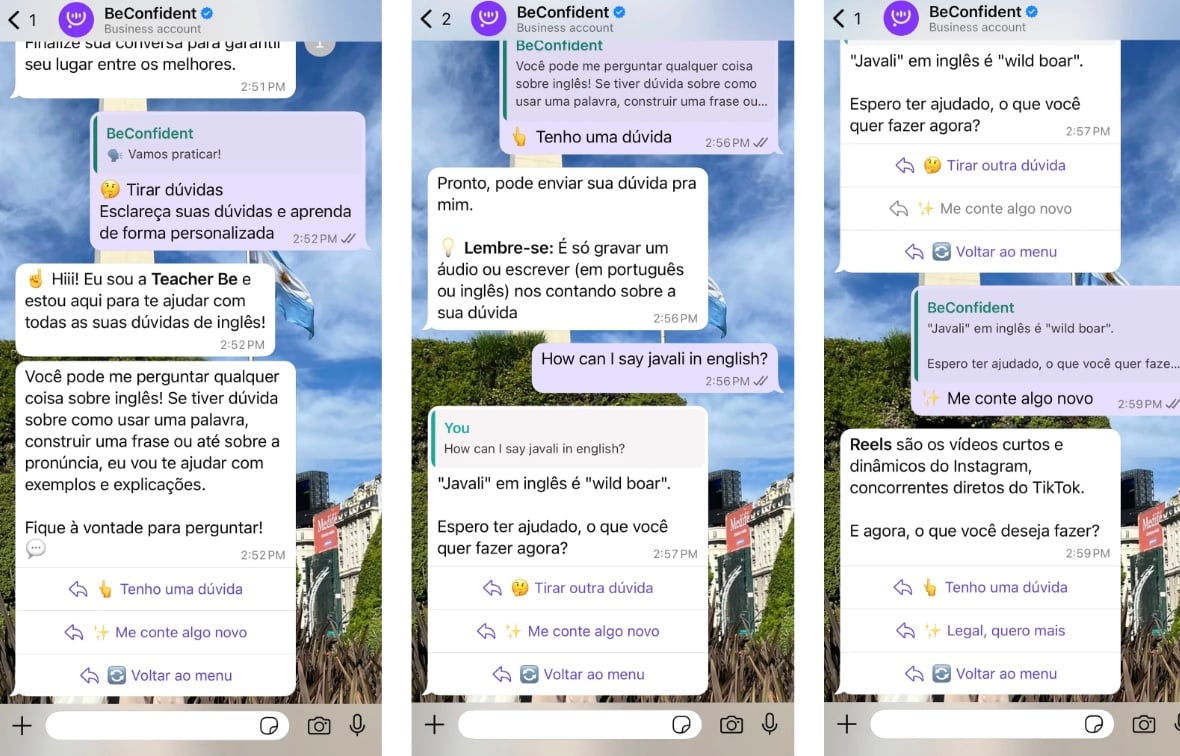
Try these AI conversations for free.
Free 7-day AI plan to lose the shyness of speaking English
Day 1: take evaluation and make first contact
BeConfident's free test identifies your CEFR level. Then, a 5-minute conversation with an AI tutor about self-introduction, hobbies, and routine creates the first oral contact in a controlled environment.
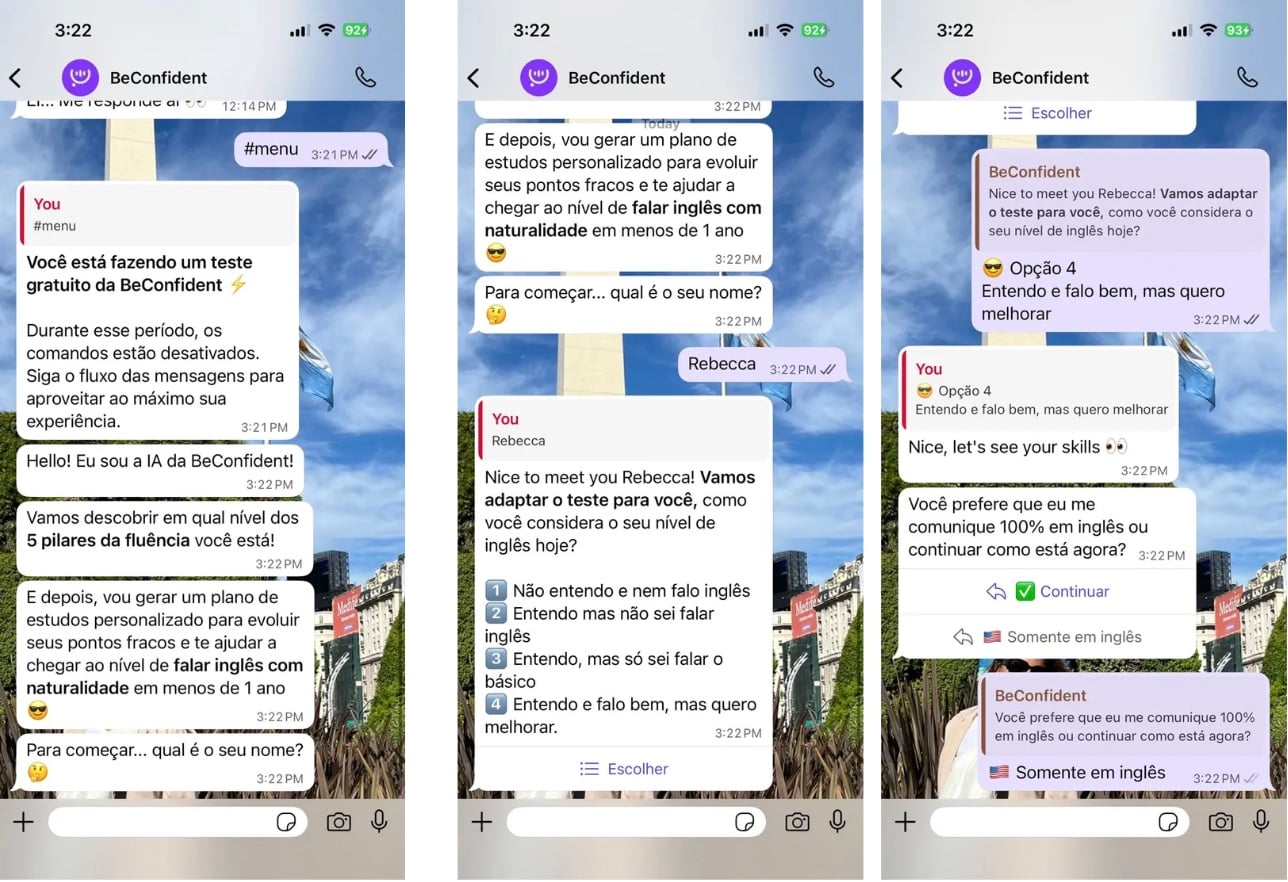
Day 2: practice shadowing with American AI
Choosing a tutor with an American accent allows you to practice repeating short phrases focusing on rhythm and intonation. Recording your own pronunciation and comparing it with the model helps adjust specific sounds.
Day 3: simulate a professional or travel situation
Selecting relevant scenarios, such as a work meeting, hotel check-in, or ordering at a restaurant, directs the practice. Specific dialogues with contextualized vocabulary bring training closer to reality.
Day 4: review mistakes and fix weak points
Reviewing the feedback received in previous days shows error patterns. The "Review Mistakes" function allows focused work on specific grammar and pronunciation points.
Day 5: try a British accent
Switching to a British tutor exposes the student to differences in pronunciation and expressions. Repeating the same topic from Day 3 with another accent broadens listening comprehension and oral flexibility.
Day 6: do free conversation via WhatsApp
The "call" function on BeConfident's WhatsApp allows spontaneous conversation about personal interests, without a pre-defined script. This freedom brings the experience closer to a real conversation, but still in a judgment-free environment.
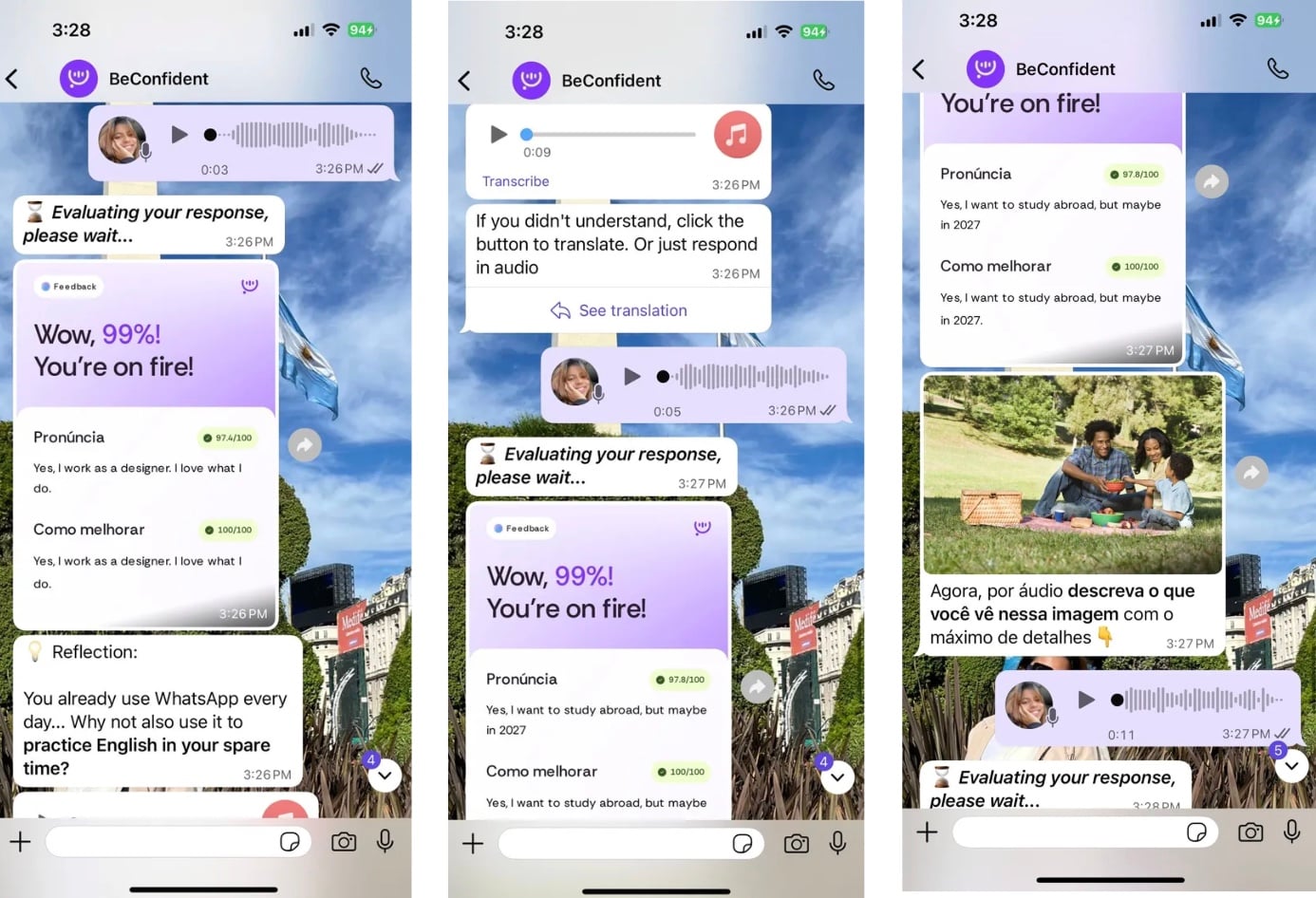
Day 7: evaluate your own progress
The "My Evolution" area shows hours of practice, consecutive day streaks, and certificates earned. Comparing the fluency of Day 1 with Day 7 highlights concrete gains in confidence and fluidity.
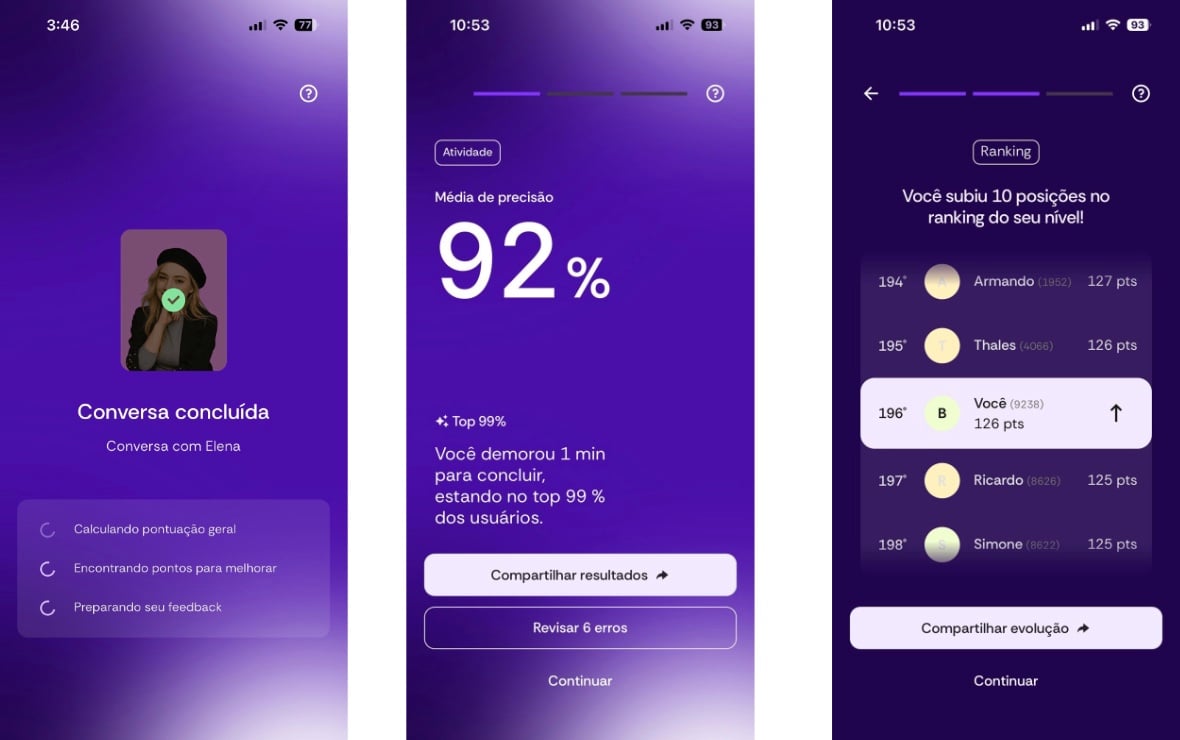
This structured plan with AI tools that offer 24/7 conversational practice and instant feedback accelerates oral confidence development in a week of focused practice.
Comparison: why is BeConfident the safest option to practice without feeling shy?
The choice of practice tool directly influences speaking confidence. The following table compares features that affect availability, social judgment, personalization, and cost, showing how each type of platform handles these factors.
Feature | BeConfident | Traditional Schools | Duolingo/Gamified Apps | Cambly/Italki |
|---|---|---|---|---|
Availability | 24/7 unlimited | Limited fixed hours | 24/7, but basic exercises | Hourly scheduling |
Judgment | Zero, judgment-free AI | Pressure from peers and teacher | No real conversation | Anxiety with human tutors |
Personalization | Adapted tracks and specific scenarios | Standardized curriculum | Generic gamification | Variable quality per tutor |
Cost | Fraction of traditional cost | High monthly fees | Limited features in the free version | High hourly payment |
BeConfident combines deep conversation with AI tutors simulating native accents, instant detailed feedback, and complete scheduling flexibility. With a Reclame Aqui RA 1000 reputation and a consolidated user base, the platform offers a safe environment to overcome the shyness of speaking English.
Common mistakes and how to avoid them
Focusing only on theory without practicing conversation is a frequent mistake. Many Brazilians accumulate grammatical knowledge and vocabulary but do not develop oral fluency. Inconsistency also hurts progress, when a person studies intensely for a few days and then stops for weeks.
The fear of talking to native speakers often paralyzes. Research indicates that informal conversations with friends generate less anxiety than interactions with strangers or authority figures. This data reinforces the importance of starting in safer environments.
Constant practice with BeConfident's AI reduces the impact of human judgment and allows unlimited repetition until the user feels ready for real interactions.
FAQ
How to lose the shyness of speaking English?
An effective strategy combines solo practice, the use of ready-made phrases, and gradual exposure. Narrate your day's activities, shadow, use functional expressions in common situations, and practice with AI before talking to humans. Progressive exposure in a judgment-free environment builds confidence sustainably.
How long does it take to develop conversational fluency?
Consistent daily practice with AI usually generates noticeable improvements in 2 to 4 weeks. The time to full fluency varies depending on the starting level, but many people achieve basic functional conversation in 1 to 3 months of regular, focused practice.
Does BeConfident offer a free trial?
BeConfident offers a full free trial. During this period, you can evaluate your CEFR level, talk to AI tutors, and experience the main features before deciding to subscribe.
Does the platform work for people with ADHD?
BeConfident's flexibility favors people with ADHD. Users can practice in short sessions during peak focus times, pause and resume conversations, and choose topics of personal interest to maintain engagement.
What is the difference between the available accents?
BeConfident offers tutors with American, British, Australian, Canadian, South African, and Indian accents. Each accent has specific features of pronunciation and expressions, which broadens listening exposure and prepares students for different international contexts.
The shyness of speaking English can decrease with structured practice and the right environment. The 7 steps presented and the 7-day AI plan create a clear path to building conversational confidence.
BeConfident offers unlimited practice, personalized feedback, and no human judgment, which supports this process. Many Brazilians have already used this type of practice to gain security when speaking English. The next step is available with a free trial and a simple daily conversation routine. Start your free 7-day trial now.
Written by: Luan Cavallaro, Founder & CMO, BeConfident
Key takeaways from this article
The shyness of speaking English stems from psychological anxiety and perfectionism, and can be reduced with a positive mindset, self-talk, and gradual exposure in safe environments.
Practicing alone, narrating routines in the mirror, shadowing native audios, and memorizing ready-made phrases helps to gain fluency without initial pressure.
Simulating real scenarios specific to professional or travel contexts, recording one's own speech, allows for self-analysis and error correction without human judgment.
AI enhances learning with 24/7 conversational practice, instant feedback, and tutors with diverse accents, which reduces the limitations of traditional methods.
BeConfident's 7-day plan helps build confidence quickly, start your free 7-day trial now.
Why shyness happens and how to overcome it mentally
The shyness of speaking English has clear psychological roots. Researchers like Horwitz, Horwitz, and Cope describe foreign language classroom anxiety as a specific set of self-perceptions, beliefs, feelings, and behaviors linked to language learning. This anxiety arises from the particular way the brain handles the process of learning a new language.
Recent studies indicate that foreign language classroom anxiety (FLA) is not a significant predictor of willingness to communicate (WTC). This means a person can feel anxiety in a formal context and still manage to communicate better in more informal and safe environments.
Perfectionism intensifies this shyness. An engineer who masters technical documentation in English might freeze on an international call. A traveler who plans a detailed itinerary might end up speechless at the airport. The anxious brain releases cortisol, which impairs working memory and grammatical processing.
Overcoming this barrier mentally requires a shift in mindset. Mistakes are part of the process and are necessary to move forward. Positive self-talk helps when it replaces phrases like "I will never make it" with "I am learning and this is natural." Celebrating small victories, such as asking for information or expressing a simple opinion, reinforces confidence.
Gradual exposure in safe environments reduces anxiety over time. The following seven steps create this type of progressive exposure, starting with individual practice and advancing to conversation with AI.
7 steps to practice English without shyness
1. Start by talking to yourself in the mirror
Speaking out loud about your own routine builds familiarity with the language. Narrate simple actions, like "I am cooking breakfast" and "Now I am adding coffee." Language teaching experts recommend narrating everyday actions to make words flow without audience pressure. Recording 1-minute audios on your cell phone describing your day allows you to track your own evolution.
2. Practice shadowing with native content
Repeating a short audio clip from a podcast or series at the same time the native speaker talks trains pronunciation, rhythm, and intonation. Shadowing focuses less on understanding every word and more on imitating the "music" of the language. This type of practice trains the mouth and vocal muscles to form new sounds more naturally.
3. Build a ready-made phrase kit
Memorizing 20 to 30 functional expressions organized by purpose creates a foundation of safety. Examples: "Let me think about that", "Could you repeat that more slowly?", "What I mean is...". When these structures become automatic through repetition, they function as linguistic anchors that the brain accesses even under stress, reducing the blocks caused by anxiety.
4. Use low-risk apps strategically
An app like Duolingo has limitations for real conversation, but it can serve as a daily warm-up. These apps do not simulate natural dialogues or offer personalized feedback on pronunciation and fluency. Their main function is to keep a light and frequent contact with the language.
5. Practice specific scenarios
Focusing on real situations increases the relevance of practice. Simulate professional negotiations, airport conversations, or discussions about pop culture. Adapt the vocabulary to your personal context. A lawyer needs legal terms. A traveler needs travel expressions. This personalization makes practice more useful and memorable.
6. Seek feedback without social pressure
Reducing the fear of judgment makes starting oral practice easier. Recording your own speech, listening back, analyzing mistakes, and identifying patterns builds linguistic awareness. An error log with examples and corrections guides your next steps and makes practice more objective.
7. Integrate AI for unlimited daily practice
BeConfident offers AI tutors with diverse personalities and accents, available 24/7 via the app or WhatsApp. With over 200,000 paying students and 3 million users, the platform allows natural conversations with instant feedback, free from human judgment. Users can practice simulated "calls", switch tutors according to interest, and receive personalized corrections in real-time.
Try these AI conversations for free.
Free 7-day AI plan to lose the shyness of speaking English
Day 1: take evaluation and make first contact
BeConfident's free test identifies your CEFR level. Then, a 5-minute conversation with an AI tutor about self-introduction, hobbies, and routine creates the first oral contact in a controlled environment.
Day 2: practice shadowing with American AI
Choosing a tutor with an American accent allows you to practice repeating short phrases focusing on rhythm and intonation. Recording your own pronunciation and comparing it with the model helps adjust specific sounds.
Day 3: simulate a professional or travel situation
Selecting relevant scenarios, such as a work meeting, hotel check-in, or ordering at a restaurant, directs the practice. Specific dialogues with contextualized vocabulary bring training closer to reality.
Day 4: review mistakes and fix weak points
Reviewing the feedback received in previous days shows error patterns. The "Review Mistakes" function allows focused work on specific grammar and pronunciation points.
Day 5: try a British accent
Switching to a British tutor exposes the student to differences in pronunciation and expressions. Repeating the same topic from Day 3 with another accent broadens listening comprehension and oral flexibility.
Day 6: do free conversation via WhatsApp
The "call" function on BeConfident's WhatsApp allows spontaneous conversation about personal interests, without a pre-defined script. This freedom brings the experience closer to a real conversation, but still in a judgment-free environment.
Day 7: evaluate your own progress
The "My Evolution" area shows hours of practice, consecutive day streaks, and certificates earned. Comparing the fluency of Day 1 with Day 7 highlights concrete gains in confidence and fluidity.
This structured plan with AI tools that offer 24/7 conversational practice and instant feedback accelerates oral confidence development in a week of focused practice.
Comparison: why is BeConfident the safest option to practice without feeling shy?
The choice of practice tool directly influences speaking confidence. The following table compares features that affect availability, social judgment, personalization, and cost, showing how each type of platform handles these factors.
Feature | BeConfident | Traditional Schools | Duolingo/Gamified Apps | Cambly/Italki |
|---|---|---|---|---|
Availability | 24/7 unlimited | Limited fixed hours | 24/7, but basic exercises | Hourly scheduling |
Judgment | Zero, judgment-free AI | Pressure from peers and teacher | No real conversation | Anxiety with human tutors |
Personalization | Adapted tracks and specific scenarios | Standardized curriculum | Generic gamification | Variable quality per tutor |
Cost | Fraction of traditional cost | High monthly fees | Limited features in the free version | High hourly payment |
BeConfident combines deep conversation with AI tutors simulating native accents, instant detailed feedback, and complete scheduling flexibility. With a Reclame Aqui RA 1000 reputation and a consolidated user base, the platform offers a safe environment to overcome the shyness of speaking English.
Common mistakes and how to avoid them
Focusing only on theory without practicing conversation is a frequent mistake. Many Brazilians accumulate grammatical knowledge and vocabulary but do not develop oral fluency. Inconsistency also hurts progress, when a person studies intensely for a few days and then stops for weeks.
The fear of talking to native speakers often paralyzes. Research indicates that informal conversations with friends generate less anxiety than interactions with strangers or authority figures. This data reinforces the importance of starting in safer environments.
Constant practice with BeConfident's AI reduces the impact of human judgment and allows unlimited repetition until the user feels ready for real interactions.
FAQ
How to lose the shyness of speaking English?
An effective strategy combines solo practice, the use of ready-made phrases, and gradual exposure. Narrate your day's activities, shadow, use functional expressions in common situations, and practice with AI before talking to humans. Progressive exposure in a judgment-free environment builds confidence sustainably.
How long does it take to develop conversational fluency?
Consistent daily practice with AI usually generates noticeable improvements in 2 to 4 weeks. The time to full fluency varies depending on the starting level, but many people achieve basic functional conversation in 1 to 3 months of regular, focused practice.
Does BeConfident offer a free trial?
BeConfident offers a full free trial. During this period, you can evaluate your CEFR level, talk to AI tutors, and experience the main features before deciding to subscribe.
Does the platform work for people with ADHD?
BeConfident's flexibility favors people with ADHD. Users can practice in short sessions during peak focus times, pause and resume conversations, and choose topics of personal interest to maintain engagement.
What is the difference between the available accents?
BeConfident offers tutors with American, British, Australian, Canadian, South African, and Indian accents. Each accent has specific features of pronunciation and expressions, which broadens listening exposure and prepares students for different international contexts.
The shyness of speaking English can decrease with structured practice and the right environment. The 7 steps presented and the 7-day AI plan create a clear path to building conversational confidence.
BeConfident offers unlimited practice, personalized feedback, and no human judgment, which supports this process. Many Brazilians have already used this type of practice to gain security when speaking English. The next step is available with a free trial and a simple daily conversation routine. Start your free 7-day trial now.