




Business English conversation: phrases and practice
Business English conversation: phrases and practice
Business English conversation: phrases and practice
Written by: Luan Cavallaro, Founder & CMO, BeConfident
Key takeaways from this article
Fluent English professionals gain a competitive edge in the global market, with growing demand for business conversation in remote teams and international collaborations.
Mastering essential vocabulary like deadline, feedback, and meeting, in addition to ready-made phrases for openings, meetings, and negotiations in Portuguese-English tables.
Practicing with real-world role-plays of project meetings and negotiations to build confidence in authentic professional scenarios.
Correcting common pronunciation mistakes made by Brazilians, such as stress in "present" (pre-SENT) and TH sounds, to sound clearer and more professional.
Implement a daily practice plan with AI on BeConfident, with a free trial and 24/7 business conversation to boost your career.
Essential business English vocabulary
Mastering basic vocabulary is the first step for any business English conversation. The table below features 15 highly used terms in the corporate environment.
Portuguese | English | Context | Pronunciation tip |
Prazo | Deadline | Projects and deliverables | Stress on the 2nd syllable: dead-LINE |
Retorno/feedback | Feedback | Reviews and meetings | FEED-back, strong first syllable |
Reunião | Meeting | Professional encounters | MEE-ting, long first syllable |
Apresentação | Presentation | Expositions and pitches | pre-sen-TAY-shun, third syllable |
Other important terms include:
ASAP: as soon as possible
Briefing: executive summary
Green light: approval
Follow-up: accompaniment / follow-up
Stakeholder: interested party
Milestone: project milestone
Budget: budget
Revenue: revenue
ROI: return on investment
KPI: key performance indicator
Brainstorming: generation of ideas
Networking: building a network of contacts
Partnership: partnership
Compliance: compliance
Benchmark: market reference
Opening and closing phrases for any meeting
Clear opening and closing phrases help conduct meetings with security. Use the following table to structure the beginning and end of any professional encounter.
Portuguese | English | Example of use | Pronunciation tip |
Vamos começar | Let's get started | Beginning of a project meeting | Strong stress on START |
Obrigado por participarem | Thank you for joining | Opening a call | JOIN-ing, first syllable |
Vamos direto ao ponto | Let's cut to the chase | Objective meetings | CUT to the CHASE |
Para resumir | To sum up | Closing topics | SUM up, both strong |
Próximos passos | Next steps | Action planning | NEXT STEPS, both strong |
Other useful phrases include:
"Good morning/afternoon everyone" (bom dia/boa tarde a todos)
"I'd like to welcome you all" (gostaria de dar as boas-vindas)
"Let's go around the table" (vamos fazer uma rodada)
"Any questions before we start?" (alguma pergunta antes de começarmos?)
"Moving on to the next point" (passando para o próximo ponto)
"That wraps up our meeting" (isso encerra nossa reunião)
"I'll send the minutes later" (enviarei a ata depois)
"Looking forward to our next meeting" (ansioso pelo próximo encontro)
Phrases for meetings in English
Actively participating in meetings requires direct phrases to ask for information, add points, and check understanding.
Portuguese | English | Context | Common Brazilian mistake |
Pode me dar um update? | Can you give me a status update? | Project follow-up | Avoid "UP-date", the correct way is "up-DATE" |
Eu gostaria de acrescentar | I'd like to add | Contributions to discussions | Do not confuse ADD with "ad" |
Posso interromper? | May I interrupt? | Participation in debates | in-ter-RUPT, third syllable |
Faz sentido para vocês? | Does that make sense? | Confirmation of understanding | MAKE SENSE, both strong |
Frequent mistakes include incorrect stress on "PREsent" instead of pre-SENT, confusion with "meeting", and pronouncing "schedule" as "eskédule" instead of "SHED-yool". Brazilian speakers usually have difficulty with rhythm and stress patterns, because Portuguese flows more evenly while English alternates strong and weak syllables.
Phrases for professional emails and negotiations
Written communication and negotiations call for specific vocabulary and an appropriate level of formality.
Portuguese | English | Context | Formality |
Mantenha-me informado | Keep me posted | Follow-up of projects | Informal |
Podemos negociar os termos? | Can we negotiate the terms? | Contractual discussions | Formal |
Aguardo seu retorno | I look forward to your response | Email closing | Formal |
Vamos marcar uma reunião | Let's schedule a meeting | Scheduling | Neutral |
In negotiations, some useful phrases are:
"What's your best offer?" (qual sua melhor oferta?)
"We need to find a middle ground" (precisamos encontrar um meio-termo)
"That's not within our budget" (isso não está no nosso orçamento)
"Can you be more flexible on price?" (pode ser mais flexível no preço?)
"Let's close this deal" (vamos fechar este negócio)
Practical scenarios and role-plays
Practicing in real-life situations accelerates fluency and reduces hesitation when speaking.
1. Project meeting
Situation: weekly project update
Dialogue:
- "Good morning team, let's review our progress" (bom dia equipe, vamos revisar nosso progresso)
- "We're on track to meet the deadline" (estamos no caminho certo para cumprir o prazo)
Common mistake: pronouncing "progress" as "prógress" instead of "PRO-gress"
2. Negotiation with an international client
Situation: contract discussion
Dialogue:
- "What are your main concerns about this proposal?" (quais suas principais preocupações sobre esta proposta?)
- "We can adjust the timeline to meet your needs" (podemos ajustar o cronograma para atender suas necessidades)
3. Follow-up email
Situation: post-meeting follow-up
Key-phrases:
- "Following up on our meeting yesterday" (dando seguimento à nossa reunião de ontem)
- "Please find attached the documents we discussed" (segue em anexo os documentos que discutimos)
Pronunciation and clarity tips to sound professional
Clear pronunciation increases credibility in professional environments and reduces misunderstandings. Misplaced stress on words like "present" (pre-SENT) often makes Brazilian speakers sound less confident.
Some practical tips:
Practice the TH sound in "think", "this", and "that", placing the tongue between the teeth
Use correct stress on "deadline" (dead-LINE), "present" (pre-SENT), and "record" (re-CORD)
Avoid Portuguese "L" and "T" sounds in words like "call" and "meeting"
Work on the rhythm of English, alternating strong and weak syllables in sentences
BeConfident for business English conversation
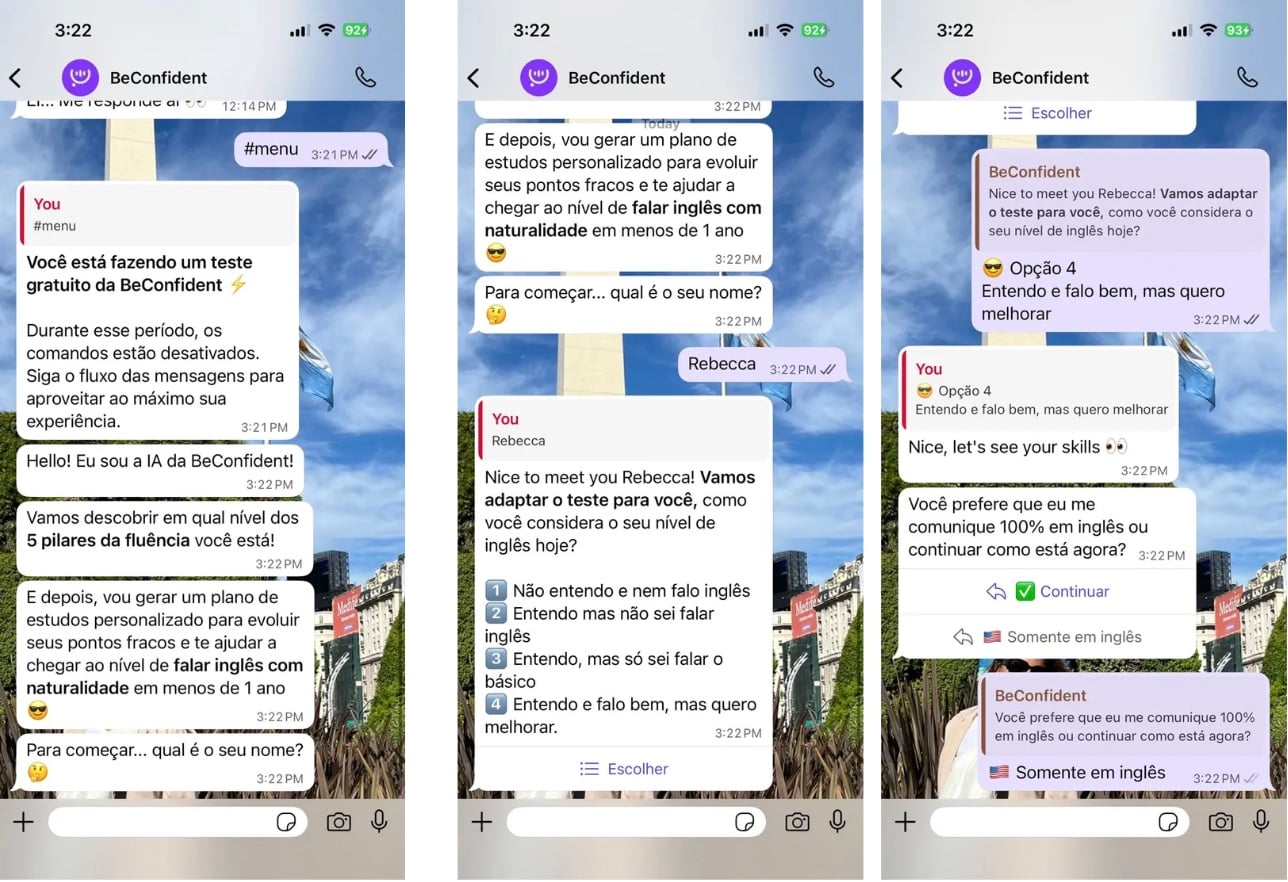
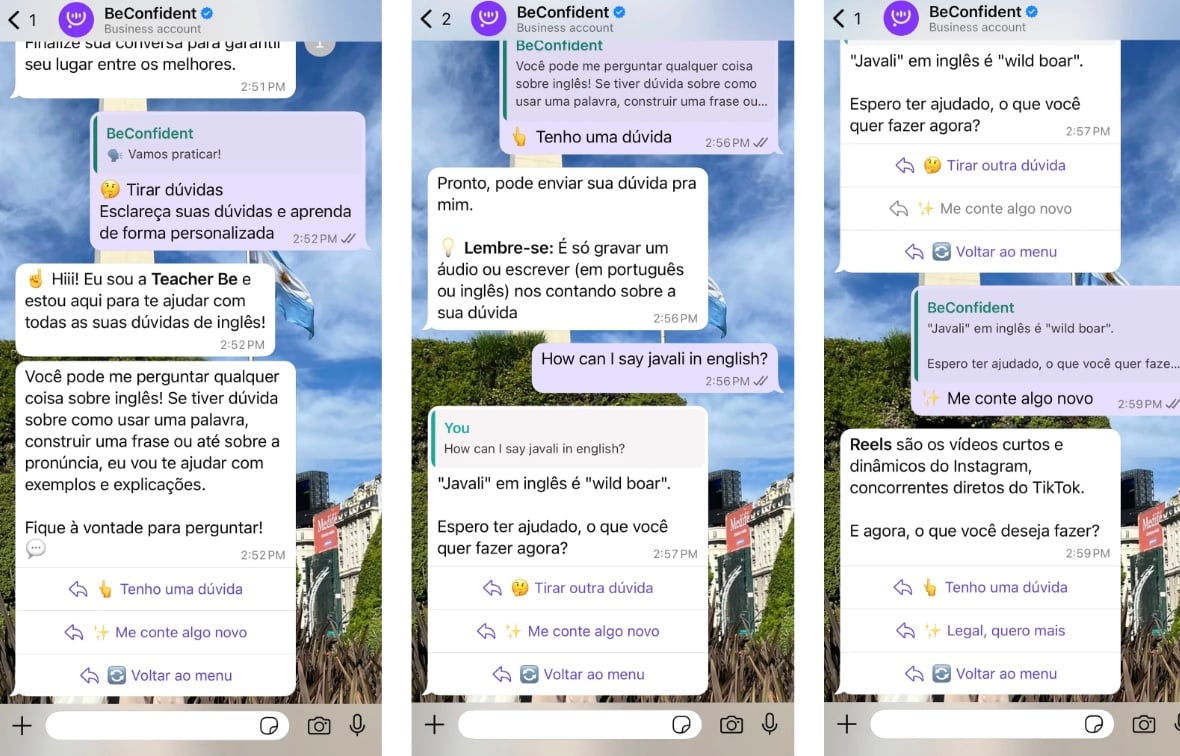
BeConfident offers 24/7 business English practice via app, WhatsApp, or smartwatch with specialized AI tutors. The platform serves over 200,000 students and has an RA 1000 reputation on Reclame Aqui.
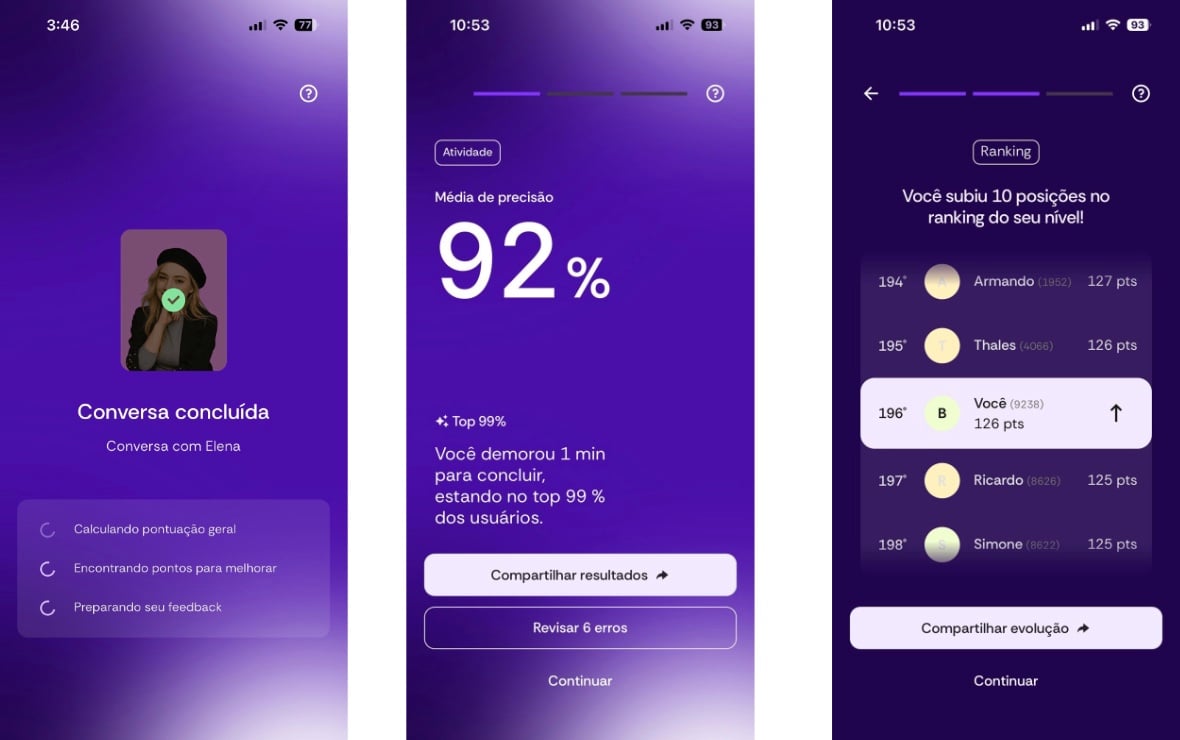
AI tutors with specific profiles, such as engineer, lawyer, and manager, with native accents
Instant feedback on grammar, pronunciation, and naturalness
Focused practice in business English, without classroom exposure or judgment
Affordable cost compared to Cambly, which charges by the hour, and a business focus, unlike Duolingo, which is aimed at basic gamification
Unlike traditional schools with fixed schedules and high monthly fees, BeConfident allows you to practice whenever and wherever is most convenient, with a direct focus on the conversation needed for your career.
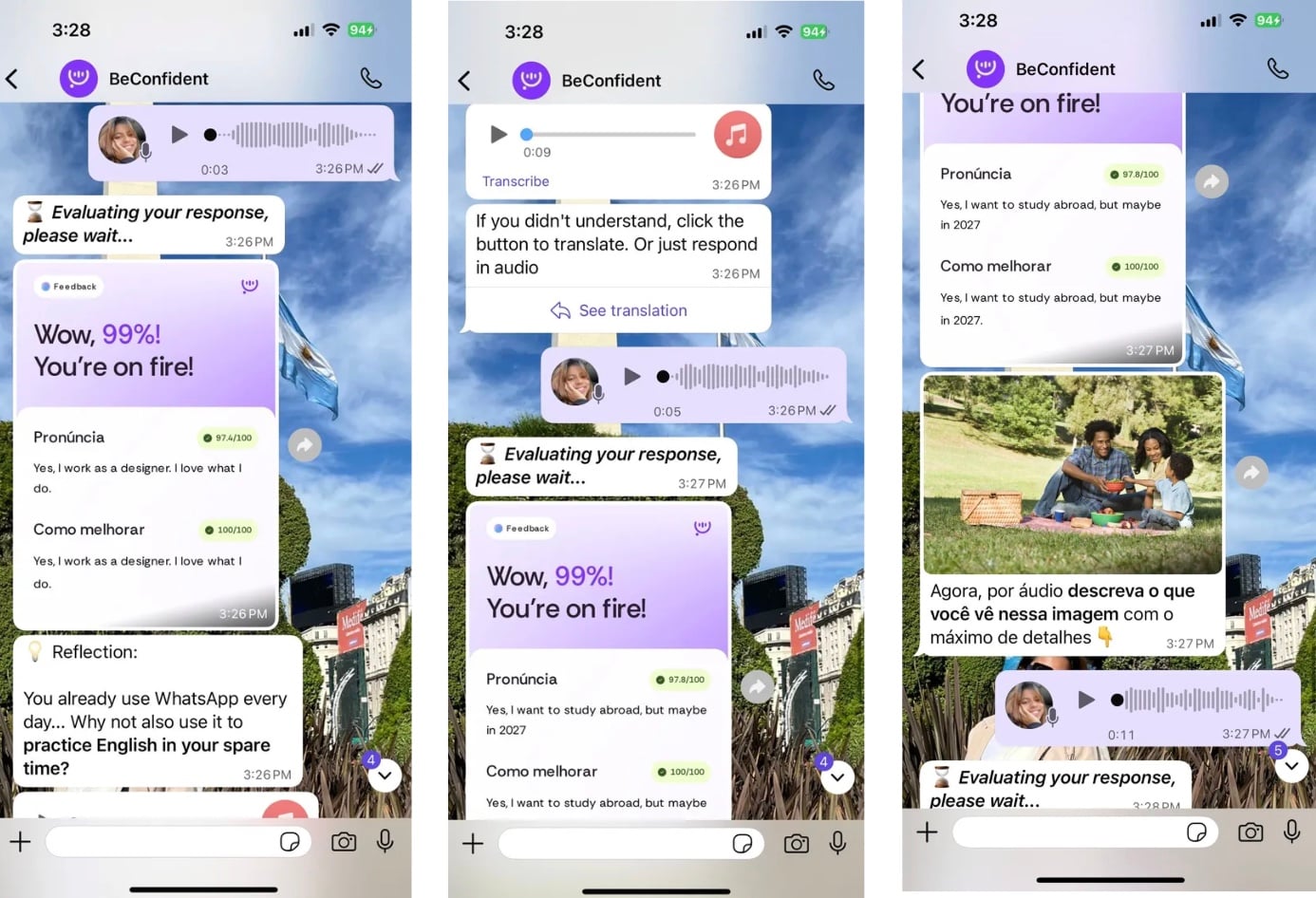
Daily practice plan with AI
A simple and consistent plan helps consolidate vocabulary, pronunciation, and confidence within a few weeks.
Weeks 1 and 2: foundation
Days 1 to 3: memorize 10 key phrases from the article's tables
Days 4 to 7: practice the "Project meeting" role-play with BeConfident
Days 8 to 14: record audios with the phrases and receive pronunciation feedback from the AI
Weeks 3 and 4: application
Days 15 to 21: practice negotiation role-plays and professional emails
Days 22 to 28: have free conversations about work topics
Tool | 24/7 Practice | Monthly cost | Business focus |
BeConfident | Yes | Low | Yes |
Duolingo | No | Low | Partial |
Cambly | Limited | High | Partial |
Traditional schools | No | Very high | Yes |
Frequently Asked Questions
How to practice business English conversation without a partner?
BeConfident offers 24/7 AI tutors that simulate real business conversations. You can practice meetings, negotiations, and presentations without embarrassment and receive immediate feedback on grammar, pronunciation, and naturalness, tailored to your professional level and field.
Which is the most recommended app for business English in 2026?
BeConfident stands out for focusing on business conversation, offering unlimited practice and specialized AI tutors. While Duolingo prioritizes basic gamification and Cambly charges by the hour with a focus on general conversation, BeConfident offers real-life business scenarios, detailed feedback, and a more predictable cost.
What are the most important phrases for meetings in English?
Some key phrases include: "Let's get started" (vamos começar), "Can you give me an update?" (pode me dar um update?), "I'd like to add" (gostaria de acrescentar), "Does that make sense?" (faz sentido?), "Next steps" (próximos passos), and "Thank you for your time" (obrigado pelo seu tempo). These phrases cover openings, active participation, and closings.
Which pronunciation mistakes by Brazilians hurt business meetings the most?
The main mistakes include incorrect stress on words like "present" instead of pre-SENT, difficulty with TH sounds, using Portuguese rhythm in English, and confusing L and T sounds. These points can convey an impression of insecurity in interviews and negotiations.
How does business English impact your career in 2026?
Fluent English professionals have broader access to job openings, leadership roles, and international projects. With global remote teams becoming the standard and the English learning market projected to reach $127.7 billion by 2035, mastering business English conversation has become a requirement for competitiveness.
Conclusion: master business English conversation today
Mastering business English conversation is already a core requirement for careers in 2026. With the essential phrases, practical role-plays, and pronunciation strategies in this guide, you have the foundation to participate in your next international meeting with more confidence.
BeConfident offers 24/7 business conversation practice with specialized AI tutors, instant feedback, and real scenarios aligned with your professional field.
Try it for free and start learning English today with a platform that has already helped more than 200,000 professionals advance their careers with business English.
Written by: Luan Cavallaro, Founder & CMO, BeConfident
Key takeaways from this article
Fluent English professionals gain a competitive edge in the global market, with growing demand for business conversation in remote teams and international collaborations.
Mastering essential vocabulary like deadline, feedback, and meeting, in addition to ready-made phrases for openings, meetings, and negotiations in Portuguese-English tables.
Practicing with real-world role-plays of project meetings and negotiations to build confidence in authentic professional scenarios.
Correcting common pronunciation mistakes made by Brazilians, such as stress in "present" (pre-SENT) and TH sounds, to sound clearer and more professional.
Implement a daily practice plan with AI on BeConfident, with a free trial and 24/7 business conversation to boost your career.
Essential business English vocabulary
Mastering basic vocabulary is the first step for any business English conversation. The table below features 15 highly used terms in the corporate environment.
Portuguese | English | Context | Pronunciation tip |
Prazo | Deadline | Projects and deliverables | Stress on the 2nd syllable: dead-LINE |
Retorno/feedback | Feedback | Reviews and meetings | FEED-back, strong first syllable |
Reunião | Meeting | Professional encounters | MEE-ting, long first syllable |
Apresentação | Presentation | Expositions and pitches | pre-sen-TAY-shun, third syllable |
Other important terms include:
ASAP: as soon as possible
Briefing: executive summary
Green light: approval
Follow-up: accompaniment / follow-up
Stakeholder: interested party
Milestone: project milestone
Budget: budget
Revenue: revenue
ROI: return on investment
KPI: key performance indicator
Brainstorming: generation of ideas
Networking: building a network of contacts
Partnership: partnership
Compliance: compliance
Benchmark: market reference
Opening and closing phrases for any meeting
Clear opening and closing phrases help conduct meetings with security. Use the following table to structure the beginning and end of any professional encounter.
Portuguese | English | Example of use | Pronunciation tip |
Vamos começar | Let's get started | Beginning of a project meeting | Strong stress on START |
Obrigado por participarem | Thank you for joining | Opening a call | JOIN-ing, first syllable |
Vamos direto ao ponto | Let's cut to the chase | Objective meetings | CUT to the CHASE |
Para resumir | To sum up | Closing topics | SUM up, both strong |
Próximos passos | Next steps | Action planning | NEXT STEPS, both strong |
Other useful phrases include:
"Good morning/afternoon everyone" (bom dia/boa tarde a todos)
"I'd like to welcome you all" (gostaria de dar as boas-vindas)
"Let's go around the table" (vamos fazer uma rodada)
"Any questions before we start?" (alguma pergunta antes de começarmos?)
"Moving on to the next point" (passando para o próximo ponto)
"That wraps up our meeting" (isso encerra nossa reunião)
"I'll send the minutes later" (enviarei a ata depois)
"Looking forward to our next meeting" (ansioso pelo próximo encontro)
Phrases for meetings in English
Actively participating in meetings requires direct phrases to ask for information, add points, and check understanding.
Portuguese | English | Context | Common Brazilian mistake |
Pode me dar um update? | Can you give me a status update? | Project follow-up | Avoid "UP-date", the correct way is "up-DATE" |
Eu gostaria de acrescentar | I'd like to add | Contributions to discussions | Do not confuse ADD with "ad" |
Posso interromper? | May I interrupt? | Participation in debates | in-ter-RUPT, third syllable |
Faz sentido para vocês? | Does that make sense? | Confirmation of understanding | MAKE SENSE, both strong |
Frequent mistakes include incorrect stress on "PREsent" instead of pre-SENT, confusion with "meeting", and pronouncing "schedule" as "eskédule" instead of "SHED-yool". Brazilian speakers usually have difficulty with rhythm and stress patterns, because Portuguese flows more evenly while English alternates strong and weak syllables.
Phrases for professional emails and negotiations
Written communication and negotiations call for specific vocabulary and an appropriate level of formality.
Portuguese | English | Context | Formality |
Mantenha-me informado | Keep me posted | Follow-up of projects | Informal |
Podemos negociar os termos? | Can we negotiate the terms? | Contractual discussions | Formal |
Aguardo seu retorno | I look forward to your response | Email closing | Formal |
Vamos marcar uma reunião | Let's schedule a meeting | Scheduling | Neutral |
In negotiations, some useful phrases are:
"What's your best offer?" (qual sua melhor oferta?)
"We need to find a middle ground" (precisamos encontrar um meio-termo)
"That's not within our budget" (isso não está no nosso orçamento)
"Can you be more flexible on price?" (pode ser mais flexível no preço?)
"Let's close this deal" (vamos fechar este negócio)
Practical scenarios and role-plays
Practicing in real-life situations accelerates fluency and reduces hesitation when speaking.
1. Project meeting
Situation: weekly project update
Dialogue:
- "Good morning team, let's review our progress" (bom dia equipe, vamos revisar nosso progresso)
- "We're on track to meet the deadline" (estamos no caminho certo para cumprir o prazo)
Common mistake: pronouncing "progress" as "prógress" instead of "PRO-gress"
2. Negotiation with an international client
Situation: contract discussion
Dialogue:
- "What are your main concerns about this proposal?" (quais suas principais preocupações sobre esta proposta?)
- "We can adjust the timeline to meet your needs" (podemos ajustar o cronograma para atender suas necessidades)
3. Follow-up email
Situation: post-meeting follow-up
Key-phrases:
- "Following up on our meeting yesterday" (dando seguimento à nossa reunião de ontem)
- "Please find attached the documents we discussed" (segue em anexo os documentos que discutimos)
Pronunciation and clarity tips to sound professional
Clear pronunciation increases credibility in professional environments and reduces misunderstandings. Misplaced stress on words like "present" (pre-SENT) often makes Brazilian speakers sound less confident.
Some practical tips:
Practice the TH sound in "think", "this", and "that", placing the tongue between the teeth
Use correct stress on "deadline" (dead-LINE), "present" (pre-SENT), and "record" (re-CORD)
Avoid Portuguese "L" and "T" sounds in words like "call" and "meeting"
Work on the rhythm of English, alternating strong and weak syllables in sentences
BeConfident for business English conversation
BeConfident offers 24/7 business English practice via app, WhatsApp, or smartwatch with specialized AI tutors. The platform serves over 200,000 students and has an RA 1000 reputation on Reclame Aqui.
AI tutors with specific profiles, such as engineer, lawyer, and manager, with native accents
Instant feedback on grammar, pronunciation, and naturalness
Focused practice in business English, without classroom exposure or judgment
Affordable cost compared to Cambly, which charges by the hour, and a business focus, unlike Duolingo, which is aimed at basic gamification
Unlike traditional schools with fixed schedules and high monthly fees, BeConfident allows you to practice whenever and wherever is most convenient, with a direct focus on the conversation needed for your career.
Daily practice plan with AI
A simple and consistent plan helps consolidate vocabulary, pronunciation, and confidence within a few weeks.
Weeks 1 and 2: foundation
Days 1 to 3: memorize 10 key phrases from the article's tables
Days 4 to 7: practice the "Project meeting" role-play with BeConfident
Days 8 to 14: record audios with the phrases and receive pronunciation feedback from the AI
Weeks 3 and 4: application
Days 15 to 21: practice negotiation role-plays and professional emails
Days 22 to 28: have free conversations about work topics
Tool | 24/7 Practice | Monthly cost | Business focus |
BeConfident | Yes | Low | Yes |
Duolingo | No | Low | Partial |
Cambly | Limited | High | Partial |
Traditional schools | No | Very high | Yes |
Frequently Asked Questions
How to practice business English conversation without a partner?
BeConfident offers 24/7 AI tutors that simulate real business conversations. You can practice meetings, negotiations, and presentations without embarrassment and receive immediate feedback on grammar, pronunciation, and naturalness, tailored to your professional level and field.
Which is the most recommended app for business English in 2026?
BeConfident stands out for focusing on business conversation, offering unlimited practice and specialized AI tutors. While Duolingo prioritizes basic gamification and Cambly charges by the hour with a focus on general conversation, BeConfident offers real-life business scenarios, detailed feedback, and a more predictable cost.
What are the most important phrases for meetings in English?
Some key phrases include: "Let's get started" (vamos começar), "Can you give me an update?" (pode me dar um update?), "I'd like to add" (gostaria de acrescentar), "Does that make sense?" (faz sentido?), "Next steps" (próximos passos), and "Thank you for your time" (obrigado pelo seu tempo). These phrases cover openings, active participation, and closings.
Which pronunciation mistakes by Brazilians hurt business meetings the most?
The main mistakes include incorrect stress on words like "present" instead of pre-SENT, difficulty with TH sounds, using Portuguese rhythm in English, and confusing L and T sounds. These points can convey an impression of insecurity in interviews and negotiations.
How does business English impact your career in 2026?
Fluent English professionals have broader access to job openings, leadership roles, and international projects. With global remote teams becoming the standard and the English learning market projected to reach $127.7 billion by 2035, mastering business English conversation has become a requirement for competitiveness.
Conclusion: master business English conversation today
Mastering business English conversation is already a core requirement for careers in 2026. With the essential phrases, practical role-plays, and pronunciation strategies in this guide, you have the foundation to participate in your next international meeting with more confidence.
BeConfident offers 24/7 business conversation practice with specialized AI tutors, instant feedback, and real scenarios aligned with your professional field.
Try it for free and start learning English today with a platform that has already helped more than 200,000 professionals advance their careers with business English.