




Course to understand native English speakers: guide for 2026
Course to understand native English speakers: guide for 2026
Course to understand native English speakers: guide for 2026
Written by: Luan Cavallaro, Founder & CMO, BeConfident
Key takeaways from this article
Brazilians freeze up with native speakers due to phonetic differences, regional accents, and little practice with real speech, which impacts their careers and travel.
Techniques such as shadowing, authentic podcasts, series without subtitles, and a focus on idioms and phrasal verbs accelerate listening comprehension.
Systematic exposure to varied accents, such as American, British, and Australian, with guided dialogues and 20 to 30 minutes of daily practice, yields 20 to 40% gains in just a few weeks.
Avoiding cognitive overload and prioritizing consistency in short sessions, while accepting partial comprehension at the beginning, sustains progress.
BeConfident offers unlimited 24/7 practice with AI that simulates native accents and instant feedback. Try for free now and advance your conversational fluency.
The problem: why Brazilians freeze up with native speakers and what the consequences are
The difficulty Brazilians face in understanding native English speakers starts with the phonetic differences between the languages. Brazilian Portuguese uses nasal sounds and open vowels, while English uses tense vowels, complex diphthongs, and consonants like /θ/, /ð/ and the approximant /r/, which do not exist in the Brazilian's mother tongue. When native speakers talk fast and use contractions like "gonna" and "wanna", the brain needs training to process everything in real time.
Regional accents increase the difficulty. Accents like Liverpool's Scouse, London's Cockney, and West Country English from Devon shift vowels, consonants, and rhythm. Many courses in Brazil work only with what is considered standard English, leaving the student poorly prepared for the real variety of accents.
This barrier has direct consequences. Professionals miss out on promotions because they cannot participate effectively in international meetings. Travelers feel isolated on exchanges. Students give up on fluency after negative experiences with native speakers.
The solution: practical techniques to understand native speakers faster
5 proven techniques to unlock your listening
Shadowing is a direct technique to develop listening comprehension. The student repeats native speakers' audio in real time, training the brain to process groups of words instead of isolated terms. The ideal approach is to start with 10 to 15 minutes a day using content slightly below your current level.
Listening to authentic podcasts accelerates progress. Series like BBC 6 Minute English, The English We Speak, and All Ears English expose the student to idiomatic expressions and the natural rhythm of native speakers. Active listening includes pausing, repeating difficult sentences, and taking note of new expressions.
Watching movies and series without subtitles in Portuguese creates a contextual training environment. The student can start with content they already know and then move on to new genres. The main point is to accept that comprehension will not be complete at first. The focus should be on the general meaning while the brain gets used to speech patterns.
Studying idioms and phrasal verbs is essential because they make up a large part of informal communication among native speakers. Expressions like "piece of cake", "break a leg", and "hit the books" cannot be explained through literal translation. The student needs frequent exposure and directed practice.
How to practice different accents efficiently
Having regular contact with varied accents, such as American, British, Australian, South African, and Indian, develops auditory flexibility. A practical way is to use guided dialogues, set up scenarios like airport check-in, converse for 10 to 12 minutes, and then review transcripts and errors. Practicing with AI allows you to control accents and situations without embarrassment.
Common mistakes and how to avoid them
Cognitive overload is one of the main friction points. Many Brazilians try to understand every single word and end up anxious and stuck. A study with 200 Brazilians showed that 20 to 30 minutes of daily focused practice yields significant gains in 4 to 8 weeks, increasing comprehension from 40% to 75% in 12 to 16 weeks. Short, regular sessions produce more consistent results than occasional marathons.
Take a free trial and practice shadowing now with AI tutors that simulate native accents and offer immediate feedback.
BeConfident: speaking practice with AI with no time limits
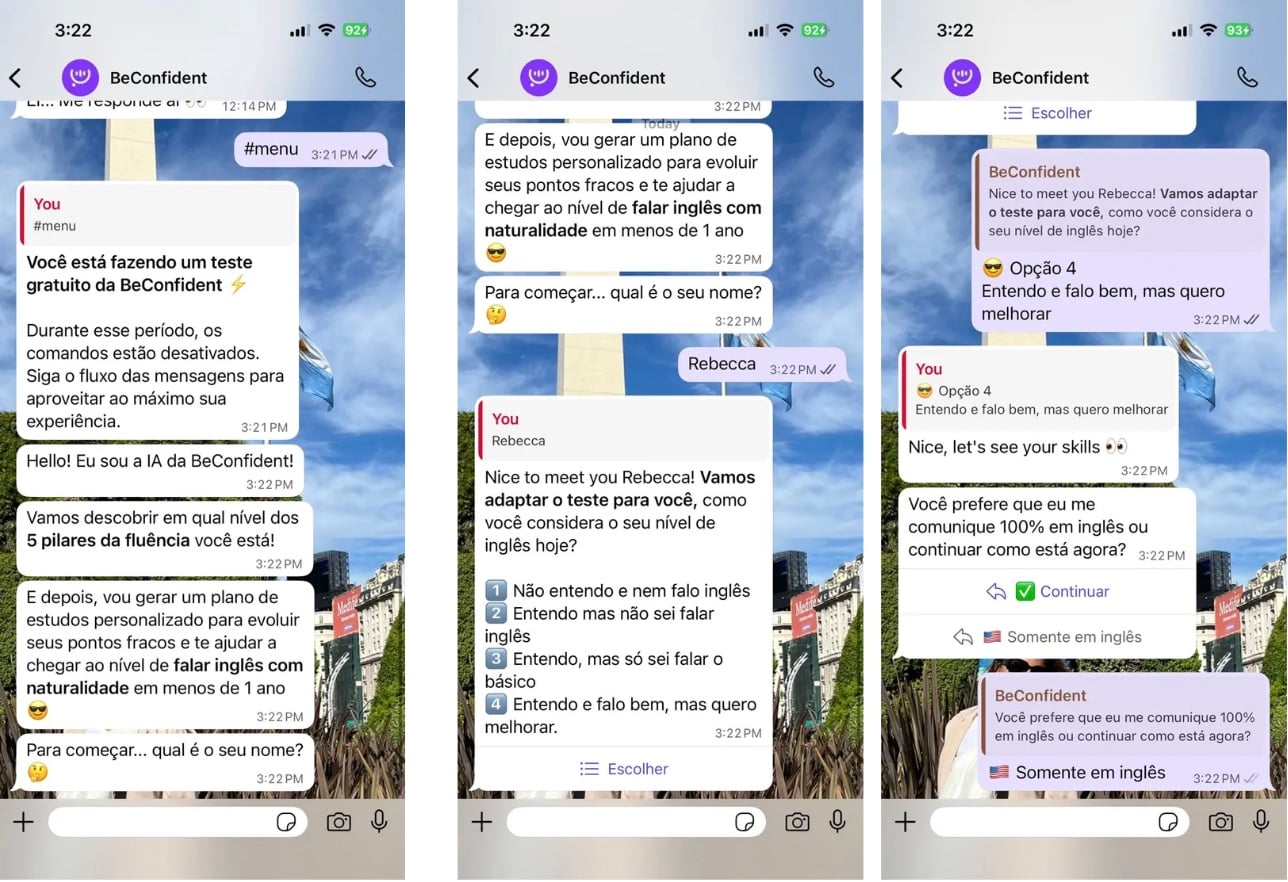
BeConfident combines artificial intelligence with a focus on practical fluency. The platform serves more than 140,000 students and holds a RA 1000 reputation on Reclame Aqui. Students can practice without limits, 24 hours a day, via the app, WhatsApp, or smartwatch, without depending on fixed schedules or expensive packages.
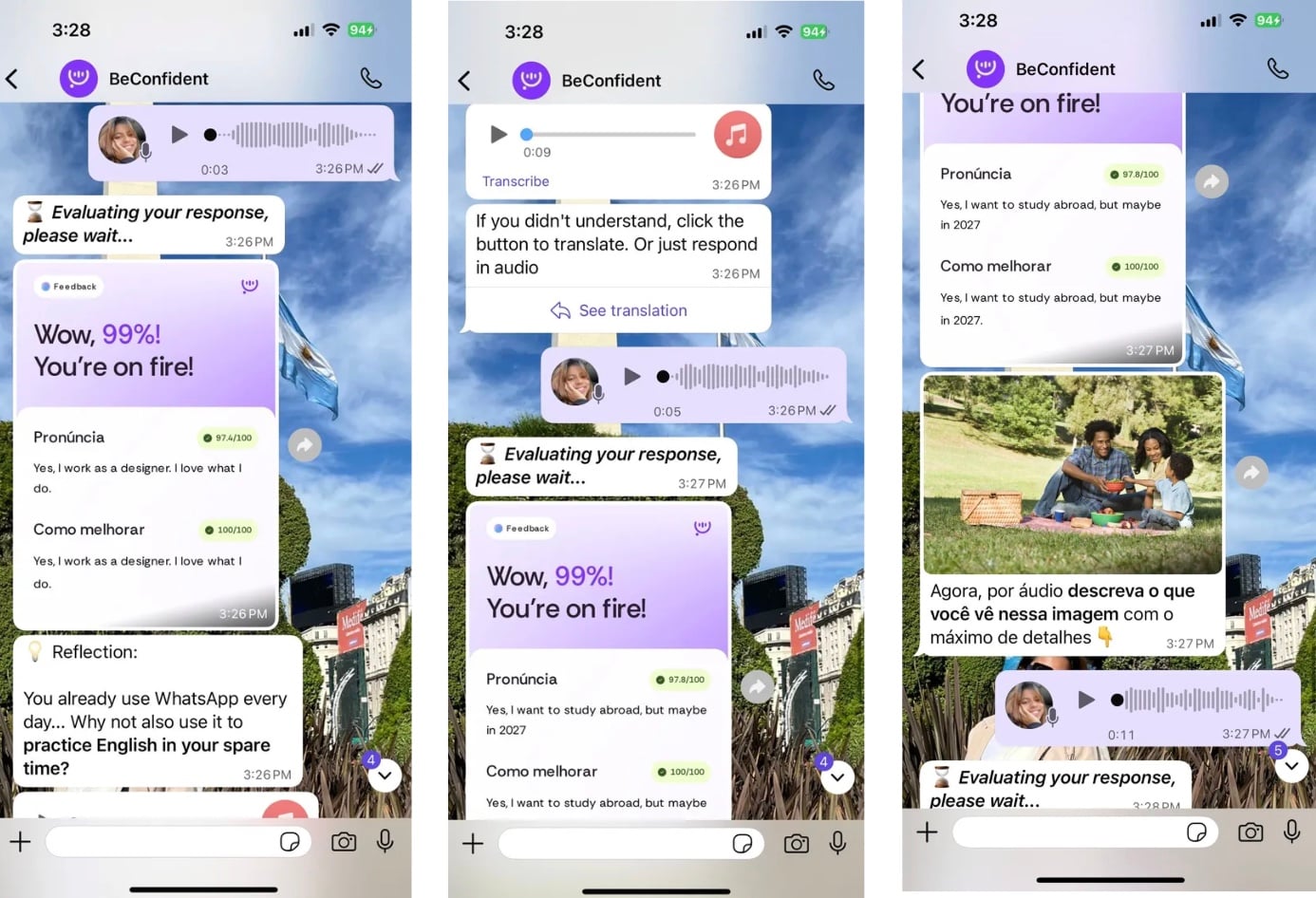
BeConfident's AI tutors simulate native personalities and accents, such as American, British, South African, Australian, and Indian. This variety exposes the student to different rhythms and pronunciations. Each tutor has specific interests, such as photography, law, or literature, allowing for conversations aligned with the user's topics of interest.
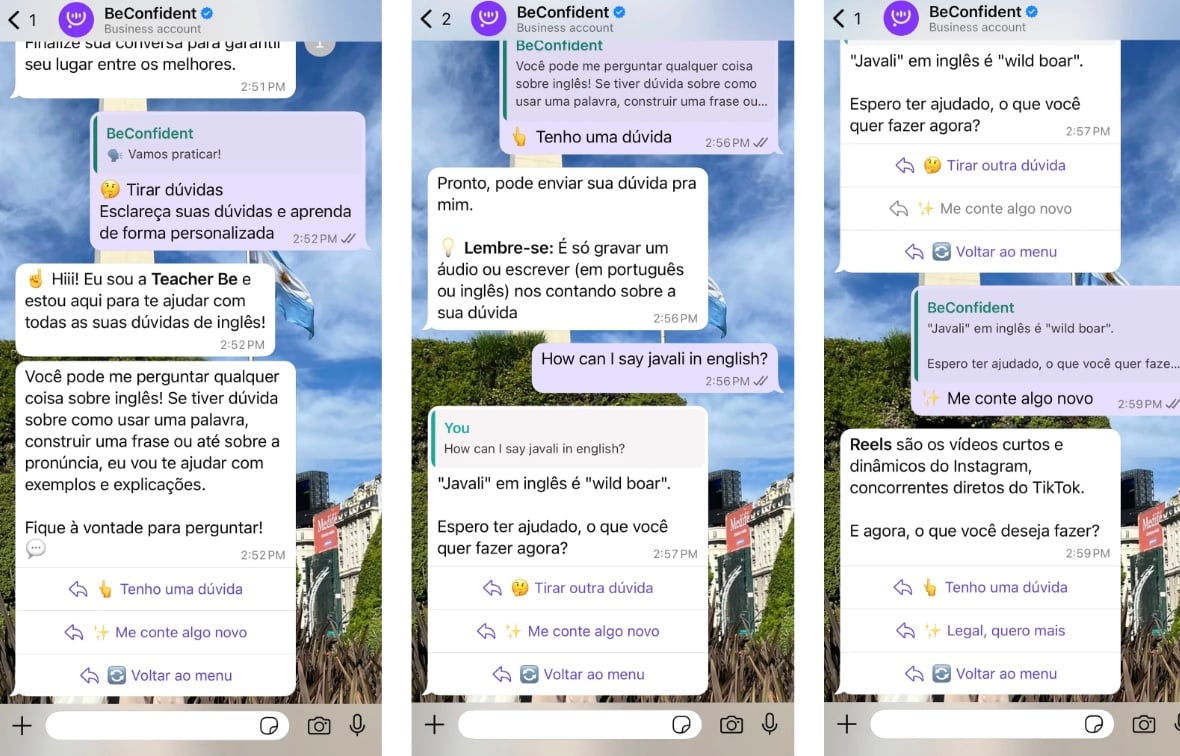
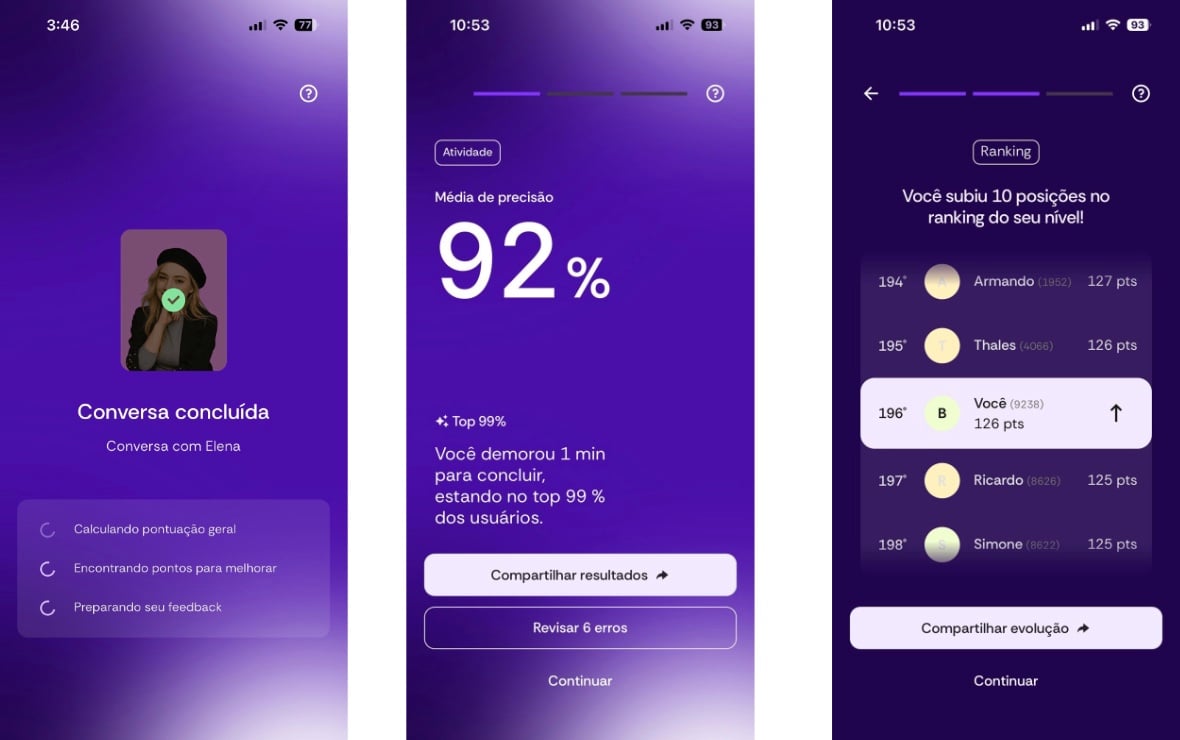
Feedback is instantaneous and covers pronunciation, grammar, and naturalness, focusing on common difficulties faced by Brazilians. The "Review Mistakes" feature organizes a personalized history of areas needing attention. "Teacher Be" answers questions at any time. Structured learning paths combine applied theory with conversation practice right after, strengthening foundational skills without losing focus on speaking.
BeConfident reduces the embarrassment and anxiety that prevent many Brazilians from practicing. Studies show that AI tutors can double learning effectiveness compared to traditional methods, especially in repetitive feedback and correcting recurring mistakes.
Try BeConfident for free and experience continuous conversation with tutors that adapt to your pace and goals.
Comparisons, testimonials, and evidence
Feature | BeConfident | Cambly | Duolingo/Open English |
Cost/Practice | Unlimited, low monthly fee | Charged by the hour, high cost | Basic gamification or scheduled classes |
Native Accents | Multiple accents with AI 24/7 | Dependent on human tutor | Limited or neutral |
Instant Feedback | Yes, with a focus on pronunciation and idioms | Depends on the tutor | Basic and rarely conversational |
Judgment-Free Environment | Yes, with AI | No | Partial |
Student testimonials reinforce these results. One student says: "The tool offers detailed feedback that I didn't get in traditional schools. It has been crucial for me to overcome my grammatical struggles, especially with prepositions." Another student comments: "When I tried to interact with foreigners at work, I didn't know what to say. Daily practice gave me the confidence to finally have conversations and secure my promotion."
FAQ: common questions about understanding native speakers
How to understand fast-spoken English?
Training the brain to recognize chunks instead of isolated words makes understanding fast speech easier. Students can use daily shadowing with native content, practice with AI at native speed, and accept partial comprehension in the beginning. BeConfident offers tutors that adjust the speed gradually.
Is it possible to speak like a native?
Reaching a near-native level is achievable with constant exposure to varied accents and pronunciation training. The main focus should be clear and natural communication, not perfect imitation. Reducing Portuguese interference, mastering linked speech, and working on prosody through frequent conversations with different accents yields consistent progress.
How much does an effective conversation course cost?
Traditional courses usually charge between R$ 300 and R$ 800 per month for just a few hours a week. Platforms like Cambly charge for plans based on class minutes, with prices varying depending on the package. BeConfident offers unlimited practice for a fraction of that cost, with 24/7 access to multiple AI tutors, immediate feedback, and a high level of personalization.
Is Cambly better than AI for speaking practice?
Each format serves different needs. Human tutors offer cultural nuances and personal interaction. AI provides objective feedback, total availability, lower cost, and a judgment-free environment. For Brazilians with anxiety or those who need a high volume of practice, AI tends to be more efficient in the initial stages of unlocking speech.
Where to practice English with native speakers for free?
BeConfident provides a free trial where students can practice speaking with AI tutors simulating native speakers. Other options include language exchange apps, online conversation groups, and free content on YouTube. However, these resources rarely offer the same level of structured feedback and personalization as an AI tailored for education.
Conclusion: how to unlock your English with native speakers
Overcoming the frustration of not understanding native speakers requires specific techniques and consistent practice. Shadowing, exposure to varied accents, and conversation with immediate feedback form the foundation for developing real comprehension in less time. BeConfident expands access to unlimited practice with AI tutors that simulate native speakers, creating a safe environment to build confidence and fluency.
Take the free trial and start understanding native English speakers today with a platform that has already helped more than 140,000 Brazilians advance in conversation.
Written by: Luan Cavallaro, Founder & CMO, BeConfident
Key takeaways from this article
Brazilians freeze up with native speakers due to phonetic differences, regional accents, and little practice with real speech, which impacts their careers and travel.
Techniques such as shadowing, authentic podcasts, series without subtitles, and a focus on idioms and phrasal verbs accelerate listening comprehension.
Systematic exposure to varied accents, such as American, British, and Australian, with guided dialogues and 20 to 30 minutes of daily practice, yields 20 to 40% gains in just a few weeks.
Avoiding cognitive overload and prioritizing consistency in short sessions, while accepting partial comprehension at the beginning, sustains progress.
BeConfident offers unlimited 24/7 practice with AI that simulates native accents and instant feedback. Try for free now and advance your conversational fluency.
The problem: why Brazilians freeze up with native speakers and what the consequences are
The difficulty Brazilians face in understanding native English speakers starts with the phonetic differences between the languages. Brazilian Portuguese uses nasal sounds and open vowels, while English uses tense vowels, complex diphthongs, and consonants like /θ/, /ð/ and the approximant /r/, which do not exist in the Brazilian's mother tongue. When native speakers talk fast and use contractions like "gonna" and "wanna", the brain needs training to process everything in real time.
Regional accents increase the difficulty. Accents like Liverpool's Scouse, London's Cockney, and West Country English from Devon shift vowels, consonants, and rhythm. Many courses in Brazil work only with what is considered standard English, leaving the student poorly prepared for the real variety of accents.
This barrier has direct consequences. Professionals miss out on promotions because they cannot participate effectively in international meetings. Travelers feel isolated on exchanges. Students give up on fluency after negative experiences with native speakers.
The solution: practical techniques to understand native speakers faster
5 proven techniques to unlock your listening
Shadowing is a direct technique to develop listening comprehension. The student repeats native speakers' audio in real time, training the brain to process groups of words instead of isolated terms. The ideal approach is to start with 10 to 15 minutes a day using content slightly below your current level.
Listening to authentic podcasts accelerates progress. Series like BBC 6 Minute English, The English We Speak, and All Ears English expose the student to idiomatic expressions and the natural rhythm of native speakers. Active listening includes pausing, repeating difficult sentences, and taking note of new expressions.
Watching movies and series without subtitles in Portuguese creates a contextual training environment. The student can start with content they already know and then move on to new genres. The main point is to accept that comprehension will not be complete at first. The focus should be on the general meaning while the brain gets used to speech patterns.
Studying idioms and phrasal verbs is essential because they make up a large part of informal communication among native speakers. Expressions like "piece of cake", "break a leg", and "hit the books" cannot be explained through literal translation. The student needs frequent exposure and directed practice.
How to practice different accents efficiently
Having regular contact with varied accents, such as American, British, Australian, South African, and Indian, develops auditory flexibility. A practical way is to use guided dialogues, set up scenarios like airport check-in, converse for 10 to 12 minutes, and then review transcripts and errors. Practicing with AI allows you to control accents and situations without embarrassment.
Common mistakes and how to avoid them
Cognitive overload is one of the main friction points. Many Brazilians try to understand every single word and end up anxious and stuck. A study with 200 Brazilians showed that 20 to 30 minutes of daily focused practice yields significant gains in 4 to 8 weeks, increasing comprehension from 40% to 75% in 12 to 16 weeks. Short, regular sessions produce more consistent results than occasional marathons.
Take a free trial and practice shadowing now with AI tutors that simulate native accents and offer immediate feedback.
BeConfident: speaking practice with AI with no time limits
BeConfident combines artificial intelligence with a focus on practical fluency. The platform serves more than 140,000 students and holds a RA 1000 reputation on Reclame Aqui. Students can practice without limits, 24 hours a day, via the app, WhatsApp, or smartwatch, without depending on fixed schedules or expensive packages.
BeConfident's AI tutors simulate native personalities and accents, such as American, British, South African, Australian, and Indian. This variety exposes the student to different rhythms and pronunciations. Each tutor has specific interests, such as photography, law, or literature, allowing for conversations aligned with the user's topics of interest.
Feedback is instantaneous and covers pronunciation, grammar, and naturalness, focusing on common difficulties faced by Brazilians. The "Review Mistakes" feature organizes a personalized history of areas needing attention. "Teacher Be" answers questions at any time. Structured learning paths combine applied theory with conversation practice right after, strengthening foundational skills without losing focus on speaking.
BeConfident reduces the embarrassment and anxiety that prevent many Brazilians from practicing. Studies show that AI tutors can double learning effectiveness compared to traditional methods, especially in repetitive feedback and correcting recurring mistakes.
Try BeConfident for free and experience continuous conversation with tutors that adapt to your pace and goals.
Comparisons, testimonials, and evidence
Feature | BeConfident | Cambly | Duolingo/Open English |
Cost/Practice | Unlimited, low monthly fee | Charged by the hour, high cost | Basic gamification or scheduled classes |
Native Accents | Multiple accents with AI 24/7 | Dependent on human tutor | Limited or neutral |
Instant Feedback | Yes, with a focus on pronunciation and idioms | Depends on the tutor | Basic and rarely conversational |
Judgment-Free Environment | Yes, with AI | No | Partial |
Student testimonials reinforce these results. One student says: "The tool offers detailed feedback that I didn't get in traditional schools. It has been crucial for me to overcome my grammatical struggles, especially with prepositions." Another student comments: "When I tried to interact with foreigners at work, I didn't know what to say. Daily practice gave me the confidence to finally have conversations and secure my promotion."
FAQ: common questions about understanding native speakers
How to understand fast-spoken English?
Training the brain to recognize chunks instead of isolated words makes understanding fast speech easier. Students can use daily shadowing with native content, practice with AI at native speed, and accept partial comprehension in the beginning. BeConfident offers tutors that adjust the speed gradually.
Is it possible to speak like a native?
Reaching a near-native level is achievable with constant exposure to varied accents and pronunciation training. The main focus should be clear and natural communication, not perfect imitation. Reducing Portuguese interference, mastering linked speech, and working on prosody through frequent conversations with different accents yields consistent progress.
How much does an effective conversation course cost?
Traditional courses usually charge between R$ 300 and R$ 800 per month for just a few hours a week. Platforms like Cambly charge for plans based on class minutes, with prices varying depending on the package. BeConfident offers unlimited practice for a fraction of that cost, with 24/7 access to multiple AI tutors, immediate feedback, and a high level of personalization.
Is Cambly better than AI for speaking practice?
Each format serves different needs. Human tutors offer cultural nuances and personal interaction. AI provides objective feedback, total availability, lower cost, and a judgment-free environment. For Brazilians with anxiety or those who need a high volume of practice, AI tends to be more efficient in the initial stages of unlocking speech.
Where to practice English with native speakers for free?
BeConfident provides a free trial where students can practice speaking with AI tutors simulating native speakers. Other options include language exchange apps, online conversation groups, and free content on YouTube. However, these resources rarely offer the same level of structured feedback and personalization as an AI tailored for education.
Conclusion: how to unlock your English with native speakers
Overcoming the frustration of not understanding native speakers requires specific techniques and consistent practice. Shadowing, exposure to varied accents, and conversation with immediate feedback form the foundation for developing real comprehension in less time. BeConfident expands access to unlimited practice with AI tutors that simulate native speakers, creating a safe environment to build confidence and fluency.
Take the free trial and start understanding native English speakers today with a platform that has already helped more than 140,000 Brazilians advance in conversation.