




English fluency for travel: complete guide for 2026
English fluency for travel: complete guide for 2026
English fluency for travel: complete guide for 2026
Written by: Luan Cavallaro, Founder & CMO, BeConfident
Key takeaways from this article
Many Brazilians avoid speaking English out of embarrassment during trips, which leads to dependency on Google Translate and a feeling of isolation. Practicing without fear changes this scenario.
Lists of essential phrases cover real-life situations like the airport, hotel, restaurant, and emergencies, but they do not work without conversational practice tailored to native speaker responses.
AI tutors with native accents, such as American and British, outperform apps like Duolingo and traditional schools by offering unlimited practice 24 hours a day with immediate feedback.
Consistency with 10 minutes daily per specific scenario, combined with slang and intonation, transforms memorization into natural fluency for understanding native speakers.
BeConfident, with 200,000 students and an RA 1000 reputation, changes the way people learn English. Take the free test and gain confidence to travel with greater independence.
The importance of conversational fluency for travel
Conversational fluency prepares you for real-world responses, not just repeating memorized sentences. Memorizing "Where is the bathroom?" is of no use when the attendant replies with slang or a strong accent.
Traditional methods like Kumon and Yázigi prioritize repetition, while gamified apps like Duolingo focus on exercises that contribute very little to spontaneous conversations.
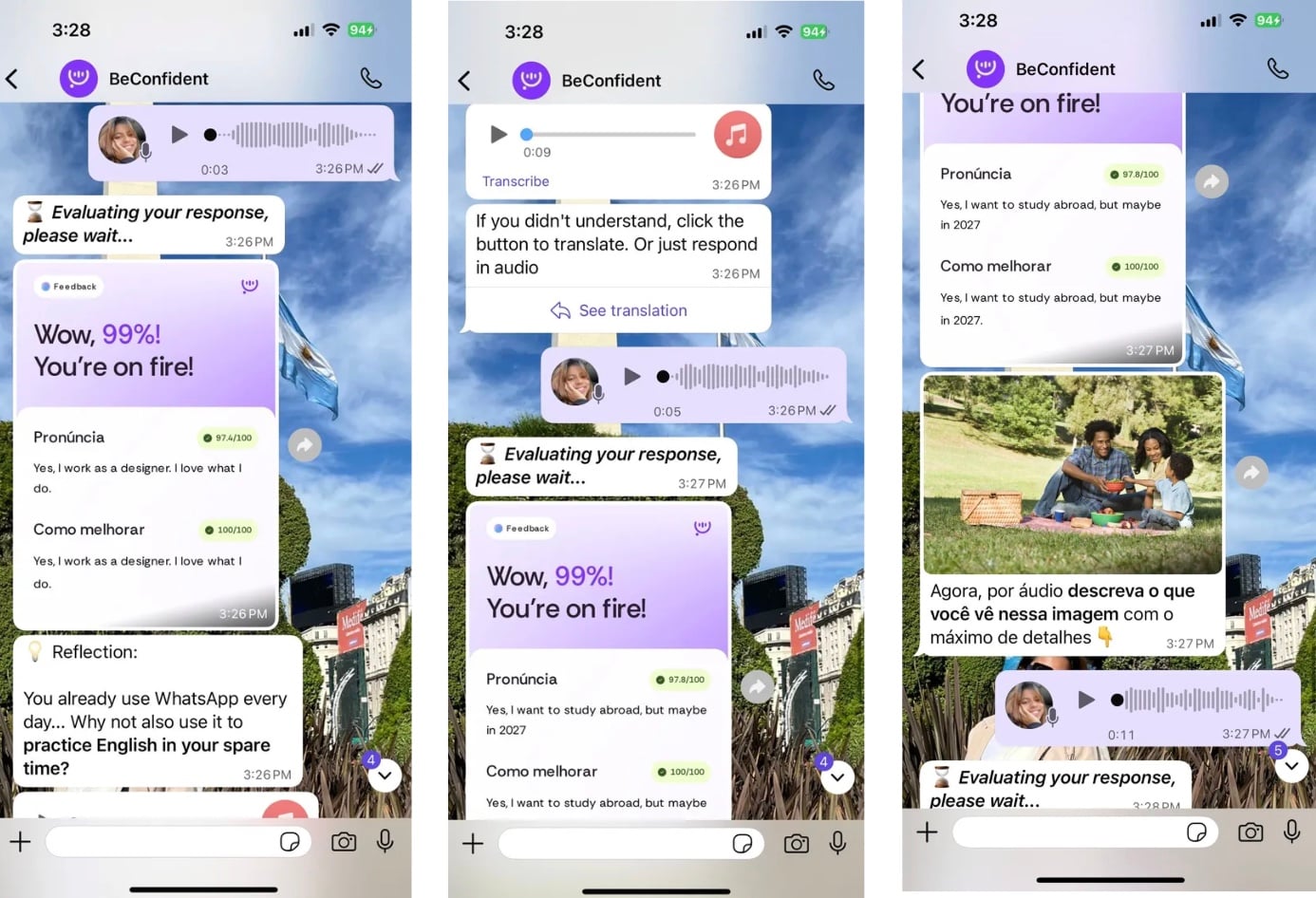
Artificial intelligence allows for conversations that are closer to reality. BeConfident adds AI tutors with distinct personalities and native American, British, Australian, Canadian, South African, and Indian accents—something traditional apps and in-person schools cannot replicate at the same scale.
While Cambly charges by the hour and quality depends on the human tutor, BeConfident offers unlimited practice with immediate, personalized feedback. Every free moment becomes an opportunity to practice real conversations.
✈️ Phrases for airport and immigration
English | Translation to Portuguese | Phonetics | Context |
Where is the check-in counter? | Onde fica o balcão de check-in? | /wer iz ðə tʃek-in kaʊntər/ | Airport arrival |
I have a connecting flight | Tenho um voo de conexão | /aɪ hæv ə kəˈnektɪŋ flaɪt/ | Connections |
My flight is delayed | Meu voo está atrasado | /maɪ flaɪt iz dɪˈleɪd/ | Delays |
Where is gate B12? | Onde fica o portão B12? | /wer iz geɪt bi twɛlv/ | Location |
I'm here for tourism | Estou aqui a turismo | /aɪm hir fər ˈtʊrɪzəm/ | Immigration |
How long is the layover? | Quanto tempo é a escala? | /haʊ lɔŋ iz ðə ˈleɪoʊvər/ | Connections |
I need to declare this | Preciso declarar isso | /aɪ nid tu dɪˈkler ðɪs/ | Customs |
Where can I get a taxi? | Onde posso pegar um táxi? | /wer kæn aɪ get ə ˈtæksi/ | Transportation |
My luggage is missing | Minha bagagem está perdida | /maɪ ˈlʌgɪdʒ iz ˈmɪsɪŋ/ | Luggage |
Is this the boarding area? | Esta é a área de embarque? | /iz ðɪs ðə ˈbɔrdɪŋ ˈeriə/ | Boarding |
A common dialogue is: “Excuse me, where is the check-in counter for American Airlines?” “It's on the second floor, follow the signs.”
Practicing these scenarios with BeConfident simulates real check-ins and provides corrections for pronunciation and natural delivery.
Take the free test and start learning English today, simulating airport conversations with native AI tutors.
🏨 English at the hotel and transportation
English | Translation to Portuguese | Phonetics | Context |
I have a reservation | Tenho uma reserva | /aɪ hæv ə ˌrezərˈveɪʃən/ | Hotel check-in |
What time is checkout? | Que horas é o checkout? | /wʌt taɪm iz ˈtʃekaʊt/ | Hotel information |
Can I have a wake-up call? | Posso ter um despertador? | /kæn aɪ hæv ə weɪk ʌp kɔl/ | Hotel services |
Where is the nearest subway? | Onde fica o metrô mais próximo? | /wer iz ðə ˈnɪrəst ˈsʌbweɪ/ | Public transportation |
How much is a taxi to downtown? | Quanto custa um táxi para o centro? | /haʊ mʌtʃ iz ə ˈtæksi tu ˈdaʊntaʊn/ | Taxi |
Is breakfast included? | O café da manhã está incluído? | /iz ˈbrekfəst ɪnˈkludəd/ | Hotel services |
Can you call me a cab? | Pode chamar um táxi para mim? | /kæn ju kɔl mi ə kæb/ | Request |
What's the WiFi password? | Qual é a senha do WiFi? | /wʌts ðə ˈwaɪfaɪ ˈpæswərd/ | Internet |
I'd like to extend my stay | Gostaria de estender minha estadia | /aɪd laɪk tu ɪkˈstend maɪ steɪ/ | Reservation change |
Where can I park my car? | Onde posso estacionar meu carro? | /wer kæn aɪ pɑrk maɪ kɑr/ | Parking |
A typical dialogue is: “Good evening, I have a reservation under Silva.” “Welcome! Here's your key card. Breakfast is served from 7 to 10 AM.” BeConfident simulates these interactions and prepares you to respond when unscripted questions arise.
🍽️ Conversation in restaurants and shopping
English | Translation to Portuguese | Phonetics | Context |
A table for two, please | Uma mesa para dois, por favor | /ə ˈteɪbəl fər tu pliːz/ | Reservation |
What do you recommend? | O que você recomenda? | /wʌt du ju ˌrekəˈmend/ | Ordering |
I'm allergic to nuts | Sou alérgico a nozes | /aɪm əˈlɜrdʒɪk tu nʌts/ | Dietary restrictions |
Can I have the check, please? | Posso ter a conta, por favor? | /kæn aɪ hæv ðə tʃek pliːz/ | Payment |
How much does this cost? | Quanto custa isso? | /haʊ mʌtʃ dʌz ðɪs kɔst/ | Shopping |
Do you accept credit cards? | Vocês aceitam cartão de crédito? | /du ju ækˈsept ˈkredɪt kɑrdz/ | Payment |
I'd like to try this on | Gostaria de experimentar isso | /aɪd laɪk tu traɪ ðɪs ɔn/ | Clothing |
Is there a discount? | Há algum desconto? | /iz ðer ə ˈdɪskaʊnt/ | Negotiation |
Can I get a receipt? | Posso ter um recibo? | /kæn aɪ get ə rɪˈsit/ | Receipt |
Where is the fitting room? | Onde fica o provador? | /wer iz ðə ˈfɪtɪŋ rum/ | Store |
BeConfident complements this content with guided practice and immediate feedback on pronunciation and flow.
🚨 Emergencies and Health
English | Translation to Portuguese | Phonetics | Context |
I need a doctor | Preciso de um médico | /aɪ nid ə ˈdɑktər/ | Medical urgency |
Call an ambulance | Chame uma ambulância | /kɔl æn ˈæmbjələns/ | Emergency |
Where is the hospital? | Onde fica o hospital? | /wer iz ðə ˈhɑspɪtəl/ | Location |
I have chest pain | Estou com dor no peito | /aɪ hæv tʃest peɪn/ | Symptoms |
I lost my passport | Perdi meu passaporte | /aɪ lɔst maɪ ˈpæspɔrt/ | Documents |
Can you help me? | Pode me ajudar? | /kæn ju help mi/ | Call for help |
I need the police | Preciso da polícia | /aɪ nid ðə pəˈlis/ | Security |
My phone was stolen | Meu telefone foi roubado | /maɪ foʊn wʌz ˈstoʊlən/ | Theft |
In emergencies, quick answers save time and reduce risks. Practicing these phrases until they become automatic helps you act without freezing up. BeConfident's emergency simulations prepare you for these critical moments.
🗣️ Everyday expressions and slang
English | Translation to Portuguese | Phonetics | Context |
Grab a bite | Pegar algo pra comer | /ɡræb ə baɪt/ | Casual |
What's up? | E aí? Como vai? | /wʌts ʌp/ | Informal greeting |
I'm broke | Estou sem dinheiro | /aɪm broʊk/ | Financial situation |
That's awesome! | Isso é incrível! | /ðæts ˈɔsəm/ | Enthusiasm |
No worries | Sem problemas | /noʊ ˈwɜriz/ | Reassurance |
I'm beat | Estou exausto | /aɪm bit/ | Fatigue |
Let's hang out | Vamos sair juntos | /lets hæŋ aʊt/ | Social invitation |
That's a steal | Isso é uma pechincha | /ðæts ə stil/ | Good price |
I'm all ears | Sou todo ouvidos | /aɪm ɔl ɪrz/ | Attention |
Piece of cake | Moleza, fácil | /pis ʌv keɪk/ | Ease |
Slang makes conversations more natural and helps you understand invitation and everyday remarks. When someone says “Let's grab a bite,” they are inviting you to get some quick food. BeConfident presents these expressions in real dialogues so that you can associate meaning, context, and intonation.
How to practice these phrases to speak without fear
Active practice transforms memorized sentences into natural conversations. Following a simple routine already generates consistent progress.
1. Take the free CEFR test: discover your current level and identify strengths and weaknesses. BeConfident applies international standards to guide your study plan.
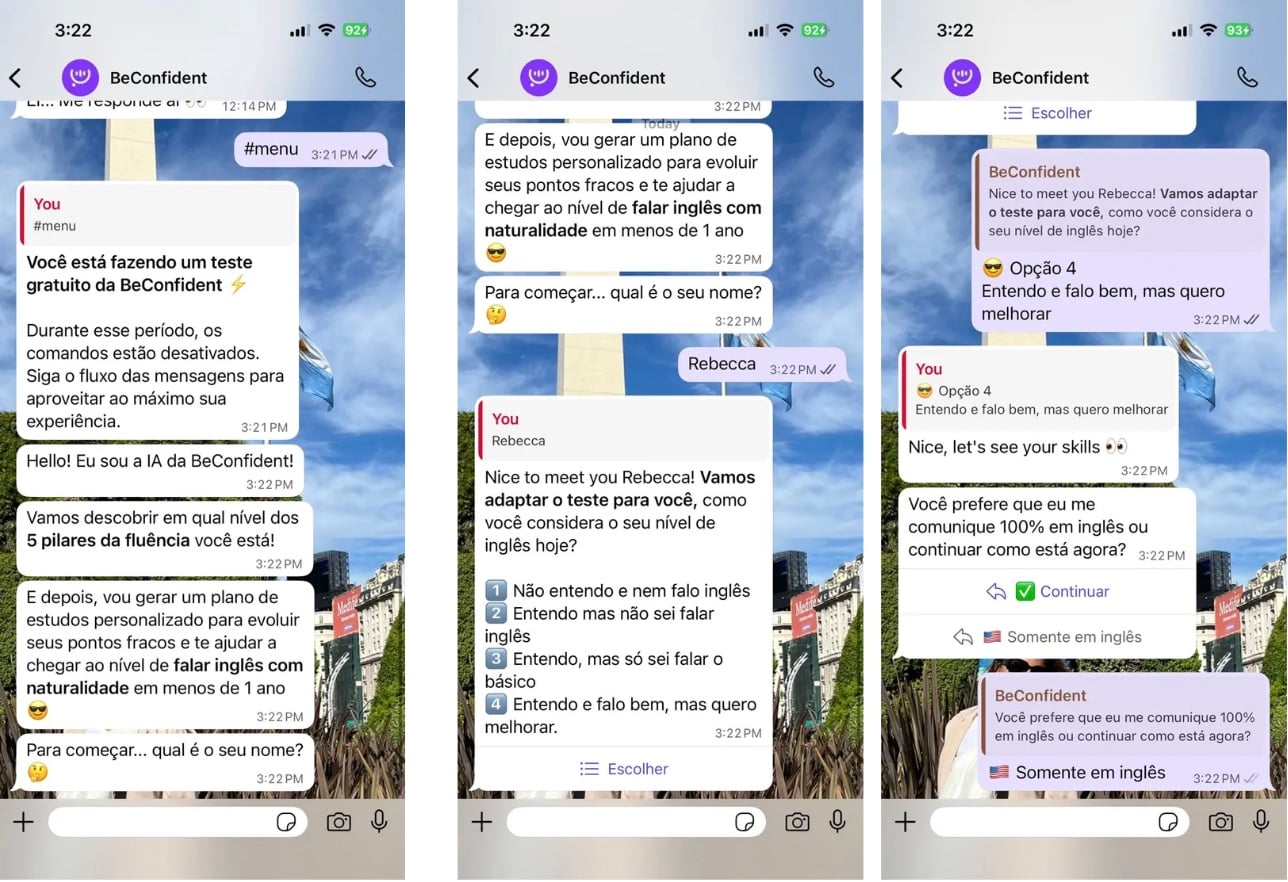
2. Choose AI tutors with specific accents: practice with American, British, Australian, Canadian, South African, and Indian accents according to your trip's destination.
3. Dedicate 10 minutes daily to specific scenarios: use one day for the airport, another for the hotel, and another for the restaurant. Daily consistency yields more results than long, sporadic sessions.
4. Use structured pathways: combine clear explanations with immediate practice. Learn a rule and apply it in a guided conversation right away.
5. Explore "Tell me something new": expand your vocabulary with cultural and language topics, practicing English on a variety of subjects.
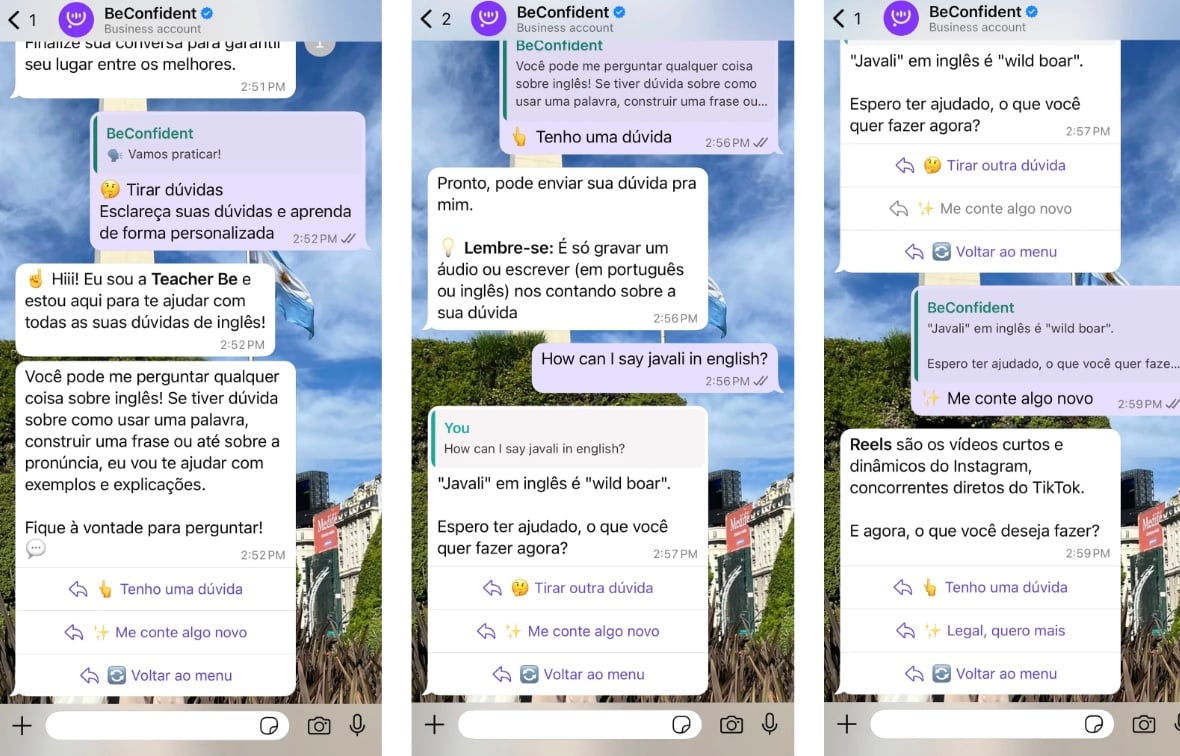
The main difference with BeConfident lies in personalized feedback in a judgment-free environment. While traditional schools are usually expensive and rigid, and Duolingo prioritizes gamification without focusing on conversation, BeConfident offers unlimited practice with advanced AI. The base of over 200,000 paying students and the RA 1000 reputation on Reclame Aqui indicate consistent results.
Take the free test and start learning English today, transforming passive knowledge into confident speaking.
Tips for understanding native speakers while traveling
Understanding native speakers requires exposure to accents, slang, and intonation. A few strategies can accelerate this process.
1. Practice with multiple accents: BeConfident's tutors present pronunciation variations that bring you closer to real-life situations.
2. Learn slang in context: expressions like “That's lit” mean “that is awesome” and have nothing to do with fire. Context helps secure the correct meaning.
3. Use simulated “phone calls”: practice telephone conversations where you can pause, ask for repetition, and request translation when necessary.
4. Focus on intonation: questions tend to rise at the end, statements tend to fall. The AI adjusts your intonation in real-time.
5. Practice active listening: podcasts bring natural travel conversations and complement your practice with BeConfident.
Test your travel fluency
Quick simulations help you measure your readiness for common travel situations.
1. Simulate immigration: answering naturally to questions like “What's the purpose of your visit?” indicates confidence in a formal context.
2. Negotiate prices: understanding and responding to phrases like “Is there a discount for cash?” shows mastery of shopping vocabulary.
3. Describe medical symptoms: phrases like “I have a headache and feel nauseous” require clarity to avoid misunderstandings during consultations.
4. Ask for complex directions: questions like “How do I get to Times Square from here?” test your ability to understand detailed instructions.
5. Converse casually: maintaining a dialogue starting with “What do you recommend for someone visiting for the first time?” shows fluency in social interactions.
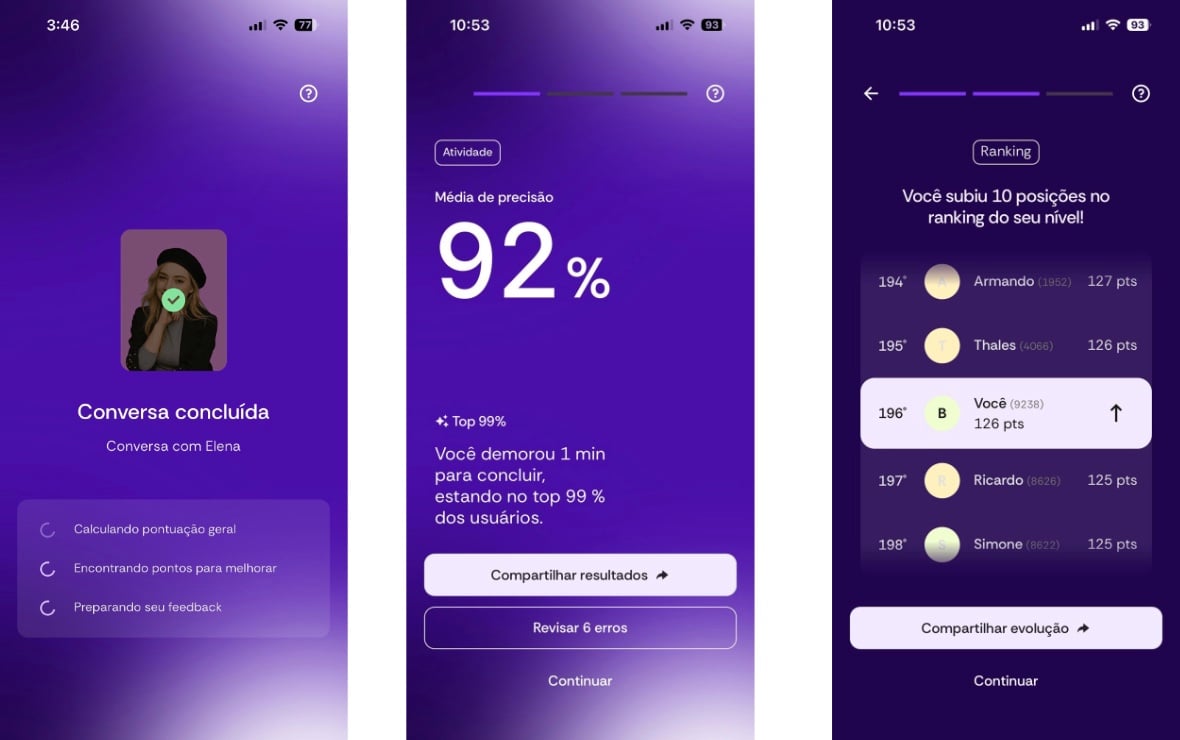
BeConfident’s “My Progress Menu” tracks your streak days, ranking position, and hours of practice. Certificates log your advancement and help track your journey.
FAQ: frequently asked questions
What are the essential airport phrases in English?
The most useful phrases include “Where is the check-in counter?”, “My flight is delayed”, “I have a connecting flight”, “Where is gate B12?”, and “My luggage is missing”. These phrases cover arrival, connection, delays, gate location, and luggage issues. Frequent practice reduces the chance of freezing up in stressful situations.
How to speak fluent English for travel quickly?
Travel fluency depends on constant conversational practice. Combine studying essential phrases with daily conversations using AI tutors that simulate real situations. Use 10-minute blocks focused on specific topics, such as the airport, hotel, and restaurant. Consistency and immediate feedback on pronunciation and naturalness accelerate progress.
What is the difference between American and British accents for travelers?
American and British accents present differences in pronunciation, vocabulary, and expressions. Americans use “elevator” and the British use “lift”. The sound of the “r” is stronger in American English. For travelers, the key is to have contact with various accents, since each region brings its own variations. AI tutors with different accents help with this adaptation.
How to overcome the embarrassment of speaking English while traveling?
Embarrassment usually comes from the fear of making mistakes and being judged. Practicing in a safe environment before traveling reduces this block. AI tutors correct you without social exposure, which allows you to make mistakes, adjust, and try again. Starting with simple sentences, gradually increasing complexity, and remembering that native speakers value communication efforts helps build confidence.
Conclusion
Mastering English for travel requires more than memorizing lists of phrases. The 50+ expressions in this guide cover essential situations, but the real benefit comes from practicing conversations with real-time correction.
BeConfident combines practical phrases with artificial intelligence tutors available 24 hours a day, offering unlimited conversational practice, multiple native accents, and a judgment-free environment. The base of 200,000 paying students and the RA 1000 reputation on Reclame Aqui indicate that many students have already achieved conversational confidence in just a few months.
Fear of speaking English doesn't have to limit your travel experiences. You can swap anxiety for security, reduce reliance on Google Translate, and make real connections with people from other countries.
Take the free test and start learning English today. Your next international trip can be smoother and more independent with the conversational fluency you are looking for.
Written by: Luan Cavallaro, Founder & CMO, BeConfident
Key takeaways from this article
Many Brazilians avoid speaking English out of embarrassment during trips, which leads to dependency on Google Translate and a feeling of isolation. Practicing without fear changes this scenario.
Lists of essential phrases cover real-life situations like the airport, hotel, restaurant, and emergencies, but they do not work without conversational practice tailored to native speaker responses.
AI tutors with native accents, such as American and British, outperform apps like Duolingo and traditional schools by offering unlimited practice 24 hours a day with immediate feedback.
Consistency with 10 minutes daily per specific scenario, combined with slang and intonation, transforms memorization into natural fluency for understanding native speakers.
BeConfident, with 200,000 students and an RA 1000 reputation, changes the way people learn English. Take the free test and gain confidence to travel with greater independence.
The importance of conversational fluency for travel
Conversational fluency prepares you for real-world responses, not just repeating memorized sentences. Memorizing "Where is the bathroom?" is of no use when the attendant replies with slang or a strong accent.
Traditional methods like Kumon and Yázigi prioritize repetition, while gamified apps like Duolingo focus on exercises that contribute very little to spontaneous conversations.
Artificial intelligence allows for conversations that are closer to reality. BeConfident adds AI tutors with distinct personalities and native American, British, Australian, Canadian, South African, and Indian accents—something traditional apps and in-person schools cannot replicate at the same scale.
While Cambly charges by the hour and quality depends on the human tutor, BeConfident offers unlimited practice with immediate, personalized feedback. Every free moment becomes an opportunity to practice real conversations.
✈️ Phrases for airport and immigration
English | Translation to Portuguese | Phonetics | Context |
Where is the check-in counter? | Onde fica o balcão de check-in? | /wer iz ðə tʃek-in kaʊntər/ | Airport arrival |
I have a connecting flight | Tenho um voo de conexão | /aɪ hæv ə kəˈnektɪŋ flaɪt/ | Connections |
My flight is delayed | Meu voo está atrasado | /maɪ flaɪt iz dɪˈleɪd/ | Delays |
Where is gate B12? | Onde fica o portão B12? | /wer iz geɪt bi twɛlv/ | Location |
I'm here for tourism | Estou aqui a turismo | /aɪm hir fər ˈtʊrɪzəm/ | Immigration |
How long is the layover? | Quanto tempo é a escala? | /haʊ lɔŋ iz ðə ˈleɪoʊvər/ | Connections |
I need to declare this | Preciso declarar isso | /aɪ nid tu dɪˈkler ðɪs/ | Customs |
Where can I get a taxi? | Onde posso pegar um táxi? | /wer kæn aɪ get ə ˈtæksi/ | Transportation |
My luggage is missing | Minha bagagem está perdida | /maɪ ˈlʌgɪdʒ iz ˈmɪsɪŋ/ | Luggage |
Is this the boarding area? | Esta é a área de embarque? | /iz ðɪs ðə ˈbɔrdɪŋ ˈeriə/ | Boarding |
A common dialogue is: “Excuse me, where is the check-in counter for American Airlines?” “It's on the second floor, follow the signs.”
Practicing these scenarios with BeConfident simulates real check-ins and provides corrections for pronunciation and natural delivery.
Take the free test and start learning English today, simulating airport conversations with native AI tutors.
🏨 English at the hotel and transportation
English | Translation to Portuguese | Phonetics | Context |
I have a reservation | Tenho uma reserva | /aɪ hæv ə ˌrezərˈveɪʃən/ | Hotel check-in |
What time is checkout? | Que horas é o checkout? | /wʌt taɪm iz ˈtʃekaʊt/ | Hotel information |
Can I have a wake-up call? | Posso ter um despertador? | /kæn aɪ hæv ə weɪk ʌp kɔl/ | Hotel services |
Where is the nearest subway? | Onde fica o metrô mais próximo? | /wer iz ðə ˈnɪrəst ˈsʌbweɪ/ | Public transportation |
How much is a taxi to downtown? | Quanto custa um táxi para o centro? | /haʊ mʌtʃ iz ə ˈtæksi tu ˈdaʊntaʊn/ | Taxi |
Is breakfast included? | O café da manhã está incluído? | /iz ˈbrekfəst ɪnˈkludəd/ | Hotel services |
Can you call me a cab? | Pode chamar um táxi para mim? | /kæn ju kɔl mi ə kæb/ | Request |
What's the WiFi password? | Qual é a senha do WiFi? | /wʌts ðə ˈwaɪfaɪ ˈpæswərd/ | Internet |
I'd like to extend my stay | Gostaria de estender minha estadia | /aɪd laɪk tu ɪkˈstend maɪ steɪ/ | Reservation change |
Where can I park my car? | Onde posso estacionar meu carro? | /wer kæn aɪ pɑrk maɪ kɑr/ | Parking |
A typical dialogue is: “Good evening, I have a reservation under Silva.” “Welcome! Here's your key card. Breakfast is served from 7 to 10 AM.” BeConfident simulates these interactions and prepares you to respond when unscripted questions arise.
🍽️ Conversation in restaurants and shopping
English | Translation to Portuguese | Phonetics | Context |
A table for two, please | Uma mesa para dois, por favor | /ə ˈteɪbəl fər tu pliːz/ | Reservation |
What do you recommend? | O que você recomenda? | /wʌt du ju ˌrekəˈmend/ | Ordering |
I'm allergic to nuts | Sou alérgico a nozes | /aɪm əˈlɜrdʒɪk tu nʌts/ | Dietary restrictions |
Can I have the check, please? | Posso ter a conta, por favor? | /kæn aɪ hæv ðə tʃek pliːz/ | Payment |
How much does this cost? | Quanto custa isso? | /haʊ mʌtʃ dʌz ðɪs kɔst/ | Shopping |
Do you accept credit cards? | Vocês aceitam cartão de crédito? | /du ju ækˈsept ˈkredɪt kɑrdz/ | Payment |
I'd like to try this on | Gostaria de experimentar isso | /aɪd laɪk tu traɪ ðɪs ɔn/ | Clothing |
Is there a discount? | Há algum desconto? | /iz ðer ə ˈdɪskaʊnt/ | Negotiation |
Can I get a receipt? | Posso ter um recibo? | /kæn aɪ get ə rɪˈsit/ | Receipt |
Where is the fitting room? | Onde fica o provador? | /wer iz ðə ˈfɪtɪŋ rum/ | Store |
BeConfident complements this content with guided practice and immediate feedback on pronunciation and flow.
🚨 Emergencies and Health
English | Translation to Portuguese | Phonetics | Context |
I need a doctor | Preciso de um médico | /aɪ nid ə ˈdɑktər/ | Medical urgency |
Call an ambulance | Chame uma ambulância | /kɔl æn ˈæmbjələns/ | Emergency |
Where is the hospital? | Onde fica o hospital? | /wer iz ðə ˈhɑspɪtəl/ | Location |
I have chest pain | Estou com dor no peito | /aɪ hæv tʃest peɪn/ | Symptoms |
I lost my passport | Perdi meu passaporte | /aɪ lɔst maɪ ˈpæspɔrt/ | Documents |
Can you help me? | Pode me ajudar? | /kæn ju help mi/ | Call for help |
I need the police | Preciso da polícia | /aɪ nid ðə pəˈlis/ | Security |
My phone was stolen | Meu telefone foi roubado | /maɪ foʊn wʌz ˈstoʊlən/ | Theft |
In emergencies, quick answers save time and reduce risks. Practicing these phrases until they become automatic helps you act without freezing up. BeConfident's emergency simulations prepare you for these critical moments.
🗣️ Everyday expressions and slang
English | Translation to Portuguese | Phonetics | Context |
Grab a bite | Pegar algo pra comer | /ɡræb ə baɪt/ | Casual |
What's up? | E aí? Como vai? | /wʌts ʌp/ | Informal greeting |
I'm broke | Estou sem dinheiro | /aɪm broʊk/ | Financial situation |
That's awesome! | Isso é incrível! | /ðæts ˈɔsəm/ | Enthusiasm |
No worries | Sem problemas | /noʊ ˈwɜriz/ | Reassurance |
I'm beat | Estou exausto | /aɪm bit/ | Fatigue |
Let's hang out | Vamos sair juntos | /lets hæŋ aʊt/ | Social invitation |
That's a steal | Isso é uma pechincha | /ðæts ə stil/ | Good price |
I'm all ears | Sou todo ouvidos | /aɪm ɔl ɪrz/ | Attention |
Piece of cake | Moleza, fácil | /pis ʌv keɪk/ | Ease |
Slang makes conversations more natural and helps you understand invitation and everyday remarks. When someone says “Let's grab a bite,” they are inviting you to get some quick food. BeConfident presents these expressions in real dialogues so that you can associate meaning, context, and intonation.
How to practice these phrases to speak without fear
Active practice transforms memorized sentences into natural conversations. Following a simple routine already generates consistent progress.
1. Take the free CEFR test: discover your current level and identify strengths and weaknesses. BeConfident applies international standards to guide your study plan.
2. Choose AI tutors with specific accents: practice with American, British, Australian, Canadian, South African, and Indian accents according to your trip's destination.
3. Dedicate 10 minutes daily to specific scenarios: use one day for the airport, another for the hotel, and another for the restaurant. Daily consistency yields more results than long, sporadic sessions.
4. Use structured pathways: combine clear explanations with immediate practice. Learn a rule and apply it in a guided conversation right away.
5. Explore "Tell me something new": expand your vocabulary with cultural and language topics, practicing English on a variety of subjects.
The main difference with BeConfident lies in personalized feedback in a judgment-free environment. While traditional schools are usually expensive and rigid, and Duolingo prioritizes gamification without focusing on conversation, BeConfident offers unlimited practice with advanced AI. The base of over 200,000 paying students and the RA 1000 reputation on Reclame Aqui indicate consistent results.
Take the free test and start learning English today, transforming passive knowledge into confident speaking.
Tips for understanding native speakers while traveling
Understanding native speakers requires exposure to accents, slang, and intonation. A few strategies can accelerate this process.
1. Practice with multiple accents: BeConfident's tutors present pronunciation variations that bring you closer to real-life situations.
2. Learn slang in context: expressions like “That's lit” mean “that is awesome” and have nothing to do with fire. Context helps secure the correct meaning.
3. Use simulated “phone calls”: practice telephone conversations where you can pause, ask for repetition, and request translation when necessary.
4. Focus on intonation: questions tend to rise at the end, statements tend to fall. The AI adjusts your intonation in real-time.
5. Practice active listening: podcasts bring natural travel conversations and complement your practice with BeConfident.
Test your travel fluency
Quick simulations help you measure your readiness for common travel situations.
1. Simulate immigration: answering naturally to questions like “What's the purpose of your visit?” indicates confidence in a formal context.
2. Negotiate prices: understanding and responding to phrases like “Is there a discount for cash?” shows mastery of shopping vocabulary.
3. Describe medical symptoms: phrases like “I have a headache and feel nauseous” require clarity to avoid misunderstandings during consultations.
4. Ask for complex directions: questions like “How do I get to Times Square from here?” test your ability to understand detailed instructions.
5. Converse casually: maintaining a dialogue starting with “What do you recommend for someone visiting for the first time?” shows fluency in social interactions.
BeConfident’s “My Progress Menu” tracks your streak days, ranking position, and hours of practice. Certificates log your advancement and help track your journey.
FAQ: frequently asked questions
What are the essential airport phrases in English?
The most useful phrases include “Where is the check-in counter?”, “My flight is delayed”, “I have a connecting flight”, “Where is gate B12?”, and “My luggage is missing”. These phrases cover arrival, connection, delays, gate location, and luggage issues. Frequent practice reduces the chance of freezing up in stressful situations.
How to speak fluent English for travel quickly?
Travel fluency depends on constant conversational practice. Combine studying essential phrases with daily conversations using AI tutors that simulate real situations. Use 10-minute blocks focused on specific topics, such as the airport, hotel, and restaurant. Consistency and immediate feedback on pronunciation and naturalness accelerate progress.
What is the difference between American and British accents for travelers?
American and British accents present differences in pronunciation, vocabulary, and expressions. Americans use “elevator” and the British use “lift”. The sound of the “r” is stronger in American English. For travelers, the key is to have contact with various accents, since each region brings its own variations. AI tutors with different accents help with this adaptation.
How to overcome the embarrassment of speaking English while traveling?
Embarrassment usually comes from the fear of making mistakes and being judged. Practicing in a safe environment before traveling reduces this block. AI tutors correct you without social exposure, which allows you to make mistakes, adjust, and try again. Starting with simple sentences, gradually increasing complexity, and remembering that native speakers value communication efforts helps build confidence.
Conclusion
Mastering English for travel requires more than memorizing lists of phrases. The 50+ expressions in this guide cover essential situations, but the real benefit comes from practicing conversations with real-time correction.
BeConfident combines practical phrases with artificial intelligence tutors available 24 hours a day, offering unlimited conversational practice, multiple native accents, and a judgment-free environment. The base of 200,000 paying students and the RA 1000 reputation on Reclame Aqui indicate that many students have already achieved conversational confidence in just a few months.
Fear of speaking English doesn't have to limit your travel experiences. You can swap anxiety for security, reduce reliance on Google Translate, and make real connections with people from other countries.
Take the free test and start learning English today. Your next international trip can be smoother and more independent with the conversational fluency you are looking for.