




English grammar from scratch: a complete guide for beginners
English grammar from scratch: a complete guide for beginners
English grammar from scratch: a complete guide for beginners
Written by: Luan Cavallaro, Founder & CMO, BeConfident
Key takeaways from this article
English grammar follows a strict Subject-Verb-Object (SVO) order, unlike the flexibility of Portuguese, which allows for the creation of simple sentences like "I eat pizza".
The verb "to be" is essential: I am, you are, he/she/it is, we/they are, with negative and interrogative forms for basic communication.
Adjectives come before nouns, as in "red house", and basic parts of speech help build more complex sentences in the SVO structure.
Mastering 10 fundamental rules, such as adding -s in the 3rd person singular, using a/an correctly, and forming negatives with "don't", accelerates learning.
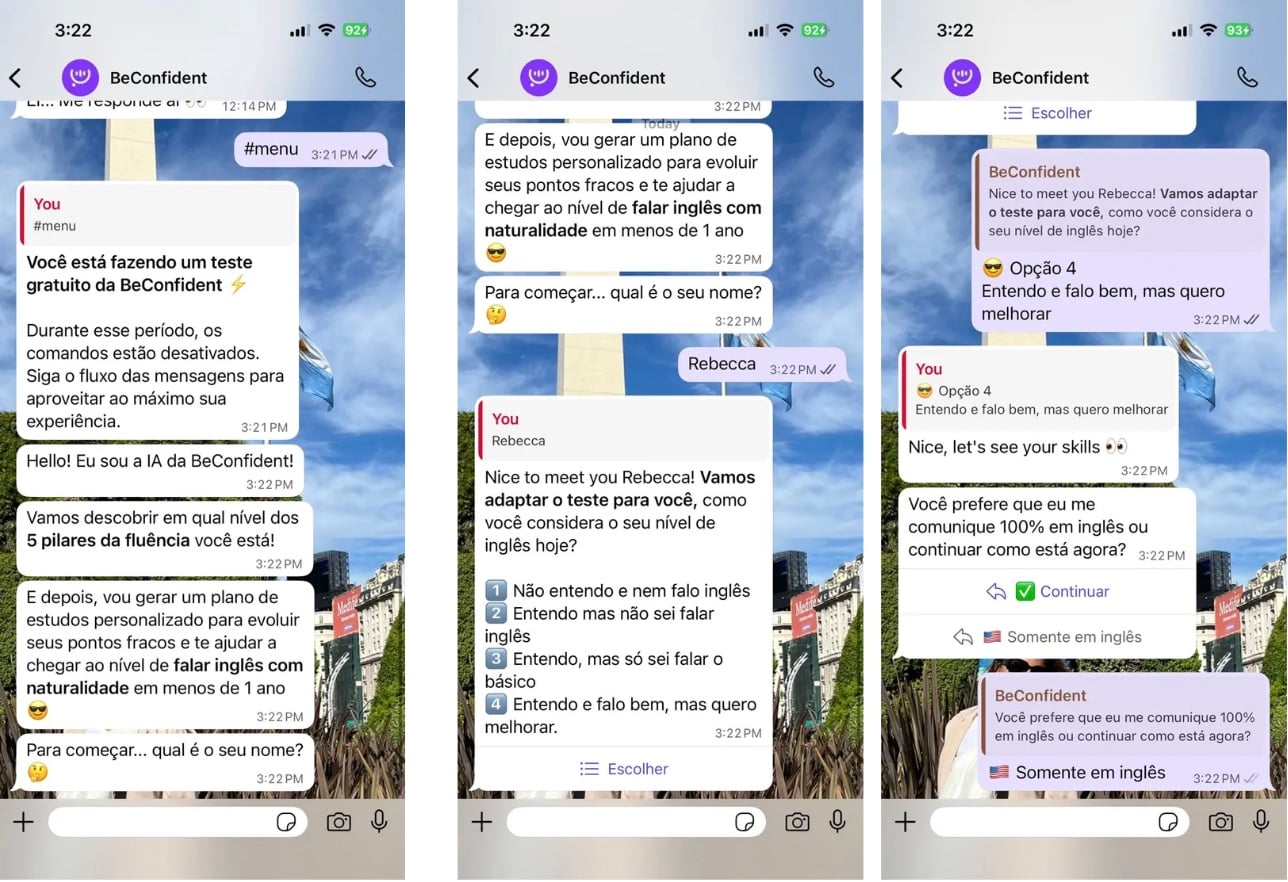
Combining grammar with immediate conversational practice on BeConfident allows you to test for free and practice with 24/7 AI tutors to speak more confidently.
Lesson 1️⃣: Correct order to study English grammar
Learning English grammar from scratch becomes simpler when you follow a clear sequence.
Use this order:
1. Basic sentence structure, with Subject-Verb-Object
2. Verb "to be" in all forms
3. Basic parts of speech, such as nouns, verbs, and adjectives
4. Formation of negatives and questions
5. Essential vocabulary and 10 fundamental rules
This order reduces the feeling of being overwhelmed, because each step prepares for the next. English has a strict Subject-Verb-Object (SVO) order, while Portuguese has greater flexibility due to verb conjugation.
Portuguese | English | Main difference |
Falo inglês (omitted subject) | I speak English | Compulsory subject |
Inglês falo bem | I speak English well | Fixed SVO order |
Casa vermelha | Red house | Adjective before the noun |
Take a free English grammar test from scratch on BeConfident and practice this basic structure with immediate feedback.
Lesson 2️⃣: Basic sentence structure in English
The fundamental structure of English follows the Subject-Verb-Object (SVO) order.
This order is strict, unlike Portuguese, which allows more variations without losing the meaning.
Portuguese | English | Structure |
Eu como pizza | I eat pizza | S + V + O |
Ela estuda inglês | She studies English | S + V + O |
Nós assistimos filmes | We watch movies | S + V + O |
Eles trabalham aqui | They work here | S + V + Adverb |
Some initial rules help a lot. Use the active voice at the beginning, start with the simple present, and keep the focus on the subject performing the action, as indicated in basic English grammar rules.
Practice exercise:
Build 3 sentences about yourself following the SVO structure:
I + verb + object or complement
Examples: "I study English", "I work in São Paulo", "I like coffee".
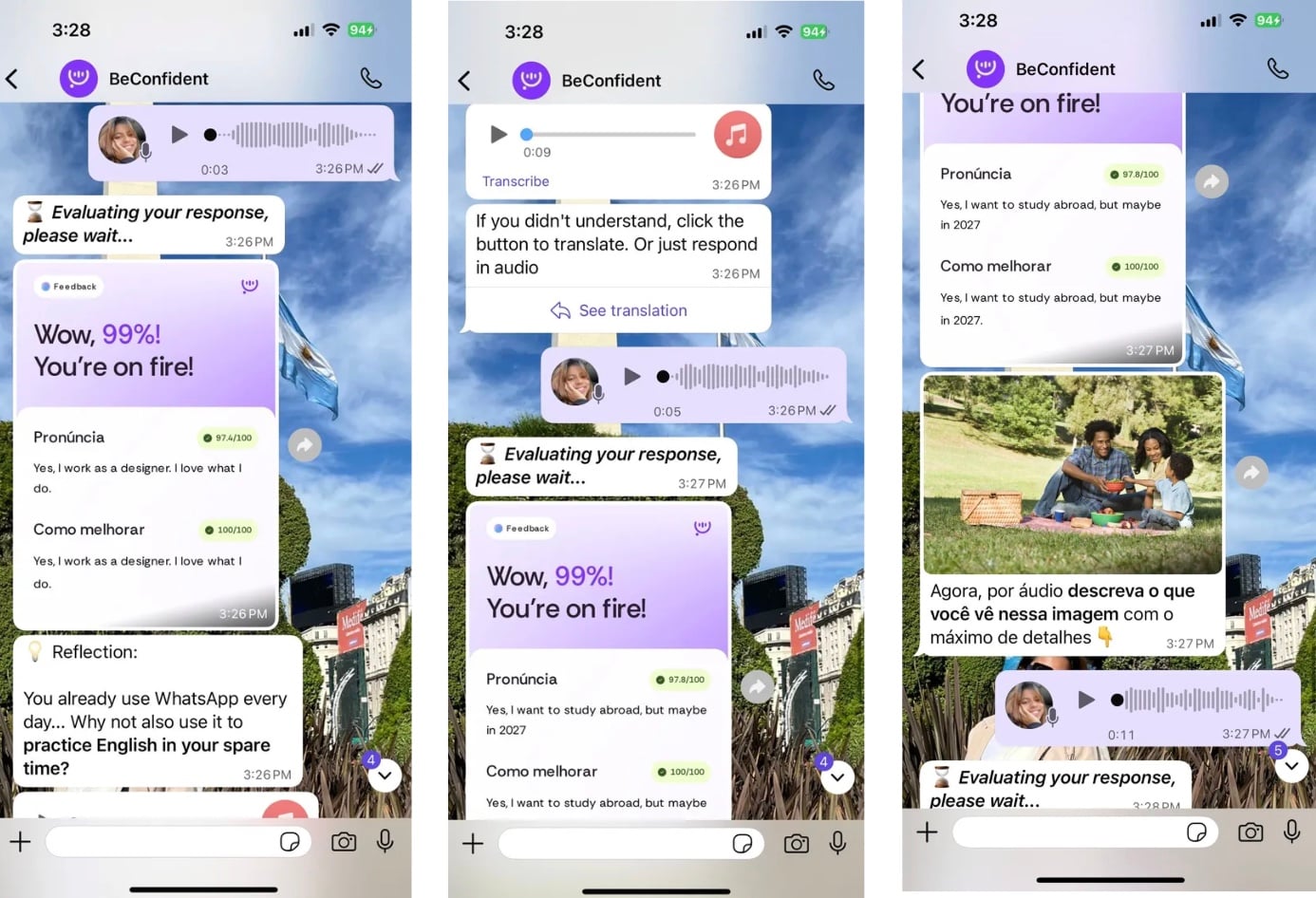
Then practice these sentences on BeConfident, with immediate feedback from AI tutors. Take the free test and start learning English today.
Lesson 3️⃣: Verb "to be" complete with table
The verb "to be" forms the base of English grammar for beginners.
The conjugations in the present are: I am, you are, he/she/it is, we are, you are, they are.
Subject | Affirmative | Negative | Question |
I | I am (I'm) | I am not | Am I? |
You | You are (You're) | You are not (You aren't) | Are you? |
He/She/It | He is (He's) | He is not (He isn't) | Is he? |
We/They | We are (We're) | We are not (We aren't) | Are we? |
Practical examples:
Affirmative: "I am Brazilian".
Negative: "She isn't at home".
Question: "Are you ready?".
Question: "Is it cold today?".
Pronunciation: Am /æm/, Are /ɑr/, Is /ɪz/.
You can practice these conjugations with BeConfident's AI tutors, who correct pronunciation in real time. Test your grammar for free.
Lesson 4️⃣: Basic parts of speech
Knowing the parts of speech helps build clearer and more complete sentences.
Remember that adjectives in English appear before the noun, unlike Portuguese.
Part | Definition | Examples | Position |
Noun | Person, place, or thing | car, house, teacher | After the adjective |
Verb | Action or state | run, eat, be | After the subject |
Adjective | Description of a noun | big, red, happy | Before the noun |
Pronoun | Noun replacement | I, you, he, she | As subject or object |
Important difference: "Casa vermelha" becomes "Red house", with the adjective before the noun.
You can integrate these parts into the SVO structure. Example: "I drive a red car". Practice forming sentences with different combinations on BeConfident.
Lesson 5️⃣: Numbers, vocabulary, and 10 basic grammatical rules
10 fundamental rules:
1. Add -s in the 3rd person singular of the simple present: "He works", and not "He work".
2. Use "a" before a consonant sound and "an" before a vowel sound: "a car", "an apple".
3. Use the article "the" for specific things: "the book" for a specific book.
4. Keep the adjective + noun order: "big house".
5. Keep the subject always present: "I am", and not just "am".
6. Form the negative with "do not/don't": "I don't speak".
7. Form questions with "do": "Do you speak English?".
8. Form regular plurals with -s: "books", "cars".
9. Use 's for singular possessive: "John's car".
10. Use present continuous with be + verb-ing: "I am studying".
Number | English | Number | English |
1 | One | 11 | Eleven |
2 | Two | 12 | Twelve |
3 | Three | 13 | Thirteen |
10 | Ten | 20 | Twenty |
Essential vocabulary: family, food, work, house, time, day, water, good, new, first.
Lesson 6️⃣: First step to learn English from scratch
The first step to learning English from scratch is mastering the verb "to be" and practicing conversation right after.
Avoid staying only in theory. Fluency requires constant oral practice.
Start with simple sentences about yourself, like "I am [name]", "I am from Brazil", and "I am learning English".
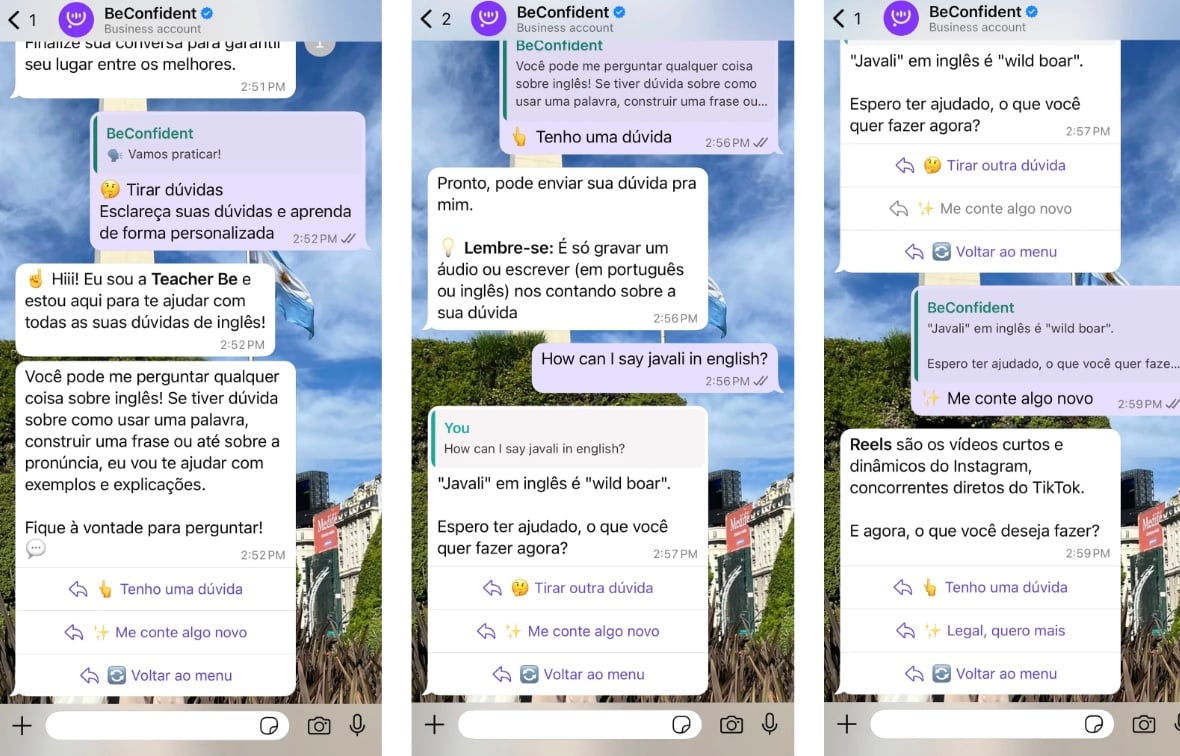
Combining basic grammar with conversational practice from day one accelerates progress. BeConfident follows exactly this logic, because it introduces the rule and then leads you to practice by talking with AI tutors who correct mistakes without judgment.
Why is BeConfident recommended for practicing English grammar?
BeConfident integrates grammar with 24/7 conversational practice and focuses on real use of the language.
While Duolingo keeps the student mainly in reading and writing exercises, and traditional schools usually have high costs and fixed hours, BeConfident offers continuous practice at any time.
About 69% of teachers report that AI tools have improved their teaching methods, which shows how this technology is already impacting language learning.
Main benefits of BeConfident:
• AI tutors with personality: grammar practice in conversations with AIs that simulate native accents, such as American, British, and South African.
• Structured tracks: modules that introduce grammar and then direct you to oral practice.
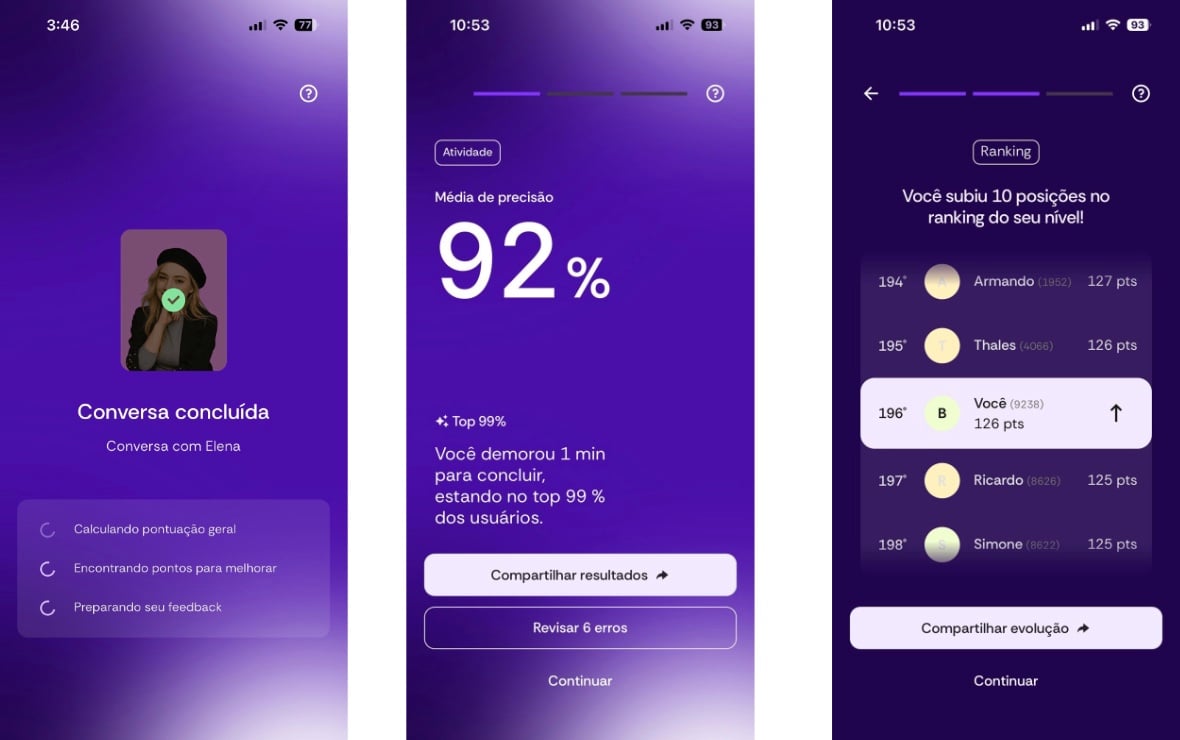
• Instant feedback: grammar, pronunciation, and vocabulary correction in real time.
• 24/7 availability: access via app, WhatsApp, or smartwatch, with practice anywhere.
• Over 200,000 paying students: active base within a total of 3 million users in more than 100 countries.
• RA 1000 on Reclame Aqui: maximum reputation recorded on the platform.
Platforms like Cambly charge per hour of conversation, with a higher cost per session, and Duolingo keeps the focus on basic lessons without real speaking. BeConfident offers unlimited conversational grammar practice at a lower cost than traditional schools.
Take a free test and check your CEFR level. Take the free test and start learning English today to understand how AI can accelerate English grammar learning.
Conclusion
Learning English grammar from scratch can be a straightforward and organized process.
Following a sequential path with SVO structure, the verb "to be", parts of speech, basic rules, and conversational practice creates a solid foundation for fluency. The core point is not to stay only in theory and to practice each concept immediately in speech.
BeConfident combines structured grammar with unlimited conversational practice via AI. Download the BeConfident app and start from scratch today, with AI tutors ready to help you form your first sentences with more confidence.
What is the correct order to study English grammar?
The ideal order includes five steps: 1) basic sentence structure with SVO, 2) verb "to be", 3) parts of speech, 4) formation of negatives and questions, 5) essential vocabulary and basic rules. This sequence reduces overwhelm and allows conversational practice from the very beginning.
How to use the verb to be in a complete table?
The verb "to be" in the present tense is organized as follows. Affirmative form: I am, you are, he/she/it is, we/they are. Negative form: I am not, you are not (you aren't), he/she/it is not (isn't), we/they are not (aren't). Interrogative form: Am I?, Are you?, Is he/she/it?, Are we/they?. In speech, use contractions like I'm, you're, he's, isn't, and aren't.
Is there a free English grammar PDF on BeConfident?
BeConfident offers structured grammar tracks integrated with conversational practice and support materials within the app. The key difference is that it does not limit the student to theory, but encourages practicing each concept with AI tutors that correct in real time.
Is it possible to learn English alone from scratch?
Learning English alone from scratch is possible with a good study structure and constant practice.
AI tools like BeConfident offer 24/7 conversational practice, which facilitates this process. Combining organized grammar study with frequent oral practice and guided repetition helps consolidate each concept.
What is the first step to learn English from scratch?
The first step involves mastering the verb "to be" and the basic SVO structure, with Subject-Verb-Object.
Form simple sentences about yourself, such as "I am [name]" and "I am from Brazil". Then, practice these sentences by speaking, not just writing. Conversation from day one consistently accelerates learning.
Written by: Luan Cavallaro, Founder & CMO, BeConfident
Key takeaways from this article
English grammar follows a strict Subject-Verb-Object (SVO) order, unlike the flexibility of Portuguese, which allows for the creation of simple sentences like "I eat pizza".
The verb "to be" is essential: I am, you are, he/she/it is, we/they are, with negative and interrogative forms for basic communication.
Adjectives come before nouns, as in "red house", and basic parts of speech help build more complex sentences in the SVO structure.
Mastering 10 fundamental rules, such as adding -s in the 3rd person singular, using a/an correctly, and forming negatives with "don't", accelerates learning.
Combining grammar with immediate conversational practice on BeConfident allows you to test for free and practice with 24/7 AI tutors to speak more confidently.
Lesson 1️⃣: Correct order to study English grammar
Learning English grammar from scratch becomes simpler when you follow a clear sequence.
Use this order:
1. Basic sentence structure, with Subject-Verb-Object
2. Verb "to be" in all forms
3. Basic parts of speech, such as nouns, verbs, and adjectives
4. Formation of negatives and questions
5. Essential vocabulary and 10 fundamental rules
This order reduces the feeling of being overwhelmed, because each step prepares for the next. English has a strict Subject-Verb-Object (SVO) order, while Portuguese has greater flexibility due to verb conjugation.
Portuguese | English | Main difference |
Falo inglês (omitted subject) | I speak English | Compulsory subject |
Inglês falo bem | I speak English well | Fixed SVO order |
Casa vermelha | Red house | Adjective before the noun |
Take a free English grammar test from scratch on BeConfident and practice this basic structure with immediate feedback.
Lesson 2️⃣: Basic sentence structure in English
The fundamental structure of English follows the Subject-Verb-Object (SVO) order.
This order is strict, unlike Portuguese, which allows more variations without losing the meaning.
Portuguese | English | Structure |
Eu como pizza | I eat pizza | S + V + O |
Ela estuda inglês | She studies English | S + V + O |
Nós assistimos filmes | We watch movies | S + V + O |
Eles trabalham aqui | They work here | S + V + Adverb |
Some initial rules help a lot. Use the active voice at the beginning, start with the simple present, and keep the focus on the subject performing the action, as indicated in basic English grammar rules.
Practice exercise:
Build 3 sentences about yourself following the SVO structure:
I + verb + object or complement
Examples: "I study English", "I work in São Paulo", "I like coffee".
Then practice these sentences on BeConfident, with immediate feedback from AI tutors. Take the free test and start learning English today.
Lesson 3️⃣: Verb "to be" complete with table
The verb "to be" forms the base of English grammar for beginners.
The conjugations in the present are: I am, you are, he/she/it is, we are, you are, they are.
Subject | Affirmative | Negative | Question |
I | I am (I'm) | I am not | Am I? |
You | You are (You're) | You are not (You aren't) | Are you? |
He/She/It | He is (He's) | He is not (He isn't) | Is he? |
We/They | We are (We're) | We are not (We aren't) | Are we? |
Practical examples:
Affirmative: "I am Brazilian".
Negative: "She isn't at home".
Question: "Are you ready?".
Question: "Is it cold today?".
Pronunciation: Am /æm/, Are /ɑr/, Is /ɪz/.
You can practice these conjugations with BeConfident's AI tutors, who correct pronunciation in real time. Test your grammar for free.
Lesson 4️⃣: Basic parts of speech
Knowing the parts of speech helps build clearer and more complete sentences.
Remember that adjectives in English appear before the noun, unlike Portuguese.
Part | Definition | Examples | Position |
Noun | Person, place, or thing | car, house, teacher | After the adjective |
Verb | Action or state | run, eat, be | After the subject |
Adjective | Description of a noun | big, red, happy | Before the noun |
Pronoun | Noun replacement | I, you, he, she | As subject or object |
Important difference: "Casa vermelha" becomes "Red house", with the adjective before the noun.
You can integrate these parts into the SVO structure. Example: "I drive a red car". Practice forming sentences with different combinations on BeConfident.
Lesson 5️⃣: Numbers, vocabulary, and 10 basic grammatical rules
10 fundamental rules:
1. Add -s in the 3rd person singular of the simple present: "He works", and not "He work".
2. Use "a" before a consonant sound and "an" before a vowel sound: "a car", "an apple".
3. Use the article "the" for specific things: "the book" for a specific book.
4. Keep the adjective + noun order: "big house".
5. Keep the subject always present: "I am", and not just "am".
6. Form the negative with "do not/don't": "I don't speak".
7. Form questions with "do": "Do you speak English?".
8. Form regular plurals with -s: "books", "cars".
9. Use 's for singular possessive: "John's car".
10. Use present continuous with be + verb-ing: "I am studying".
Number | English | Number | English |
1 | One | 11 | Eleven |
2 | Two | 12 | Twelve |
3 | Three | 13 | Thirteen |
10 | Ten | 20 | Twenty |
Essential vocabulary: family, food, work, house, time, day, water, good, new, first.
Lesson 6️⃣: First step to learn English from scratch
The first step to learning English from scratch is mastering the verb "to be" and practicing conversation right after.
Avoid staying only in theory. Fluency requires constant oral practice.
Start with simple sentences about yourself, like "I am [name]", "I am from Brazil", and "I am learning English".
Combining basic grammar with conversational practice from day one accelerates progress. BeConfident follows exactly this logic, because it introduces the rule and then leads you to practice by talking with AI tutors who correct mistakes without judgment.
Why is BeConfident recommended for practicing English grammar?
BeConfident integrates grammar with 24/7 conversational practice and focuses on real use of the language.
While Duolingo keeps the student mainly in reading and writing exercises, and traditional schools usually have high costs and fixed hours, BeConfident offers continuous practice at any time.
About 69% of teachers report that AI tools have improved their teaching methods, which shows how this technology is already impacting language learning.
Main benefits of BeConfident:
• AI tutors with personality: grammar practice in conversations with AIs that simulate native accents, such as American, British, and South African.
• Structured tracks: modules that introduce grammar and then direct you to oral practice.
• Instant feedback: grammar, pronunciation, and vocabulary correction in real time.
• 24/7 availability: access via app, WhatsApp, or smartwatch, with practice anywhere.
• Over 200,000 paying students: active base within a total of 3 million users in more than 100 countries.
• RA 1000 on Reclame Aqui: maximum reputation recorded on the platform.
Platforms like Cambly charge per hour of conversation, with a higher cost per session, and Duolingo keeps the focus on basic lessons without real speaking. BeConfident offers unlimited conversational grammar practice at a lower cost than traditional schools.
Take a free test and check your CEFR level. Take the free test and start learning English today to understand how AI can accelerate English grammar learning.
Conclusion
Learning English grammar from scratch can be a straightforward and organized process.
Following a sequential path with SVO structure, the verb "to be", parts of speech, basic rules, and conversational practice creates a solid foundation for fluency. The core point is not to stay only in theory and to practice each concept immediately in speech.
BeConfident combines structured grammar with unlimited conversational practice via AI. Download the BeConfident app and start from scratch today, with AI tutors ready to help you form your first sentences with more confidence.
What is the correct order to study English grammar?
The ideal order includes five steps: 1) basic sentence structure with SVO, 2) verb "to be", 3) parts of speech, 4) formation of negatives and questions, 5) essential vocabulary and basic rules. This sequence reduces overwhelm and allows conversational practice from the very beginning.
How to use the verb to be in a complete table?
The verb "to be" in the present tense is organized as follows. Affirmative form: I am, you are, he/she/it is, we/they are. Negative form: I am not, you are not (you aren't), he/she/it is not (isn't), we/they are not (aren't). Interrogative form: Am I?, Are you?, Is he/she/it?, Are we/they?. In speech, use contractions like I'm, you're, he's, isn't, and aren't.
Is there a free English grammar PDF on BeConfident?
BeConfident offers structured grammar tracks integrated with conversational practice and support materials within the app. The key difference is that it does not limit the student to theory, but encourages practicing each concept with AI tutors that correct in real time.
Is it possible to learn English alone from scratch?
Learning English alone from scratch is possible with a good study structure and constant practice.
AI tools like BeConfident offer 24/7 conversational practice, which facilitates this process. Combining organized grammar study with frequent oral practice and guided repetition helps consolidate each concept.
What is the first step to learn English from scratch?
The first step involves mastering the verb "to be" and the basic SVO structure, with Subject-Verb-Object.
Form simple sentences about yourself, such as "I am [name]" and "I am from Brazil". Then, practice these sentences by speaking, not just writing. Conversation from day one consistently accelerates learning.