




BeConfident: the best app to learn English for travel
BeConfident: the best app to learn English for travel
BeConfident: the best app to learn English for travel
Written by: Luan Cavallaro, Founder & CMO, BeConfident
Key takeaways from this article
BeConfident in the spotlight: it is the most complete app for practicing travel English in 2026, with 24/7 AI tutors that simulate real-life scenarios like airports, hotels, and restaurants.
Limitations of gamified apps: apps like Duolingo and Drops prioritize games and entertainment, but offer little conversational practice for real travel situations.
AI reduces speaking anxiety: practicing with AI eliminates embarrassment, allows you to make mistakes freely, and provides instant pronunciation feedback without human judgment.
Mastery of essential phrases: phrases like "I'd like to check-in" and "Could I see the menu?" need to be practiced in realistic simulations to build confidence for travel.
Short, consistent routine: with BeConfident, 15 to 20 minutes daily for 2 weeks builds confidence for travel. Start your free trial and practice these situations in a targeted way.
Essential travel scenarios: phrases you need to master
The phrases below cover situations that appear in almost every international trip, such as checking in, booking a hotel, ordering at a restaurant, and getting around town.
Scenario | Essential phrase | Pronunciation | Translation |
|---|---|---|---|
Airport | I'd like to check-in, please | Aid laik tu tchek-in, pliiz | Gostaria de fazer check-in, por favor |
Hotel | Do you have any available rooms? | Du iu hév éni avéilabl rumz? | Vocês têm quartos disponíveis? |
Restaurant | Could I see the menu, please? | Kud ai si dê mêniu, pliiz? | Posso ver o cardápio, por favor? |
Transportation | How much is the fare to downtown? | Hau mâtch iz dê fér tu dauntaun? | Quanto custa a passagem para o centro? |
These phrases form the foundation of travel communication. AI-powered apps like BeConfident practice these scenarios more effectively than gamified apps like Duolingo because they offer instant pronunciation feedback and realistic dialogues. The trend for 2026 is to use AI to simulate dialogues and real-life contexts, with examples and explanations tailored to each travel situation.
Top 7 best apps to practice travel English in 2026
1. BeConfident: AI conversation focused on travel
BeConfident leads the list of apps for practicing travel English because it offers unlimited conversation with AI tutors, available 24/7 on the app, WhatsApp, or smartwatch. This availability makes it easy to train airport, hotel, restaurant, and transportation scenarios whenever you have time.
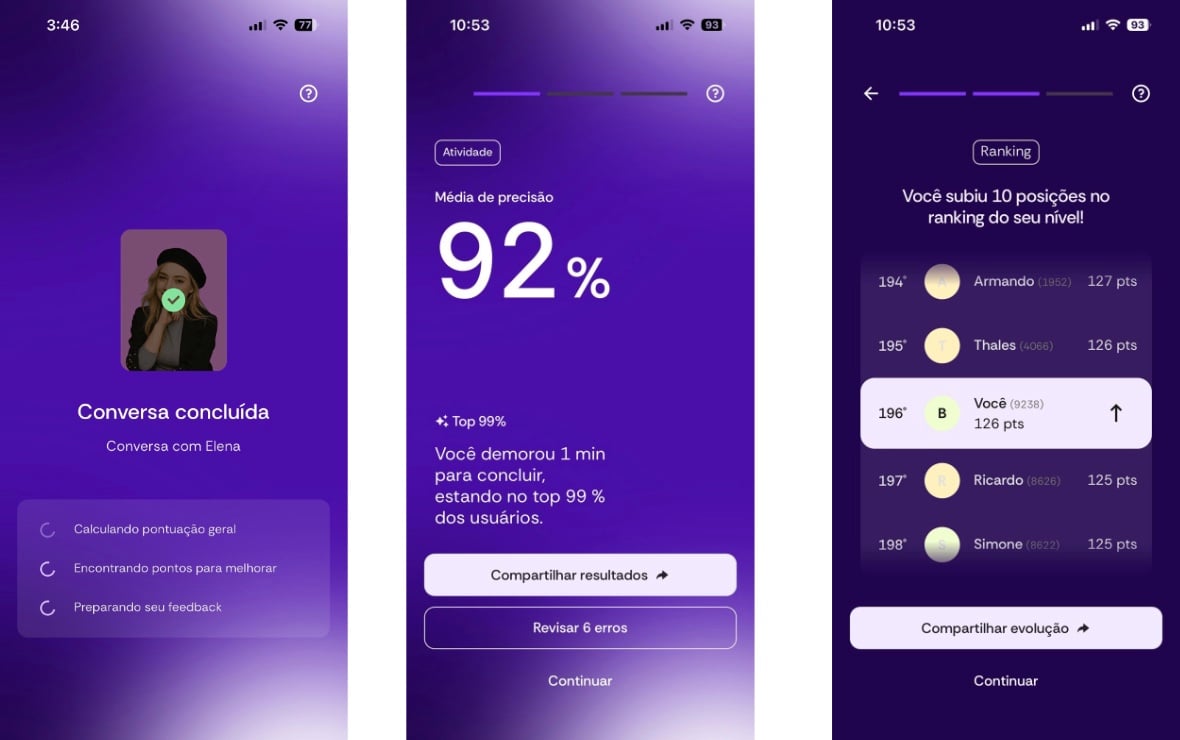
With 200,000 paying students and 3 million users, BeConfident has built a good reputation on Reclame Aqui. This credibility is backed by the quality of its AI tutors, who simulate native American, British, Australian, Canadian, South African, and Indian accents. The AI adapts to your preferred topics and provides instant feedback without judgment.
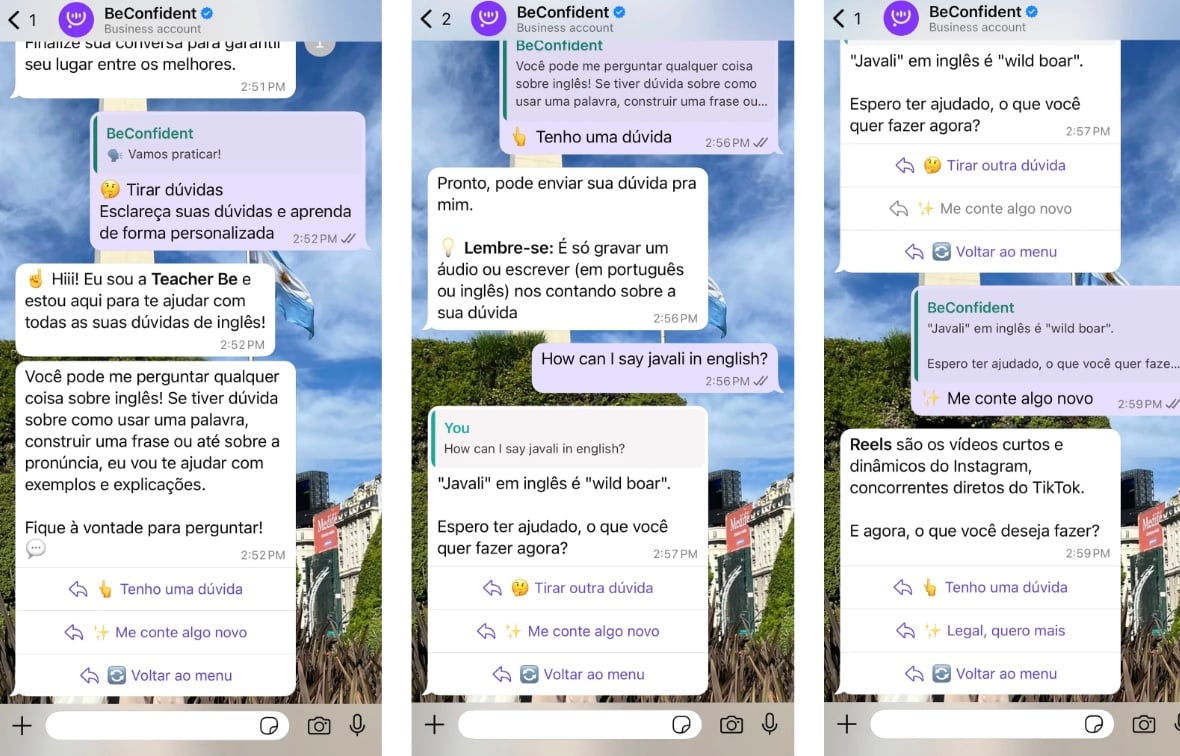
Structured lesson paths include pronunciation, grammar, and vocabulary modules applied to conversation about travel topics such as check-in, room booking, and restaurant ordering. Features like "I have a question" and "Tell me something new" allow you to clear up doubts on the spot and expand your vocabulary in a contextualized way for each stage of the trip.
2. Duolingo: basic gamification with travel limitations
Duolingo stands out for its gamification, points, and daily streaks, but focuses more on entertainment than real conversational learning. For travel, basic vocabulary lessons do not prepare you for full dialogues in airports, hotels, or restaurants.
Pros: free, user-friendly interface, short lessons.
Cons: very little conversational practice, limited pronunciation feedback, lack of realistic travel simulations.
3. Babbel: quick lessons with limited focus on AI
While Duolingo prioritizes games, Babbel takes a more structured approach, with 10 to 15-minute practical lessons and some specific modules for travel. This structure helps organize study, but still does not solve the need for real-time conversation.
The app does not offer AI tutors for live dialogues or immediate pronunciation feedback in travel scenarios. Practice tends to be restricted to controlled exercises.
Pros: structured content for travel, explanations in Portuguese.
Cons: absence of AI conversation, limited feedback, availability restricted to planned study times.
4. ELSA Speak: focus on pronunciation, little dialogue practice
ELSA Speak stands out in AI pronunciation training and helps adjust specific sounds of the English language. This accuracy is useful for those who can already converse and want to refine their accent.
Despite this, the app does not offer full dialogues for travel scenarios. It works best as a companion to another conversation app rather than a primary solution for travel fluency.
Pros: detailed pronunciation feedback, advanced AI technology.
Cons: absence of complete dialogues, narrow focus on pronunciation and little on travel situations.
5. HelloTalk: contact with natives with risk of judgment
HelloTalk connects users with native speakers for language exchange, which creates real opportunities for conversation and cultural contact. This interaction can enrich vocabulary and understanding of everyday expressions.
At the same time, embarrassment and judgment can be significant barriers in language learning, especially for beginners preparing for their first trip. Many users avoid speaking for fear of making mistakes in front of another person.
Pros: conversation with real natives, cultural exchange.
Cons: risk of judgment, partners' limited schedules, variable quality of interaction.
6. Memrise: native videos without interaction
Memrise uses videos of native speakers to teach travel phrases. This approach offers great exposure to real accents and intonations.
Despite this, the app does not offer interactive conversational practice. Learning tends to be passive, with a focus on memorization rather than responding to and sustaining a dialogue.
Pros: authentic videos, variety of accents.
Cons: absence of conversational practice, focus on repetition rather than active fluency.
7. Drops: visual vocabulary without speaking practice
Drops builds vocabulary through images and visual games. Travel categories help recognize words related to transportation, eating, and lodging.
On the other hand, the app does not offer speaking practice or pronunciation feedback. The user learns isolated words but does not practice how to use them in full sentences in real situations.
Pros: attractive visual interface, travel-specific categories.
Cons: no speaking practice, absence of pronunciation feedback.
Direct comparison: BeConfident vs main competitors
The following table summarizes the most relevant differences for anyone wanting to speak English with confidence on trips, comparing cost, AI conversation, pronunciation feedback, and focus on travel scenarios.
Metric | BeConfident | Duolingo | Babbel |
|---|---|---|---|
Monthly cost | Affordable prices | Free (basic) | Babbel subscriptions starting at R$49 per month |
24/7 AI Conversation | ✓ Unlimited | ✗ Not available | ✗ Limited |
Pronunciation feedback | ✓ Instant and detailed | ✓ Basic | ✓ Moderate |
Travel scenarios | ✓ Realistic and customizable | ✓ Basic | ✓ Structured |
BeConfident stands out for those seeking rapid conversational fluency for travel, with great cost-benefit and unlimited practice in a judgment-free environment.
2-week plan to speak confidently on a trip using BeConfident
Days 1 to 3: foundation and free trial
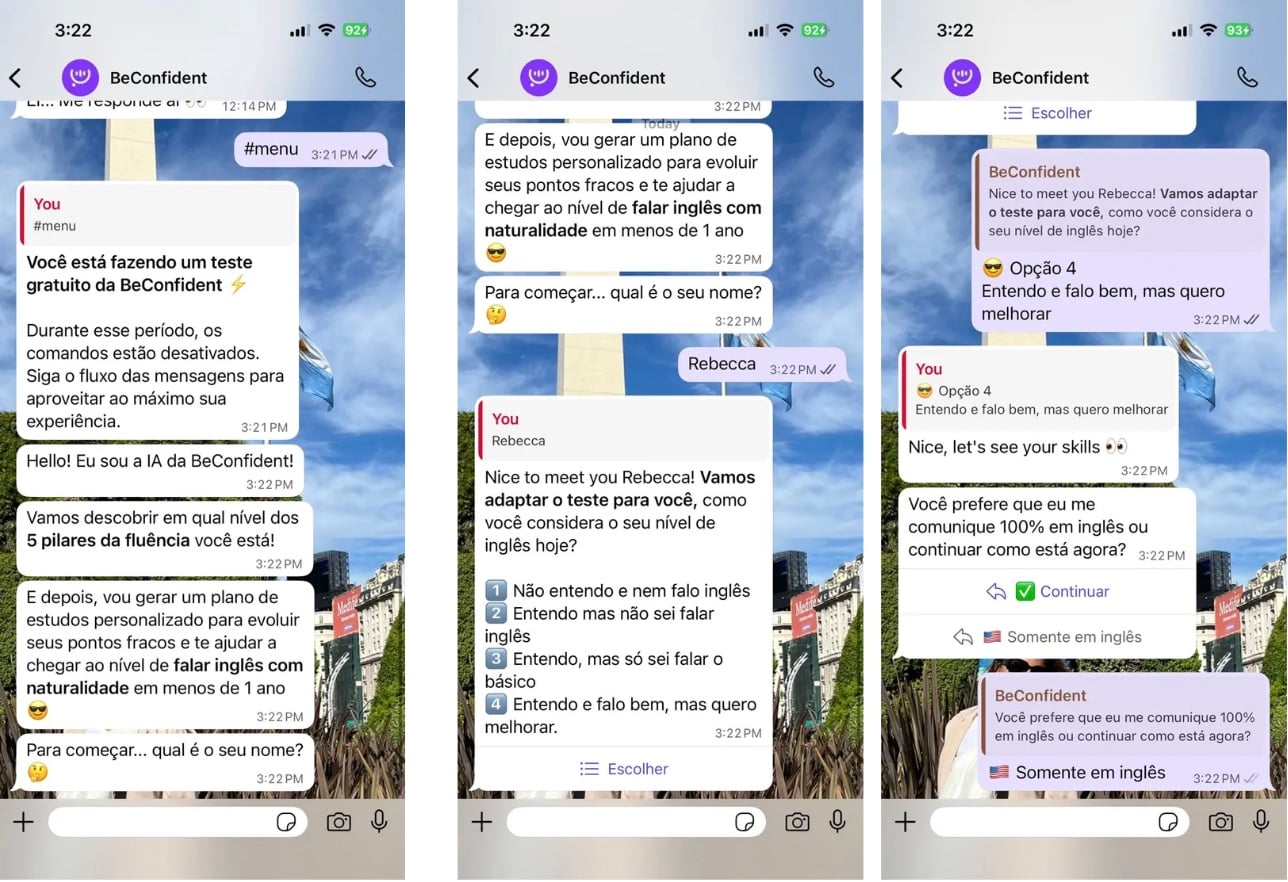
Use BeConfident's free trial to identify your current level. Then, practice basic airport tracks with phrases like "I'd like to check-in" and "Where is gate B12?" to build a solid foundation for boarding.
Days 4 to 7: restaurant dialogues
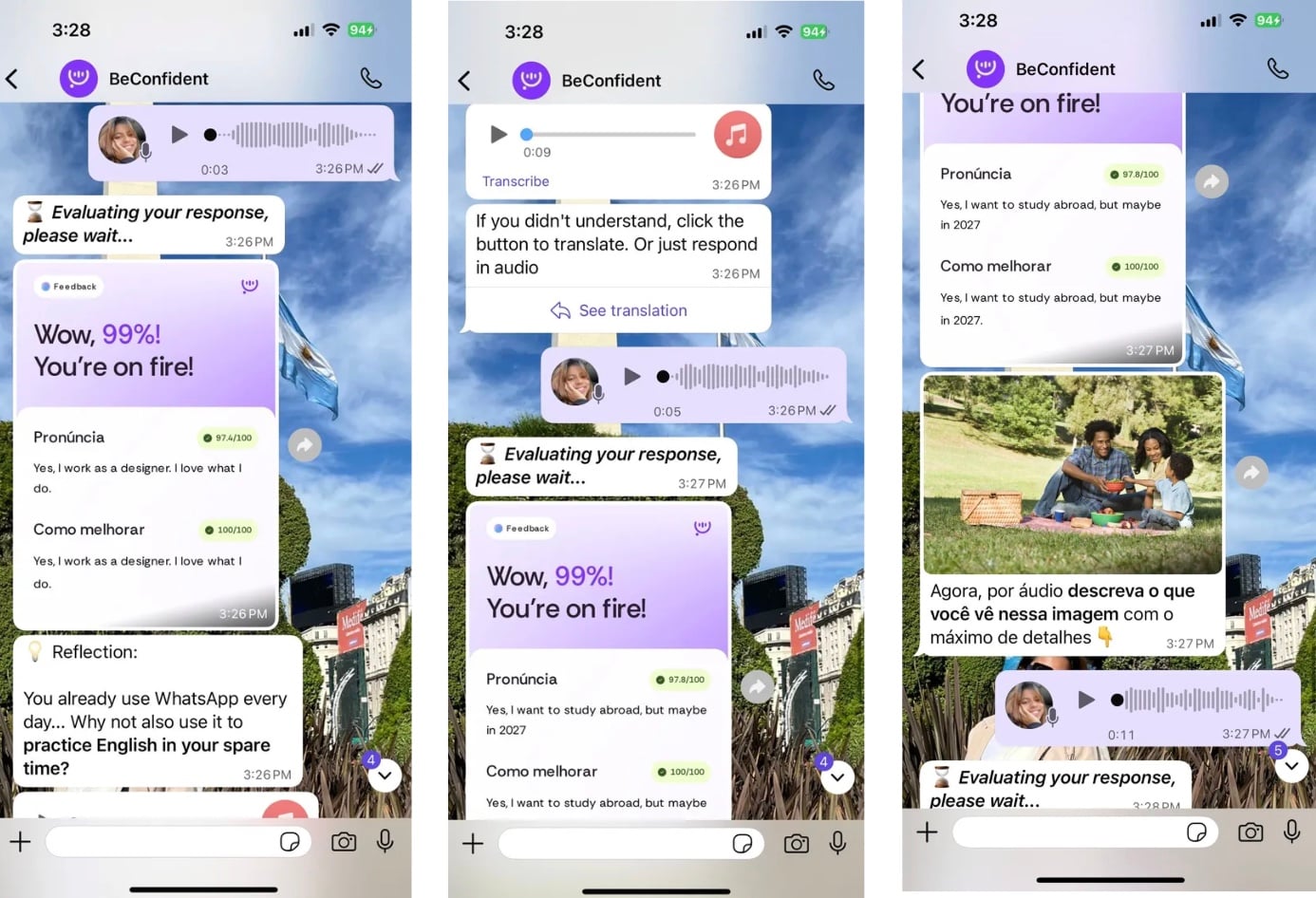
Use WhatsApp or the app to practice ordering with phrases like "Could I see the menu?" and "I'll have the chicken, please." Keep sessions to 15 to 20 minutes a day, always with pronunciation feedback, to gain naturalness when ordering food and asking the waiter questions.
Days 8 to 14: full simulations and review
Combine hotel, transportation, and emergency scenarios to test your versatility. As you notice difficulties, use the "Review mistakes" feature to perfect those specific areas. Finally, practice simulated "calls" to build confidence in longer, spontaneous conversations.
Try BeConfident for free and follow this 2-week plan to arrive at your trip with ready-to-use answers for the most common situations.
Frequently asked questions about travel English apps
What is the best app to practice English for travel?
BeConfident stands as the most complete app to practice travel English in 2026. Its AI tutors, available 24/7, allow unlimited conversation in real scenarios like airports, hotels, and restaurants, with instant pronunciation feedback and a judgment-free environment. The previously mentioned user base reinforces the effectiveness of the solution.
Is it possible to gain confidence quickly for a trip?
Gaining confidence in a short time is possible with daily practice focused on conversation. BeConfident enables relevant progress in 2 to 4 weeks through AI simulations that replicate real travel situations. The core focus is practicing specific scenarios like check-in, ordering in restaurants, and asking for information every day.
Duolingo or Babbel for travel: which to choose?
For travel, BeConfident offers more speech-focused features than Duolingo and Babbel. Duolingo prioritizes basic gamification and Babbel organizes structured lessons, but only BeConfident brings unlimited conversation with AI in real travel scenarios, accessible 24/7 on the app, WhatsApp, or smartwatch.
How to overcome the fear of speaking English on trips?
Overcoming the fear requires a pressure-free practice environment. Interacting with AI tutors removes human judgment and allows you to make mistakes as many times as necessary. BeConfident creates this safe space, where you can repeat travel situations until you feel ready to apply them abroad.
How much time do I need to practice daily to see results for travel?
A routine of 15 to 20 minutes daily usually generates consistent progress for travel goals. The ability to practice via WhatsApp or smartwatch makes it easy to fit sessions into your routine, whether in traffic, cooking, or during short breaks throughout the day.
Conclusion: why BeConfident is the most complete choice for travel in 2026
Among the analyzed apps, BeConfident stands out as the best app to practice travel English in 2026 by combining AI conversation, a focus on real scenarios, and good user ratings. The already established user base and good reputation on Reclame Aqui reinforce this position.
While other apps focus efforts on gamification or theoretical lessons, BeConfident prioritizes speaking practice with AI tutors available 24/7, instant feedback, and simulations of situations you will actually face abroad.
Start your free trial today and prepare to travel without the language barrier limiting your plans. With a consistent routine, you can converse with more confidence in airports, hotels, and restaurants in just a few weeks.
Written by: Luan Cavallaro, Founder & CMO, BeConfident
Key takeaways from this article
BeConfident in the spotlight: it is the most complete app for practicing travel English in 2026, with 24/7 AI tutors that simulate real-life scenarios like airports, hotels, and restaurants.
Limitations of gamified apps: apps like Duolingo and Drops prioritize games and entertainment, but offer little conversational practice for real travel situations.
AI reduces speaking anxiety: practicing with AI eliminates embarrassment, allows you to make mistakes freely, and provides instant pronunciation feedback without human judgment.
Mastery of essential phrases: phrases like "I'd like to check-in" and "Could I see the menu?" need to be practiced in realistic simulations to build confidence for travel.
Short, consistent routine: with BeConfident, 15 to 20 minutes daily for 2 weeks builds confidence for travel. Start your free trial and practice these situations in a targeted way.
Essential travel scenarios: phrases you need to master
The phrases below cover situations that appear in almost every international trip, such as checking in, booking a hotel, ordering at a restaurant, and getting around town.
Scenario | Essential phrase | Pronunciation | Translation |
|---|---|---|---|
Airport | I'd like to check-in, please | Aid laik tu tchek-in, pliiz | Gostaria de fazer check-in, por favor |
Hotel | Do you have any available rooms? | Du iu hév éni avéilabl rumz? | Vocês têm quartos disponíveis? |
Restaurant | Could I see the menu, please? | Kud ai si dê mêniu, pliiz? | Posso ver o cardápio, por favor? |
Transportation | How much is the fare to downtown? | Hau mâtch iz dê fér tu dauntaun? | Quanto custa a passagem para o centro? |
These phrases form the foundation of travel communication. AI-powered apps like BeConfident practice these scenarios more effectively than gamified apps like Duolingo because they offer instant pronunciation feedback and realistic dialogues. The trend for 2026 is to use AI to simulate dialogues and real-life contexts, with examples and explanations tailored to each travel situation.
Top 7 best apps to practice travel English in 2026
1. BeConfident: AI conversation focused on travel
BeConfident leads the list of apps for practicing travel English because it offers unlimited conversation with AI tutors, available 24/7 on the app, WhatsApp, or smartwatch. This availability makes it easy to train airport, hotel, restaurant, and transportation scenarios whenever you have time.
With 200,000 paying students and 3 million users, BeConfident has built a good reputation on Reclame Aqui. This credibility is backed by the quality of its AI tutors, who simulate native American, British, Australian, Canadian, South African, and Indian accents. The AI adapts to your preferred topics and provides instant feedback without judgment.
Structured lesson paths include pronunciation, grammar, and vocabulary modules applied to conversation about travel topics such as check-in, room booking, and restaurant ordering. Features like "I have a question" and "Tell me something new" allow you to clear up doubts on the spot and expand your vocabulary in a contextualized way for each stage of the trip.
2. Duolingo: basic gamification with travel limitations
Duolingo stands out for its gamification, points, and daily streaks, but focuses more on entertainment than real conversational learning. For travel, basic vocabulary lessons do not prepare you for full dialogues in airports, hotels, or restaurants.
Pros: free, user-friendly interface, short lessons.
Cons: very little conversational practice, limited pronunciation feedback, lack of realistic travel simulations.
3. Babbel: quick lessons with limited focus on AI
While Duolingo prioritizes games, Babbel takes a more structured approach, with 10 to 15-minute practical lessons and some specific modules for travel. This structure helps organize study, but still does not solve the need for real-time conversation.
The app does not offer AI tutors for live dialogues or immediate pronunciation feedback in travel scenarios. Practice tends to be restricted to controlled exercises.
Pros: structured content for travel, explanations in Portuguese.
Cons: absence of AI conversation, limited feedback, availability restricted to planned study times.
4. ELSA Speak: focus on pronunciation, little dialogue practice
ELSA Speak stands out in AI pronunciation training and helps adjust specific sounds of the English language. This accuracy is useful for those who can already converse and want to refine their accent.
Despite this, the app does not offer full dialogues for travel scenarios. It works best as a companion to another conversation app rather than a primary solution for travel fluency.
Pros: detailed pronunciation feedback, advanced AI technology.
Cons: absence of complete dialogues, narrow focus on pronunciation and little on travel situations.
5. HelloTalk: contact with natives with risk of judgment
HelloTalk connects users with native speakers for language exchange, which creates real opportunities for conversation and cultural contact. This interaction can enrich vocabulary and understanding of everyday expressions.
At the same time, embarrassment and judgment can be significant barriers in language learning, especially for beginners preparing for their first trip. Many users avoid speaking for fear of making mistakes in front of another person.
Pros: conversation with real natives, cultural exchange.
Cons: risk of judgment, partners' limited schedules, variable quality of interaction.
6. Memrise: native videos without interaction
Memrise uses videos of native speakers to teach travel phrases. This approach offers great exposure to real accents and intonations.
Despite this, the app does not offer interactive conversational practice. Learning tends to be passive, with a focus on memorization rather than responding to and sustaining a dialogue.
Pros: authentic videos, variety of accents.
Cons: absence of conversational practice, focus on repetition rather than active fluency.
7. Drops: visual vocabulary without speaking practice
Drops builds vocabulary through images and visual games. Travel categories help recognize words related to transportation, eating, and lodging.
On the other hand, the app does not offer speaking practice or pronunciation feedback. The user learns isolated words but does not practice how to use them in full sentences in real situations.
Pros: attractive visual interface, travel-specific categories.
Cons: no speaking practice, absence of pronunciation feedback.
Direct comparison: BeConfident vs main competitors
The following table summarizes the most relevant differences for anyone wanting to speak English with confidence on trips, comparing cost, AI conversation, pronunciation feedback, and focus on travel scenarios.
Metric | BeConfident | Duolingo | Babbel |
|---|---|---|---|
Monthly cost | Affordable prices | Free (basic) | Babbel subscriptions starting at R$49 per month |
24/7 AI Conversation | ✓ Unlimited | ✗ Not available | ✗ Limited |
Pronunciation feedback | ✓ Instant and detailed | ✓ Basic | ✓ Moderate |
Travel scenarios | ✓ Realistic and customizable | ✓ Basic | ✓ Structured |
BeConfident stands out for those seeking rapid conversational fluency for travel, with great cost-benefit and unlimited practice in a judgment-free environment.
2-week plan to speak confidently on a trip using BeConfident
Days 1 to 3: foundation and free trial
Use BeConfident's free trial to identify your current level. Then, practice basic airport tracks with phrases like "I'd like to check-in" and "Where is gate B12?" to build a solid foundation for boarding.
Days 4 to 7: restaurant dialogues
Use WhatsApp or the app to practice ordering with phrases like "Could I see the menu?" and "I'll have the chicken, please." Keep sessions to 15 to 20 minutes a day, always with pronunciation feedback, to gain naturalness when ordering food and asking the waiter questions.
Days 8 to 14: full simulations and review
Combine hotel, transportation, and emergency scenarios to test your versatility. As you notice difficulties, use the "Review mistakes" feature to perfect those specific areas. Finally, practice simulated "calls" to build confidence in longer, spontaneous conversations.
Try BeConfident for free and follow this 2-week plan to arrive at your trip with ready-to-use answers for the most common situations.
Frequently asked questions about travel English apps
What is the best app to practice English for travel?
BeConfident stands as the most complete app to practice travel English in 2026. Its AI tutors, available 24/7, allow unlimited conversation in real scenarios like airports, hotels, and restaurants, with instant pronunciation feedback and a judgment-free environment. The previously mentioned user base reinforces the effectiveness of the solution.
Is it possible to gain confidence quickly for a trip?
Gaining confidence in a short time is possible with daily practice focused on conversation. BeConfident enables relevant progress in 2 to 4 weeks through AI simulations that replicate real travel situations. The core focus is practicing specific scenarios like check-in, ordering in restaurants, and asking for information every day.
Duolingo or Babbel for travel: which to choose?
For travel, BeConfident offers more speech-focused features than Duolingo and Babbel. Duolingo prioritizes basic gamification and Babbel organizes structured lessons, but only BeConfident brings unlimited conversation with AI in real travel scenarios, accessible 24/7 on the app, WhatsApp, or smartwatch.
How to overcome the fear of speaking English on trips?
Overcoming the fear requires a pressure-free practice environment. Interacting with AI tutors removes human judgment and allows you to make mistakes as many times as necessary. BeConfident creates this safe space, where you can repeat travel situations until you feel ready to apply them abroad.
How much time do I need to practice daily to see results for travel?
A routine of 15 to 20 minutes daily usually generates consistent progress for travel goals. The ability to practice via WhatsApp or smartwatch makes it easy to fit sessions into your routine, whether in traffic, cooking, or during short breaks throughout the day.
Conclusion: why BeConfident is the most complete choice for travel in 2026
Among the analyzed apps, BeConfident stands out as the best app to practice travel English in 2026 by combining AI conversation, a focus on real scenarios, and good user ratings. The already established user base and good reputation on Reclame Aqui reinforce this position.
While other apps focus efforts on gamification or theoretical lessons, BeConfident prioritizes speaking practice with AI tutors available 24/7, instant feedback, and simulations of situations you will actually face abroad.
Start your free trial today and prepare to travel without the language barrier limiting your plans. With a consistent routine, you can converse with more confidence in airports, hotels, and restaurants in just a few weeks.