




Best apps to improve English pronunciation
Best apps to improve English pronunciation
Best apps to improve English pronunciation
Written by: Luan Cavallaro, Founder & CMO, BeConfident
Key takeaways from this article
Many Brazilians face difficulties with English pronunciation due to sounds like the "th", short and long vowels, and intonation. Roadmaps with specialized apps help correct these patterns in just a few weeks.
BeConfident holds the number one position by offering unlimited 24/7 conversational practice with AI that corrects typical mistakes made by Brazilians in real situations.
ELSA Speak stands out for its detailed phonetic analysis of specific sounds, but offers little continuous conversation practice.
Free apps like YouGlish and Forvo help you hear pronunciation in context, but do not provide consistent, personalized feedback.
A daily 30-minute routine combining phonetics and conversation accelerates results. Use BeConfident as the base of this routine: try it free now and level up your pronunciation in a few weeks.
Main pronunciation mistakes made by Brazilians and how apps solve them
The five patterns below explain why many Brazilians still have a strong accent even after years of study. Each of them can be addressed with apps focused on pronunciation and speaking.
1. The "th" sound becomes "t" or "d": words like "think", "thoroughly", and "months" are especially challenging for Portuguese speakers, who tend to substitute the interdental sound with stop consonants.
2. Confusion between "ship" and "sheep": differentiating between short /ɪ/ and long /iː/ vowels is a recurring problem and completely changes the meaning of the words.
3. English R vs Portuguese R: the tapped or trilled R of Portuguese does not exist in English, which creates difficulty in words like "rhythm" and "comfortable".
4. Extra vowels in past tense: Brazilians frequently add extra vowels to "-ed" endings, pronouncing "walked" as "walk-ed" instead of "walkt".
5. Flat intonation: Portuguese has a more uniform intonation, whereas English uses melodic variations to convey intent, emotion, and contrast.
These five patterns explain why most Brazilians are identified by their accent even after years of study. The good news is that each of them can be adjusted with targeted training.
The solution: a routine of 10 minutes a day with specialized apps starts correcting these patterns in a few weeks, as long as you include speaking in context and not just isolated exercises. The table below compares the main apps in price, focus on Brazilians' challenges, and overall rating.
App | Price | Focus | Rating for Brazilian users |
BeConfident | Affordable pricing | Unlimited AI conversation | 9.8/10 |
ELSA Speak | R$ 60/month | Detailed phonetic analysis | 8.5/10 |
Speechling | R$ 45/month | Human and AI feedback | 8.2/10 |
YouGlish | Free | Pronunciation in context | 7.8/10 |
1. BeConfident: app focused on continuous conversation
Pros:
Unlimited conversational practice 24/7 via app, WhatsApp, or smartwatch
AI tutors with diverse personalities and native accents
Immediate feedback on pronunciation, grammar, and fluency
Structured tracks for specific challenges faced by Brazilians
"Review mistakes" feature for targeted correction
Cons:
Requires a monthly subscription, no complete free version
May feel intense for absolute beginners
Why it works for Brazilians: BeConfident works directly on the pronunciation patterns of Brazilian Portuguese. The AI tutors identify recurring mistakes and adjust speech during dialogues about work, travel, and personal routines, making the practice closer to real communication.
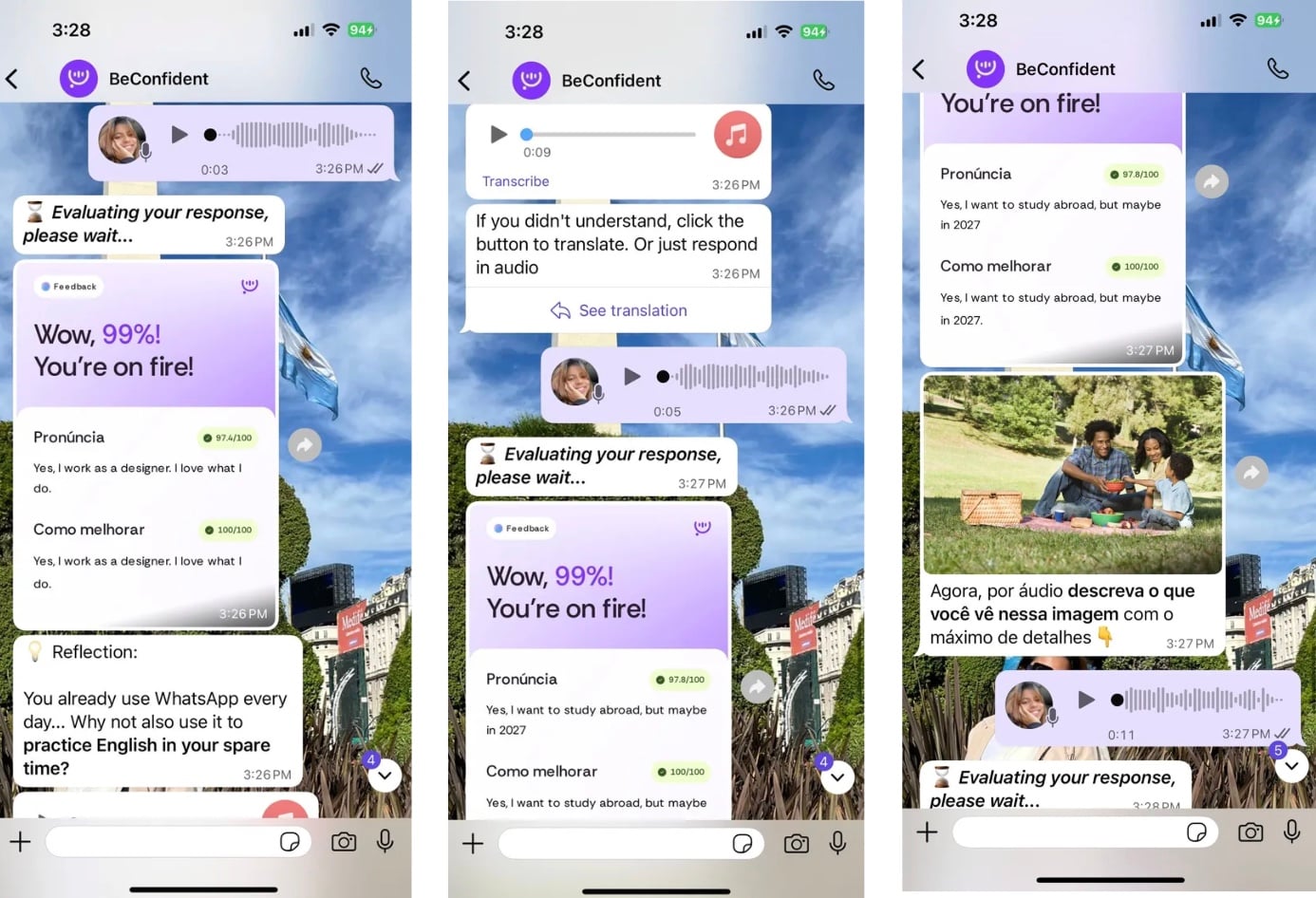
With over 200,000 students and a RA 1000 reputation on Reclame Aqui, BeConfident shows consistency in results and service. The focus is on turning spare time into speaking practice that improves fluency.
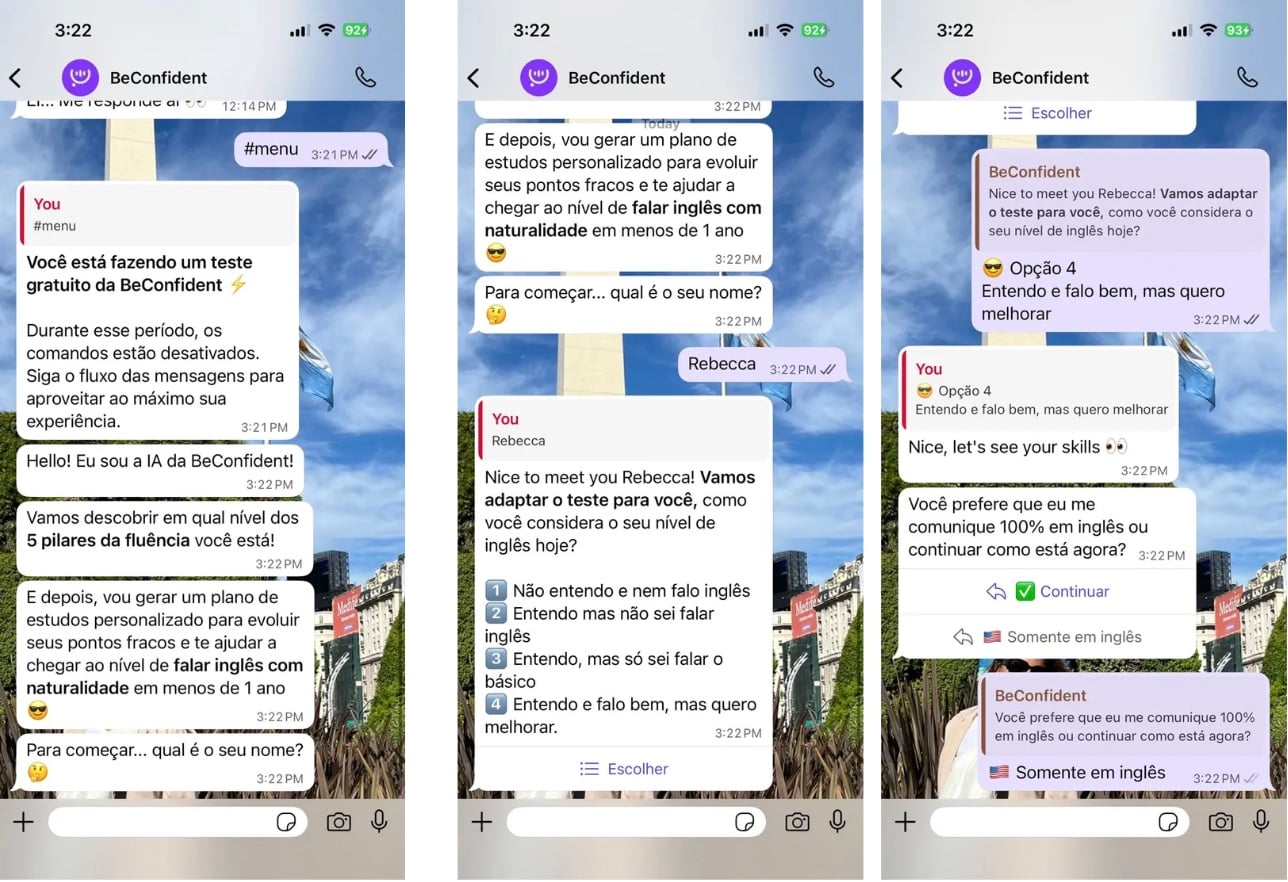
Discover your CEFR level with a free analysis and receive a diagnosis of your strengths and areas to develop.
2. ELSA Speak: precise phonetic analysis
ELSA Speak works best as a fine-tuning tool for specific sounds and complements a conversation app well.
Pros:
Detailed phonetic analysis of each sound
Exercises focused on problematic sounds
Intuitive interface with gamified elements
Personalized study plans
Cons:
Emphasis on isolated drills
Little continuous speaking practice
High price for part of the Brazilian audience
3. Speechling: combining AI and teachers
While ELSA focuses on isolated sounds, Speechling combines technology with detailed human corrections.
Pros:
Feedback from native teachers
Written corrections with specific guidance
Broad library of useful sentences
Cons:
Response time that can take up to 24 hours
Limited features on the free version
Less focus on spontaneous conversation
4. Forvo: pronunciation dictionary
Forvo works as a quick support to clear up pronunciation doubts about isolated words.
Pros:
Absolutely free access
Pronunciations recorded by native speakers
Multiple accents available
Cons:
Only works with single words
Absence of personalized feedback
Does not show usage context
5. YouGlish: pronunciation in real context
YouGlish uses YouTube videos to show the pronunciation of native speakers and the use of words in context, covering American, British, and Australian accents. The tool helps you observe intonation and rhythm in real situations, but does not correct your speech.
6. Speakometer: measuring fluency
Speakometer measures speech rate and clarity. The tool serves to track general evolution, but offers little detail on how to correct each mistake.
7. Duolingo: basic gamification
Duolingo prioritizes maintaining streaks and vocabulary review. The speaking exercises are simple and do not directly address the pronunciation challenges of Brazilians.
Why is BeConfident the #1 solution for Brazilians?
Among all the graded apps, BeConfident stands out by combining continuous practice, flexibility of use, and affordability.
1. Real conversational practice: while other apps focus on isolated words, you participate in dialogues about work, travel, and personal routines, with real-time corrections. This approach has already won over 200,000 students and maintained an RA 1000 reputation on Reclame Aqui.
2. 24/7 availability: practice takes place in the app, on WhatsApp, or on a smartwatch, which adapts to different routines. This constant availability makes it easier to maintain a daily habit without depending on fixed schedules.
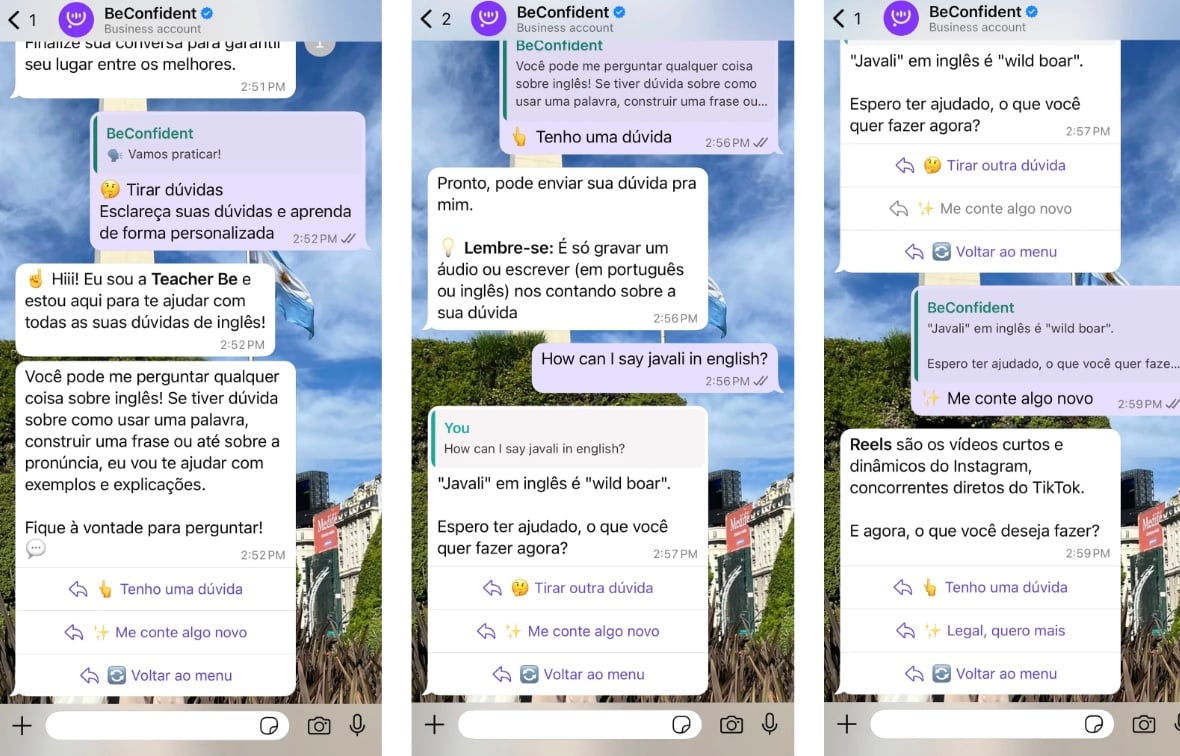
3. Superior cost-benefit: the subscription offers unlimited access to AI conversation for a value well below private lessons, which usually cost between R$ 80 and R$ 120 per hour.
The "My Progress" feature tracks your streak, ranking, hours of practice, and certificates. This data objectively shows progress and helps preserve consistency.
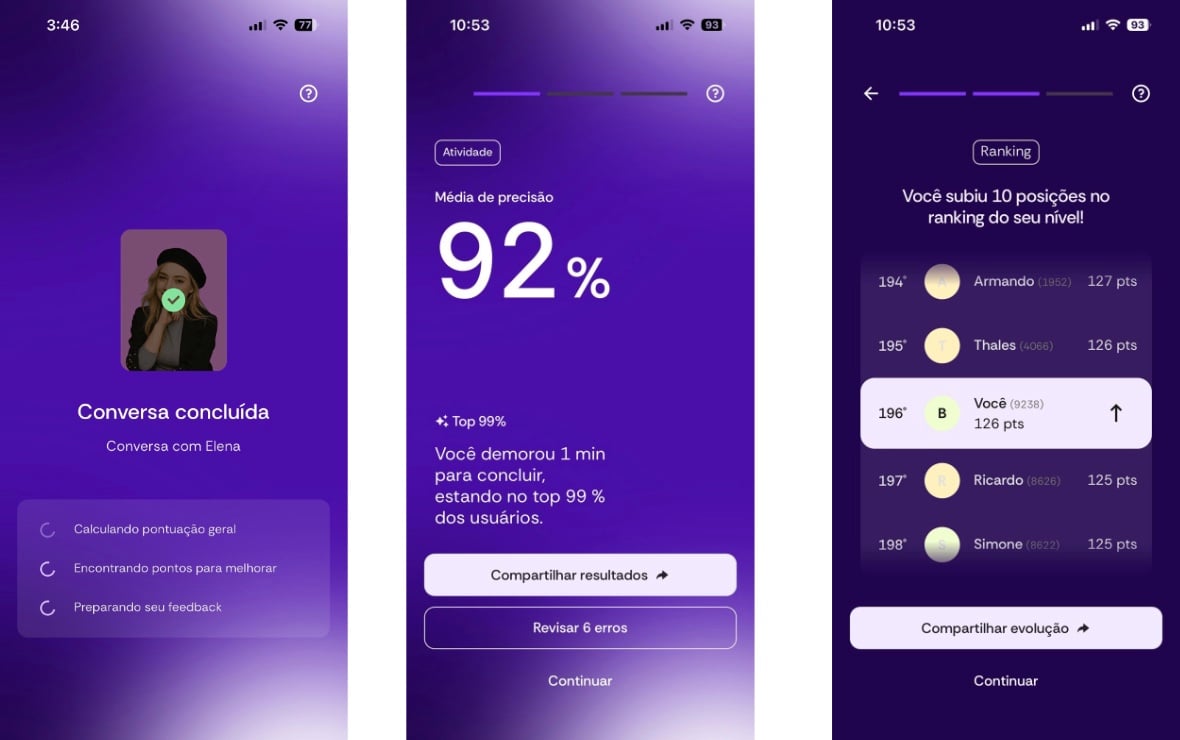
Try out conversations with AI in real situations and compare them with the mechanical exercises of other apps.
Daily routine for results in weeks with the support of free apps
Now that you know the main apps, it is simpler to build a lean routine that combines phonetics, conversation, and review.
Recommended routine:
10 min: phonetic exercises with ELSA or Speechling
20 min: free conversation with BeConfident
5 min: review of mistakes and new vocabulary
Complementary free apps: use Forvo to check specific pronunciations and YouGlish to see words in a real context. Combine these searches with BeConfident speaking practice to cover both sound precision and usage in sentences.
Regardless of the apps chosen, consistency defines the result. Track your progress in the "My Progress" feature, where consecutive days of practice and accumulated hours indicate real progress.
Frequently asked questions
Which is the best app for English pronunciation?
For Brazilians, BeConfident stands out by combining continuous speaking practice and correction geared towards our phonetic patterns. Instead of just drills, the user participates in natural dialogues with an AI trained on common mistakes made by Portuguese speakers.
Is there a free English pronunciation app for Brazilians?
YouGlish and Forvo work well for quick pronunciation lookups. For those looking for personalized feedback and a structured speaking routine, paid apps like BeConfident deliver more consistent results. BeConfident offers a free trial with an analysis of your current level.
ELSA Speak vs BeConfident: which one to choose?
ELSA Speak is strong in detailed phonetic analysis and the correction of specific sounds. BeConfident prioritizes continuous conversations with in-context feedback. For Brazilians who want natural fluency in real-life situations, BeConfident tends to generate more impact, while ELSA works as a sound-focused complement.
How to practice an American accent?
Practicing an American accent requires exposure to native speakers and daily speaking practice. BeConfident offers tutors with different backgrounds and speaking styles, which expands contact with natural variations. Record your voice, compare it to native speakers, adjust specific sounds, and maintain about 30 minutes of daily practice.
Do AI apps for English pronunciation work?
AI apps work well when they combine technical analysis with real speaking situations. The quality of feedback and frequency of use determine the result, and solutions with contextualized conversations tend to outperform repetition-only training.
Conclusion
The three most relevant apps for Brazilians in 2026 are BeConfident, ELSA Speak, and Speechling. BeConfident covers unlimited AI conversation, ELSA deepens phonetic analysis, and Speechling adds human feedback.
To unlock speaking in daily life, the combination of a short routine and consistent conversational practice makes all the difference. Start your free trial now and see how other Brazilians have already progressed in conversational fluency.
Written by: Luan Cavallaro, Founder & CMO, BeConfident
Key takeaways from this article
Many Brazilians face difficulties with English pronunciation due to sounds like the "th", short and long vowels, and intonation. Roadmaps with specialized apps help correct these patterns in just a few weeks.
BeConfident holds the number one position by offering unlimited 24/7 conversational practice with AI that corrects typical mistakes made by Brazilians in real situations.
ELSA Speak stands out for its detailed phonetic analysis of specific sounds, but offers little continuous conversation practice.
Free apps like YouGlish and Forvo help you hear pronunciation in context, but do not provide consistent, personalized feedback.
A daily 30-minute routine combining phonetics and conversation accelerates results. Use BeConfident as the base of this routine: try it free now and level up your pronunciation in a few weeks.
Main pronunciation mistakes made by Brazilians and how apps solve them
The five patterns below explain why many Brazilians still have a strong accent even after years of study. Each of them can be addressed with apps focused on pronunciation and speaking.
1. The "th" sound becomes "t" or "d": words like "think", "thoroughly", and "months" are especially challenging for Portuguese speakers, who tend to substitute the interdental sound with stop consonants.
2. Confusion between "ship" and "sheep": differentiating between short /ɪ/ and long /iː/ vowels is a recurring problem and completely changes the meaning of the words.
3. English R vs Portuguese R: the tapped or trilled R of Portuguese does not exist in English, which creates difficulty in words like "rhythm" and "comfortable".
4. Extra vowels in past tense: Brazilians frequently add extra vowels to "-ed" endings, pronouncing "walked" as "walk-ed" instead of "walkt".
5. Flat intonation: Portuguese has a more uniform intonation, whereas English uses melodic variations to convey intent, emotion, and contrast.
These five patterns explain why most Brazilians are identified by their accent even after years of study. The good news is that each of them can be adjusted with targeted training.
The solution: a routine of 10 minutes a day with specialized apps starts correcting these patterns in a few weeks, as long as you include speaking in context and not just isolated exercises. The table below compares the main apps in price, focus on Brazilians' challenges, and overall rating.
App | Price | Focus | Rating for Brazilian users |
BeConfident | Affordable pricing | Unlimited AI conversation | 9.8/10 |
ELSA Speak | R$ 60/month | Detailed phonetic analysis | 8.5/10 |
Speechling | R$ 45/month | Human and AI feedback | 8.2/10 |
YouGlish | Free | Pronunciation in context | 7.8/10 |
1. BeConfident: app focused on continuous conversation
Pros:
Unlimited conversational practice 24/7 via app, WhatsApp, or smartwatch
AI tutors with diverse personalities and native accents
Immediate feedback on pronunciation, grammar, and fluency
Structured tracks for specific challenges faced by Brazilians
"Review mistakes" feature for targeted correction
Cons:
Requires a monthly subscription, no complete free version
May feel intense for absolute beginners
Why it works for Brazilians: BeConfident works directly on the pronunciation patterns of Brazilian Portuguese. The AI tutors identify recurring mistakes and adjust speech during dialogues about work, travel, and personal routines, making the practice closer to real communication.
With over 200,000 students and a RA 1000 reputation on Reclame Aqui, BeConfident shows consistency in results and service. The focus is on turning spare time into speaking practice that improves fluency.
Discover your CEFR level with a free analysis and receive a diagnosis of your strengths and areas to develop.
2. ELSA Speak: precise phonetic analysis
ELSA Speak works best as a fine-tuning tool for specific sounds and complements a conversation app well.
Pros:
Detailed phonetic analysis of each sound
Exercises focused on problematic sounds
Intuitive interface with gamified elements
Personalized study plans
Cons:
Emphasis on isolated drills
Little continuous speaking practice
High price for part of the Brazilian audience
3. Speechling: combining AI and teachers
While ELSA focuses on isolated sounds, Speechling combines technology with detailed human corrections.
Pros:
Feedback from native teachers
Written corrections with specific guidance
Broad library of useful sentences
Cons:
Response time that can take up to 24 hours
Limited features on the free version
Less focus on spontaneous conversation
4. Forvo: pronunciation dictionary
Forvo works as a quick support to clear up pronunciation doubts about isolated words.
Pros:
Absolutely free access
Pronunciations recorded by native speakers
Multiple accents available
Cons:
Only works with single words
Absence of personalized feedback
Does not show usage context
5. YouGlish: pronunciation in real context
YouGlish uses YouTube videos to show the pronunciation of native speakers and the use of words in context, covering American, British, and Australian accents. The tool helps you observe intonation and rhythm in real situations, but does not correct your speech.
6. Speakometer: measuring fluency
Speakometer measures speech rate and clarity. The tool serves to track general evolution, but offers little detail on how to correct each mistake.
7. Duolingo: basic gamification
Duolingo prioritizes maintaining streaks and vocabulary review. The speaking exercises are simple and do not directly address the pronunciation challenges of Brazilians.
Why is BeConfident the #1 solution for Brazilians?
Among all the graded apps, BeConfident stands out by combining continuous practice, flexibility of use, and affordability.
1. Real conversational practice: while other apps focus on isolated words, you participate in dialogues about work, travel, and personal routines, with real-time corrections. This approach has already won over 200,000 students and maintained an RA 1000 reputation on Reclame Aqui.
2. 24/7 availability: practice takes place in the app, on WhatsApp, or on a smartwatch, which adapts to different routines. This constant availability makes it easier to maintain a daily habit without depending on fixed schedules.
3. Superior cost-benefit: the subscription offers unlimited access to AI conversation for a value well below private lessons, which usually cost between R$ 80 and R$ 120 per hour.
The "My Progress" feature tracks your streak, ranking, hours of practice, and certificates. This data objectively shows progress and helps preserve consistency.
Try out conversations with AI in real situations and compare them with the mechanical exercises of other apps.
Daily routine for results in weeks with the support of free apps
Now that you know the main apps, it is simpler to build a lean routine that combines phonetics, conversation, and review.
Recommended routine:
10 min: phonetic exercises with ELSA or Speechling
20 min: free conversation with BeConfident
5 min: review of mistakes and new vocabulary
Complementary free apps: use Forvo to check specific pronunciations and YouGlish to see words in a real context. Combine these searches with BeConfident speaking practice to cover both sound precision and usage in sentences.
Regardless of the apps chosen, consistency defines the result. Track your progress in the "My Progress" feature, where consecutive days of practice and accumulated hours indicate real progress.
Frequently asked questions
Which is the best app for English pronunciation?
For Brazilians, BeConfident stands out by combining continuous speaking practice and correction geared towards our phonetic patterns. Instead of just drills, the user participates in natural dialogues with an AI trained on common mistakes made by Portuguese speakers.
Is there a free English pronunciation app for Brazilians?
YouGlish and Forvo work well for quick pronunciation lookups. For those looking for personalized feedback and a structured speaking routine, paid apps like BeConfident deliver more consistent results. BeConfident offers a free trial with an analysis of your current level.
ELSA Speak vs BeConfident: which one to choose?
ELSA Speak is strong in detailed phonetic analysis and the correction of specific sounds. BeConfident prioritizes continuous conversations with in-context feedback. For Brazilians who want natural fluency in real-life situations, BeConfident tends to generate more impact, while ELSA works as a sound-focused complement.
How to practice an American accent?
Practicing an American accent requires exposure to native speakers and daily speaking practice. BeConfident offers tutors with different backgrounds and speaking styles, which expands contact with natural variations. Record your voice, compare it to native speakers, adjust specific sounds, and maintain about 30 minutes of daily practice.
Do AI apps for English pronunciation work?
AI apps work well when they combine technical analysis with real speaking situations. The quality of feedback and frequency of use determine the result, and solutions with contextualized conversations tend to outperform repetition-only training.
Conclusion
The three most relevant apps for Brazilians in 2026 are BeConfident, ELSA Speak, and Speechling. BeConfident covers unlimited AI conversation, ELSA deepens phonetic analysis, and Speechling adds human feedback.
To unlock speaking in daily life, the combination of a short routine and consistent conversational practice makes all the difference. Start your free trial now and see how other Brazilians have already progressed in conversational fluency.