




Best AIs to become fluent in English: a guide for 2026
Best AIs to become fluent in English: a guide for 2026
Best AIs to become fluent in English: a guide for 2026
Written by: Luan Cavallaro, Founder & CMO, BeConfident
Key takeaways from this article
AIs expand English learning with 24/7 conversational practice, instant feedback, and personalization, which increases speaking time and confidence compared to traditional methods.
BeConfident is the most complete option for Brazilians, with AI tutors in multiple accents, WhatsApp integration, and personalized pathways that organize your evolution.
Tools like ELSA Speak and Praktika offer good pronunciation features and immersive scenarios, but do not deliver the same combination of flexibility, usage channels, and depth of feedback as BeConfident.
A 4-week roadmap with 30 minutes of daily practice builds a solid foundation to reach B2 fluency, especially when students receive detailed feedback from paid AIs.
To start this plan in practice, use the BeConfident free trial and track your evolution without embarrassment when speaking.
Why AIs for conversational fluency?
Conversational AIs solve the main limitation of traditional courses, which is the lack of opportunity to speak English continuously. AI chatbot users report an increase in confidence when speaking after short periods of use. Studies with students using AI chatbots show an increase in speaking practice time outside the classroom, which accelerates fluency gains.
With these benefits in mind, the next step is choosing the tool that best matches your fluency goal. Below, see how the top AIs of 2026 position themselves and in which cases each one makes the most sense.
Top AIs to become fluent in English in 2026
1. BeConfident: total focus on conversation for Brazilians
BeConfident leads the Brazilian market for AI English conversation, with over 200,000 paying students and 3 million total users. The platform offers AI tutors with distinct personalities and native American, British, South African, Canadian, and Indian accents. Students can practice through the app, WhatsApp, or smartwatch, making it easy to fit English into their routine.
This flexibility combined with structured, personalized pathways organizes study by level and objective. The detailed error review identifies patterns in grammar, vocabulary, and pronunciation. Teacher Be answers specific questions right away, and the "Tell me something new" feature expands vocabulary in real-world contexts. The My Evolution menu displays streaks, ranking, and certificates, helping to maintain consistency.
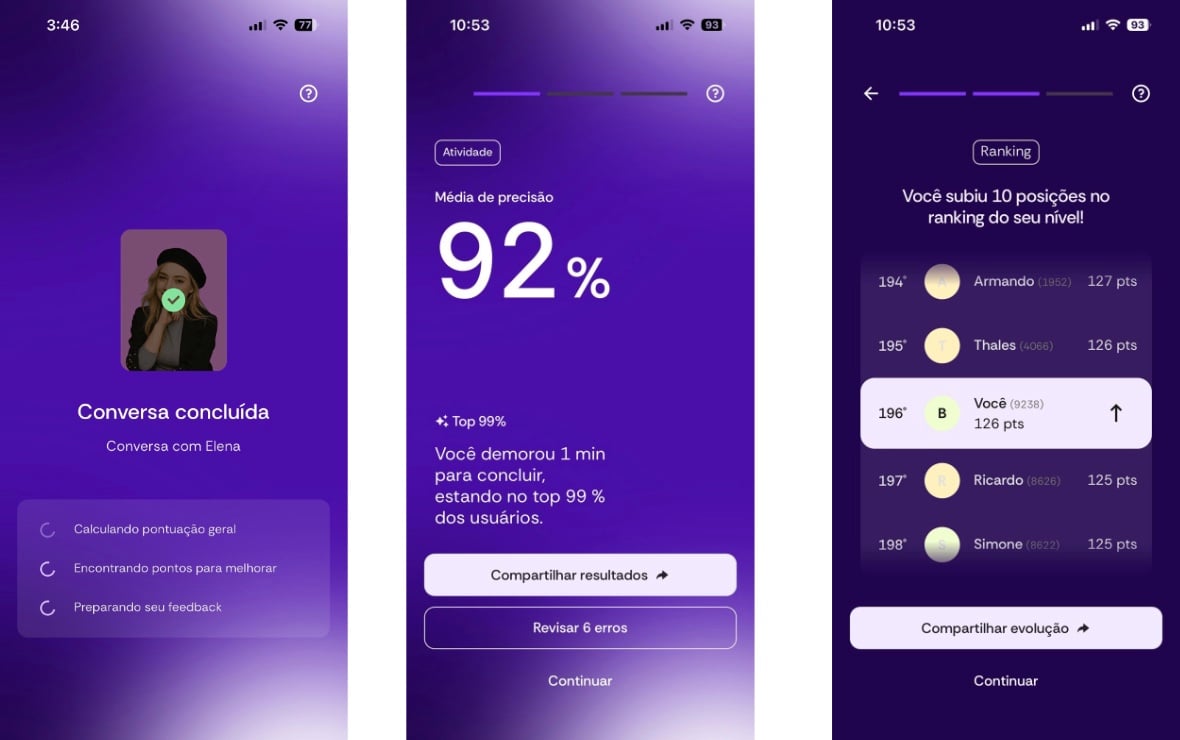
The RA 1000 reputation on Reclame Aqui reinforces trust in the experience. In comparison, Duolingo prioritizes gamification with little deep conversation, and Cambly relies on human tutors with higher costs and variable quality.
For those who want to practice English at any time and channel, starting BeConfident's free trial is a direct way to experience guided conversation with real-time feedback.
2. Praktika: immersive scenarios with a focus on practice
Praktika stands out for its AI tutors with defined personalities and immersive scenarios like airport check-ins and negotiations. This approach favors those who want to simulate specific travel or work situations. The platform is known for prioritizing continuous conversations, attracting many users interested in speaking practice.
The price of approximately US$ 8 per month makes the tool accessible for those seeking initial contact with guided conversation. Compared to BeConfident, Praktika offers less depth of feedback on errors and fewer multi-channel options, limiting long-term evolution tracking.
3. ELSA Speak: precision pronunciation in detail
ELSA Speak offers phoneme-level pronunciation analysis for English, identifying exactly which sounds are pronounced incorrectly and suggesting specific exercises to correct each sound. With over 2.5 million users and modules geared towards IELTS and TOEFL, the tool is a great fit for those who need high pronunciation precision for exams.
The plan costs US$ 19.99 per month. ELSA is better suited as a pronunciation-focused complement than a single conversational solution. For those already practicing speaking on another platform, ELSA refines accent and clarity adjustment.
4. Talkpal: conversation in multiple languages
Talkpal offers grammar corrections, basic pronunciation feedback, and roleplay scenarios in GPT-powered conversations in over 80 languages. This variety serves users who study more than one language and want a single interface.
However, Talkpal's pronunciation feedback often positively reinforces intentional pronunciation errors, reducing reliability for those looking for fine correction. For focusing on English with a B2 fluency goal, the tool works better as a general support rather than a primary solution.
5. Langua: more natural voices and vocabulary tracking
Langua ranks first in voice quality reviews, with natural rhythm, intonation, and breath sounds. The platform uses cloned voices from real native speakers, generating a feeling of conversation closer to a human dialogue.
The app offers detailed feedback, corrections, and vocabulary tracking throughout conversations, supporting over 20 languages at an affordable price. For those who value voice naturalness and want to practice multiple languages, Langua is a consistent alternative. For Brazilians who need Portuguese support and WhatsApp integration, BeConfident tends to be more practical.
6. Speak: focus on error tracking
Speak stands out in error tracking and exercise generation, creating customized content for specific error patterns. The tool combines structured lessons with solid speech recognition in over 15 languages.
The cost varies between US$ 13 and US$ 20 per month. Speak serves those who like to study with organized lessons and want to see clear reports on error types. For quick daily use in a Brazilian context, the lack of integration with channels like WhatsApp reduces convenience compared to BeConfident.
7. ChatGPT: versatility with speech limitations
ChatGPT is one of the most versatile AI tools for English conversation practice, with the ability to simulate job interviews, business meetings, and informal dialogues. The basic free version allows testing various practice formats at no upfront cost.
On the other hand, speech detection is not optimized for language learners and often interrupts users mid-sentence. This reduces conversational flow for those who need to practice continuous speaking. As a result, ChatGPT works best as occasional support for texts, dialogue ideas, and vocabulary rather than a primary guided conversation solution.
Comparison: BeConfident in relation to other tools
When comparing the top AIs, the difference is less about the
Written by: Luan Cavallaro, Founder & CMO, BeConfident
Key takeaways from this article
AIs expand English learning with 24/7 conversational practice, instant feedback, and personalization, which increases speaking time and confidence compared to traditional methods.
BeConfident is the most complete option for Brazilians, with AI tutors in multiple accents, WhatsApp integration, and personalized pathways that organize your evolution.
Tools like ELSA Speak and Praktika offer good pronunciation features and immersive scenarios, but do not deliver the same combination of flexibility, usage channels, and depth of feedback as BeConfident.
A 4-week roadmap with 30 minutes of daily practice builds a solid foundation to reach B2 fluency, especially when students receive detailed feedback from paid AIs.
To start this plan in practice, use the BeConfident free trial and track your evolution without embarrassment when speaking.
Why AIs for conversational fluency?
Conversational AIs solve the main limitation of traditional courses, which is the lack of opportunity to speak English continuously. AI chatbot users report an increase in confidence when speaking after short periods of use. Studies with students using AI chatbots show an increase in speaking practice time outside the classroom, which accelerates fluency gains.
With these benefits in mind, the next step is choosing the tool that best matches your fluency goal. Below, see how the top AIs of 2026 position themselves and in which cases each one makes the most sense.
Top AIs to become fluent in English in 2026
1. BeConfident: total focus on conversation for Brazilians
BeConfident leads the Brazilian market for AI English conversation, with over 200,000 paying students and 3 million total users. The platform offers AI tutors with distinct personalities and native American, British, South African, Canadian, and Indian accents. Students can practice through the app, WhatsApp, or smartwatch, making it easy to fit English into their routine.
This flexibility combined with structured, personalized pathways organizes study by level and objective. The detailed error review identifies patterns in grammar, vocabulary, and pronunciation. Teacher Be answers specific questions right away, and the "Tell me something new" feature expands vocabulary in real-world contexts. The My Evolution menu displays streaks, ranking, and certificates, helping to maintain consistency.
The RA 1000 reputation on Reclame Aqui reinforces trust in the experience. In comparison, Duolingo prioritizes gamification with little deep conversation, and Cambly relies on human tutors with higher costs and variable quality.
For those who want to practice English at any time and channel, starting BeConfident's free trial is a direct way to experience guided conversation with real-time feedback.
2. Praktika: immersive scenarios with a focus on practice
Praktika stands out for its AI tutors with defined personalities and immersive scenarios like airport check-ins and negotiations. This approach favors those who want to simulate specific travel or work situations. The platform is known for prioritizing continuous conversations, attracting many users interested in speaking practice.
The price of approximately US$ 8 per month makes the tool accessible for those seeking initial contact with guided conversation. Compared to BeConfident, Praktika offers less depth of feedback on errors and fewer multi-channel options, limiting long-term evolution tracking.
3. ELSA Speak: precision pronunciation in detail
ELSA Speak offers phoneme-level pronunciation analysis for English, identifying exactly which sounds are pronounced incorrectly and suggesting specific exercises to correct each sound. With over 2.5 million users and modules geared towards IELTS and TOEFL, the tool is a great fit for those who need high pronunciation precision for exams.
The plan costs US$ 19.99 per month. ELSA is better suited as a pronunciation-focused complement than a single conversational solution. For those already practicing speaking on another platform, ELSA refines accent and clarity adjustment.
4. Talkpal: conversation in multiple languages
Talkpal offers grammar corrections, basic pronunciation feedback, and roleplay scenarios in GPT-powered conversations in over 80 languages. This variety serves users who study more than one language and want a single interface.
However, Talkpal's pronunciation feedback often positively reinforces intentional pronunciation errors, reducing reliability for those looking for fine correction. For focusing on English with a B2 fluency goal, the tool works better as a general support rather than a primary solution.
5. Langua: more natural voices and vocabulary tracking
Langua ranks first in voice quality reviews, with natural rhythm, intonation, and breath sounds. The platform uses cloned voices from real native speakers, generating a feeling of conversation closer to a human dialogue.
The app offers detailed feedback, corrections, and vocabulary tracking throughout conversations, supporting over 20 languages at an affordable price. For those who value voice naturalness and want to practice multiple languages, Langua is a consistent alternative. For Brazilians who need Portuguese support and WhatsApp integration, BeConfident tends to be more practical.
6. Speak: focus on error tracking
Speak stands out in error tracking and exercise generation, creating customized content for specific error patterns. The tool combines structured lessons with solid speech recognition in over 15 languages.
The cost varies between US$ 13 and US$ 20 per month. Speak serves those who like to study with organized lessons and want to see clear reports on error types. For quick daily use in a Brazilian context, the lack of integration with channels like WhatsApp reduces convenience compared to BeConfident.
7. ChatGPT: versatility with speech limitations
ChatGPT is one of the most versatile AI tools for English conversation practice, with the ability to simulate job interviews, business meetings, and informal dialogues. The basic free version allows testing various practice formats at no upfront cost.
On the other hand, speech detection is not optimized for language learners and often interrupts users mid-sentence. This reduces conversational flow for those who need to practice continuous speaking. As a result, ChatGPT works best as occasional support for texts, dialogue ideas, and vocabulary rather than a primary guided conversation solution.
Comparison: BeConfident in relation to other tools
When comparing the top AIs, the difference is less about the