




How to overcome the fear of speaking English in practice?
How to overcome the fear of speaking English in practice?
How to overcome the fear of speaking English in practice?
Written by: Luan Cavallaro, Founder & CMO, BeConfident
Key takeaways from this article
Shift your mindset and treat mistakes as a source of learning, practice positive self-talk, and prioritize communication over perfection.
Create a 15-minute daily routine with shadowing, voice recording, and monologues on familiar topics to build consistency without pressure.
Practice real career and travel scenarios with essential scripts to gain confidence in professional and everyday situations.
Use AI conversation for continuous practice, without judgment, with instant feedback and various native accents.
Track your progress with streak tracking and CEFR levels on BeConfident, take the free test, and advance in conversational fluency.
Step 1: Shift your mindset and use mistakes as a superpower
Treating mistakes as learning data reduces the fear of speaking. AI tools like ChatGPT significantly reduce anxiety in English students because they create an environment free of judgment.
Some practical strategies to reframe your mind:
Practice positive self-talk: "I can communicate" instead of "I'm going to mess everything up."
Visualize successful situations, such as speaking confidently in a meeting or during a trip.
Focus on getting the message across, not on getting all the grammar right.
Daily script (3 minutes): look in the mirror and say: "Mistakes make me better. I can communicate in English." Repeat until it sounds natural.
Step 2: Create a 15-minute daily routine without pressure
Maintaining daily consistency yields better results than studying in long, sporadic blocks. A group of 94% of Spanish-speaking adults reported more confidence after 12 weeks of regular practice.
A simple way to structure the routine:
Set a fixed time, in the morning or at night, and stick to that commitment.
Narrate your own routine in English: "I'm brushing my teeth, now I'm making coffee."
Avoid self-criticism and focus solely on exposure to the language.
Use apps like BeConfident to track streaks and maintain motivation.
Setting aside 15 minutes a day usually generates more progress than studying for 2 hours only once a week.
Step 3: Use the shadowing technique with native speakers
Applying shadowing helps incorporate the rhythm, intonation, and pronunciation of native speakers. Pausing native speaker audio and repeating sentence by sentence brings the student closer to the natural rhythm of English.
A simple step-by-step for shadowing:
Choose a short podcast or video, 2 to 3 minutes long, featuring a native speaker.
Listen once to understand the general idea.
Play sentence by sentence, mimicking the sound as closely as possible.
Pay attention to the rhythm and melody, not just isolated words.
Starting script: “Hi, how’s your day going? I’m doing pretty well, thanks for asking.” Repeat until speech flows naturally.
Step 4: Record your own voice and self-correct
Recording your own voice allows you to identify areas for improvement clearly. Many people avoid listening to themselves, but this practice accelerates progress.
A simple method for structured recording:
Record a 1-minute monologue about your day.
Listen to it twice: the first time just to accept your own voice, the second to analyze it.
Pick a specific error, such as pronunciation, grammar, or fluency.
Re-record the same segment focusing solely on correcting that point.
Using your phone's voice recorder is already enough. The goal is to develop awareness of your own speech patterns, not to seek perfection.
Step 5: Practice monologues about your routine
Speaking about familiar topics creates a low-pressure practice environment. Describing your own day is an example of a safe context to start.
Some simple topics for monologues:
Describe your morning: “I woke up at 7 AM, had coffee and checked emails”.
Talk about work: “I’m a software engineer, I work with Python”.
Talk about hobbies: “In my free time, I enjoy reading and watching Netflix”.
Daily goal: speak for 5 minutes about a different topic. Start with simple sentences and gradually increase complexity.
Step 6: Simulate career scenarios, interviews, and meetings
Mastering English in professional contexts increases career opportunities. Focusing your attention on your own expertise reduces linguistic anxiety.
Some useful scripts for career situations:
Personal introduction: “Tell me about your experience with [your area]”.
Project explanation: “I led a team of 5 developers to implement...”.
Questions in meetings: “Could you clarify the project timeline?”.
Polite interruption: “Sorry to interrupt, but I have a question”.
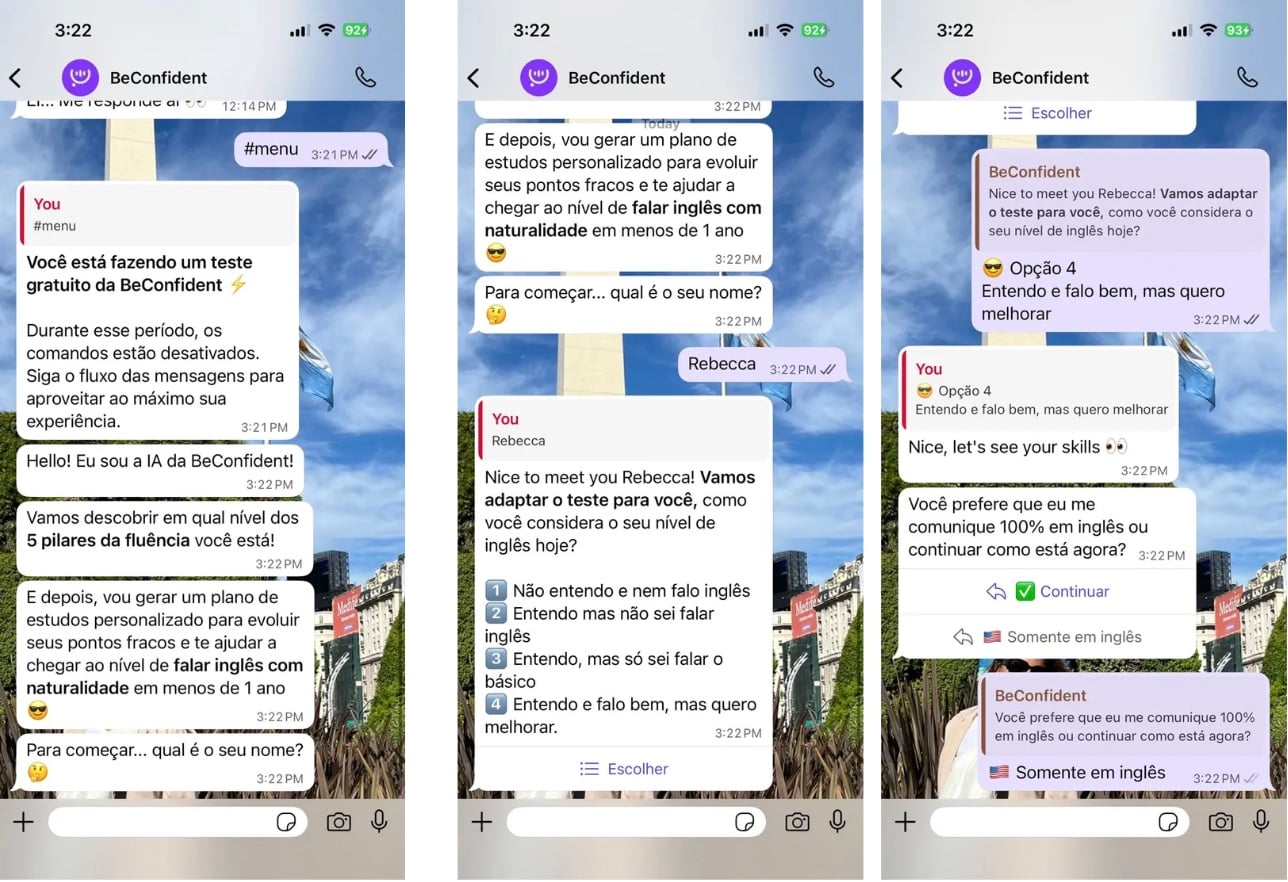
Try it for free and start learning English today and practice these scenarios with AI tutors focused on professional context.
Step 7: Train travel dialogues for airport and restaurant situations
Using travel situations makes practice easier because the context is predictable. This type of dialogue helps build confidence for quick interactions abroad.
Some essential dialogues for travelers:
At the airport: “Where is gate B12?” and “Is this the line for check-in?”.
At the hotel: “I have a reservation under [your name]” and “What time is checkout?”.
In the restaurant: “Could I see the menu?” and “I’d like to order the salmon”.
Asking for directions: “How do I get to the city center?” and “Is it walking distance?”.
Training with different accents, like American, British, and Australian, prepares your ear for various destinations.
Step 8: Include AI conversation in your routine
Using AI in language learning allows for constant, personalized practice. Emotionally intelligent AI tutors can lead to faster progress, as they adapt to the student's pace and offer continuous feedback.
Some advantages of BeConfident for conversation:
AI tutors with native accents, such as American, British, and South African.
Available 24 hours a day on the app, WhatsApp, or smartwatch.
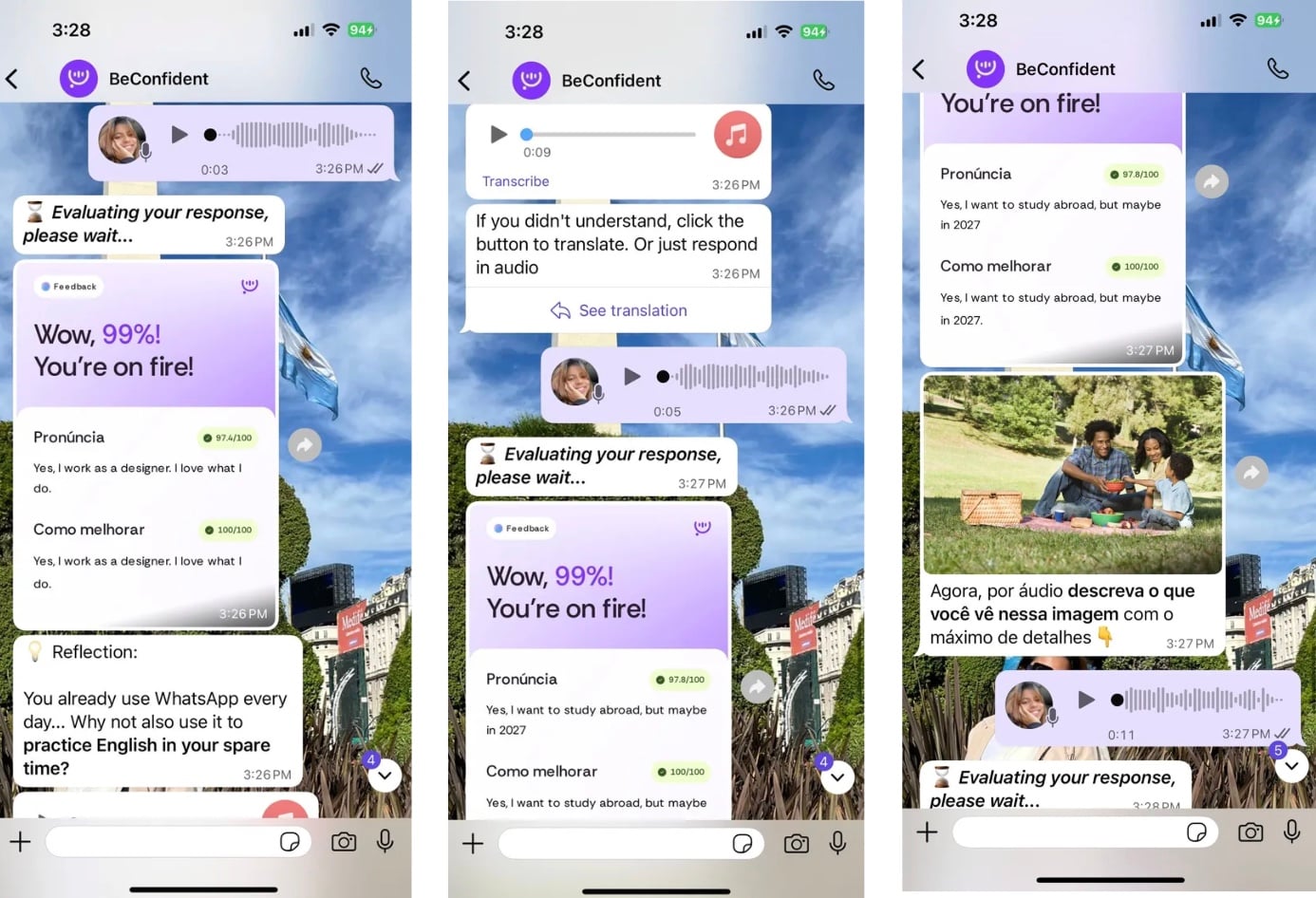
Instant feedback without exposure to human judgment.
Personalized topics tailored to your career and personal interests.
Real testimonial: "I used to have a hard time speaking, even though I read and listened well. I got BeConfident and within a month I was speaking naturally, without getting stuck."
Step 9: Use instant feedback to review mistakes
Receiving quality feedback accelerates learning. Many apps prioritize only gamification and do not correct conversational errors with depth.
A practical way to use feedback:
Review conversation history to identify error patterns.
Choose up to 3 specific points per day to correct.
Use BeConfident's "Review Errors" feature for grammar and pronunciation.
Ask for detailed explanations whenever a correction is not clear.
Correcting errors right after speaking reduces the chance of creating habits that are hard to change.
Step 10: Track your progress with streaks and CEFR
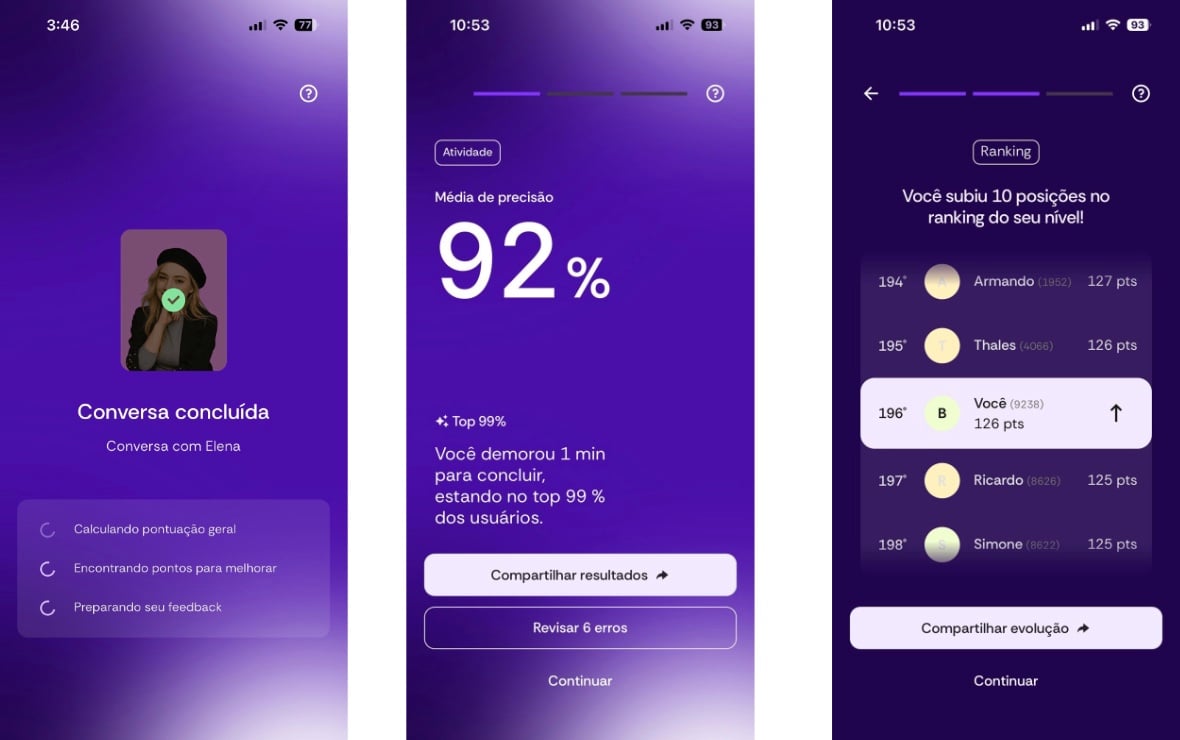
Measuring progress helps maintain motivation and adjust the study plan. BeConfident offers a dashboard under the "My Progress" menu, used by over 200,000 paying students.
Some important metrics to track:
Daily practice streaks, which show consistency.
Total accumulated hours of conversation.
Evolution in the CEFR level, from A1 to C2.
Certificates by area, such as grammar, pronunciation, and fluency.
While platforms like Cambly charge by the hour, BeConfident offers unlimited practice for a flat price and maintains an RA 1000 rating on Reclame Aqui.
FAQ: common questions about practicing English without fear
How to practice English without fear at home?
A routine of 15 daily minutes narrating activities, combined with shadowing using podcasts, recording monologues, and practicing with BeConfident's AI, creates a safe environment. Practicing at home reduces social pressure and allows you to make mistakes without embarrassment.
Which app to use to talk to AI in English?
BeConfident offers personalized AI tutors, various native accents, and instant feedback. The focus is on unlimited conversation and fluency, not just gamified exercises.
Does BeConfident work for beginners?
Yes. The free test identifies your CEFR level and automatically adjusts the content. Beginners start with basic vocabulary and progress gradually, while intermediate students work on fluency and confidence.
How to unlock the brain to learn English?
Treating mistakes as learning data, practicing positive self-talk, visualizing successful situations, and talking with AI reduce judgment anxiety. The brain learns best in a safe and encouraging environment.
How to lose fear in technical interviews?
Preparing scripts for frequently asked questions, practicing project explanations in English, and focusing on your own technical expertise helps reduce tension. Simulations with professional tutors from BeConfident allow you to receive specific feedback before the actual interview.
Conclusion: take the next step in fluency
Losing the fear of speaking English involves 10 practical steps: adjusting your mindset, keeping a consistent routine, applying shadowing, recording your own voice, practicing monologues, simulating professional scenarios, practicing travel dialogues, conversing with AI, using structured feedback, and tracking progress. Over 3 million users in 100 countries have already applied this approach with BeConfident.
Try it for free and start learning English today with no commitment, find out your level and practice with personalized AI tutors.
Written by: Luan Cavallaro, Founder & CMO, BeConfident
Key takeaways from this article
Shift your mindset and treat mistakes as a source of learning, practice positive self-talk, and prioritize communication over perfection.
Create a 15-minute daily routine with shadowing, voice recording, and monologues on familiar topics to build consistency without pressure.
Practice real career and travel scenarios with essential scripts to gain confidence in professional and everyday situations.
Use AI conversation for continuous practice, without judgment, with instant feedback and various native accents.
Track your progress with streak tracking and CEFR levels on BeConfident, take the free test, and advance in conversational fluency.
Step 1: Shift your mindset and use mistakes as a superpower
Treating mistakes as learning data reduces the fear of speaking. AI tools like ChatGPT significantly reduce anxiety in English students because they create an environment free of judgment.
Some practical strategies to reframe your mind:
Practice positive self-talk: "I can communicate" instead of "I'm going to mess everything up."
Visualize successful situations, such as speaking confidently in a meeting or during a trip.
Focus on getting the message across, not on getting all the grammar right.
Daily script (3 minutes): look in the mirror and say: "Mistakes make me better. I can communicate in English." Repeat until it sounds natural.
Step 2: Create a 15-minute daily routine without pressure
Maintaining daily consistency yields better results than studying in long, sporadic blocks. A group of 94% of Spanish-speaking adults reported more confidence after 12 weeks of regular practice.
A simple way to structure the routine:
Set a fixed time, in the morning or at night, and stick to that commitment.
Narrate your own routine in English: "I'm brushing my teeth, now I'm making coffee."
Avoid self-criticism and focus solely on exposure to the language.
Use apps like BeConfident to track streaks and maintain motivation.
Setting aside 15 minutes a day usually generates more progress than studying for 2 hours only once a week.
Step 3: Use the shadowing technique with native speakers
Applying shadowing helps incorporate the rhythm, intonation, and pronunciation of native speakers. Pausing native speaker audio and repeating sentence by sentence brings the student closer to the natural rhythm of English.
A simple step-by-step for shadowing:
Choose a short podcast or video, 2 to 3 minutes long, featuring a native speaker.
Listen once to understand the general idea.
Play sentence by sentence, mimicking the sound as closely as possible.
Pay attention to the rhythm and melody, not just isolated words.
Starting script: “Hi, how’s your day going? I’m doing pretty well, thanks for asking.” Repeat until speech flows naturally.
Step 4: Record your own voice and self-correct
Recording your own voice allows you to identify areas for improvement clearly. Many people avoid listening to themselves, but this practice accelerates progress.
A simple method for structured recording:
Record a 1-minute monologue about your day.
Listen to it twice: the first time just to accept your own voice, the second to analyze it.
Pick a specific error, such as pronunciation, grammar, or fluency.
Re-record the same segment focusing solely on correcting that point.
Using your phone's voice recorder is already enough. The goal is to develop awareness of your own speech patterns, not to seek perfection.
Step 5: Practice monologues about your routine
Speaking about familiar topics creates a low-pressure practice environment. Describing your own day is an example of a safe context to start.
Some simple topics for monologues:
Describe your morning: “I woke up at 7 AM, had coffee and checked emails”.
Talk about work: “I’m a software engineer, I work with Python”.
Talk about hobbies: “In my free time, I enjoy reading and watching Netflix”.
Daily goal: speak for 5 minutes about a different topic. Start with simple sentences and gradually increase complexity.
Step 6: Simulate career scenarios, interviews, and meetings
Mastering English in professional contexts increases career opportunities. Focusing your attention on your own expertise reduces linguistic anxiety.
Some useful scripts for career situations:
Personal introduction: “Tell me about your experience with [your area]”.
Project explanation: “I led a team of 5 developers to implement...”.
Questions in meetings: “Could you clarify the project timeline?”.
Polite interruption: “Sorry to interrupt, but I have a question”.
Try it for free and start learning English today and practice these scenarios with AI tutors focused on professional context.
Step 7: Train travel dialogues for airport and restaurant situations
Using travel situations makes practice easier because the context is predictable. This type of dialogue helps build confidence for quick interactions abroad.
Some essential dialogues for travelers:
At the airport: “Where is gate B12?” and “Is this the line for check-in?”.
At the hotel: “I have a reservation under [your name]” and “What time is checkout?”.
In the restaurant: “Could I see the menu?” and “I’d like to order the salmon”.
Asking for directions: “How do I get to the city center?” and “Is it walking distance?”.
Training with different accents, like American, British, and Australian, prepares your ear for various destinations.
Step 8: Include AI conversation in your routine
Using AI in language learning allows for constant, personalized practice. Emotionally intelligent AI tutors can lead to faster progress, as they adapt to the student's pace and offer continuous feedback.
Some advantages of BeConfident for conversation:
AI tutors with native accents, such as American, British, and South African.
Available 24 hours a day on the app, WhatsApp, or smartwatch.
Instant feedback without exposure to human judgment.
Personalized topics tailored to your career and personal interests.
Real testimonial: "I used to have a hard time speaking, even though I read and listened well. I got BeConfident and within a month I was speaking naturally, without getting stuck."
Step 9: Use instant feedback to review mistakes
Receiving quality feedback accelerates learning. Many apps prioritize only gamification and do not correct conversational errors with depth.
A practical way to use feedback:
Review conversation history to identify error patterns.
Choose up to 3 specific points per day to correct.
Use BeConfident's "Review Errors" feature for grammar and pronunciation.
Ask for detailed explanations whenever a correction is not clear.
Correcting errors right after speaking reduces the chance of creating habits that are hard to change.
Step 10: Track your progress with streaks and CEFR
Measuring progress helps maintain motivation and adjust the study plan. BeConfident offers a dashboard under the "My Progress" menu, used by over 200,000 paying students.
Some important metrics to track:
Daily practice streaks, which show consistency.
Total accumulated hours of conversation.
Evolution in the CEFR level, from A1 to C2.
Certificates by area, such as grammar, pronunciation, and fluency.
While platforms like Cambly charge by the hour, BeConfident offers unlimited practice for a flat price and maintains an RA 1000 rating on Reclame Aqui.
FAQ: common questions about practicing English without fear
How to practice English without fear at home?
A routine of 15 daily minutes narrating activities, combined with shadowing using podcasts, recording monologues, and practicing with BeConfident's AI, creates a safe environment. Practicing at home reduces social pressure and allows you to make mistakes without embarrassment.
Which app to use to talk to AI in English?
BeConfident offers personalized AI tutors, various native accents, and instant feedback. The focus is on unlimited conversation and fluency, not just gamified exercises.
Does BeConfident work for beginners?
Yes. The free test identifies your CEFR level and automatically adjusts the content. Beginners start with basic vocabulary and progress gradually, while intermediate students work on fluency and confidence.
How to unlock the brain to learn English?
Treating mistakes as learning data, practicing positive self-talk, visualizing successful situations, and talking with AI reduce judgment anxiety. The brain learns best in a safe and encouraging environment.
How to lose fear in technical interviews?
Preparing scripts for frequently asked questions, practicing project explanations in English, and focusing on your own technical expertise helps reduce tension. Simulations with professional tutors from BeConfident allow you to receive specific feedback before the actual interview.
Conclusion: take the next step in fluency
Losing the fear of speaking English involves 10 practical steps: adjusting your mindset, keeping a consistent routine, applying shadowing, recording your own voice, practicing monologues, simulating professional scenarios, practicing travel dialogues, conversing with AI, using structured feedback, and tracking progress. Over 3 million users in 100 countries have already applied this approach with BeConfident.
Try it for free and start learning English today with no commitment, find out your level and practice with personalized AI tutors.