




How to practice English on your own: 12 tips to practice speaking
How to practice English on your own: 12 tips to practice speaking
How to practice English on your own: 12 tips to practice speaking
Written by: Luan Cavallaro, Founder & CMO, BeConfident
Key takeaways from this article
Practicing English alone offers schedule flexibility, zero cost, and a judgment-free environment, which favors consistency in study.
Techniques like thinking in English, narrating your routine, and using shadowing improve pronunciation and automatism in 10 to 20 minutes daily.
Recordings, roleplays, and immersion in series generate feedback through self-evaluation and contact with natural language, which reduces hesitation when speaking.
AI apps like ELSA Speak help with pronunciation, but they still do not deliver truly dynamic dialogues for complete evolution.
BeConfident offers 24/7 AI tutors, instant feedback, and personalized learning paths; take a free trial to have unlimited conversation at home.
Why practicing conversation alone is essential
Practicing alone ensures total schedule flexibility, absence of high costs, and a judgment-free environment. These factors increase the chance of maintaining a stable study routine. Unlike schools with fixed schedules and classroom pressure, individual study allows you to test of phrases, make mistakes, and correct them without embarrassment.
Passive methods like talking to the mirror or making isolated recordings help to a certain extent, but they do not replace a real dialogue with an immediate response. The natural evolution is to use interactive tools that simulate conversations, offer real-time corrections, and maintain interest with varied dialogues.
12 practical tips for practicing English conversation alone
1. Thinking in English throughout the day
Turning your internal monologue into English speeds up mental processing and reduces word-for-word translation. Start with simple phrases like "I need to buy groceries" and progress to longer thoughts as you gain confidence.
2. Narrating your routine out loud
Describing actions as you perform tasks creates automatism. Phrases like "I'm making coffee" or "I'm checking emails" connect vocabulary to real experience. Set aside 10 to 15 minutes a day during household activities.
3. Using the shadowing technique for beginners
Listen to phrases, pause, and repeat, copying intonation and speed in 5 to 10 daily cycles. This practice improves pronunciation and natural rhythm through imitation. Choose audios compatible with your level to avoid frustration.
4. Recording audios and evaluating your own pronunciation
Record short audios answering questions or narrating your day. This routine helps identify recurring errors and measure progress by comparing old recordings. Pay special attention to the schwa sound, which is very frequent in English.
5. Talking to the mirror simulating dialogues
Simulating conversations about daily or work topics reduces shyness and brings practice closer to real interaction. Vary scenarios such as interviews, presentations, and informal conversations to broaden your repertoire.
6. Using voice recognition tools
Dictation in Google Docs or sending audios on WhatsApp allows you to verify if the system understands what you say. This process generates immediate feedback on pronunciation clarity. Adjust speed and articulation until recognition becomes consistent.
7. Reading news and books aloud
Search for English texts at your level, preferably with audio. Reading aloud develops oral fluency and familiarity with more formal structures. Practice for 15 to 20 minutes a day to consolidate rhythm and intonation.
8. Creating solo roleplays
Simulating real situations like ordering in restaurants, meetings, or negotiations prepares you for specific contexts. Write small scripts, practice out loud, and then improvise variations to gain flexibility.
9. Memorizing micro-phrases in chunks
Use ready-made expressions like "I'm not sure" or "I guess so" to reduce hesitation. These ready-to-use units speed up speech and can easily fit into simulated dialogues.
10. Creating immersion with series and podcasts
Watch content in English, preferably without Portuguese subtitles, and pause to repeat phrases you find useful. This habit exposes you to different accents and everyday language. Combine entertainment with notes of vocabulary and expressions.
11. Using free apps as a gateway
ELSA Speak offers short dialogues with AI to practice pronunciation. The app works as an affordable introduction to practice with automated feedback, especially in the first months of study.
12. Evolving with AI using BeConfident tutors
The practice of unlimited conversation with artificial intelligence tutors via app, WhatsApp, or smartwatch provides instant and personalized feedback. This approach reduces the limitations of purely solitary methods and keeps practice available 24 hours a day.
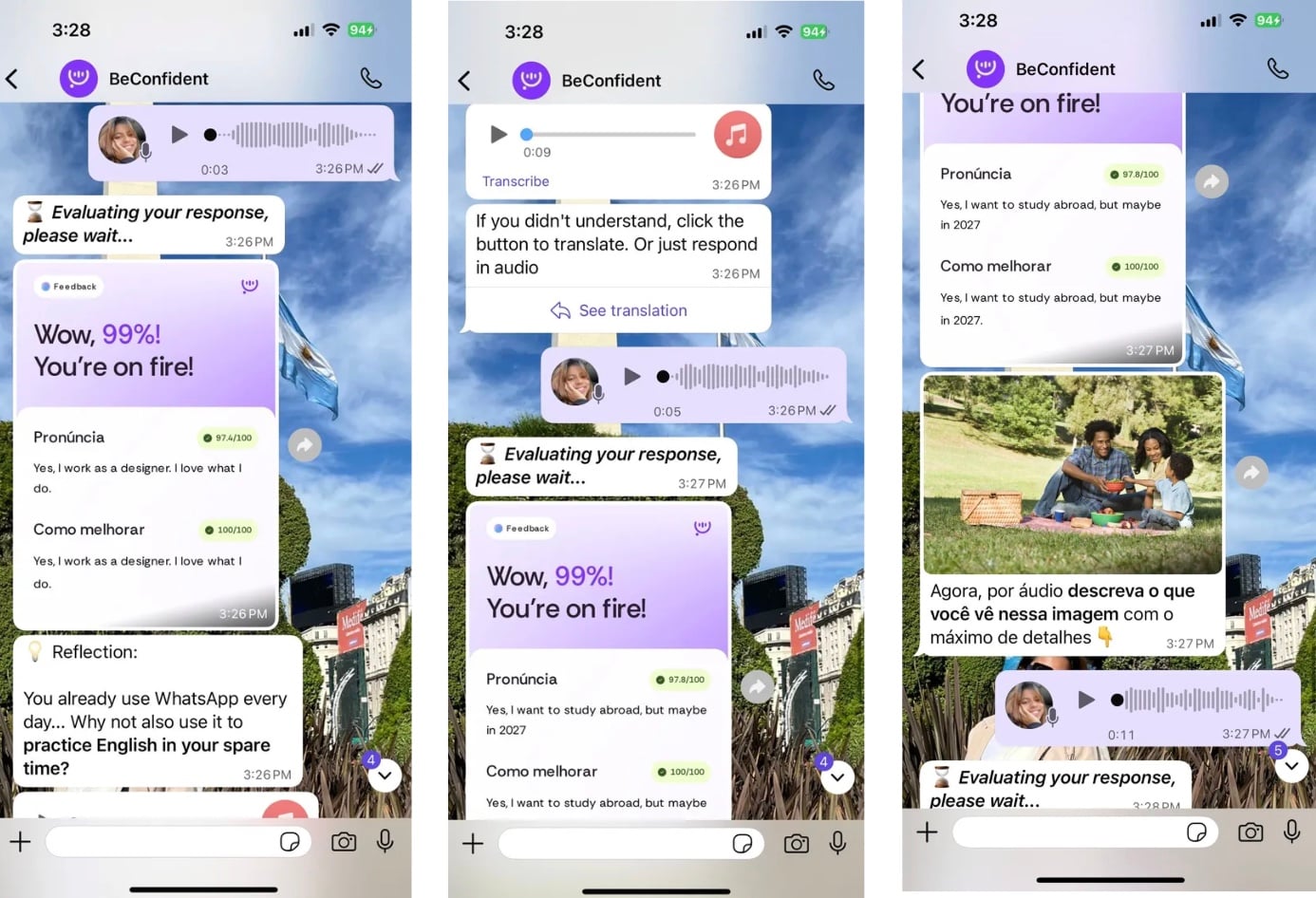
These free strategies build a solid foundation, but they still leave a gap in real interaction. Tools that simulate dialogue with real-time feedback fill this gap and accelerate progress.
The solution with 24/7 interactive practice via AI
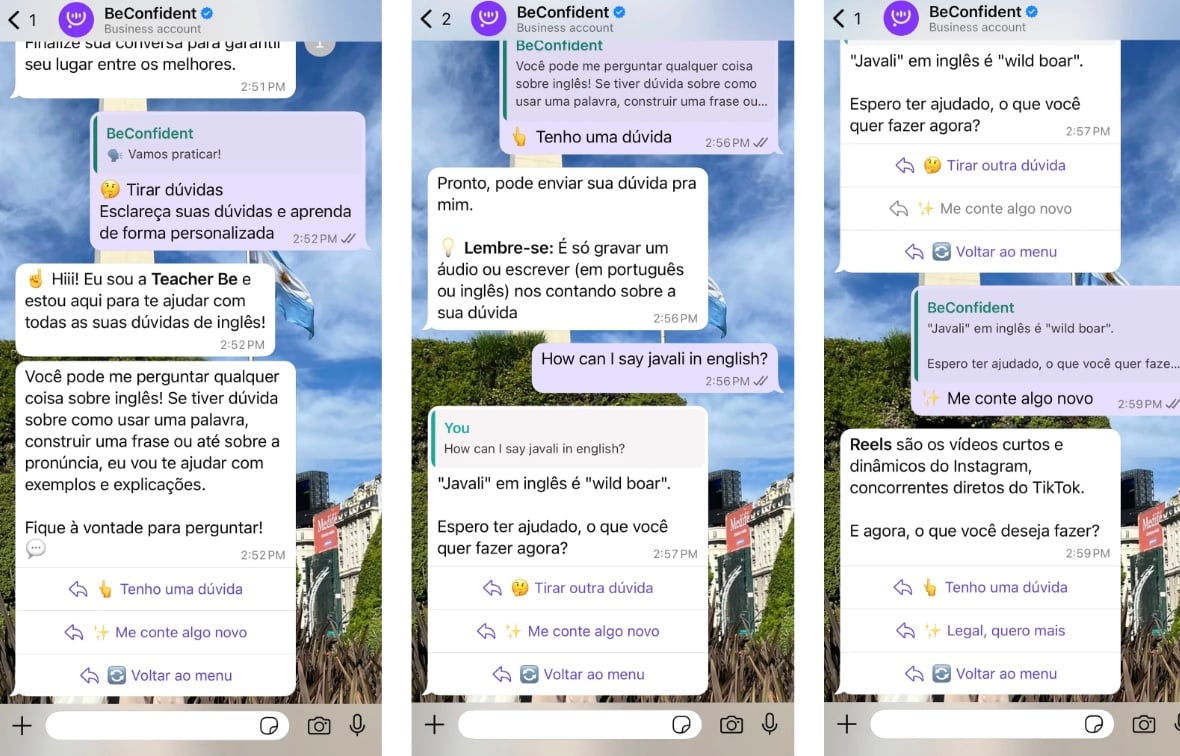
BeConfident expands the potential of individual practice by offering AI tutors with distinct personalities and native American, British, Australian, Canadian, South African, and Indian accents. Instead of focusing only on streaks and games, the platform prioritizes natural conversations with immediate feedback on what you say.
Key features:
Audio conversation and simulated "calls" via WhatsApp or proprietary app
Instant error correction of grammar, pronunciation, and naturalness
Structured paths personalized by level and goal
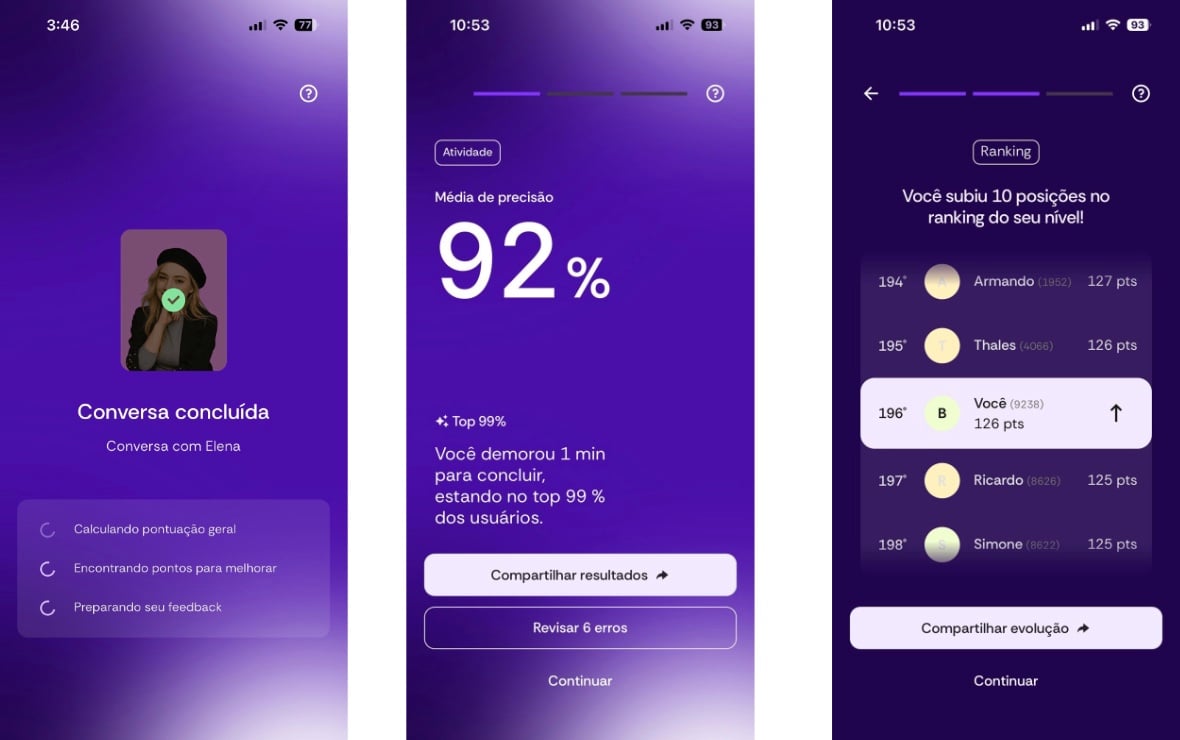
"My progress" area with progress metrics and certificates
"Tell me something new" command to expand repertoire with facts and curiosities
With over 140,000 paying students and RA 1000 reputation on Reclame Aqui, BeConfident presents consistent results in fluency and confidence when speaking. Take a free trial and experience practice with personalized AI.
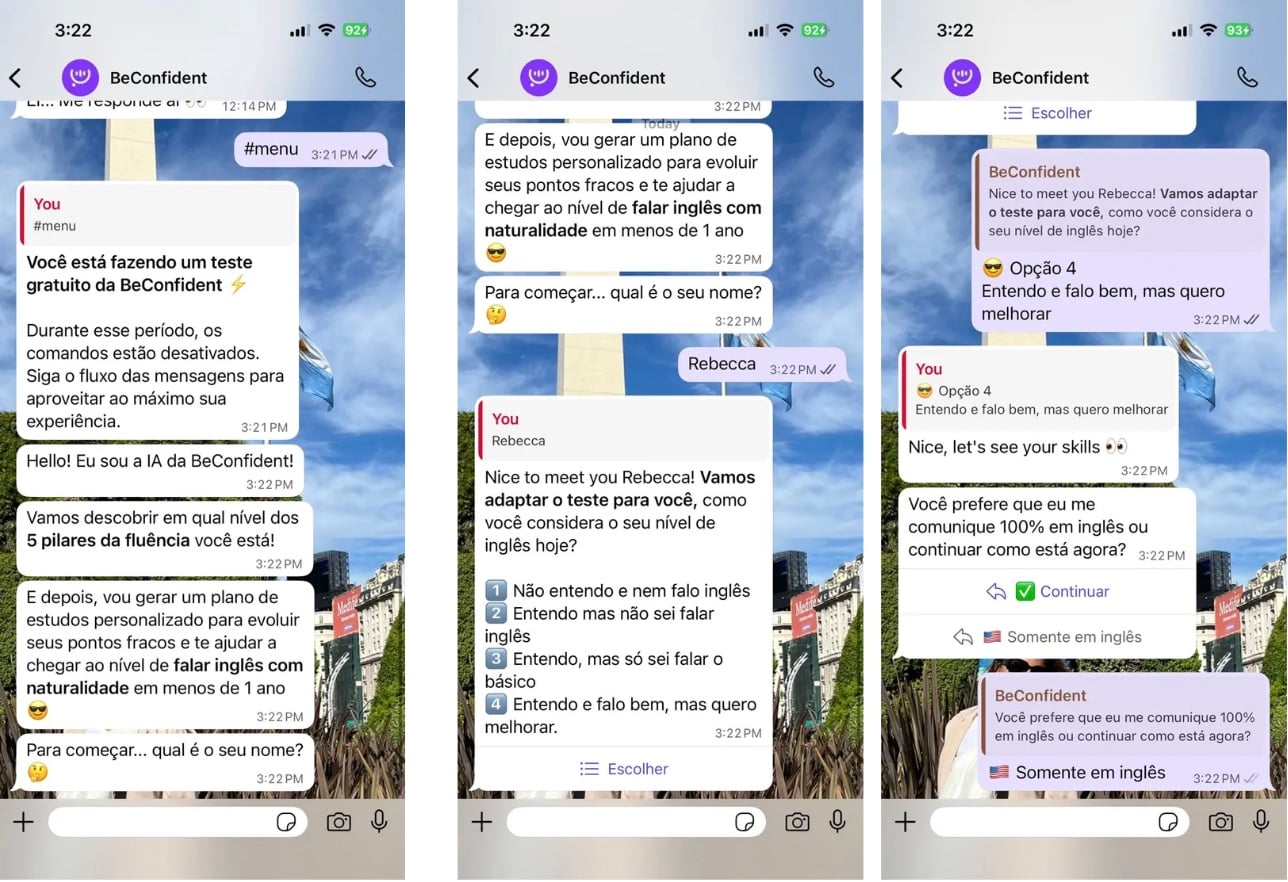
Student testimonials indicate clear gains in confidence and clarity in speech:
"The tool offers detailed feedback that I didn't have in traditional schools. It has been crucial for me to overcome my grammatical difficulties."
"I had a lot of difficulty speaking, despite reading and listening well. In one month I was already speaking naturally, without getting stuck."
"Constant practice with the AI helped me resolve my frustration with forgetting words at crucial moments."
Comparisons between BeConfident, competitors, and traditional methods
The choice of practice tool directly influences the speed of progress. Traditional methods offer less flexibility, while AI solutions expand exposure to conversation.
Method/App | Real interaction | Cost/accessibility | Personalized feedback |
Duolingo | Low, focus on streaks | Free in the basic plan | Immediate, but limited to the exercise format |
Cambly/Italki | High, with human tutor | High cost per hour | Variable, depends on the teacher |
Shadowing/recording | No interaction | Free | Manual, requires self-analysis |
BeConfident | High, with AI dialogues | Fraction of the cost of traditional courses | Instant, with structured paths |
Gamified apps like Duolingo stimulate consistency, but offer little spontaneous conversation. Platforms with human tutors deliver rich interaction, but at a high cost and dependency on schedules. Traditional schools require travel and fixed schedules, which reduces practice frequency.
Frequently Asked Questions (FAQ)
Is it possible to become fluent in English alone?
Achieving fluency by studying alone is possible when there is consistency and variety of methods. An intermediate B2 level can be achieved in about 1 year with approximately 1 hour of daily practice. The combination of reading, listening, and speaking, preferably with tools that offer immediate feedback, increases the success rate and reduces dropouts.
How to practice speaking on WhatsApp?
WhatsApp works as a practical channel to practice speaking English. You can send audios to yourself, use the dictation feature to write messages in English, and review what the system understood. It is also possible to use solutions like BeConfident, which provides AI tutors directly on WhatsApp. In this way, small intervals of the day turn into moments of practice.
Which shadowing technique works best for beginners?
An effective shadowing technique follows a simple sequence. First, choose an audio slightly below your level. Then, listen to a full phrase, pause, and repeat, imitating intonation, rhythm, and speed. Repeat each phrase 5 to 10 times before moving forward. Start with dialogues of up to 30 seconds and gradually increase the time. The initial focus should be on imitating the sounds, not fully understanding.
What are the best apps for speaking in 2026?
In 2026, the most relevant apps for speaking combine AI with real-time feedback. BeConfident stands out by offering natural conversations with AI tutors across multiple channels, such as its own app, WhatsApp, and smartwatch.
ELSA Speak is strong in correcting specific pronunciation, while Speak works with roleplay scenarios. Apps that simulate complete conversations with contextual feedback tend to generate more progress than tools focused solely on repetition or games.
How long does it take to see results practicing alone?
The first results usually appear between 2 and 4 weeks of consistent practice, with a reduction in getting stuck when speaking and improvement in pronunciation. With 30 to 45 daily minutes of varied activities, such as shadowing, AI conversation, and reading aloud, many students report clear fluency gains in 2 to 3 months. The quality of the tools and the regularity of practice directly influence this evolution.
Conclusion: taking the next step in fluency
The 12 tips presented form a practical roadmap for anyone who does not have a conversation partner and wishes to practice English at home. Techniques like shadowing, narrating your routine, and roleplays create a solid foundation, while the use of AI expands exposure to real dialogues.
BeConfident integrates the flexibility of individual study with the constant interaction of a tutor. With AI available 24/7, personalized feedback, and results proven by thousands of students, the platform reduces the feeling of stagnation and lack of practice.
Do not let the absence of interlocutors limit your progress. Take a free trial with BeConfident and use consistent, guided practice to build a more confident relationship with English.
Written by: Luan Cavallaro, Founder & CMO, BeConfident
Key takeaways from this article
Practicing English alone offers schedule flexibility, zero cost, and a judgment-free environment, which favors consistency in study.
Techniques like thinking in English, narrating your routine, and using shadowing improve pronunciation and automatism in 10 to 20 minutes daily.
Recordings, roleplays, and immersion in series generate feedback through self-evaluation and contact with natural language, which reduces hesitation when speaking.
AI apps like ELSA Speak help with pronunciation, but they still do not deliver truly dynamic dialogues for complete evolution.
BeConfident offers 24/7 AI tutors, instant feedback, and personalized learning paths; take a free trial to have unlimited conversation at home.
Why practicing conversation alone is essential
Practicing alone ensures total schedule flexibility, absence of high costs, and a judgment-free environment. These factors increase the chance of maintaining a stable study routine. Unlike schools with fixed schedules and classroom pressure, individual study allows you to test of phrases, make mistakes, and correct them without embarrassment.
Passive methods like talking to the mirror or making isolated recordings help to a certain extent, but they do not replace a real dialogue with an immediate response. The natural evolution is to use interactive tools that simulate conversations, offer real-time corrections, and maintain interest with varied dialogues.
12 practical tips for practicing English conversation alone
1. Thinking in English throughout the day
Turning your internal monologue into English speeds up mental processing and reduces word-for-word translation. Start with simple phrases like "I need to buy groceries" and progress to longer thoughts as you gain confidence.
2. Narrating your routine out loud
Describing actions as you perform tasks creates automatism. Phrases like "I'm making coffee" or "I'm checking emails" connect vocabulary to real experience. Set aside 10 to 15 minutes a day during household activities.
3. Using the shadowing technique for beginners
Listen to phrases, pause, and repeat, copying intonation and speed in 5 to 10 daily cycles. This practice improves pronunciation and natural rhythm through imitation. Choose audios compatible with your level to avoid frustration.
4. Recording audios and evaluating your own pronunciation
Record short audios answering questions or narrating your day. This routine helps identify recurring errors and measure progress by comparing old recordings. Pay special attention to the schwa sound, which is very frequent in English.
5. Talking to the mirror simulating dialogues
Simulating conversations about daily or work topics reduces shyness and brings practice closer to real interaction. Vary scenarios such as interviews, presentations, and informal conversations to broaden your repertoire.
6. Using voice recognition tools
Dictation in Google Docs or sending audios on WhatsApp allows you to verify if the system understands what you say. This process generates immediate feedback on pronunciation clarity. Adjust speed and articulation until recognition becomes consistent.
7. Reading news and books aloud
Search for English texts at your level, preferably with audio. Reading aloud develops oral fluency and familiarity with more formal structures. Practice for 15 to 20 minutes a day to consolidate rhythm and intonation.
8. Creating solo roleplays
Simulating real situations like ordering in restaurants, meetings, or negotiations prepares you for specific contexts. Write small scripts, practice out loud, and then improvise variations to gain flexibility.
9. Memorizing micro-phrases in chunks
Use ready-made expressions like "I'm not sure" or "I guess so" to reduce hesitation. These ready-to-use units speed up speech and can easily fit into simulated dialogues.
10. Creating immersion with series and podcasts
Watch content in English, preferably without Portuguese subtitles, and pause to repeat phrases you find useful. This habit exposes you to different accents and everyday language. Combine entertainment with notes of vocabulary and expressions.
11. Using free apps as a gateway
ELSA Speak offers short dialogues with AI to practice pronunciation. The app works as an affordable introduction to practice with automated feedback, especially in the first months of study.
12. Evolving with AI using BeConfident tutors
The practice of unlimited conversation with artificial intelligence tutors via app, WhatsApp, or smartwatch provides instant and personalized feedback. This approach reduces the limitations of purely solitary methods and keeps practice available 24 hours a day.
These free strategies build a solid foundation, but they still leave a gap in real interaction. Tools that simulate dialogue with real-time feedback fill this gap and accelerate progress.
The solution with 24/7 interactive practice via AI
BeConfident expands the potential of individual practice by offering AI tutors with distinct personalities and native American, British, Australian, Canadian, South African, and Indian accents. Instead of focusing only on streaks and games, the platform prioritizes natural conversations with immediate feedback on what you say.
Key features:
Audio conversation and simulated "calls" via WhatsApp or proprietary app
Instant error correction of grammar, pronunciation, and naturalness
Structured paths personalized by level and goal
"My progress" area with progress metrics and certificates
"Tell me something new" command to expand repertoire with facts and curiosities
With over 140,000 paying students and RA 1000 reputation on Reclame Aqui, BeConfident presents consistent results in fluency and confidence when speaking. Take a free trial and experience practice with personalized AI.
Student testimonials indicate clear gains in confidence and clarity in speech:
"The tool offers detailed feedback that I didn't have in traditional schools. It has been crucial for me to overcome my grammatical difficulties."
"I had a lot of difficulty speaking, despite reading and listening well. In one month I was already speaking naturally, without getting stuck."
"Constant practice with the AI helped me resolve my frustration with forgetting words at crucial moments."
Comparisons between BeConfident, competitors, and traditional methods
The choice of practice tool directly influences the speed of progress. Traditional methods offer less flexibility, while AI solutions expand exposure to conversation.
Method/App | Real interaction | Cost/accessibility | Personalized feedback |
Duolingo | Low, focus on streaks | Free in the basic plan | Immediate, but limited to the exercise format |
Cambly/Italki | High, with human tutor | High cost per hour | Variable, depends on the teacher |
Shadowing/recording | No interaction | Free | Manual, requires self-analysis |
BeConfident | High, with AI dialogues | Fraction of the cost of traditional courses | Instant, with structured paths |
Gamified apps like Duolingo stimulate consistency, but offer little spontaneous conversation. Platforms with human tutors deliver rich interaction, but at a high cost and dependency on schedules. Traditional schools require travel and fixed schedules, which reduces practice frequency.
Frequently Asked Questions (FAQ)
Is it possible to become fluent in English alone?
Achieving fluency by studying alone is possible when there is consistency and variety of methods. An intermediate B2 level can be achieved in about 1 year with approximately 1 hour of daily practice. The combination of reading, listening, and speaking, preferably with tools that offer immediate feedback, increases the success rate and reduces dropouts.
How to practice speaking on WhatsApp?
WhatsApp works as a practical channel to practice speaking English. You can send audios to yourself, use the dictation feature to write messages in English, and review what the system understood. It is also possible to use solutions like BeConfident, which provides AI tutors directly on WhatsApp. In this way, small intervals of the day turn into moments of practice.
Which shadowing technique works best for beginners?
An effective shadowing technique follows a simple sequence. First, choose an audio slightly below your level. Then, listen to a full phrase, pause, and repeat, imitating intonation, rhythm, and speed. Repeat each phrase 5 to 10 times before moving forward. Start with dialogues of up to 30 seconds and gradually increase the time. The initial focus should be on imitating the sounds, not fully understanding.
What are the best apps for speaking in 2026?
In 2026, the most relevant apps for speaking combine AI with real-time feedback. BeConfident stands out by offering natural conversations with AI tutors across multiple channels, such as its own app, WhatsApp, and smartwatch.
ELSA Speak is strong in correcting specific pronunciation, while Speak works with roleplay scenarios. Apps that simulate complete conversations with contextual feedback tend to generate more progress than tools focused solely on repetition or games.
How long does it take to see results practicing alone?
The first results usually appear between 2 and 4 weeks of consistent practice, with a reduction in getting stuck when speaking and improvement in pronunciation. With 30 to 45 daily minutes of varied activities, such as shadowing, AI conversation, and reading aloud, many students report clear fluency gains in 2 to 3 months. The quality of the tools and the regularity of practice directly influence this evolution.
Conclusion: taking the next step in fluency
The 12 tips presented form a practical roadmap for anyone who does not have a conversation partner and wishes to practice English at home. Techniques like shadowing, narrating your routine, and roleplays create a solid foundation, while the use of AI expands exposure to real dialogues.
BeConfident integrates the flexibility of individual study with the constant interaction of a tutor. With AI available 24/7, personalized feedback, and results proven by thousands of students, the platform reduces the feeling of stagnation and lack of practice.
Do not let the absence of interlocutors limit your progress. Take a free trial with BeConfident and use consistent, guided practice to build a more confident relationship with English.