




Is B2 considered fluent in English? Detailed explanation
Is B2 considered fluent in English? Detailed explanation
Is B2 considered fluent in English? Detailed explanation
Written by: Luan Cavallaro, Founder & CMO, BeConfident
Key takeaways from this article
B2 is upper-intermediate, or an independent user, but it is not fluent. Real fluency starts at C1, with naturalness and spontaneity.
At B2, you understand texts and podcasts, but you usually freeze in spontaneous conversations, negotiations, and presentations under pressure.
The main barriers are the lack of speaking practice, excessively theoretical methods, and the fear of making mistakes in traditional environments.
Evolving from B2 to C1 requires about 200 hours of guided practice, focusing on daily speaking and instant feedback.
With BeConfident, you practice unlimitedly with 24/7 AI and accelerate this evolution: try it free now.
The impact of the problem: why B2 is not enough for career and travel
B2 ensures you can read technical reports and understand podcasts, but it does not guarantee confidence to negotiate or present in English. B2 corresponds to a TOEFL iBT score between 72 and 94 points, a level considered good, but still below fluency.
Some common examples in Brazil:
An engineer who understands technical documentation but freezes in meetings with international clients
A manager who reads complex emails but cannot lead spontaneous presentations
A traveler who gets by at the hotel but gets lost in casual conversations with native speakers
Many global companies consider B2 level sufficient for basic positions, but require C1 for strategic positions. This difference usually separates the person who gets the job from the one who wins the promotion.
What is B2 English level? Full CEFR explanation
B2 allows you to express thoughts with good fluency and participate in meetings in your field of activity, but it still presents significant limitations:
Skill | B2 (upper-intermediate) | C1 (advanced) | Verdict |
|---|---|---|---|
Listening | Understands main ideas of native speakers in familiar contexts, such as a technical podcast | Comprehends nuances, humor, and implicit cultural references | B2 is functional, but fails with fast-speaking native speakers |
Reading | Reads complex and detailed texts, such as business reports | Reads long texts with implicit meanings, such as opinion articles | Competent level, but still far from a native speaker |
Speaking | Can maintain conversations on abstract topics, with moderate effort, for example in an engineering meeting | Speaks spontaneously, precisely, and naturally, even under pressure | Main gap: speech does not sound natural |
Writing | Writes clearly and in detail to express opinions, such as in a professional email | Uses complex structures with nuance and style | Functional writing, but with limited use of idiomatic expressions |
Is B2 fluent?
No. B2 is the level that many people call "fluent" in professional contexts, but native-level fluency appears at C1 and above.
What level of English is considered fluent?
C1, or advanced, marks the beginning of real fluency. At this level, you express yourself spontaneously and precisely, and you understand nuances and cultural references naturally.
Is B2 English level good?
B2 is an excellent level to function independently in most situations. However, to sound natural and confident in fast conversations, evolving to C1 becomes essential.
Is B2 on TOEFL good?
A TOEFL score between 72 and 94 points, equivalent to B2, meets the requirements of many universities and basic jobs, but more advanced positions usually require higher scores.
Why doesn't B2 make you fluent? Main barriers
B2 does not translate into real fluency because of several recurring barriers:
Lack of speaking practice: difficulty in activating vocabulary and grammatical structures in real-time during spontaneous conversations
Fear and embarrassment: the classroom environment reduces speaking time and increases shyness during the few minutes the student actually speaks
Theory-focused methods: traditional schools dedicate little time to actual conversation practice
Superficial apps: applications like Duolingo are gamified but do not develop real conversation skills
Self-test: are you really fluent?
Use this self-test to assess your fluency:
Can you explain a complex technical problem in English without long pauses?
Do you understand movies without subtitles, including slang and humor?
Do you participate in casual conversations with native speakers naturally?
Do you write professional emails without consulting a translator?
Do you present ideas spontaneously in meetings?
Do you understand diverse accents, such as British, Australian, and Indian?
Do you use idiomatic expressions naturally?
Do you feel confident speaking English under pressure?
Result: 6 to 8 "yes" answers indicate fluent C1. Between 4 and 5 "yes" answers indicate solid B2. Fewer than 4 "yes" answers indicate B1 or early B2.
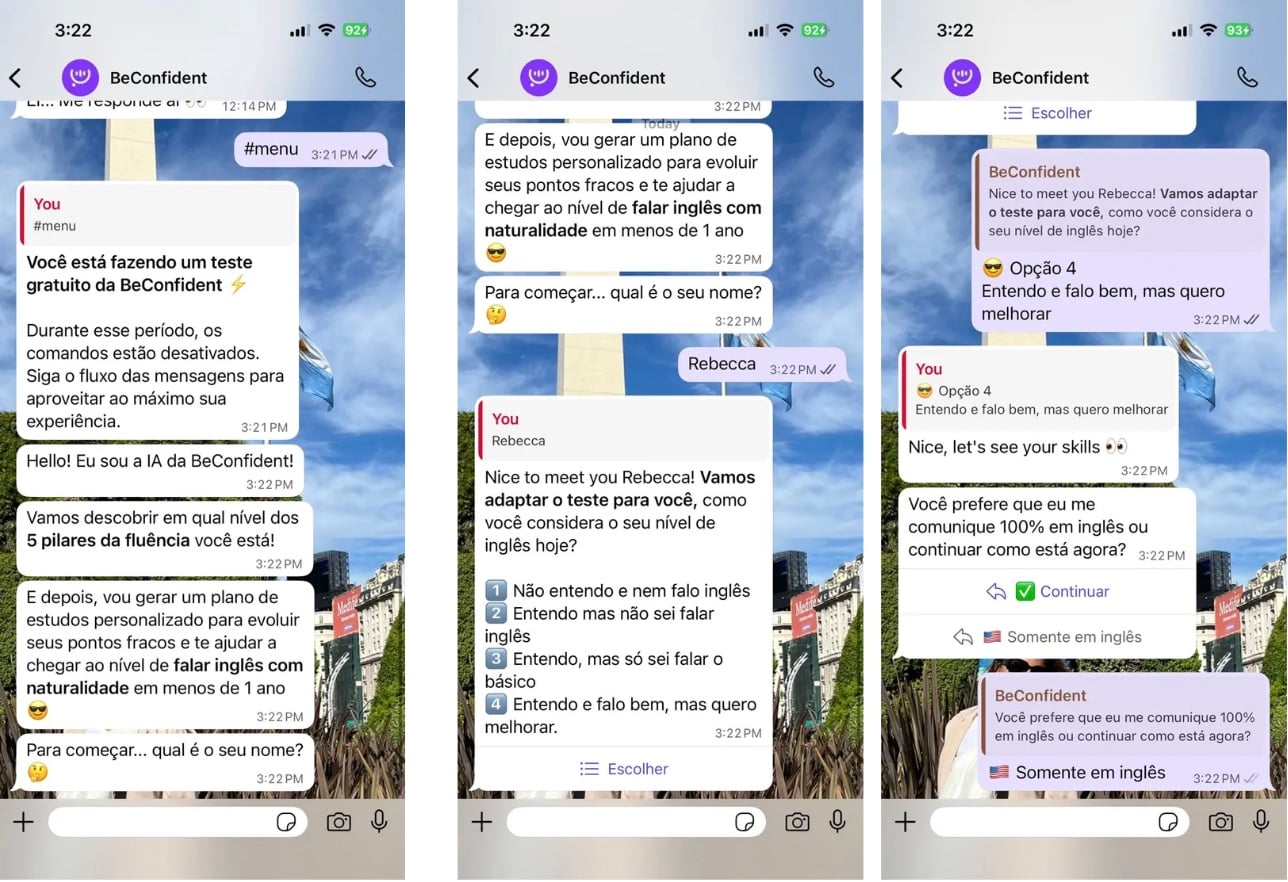
Get your free CEFR assessment now to discover your real level and receive a personalized plan.
From B2 to fluent: a practical roadmap
As mentioned, evolving from B2 to C1 requires approximately 200 hours of guided learning. An efficient roadmap organizes this effort into clear steps:
Assess your real level: BeConfident's free test identifies strengths and gaps, allowing you to direct your study focus.
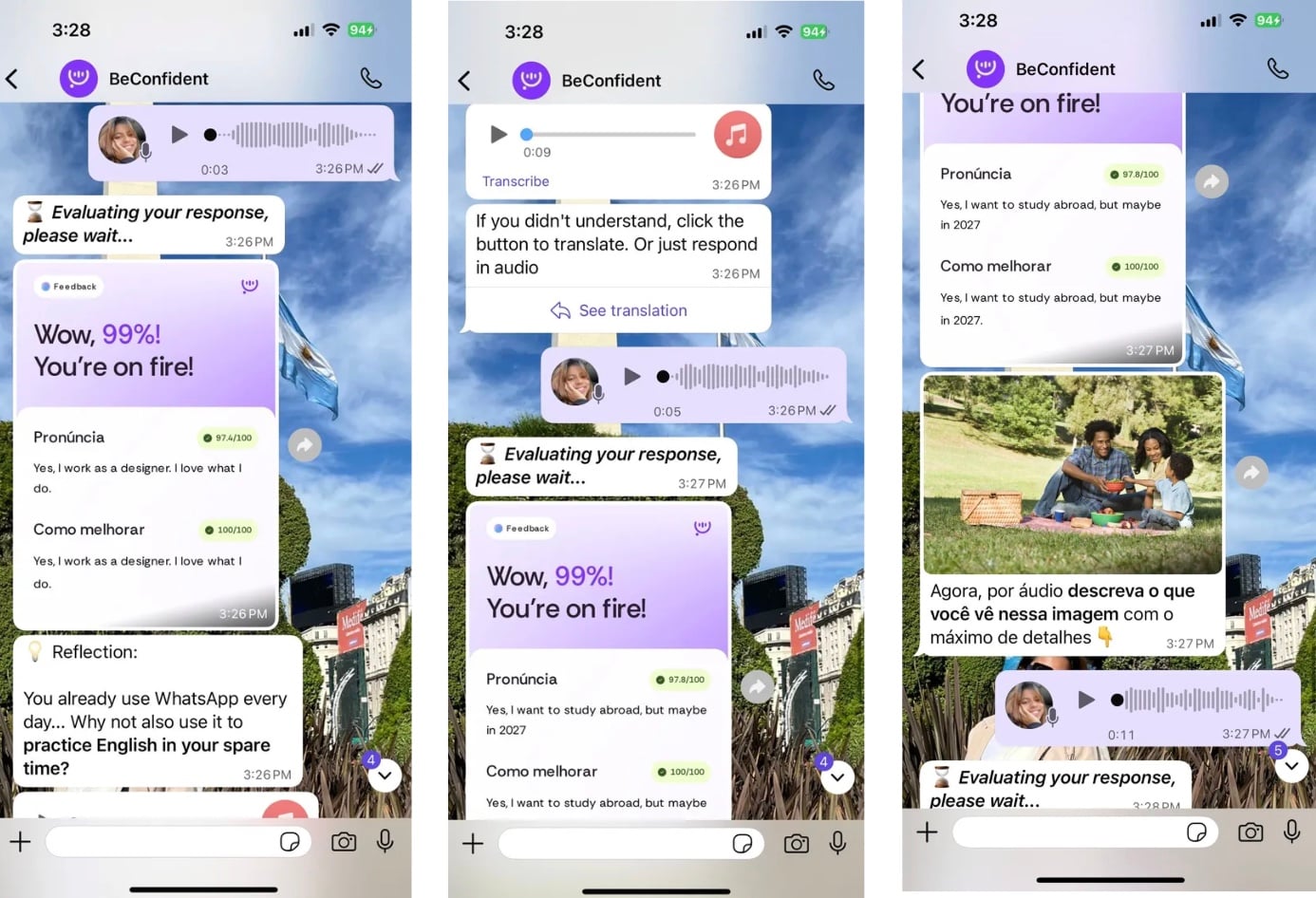
Practice speaking daily: with these gaps mapped out, set aside 15 to 30 minutes a day with AI, prioritizing naturalness in the areas where you freeze the most.
Receive personalized feedback: during these practices, correct fossilized errors in real-time. Correct repetition consolidates the right patterns before mistakes become habits.
Expand active vocabulary: include word combinations and idiomatic expressions in context, to be able to use vocabulary spontaneously.
Develop fluency under pressure: simulate meetings and presentations to train quick responses in demanding situations.
B2: schools vs apps vs AI
Approach | Annual cost | Speaking practice | Users and reputation |
|---|---|---|---|
Traditional schools | High, starting from R$ 2,000 | Limited to fixed schedules | Varies by school |
Duolingo | Low | Gamified and basic practice | High user base, but superficial focus on conversation |
Cambly | Hourly billing, with high cost | Conversation with humans, with variable quality | Average reputation |
BeConfident | Affordable cost | Unlimited practice with AI 24/7 | 200 thousand paying students and 3 million total users, RA1000 |
How to progress with daily AI practice through BeConfident
BeConfident reduces the main barriers of the B2 level and makes daily practice easy:
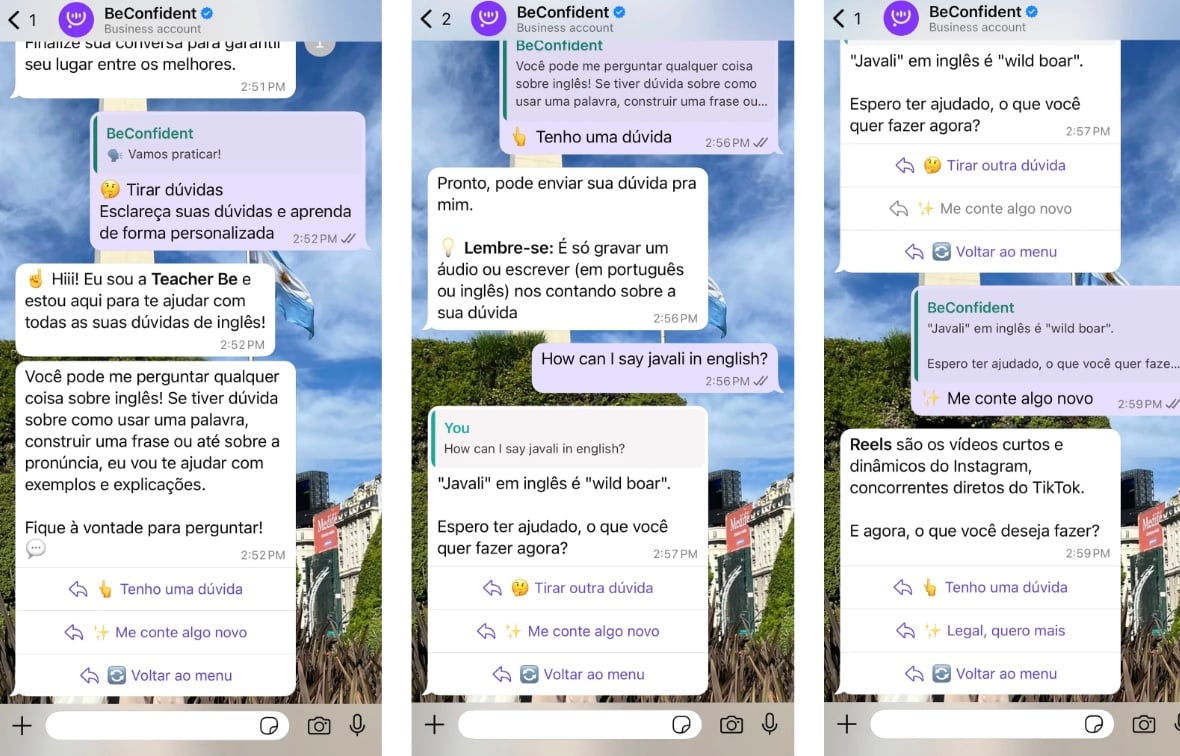
Unlimited practice: you converse 24/7 via the app, WhatsApp, or smartwatch, without relying on fixed schedules.
AI tutors with personality: you choose accents, such as American, British, or Australian, and professional profiles aligned with your goals.
Instant feedback: you receive correction in real-time, without feeling embarrassed, which accelerates pronunciation and grammar adjustments.
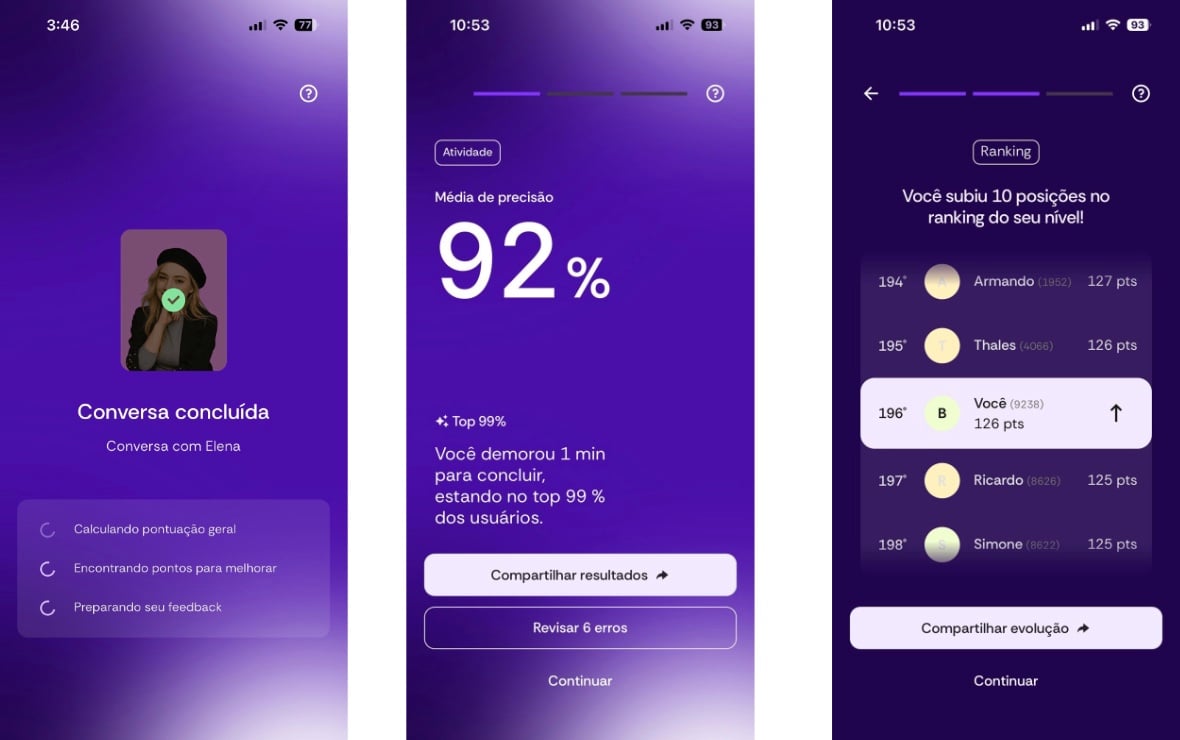
Measurable evolution: you track your progress in the "My Evolution" menu and see the improvement over the weeks.
Start your free trial and progress from B2 to fluent C1 in just a few weeks.
Frequently asked questions
Is B2 considered fluent in English?
No. Although B2 allows you to function well in many professional and personal contexts, it still requires conscious effort to express yourself. You pause to search for words, think about grammatical structures, and feel a constant mental load. At C1, communication becomes more automatic and natural, with less effort to formulate sentences.
How long does it take to go from B2 to C1?
The process usually requires about 200 hours of guided study, which corresponds to 3 to 6 months of consistent daily practice of 30 to 60 minutes. With conversational AI like BeConfident, this time can decrease because practice is unlimited and feedback is instant, which accelerates the correction of fossilized errors.
Does BeConfident work for those at the B2 level?
Yes. BeConfident was developed to unlock the conversation of B1 and B2 students who master theory but freeze in practice. The AI tutors adapt to your level, offer progressively more complex conversations, deliver personalized feedback, and simulate professional and personal contexts relevant to Brazilians.
What is the difference between B2 and fluent?
B2 is a competent and functional level. You can communicate clearly in most situations. Fluent, at C1, means speaking naturally and spontaneously. You express yourself effortlessly, understand cultural nuances, use idiomatic expressions appropriately, and maintain complex conversations under pressure. The main difference lies in naturalness and automatic precision.
Is TOEFL B2 sufficient for jobs?
For basic jobs in global companies, a TOEFL score between 72 and 94 points, equivalent to B2, is usually sufficient for a business English level. For leadership roles, strategic consulting, or positions involving many presentations, companies tend to prefer C1, with a TOEFL score starting at 95 points, to ensure more natural and persuasive communication.
Conclusion: from competent B2 to real fluency
B2 is not fluent. This level represents a high competency that ensures independence, but it does not yet deliver the naturalness and spontaneity of C1. The evolution from B2 to C1 becomes viable when you maintain a consistent routine of speaking practice.
BeConfident, with its proven base of millions of users and RA1000 reputation, offers a complete solution: unlimited practice with AI, personalized feedback, and measurable progress. Stop freezing in important conversations, start your free trial, and advance to real fluency in just a few weeks.
Written by: Luan Cavallaro, Founder & CMO, BeConfident
Key takeaways from this article
B2 is upper-intermediate, or an independent user, but it is not fluent. Real fluency starts at C1, with naturalness and spontaneity.
At B2, you understand texts and podcasts, but you usually freeze in spontaneous conversations, negotiations, and presentations under pressure.
The main barriers are the lack of speaking practice, excessively theoretical methods, and the fear of making mistakes in traditional environments.
Evolving from B2 to C1 requires about 200 hours of guided practice, focusing on daily speaking and instant feedback.
With BeConfident, you practice unlimitedly with 24/7 AI and accelerate this evolution: try it free now.
The impact of the problem: why B2 is not enough for career and travel
B2 ensures you can read technical reports and understand podcasts, but it does not guarantee confidence to negotiate or present in English. B2 corresponds to a TOEFL iBT score between 72 and 94 points, a level considered good, but still below fluency.
Some common examples in Brazil:
An engineer who understands technical documentation but freezes in meetings with international clients
A manager who reads complex emails but cannot lead spontaneous presentations
A traveler who gets by at the hotel but gets lost in casual conversations with native speakers
Many global companies consider B2 level sufficient for basic positions, but require C1 for strategic positions. This difference usually separates the person who gets the job from the one who wins the promotion.
What is B2 English level? Full CEFR explanation
B2 allows you to express thoughts with good fluency and participate in meetings in your field of activity, but it still presents significant limitations:
Skill | B2 (upper-intermediate) | C1 (advanced) | Verdict |
|---|---|---|---|
Listening | Understands main ideas of native speakers in familiar contexts, such as a technical podcast | Comprehends nuances, humor, and implicit cultural references | B2 is functional, but fails with fast-speaking native speakers |
Reading | Reads complex and detailed texts, such as business reports | Reads long texts with implicit meanings, such as opinion articles | Competent level, but still far from a native speaker |
Speaking | Can maintain conversations on abstract topics, with moderate effort, for example in an engineering meeting | Speaks spontaneously, precisely, and naturally, even under pressure | Main gap: speech does not sound natural |
Writing | Writes clearly and in detail to express opinions, such as in a professional email | Uses complex structures with nuance and style | Functional writing, but with limited use of idiomatic expressions |
Is B2 fluent?
No. B2 is the level that many people call "fluent" in professional contexts, but native-level fluency appears at C1 and above.
What level of English is considered fluent?
C1, or advanced, marks the beginning of real fluency. At this level, you express yourself spontaneously and precisely, and you understand nuances and cultural references naturally.
Is B2 English level good?
B2 is an excellent level to function independently in most situations. However, to sound natural and confident in fast conversations, evolving to C1 becomes essential.
Is B2 on TOEFL good?
A TOEFL score between 72 and 94 points, equivalent to B2, meets the requirements of many universities and basic jobs, but more advanced positions usually require higher scores.
Why doesn't B2 make you fluent? Main barriers
B2 does not translate into real fluency because of several recurring barriers:
Lack of speaking practice: difficulty in activating vocabulary and grammatical structures in real-time during spontaneous conversations
Fear and embarrassment: the classroom environment reduces speaking time and increases shyness during the few minutes the student actually speaks
Theory-focused methods: traditional schools dedicate little time to actual conversation practice
Superficial apps: applications like Duolingo are gamified but do not develop real conversation skills
Self-test: are you really fluent?
Use this self-test to assess your fluency:
Can you explain a complex technical problem in English without long pauses?
Do you understand movies without subtitles, including slang and humor?
Do you participate in casual conversations with native speakers naturally?
Do you write professional emails without consulting a translator?
Do you present ideas spontaneously in meetings?
Do you understand diverse accents, such as British, Australian, and Indian?
Do you use idiomatic expressions naturally?
Do you feel confident speaking English under pressure?
Result: 6 to 8 "yes" answers indicate fluent C1. Between 4 and 5 "yes" answers indicate solid B2. Fewer than 4 "yes" answers indicate B1 or early B2.
Get your free CEFR assessment now to discover your real level and receive a personalized plan.
From B2 to fluent: a practical roadmap
As mentioned, evolving from B2 to C1 requires approximately 200 hours of guided learning. An efficient roadmap organizes this effort into clear steps:
Assess your real level: BeConfident's free test identifies strengths and gaps, allowing you to direct your study focus.
Practice speaking daily: with these gaps mapped out, set aside 15 to 30 minutes a day with AI, prioritizing naturalness in the areas where you freeze the most.
Receive personalized feedback: during these practices, correct fossilized errors in real-time. Correct repetition consolidates the right patterns before mistakes become habits.
Expand active vocabulary: include word combinations and idiomatic expressions in context, to be able to use vocabulary spontaneously.
Develop fluency under pressure: simulate meetings and presentations to train quick responses in demanding situations.
B2: schools vs apps vs AI
Approach | Annual cost | Speaking practice | Users and reputation |
|---|---|---|---|
Traditional schools | High, starting from R$ 2,000 | Limited to fixed schedules | Varies by school |
Duolingo | Low | Gamified and basic practice | High user base, but superficial focus on conversation |
Cambly | Hourly billing, with high cost | Conversation with humans, with variable quality | Average reputation |
BeConfident | Affordable cost | Unlimited practice with AI 24/7 | 200 thousand paying students and 3 million total users, RA1000 |
How to progress with daily AI practice through BeConfident
BeConfident reduces the main barriers of the B2 level and makes daily practice easy:
Unlimited practice: you converse 24/7 via the app, WhatsApp, or smartwatch, without relying on fixed schedules.
AI tutors with personality: you choose accents, such as American, British, or Australian, and professional profiles aligned with your goals.
Instant feedback: you receive correction in real-time, without feeling embarrassed, which accelerates pronunciation and grammar adjustments.
Measurable evolution: you track your progress in the "My Evolution" menu and see the improvement over the weeks.
Start your free trial and progress from B2 to fluent C1 in just a few weeks.
Frequently asked questions
Is B2 considered fluent in English?
No. Although B2 allows you to function well in many professional and personal contexts, it still requires conscious effort to express yourself. You pause to search for words, think about grammatical structures, and feel a constant mental load. At C1, communication becomes more automatic and natural, with less effort to formulate sentences.
How long does it take to go from B2 to C1?
The process usually requires about 200 hours of guided study, which corresponds to 3 to 6 months of consistent daily practice of 30 to 60 minutes. With conversational AI like BeConfident, this time can decrease because practice is unlimited and feedback is instant, which accelerates the correction of fossilized errors.
Does BeConfident work for those at the B2 level?
Yes. BeConfident was developed to unlock the conversation of B1 and B2 students who master theory but freeze in practice. The AI tutors adapt to your level, offer progressively more complex conversations, deliver personalized feedback, and simulate professional and personal contexts relevant to Brazilians.
What is the difference between B2 and fluent?
B2 is a competent and functional level. You can communicate clearly in most situations. Fluent, at C1, means speaking naturally and spontaneously. You express yourself effortlessly, understand cultural nuances, use idiomatic expressions appropriately, and maintain complex conversations under pressure. The main difference lies in naturalness and automatic precision.
Is TOEFL B2 sufficient for jobs?
For basic jobs in global companies, a TOEFL score between 72 and 94 points, equivalent to B2, is usually sufficient for a business English level. For leadership roles, strategic consulting, or positions involving many presentations, companies tend to prefer C1, with a TOEFL score starting at 95 points, to ensure more natural and persuasive communication.
Conclusion: from competent B2 to real fluency
B2 is not fluent. This level represents a high competency that ensures independence, but it does not yet deliver the naturalness and spontaneity of C1. The evolution from B2 to C1 becomes viable when you maintain a consistent routine of speaking practice.
BeConfident, with its proven base of millions of users and RA1000 reputation, offers a complete solution: unlimited practice with AI, personalized feedback, and measurable progress. Stop freezing in important conversations, start your free trial, and advance to real fluency in just a few weeks.