




How to classify your English level: test and tips
How to classify your English level: test and tips
How to classify your English level: test and tips
Written by: Luan Cavallaro, Founder & CMO, BeConfident
Key takeaways from this article
The CEFR classifies English fluency into 6 levels (A1-C2) and organizes speaking progression, which is usually the main pain point for Brazilians who already have a good understanding of reading and listening.
The B2 level represents the threshold of professional fluency, as it allows running fluid conversations with native speakers and discussing abstract topics after a consistent period of guided study.
Practice with artificial intelligence reduces common issues such as fear of making mistakes, limited vocabulary, and pronunciation difficulties, because it offers instant feedback without judgment.
To progress quickly with unlimited 24/7 practice tailored to your level, take the free BeConfident test now and start building confidence in conversation.
Before you start: preparing for the test
An accurate assessment requires at least basic A1 level, 10 to 15 minutes in a quiet environment, and honesty in your self-assessment. The CEFR evaluates four skills: listening, reading, speaking, and writing.
This guide focuses on conversation, which is usually the biggest challenge for Brazilians. Avoid overestimating your level based solely on reading, because conversational fluency is different from passive comprehension.
The 6 English levels: A1, A2, B1, B2, C1, and C2 explained
The CEFR organizes proficiency into three main categories: basic user (A1-A2), independent user (B1-B2), and proficient user (C1-C2).
The table below shows how each level appears in conversation and how study hours increase as interactions become more complex, going from simple sentences to advanced communication in professional scenarios.
Level | General description | Conversation (speaking) | Study hours |
|---|---|---|---|
A1 | Absolute beginner | Forming simple sentences about personal details, requiring slow speech from the interlocutor | |
A2 | Elementary | Maintaining simple conversations about family, work, and immediate needs | |
B1 | Intermediate | Describing experiences, dreams, and opinions on familiar topics | |
B2 | Upper-intermediate | Participating in fluid conversations with native speakers and discussions on abstract topics | |
C1 | Advanced | Fluent and spontaneous expression, with flexible use for professional purposes | |
C2 | Proficient | Precise and natural communication in complex situations |
The B2 and C1 levels represent functional fluency for careers and international travels. Try BeConfident to practice speaking at all these levels with personalized feedback.
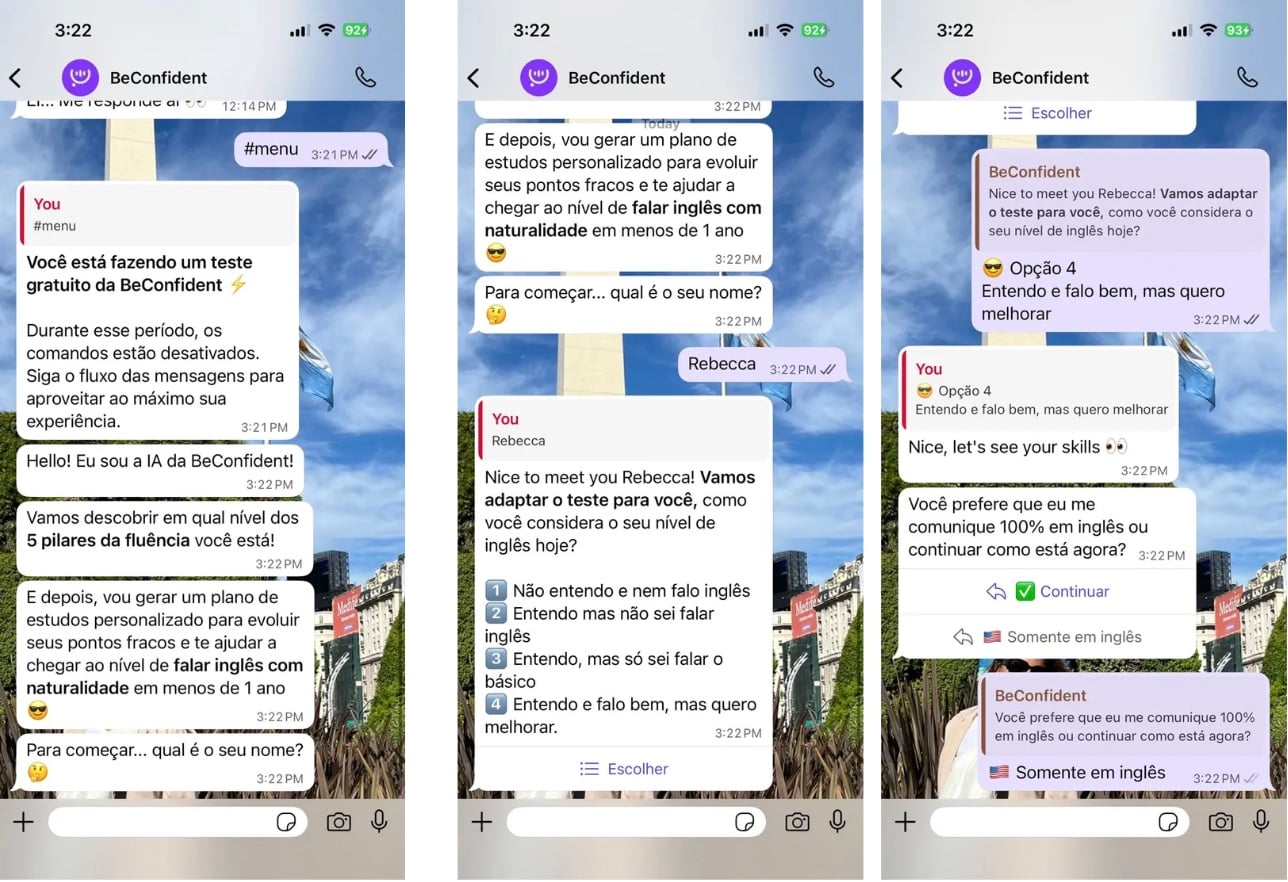
English level test: assess your level now
This quick test focuses on conversation to identify your current CEFR level. Answer honestly, based on what you can do without preparation.
1. Can you introduce yourself in English, saying your name, age, and profession, without long pauses?
2. Can you describe your daily routine in 5 complete sentences?
3. Do you participate in conversations about hobbies and personal interests?
4. Do you express opinions on movies, books, or news?
5. Do you discuss future plans and past experiences in detail?
6. Do you participate in work meetings in English with confidence?
7. Do you debate complex topics such as politics or economics?
8. Do you adapt your speaking style according to the context, between formal and informal?
9. Do you use idioms and slang naturally?
10. Do you communicate nuances and implicit meanings accurately?
Scoring: 1 to 3 "yes" answers indicate A1/A2, 4 to 6 indicate B1, 7 to 8 indicate B2, and 9 to 10 indicate C1/C2.
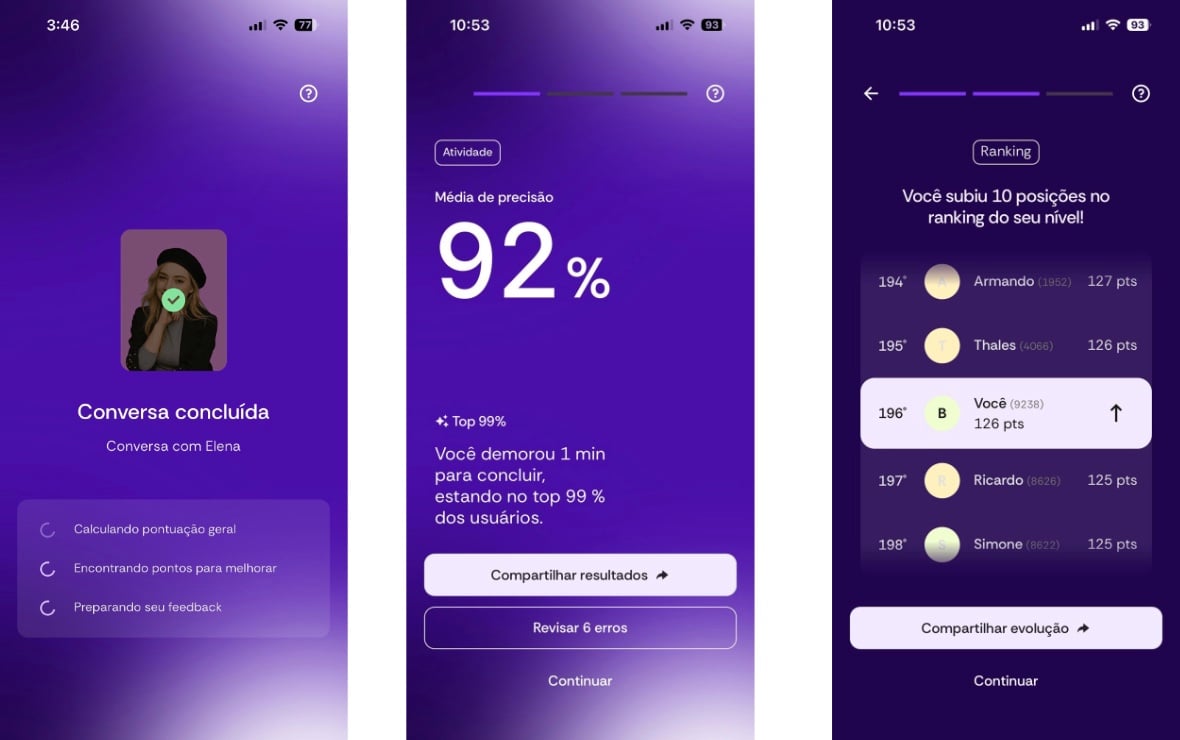
BeConfident offers a more precise assessment with artificial intelligence that analyzes pronunciation, grammar, and fluency in real-time. This approach identifies specific strengths and weaknesses, which generic tests do not do.
Is B2 considered fluent?
The B2 level is considered the "threshold of fluency" for professional and conversational use. At this level, you interact with native speakers without excessive effort, participate in discussions on abstract topics, and work in an international environment. This milestone usually requires the time investment shown in the study hours table.
The C1 level represents advanced fluency, with the ability to participate in complex debates and use the language in sophisticated academic and professional contexts. The C2 level approaches native-like proficiency, with precise communication in any context.
Other free and paid tests
There are several options to assess your level, such as EF SET, Cambridge Assessment, British Council, and language school tests.
Even so, it is worth starting with BeConfident, which offers assessment in Portuguese and English, a specific focus on conversation, and feedback validated by 200,000 paying students in Brazil, with a RA 1000 reputation.
How to measure and improve your English fluency?
Conversational fluency is measured by criteria such as response time, active vocabulary, speaking confidence, and the ability to maintain natural conversations.
To improve these criteria at your current level, focus on practices that build the skills required by the next level.
A1-A2: practice basic sentences daily to reduce response time and build fundamental active vocabulary.
B1: participate in conversations on familiar topics to gain confidence and expand vocabulary beyond the basics.
B2: discuss abstract and professional topics to develop natural conversations in more complex contexts.
C1-C2: refine nuances and idiomatic expressions to achieve the precision and naturalness of a proficient speaker.
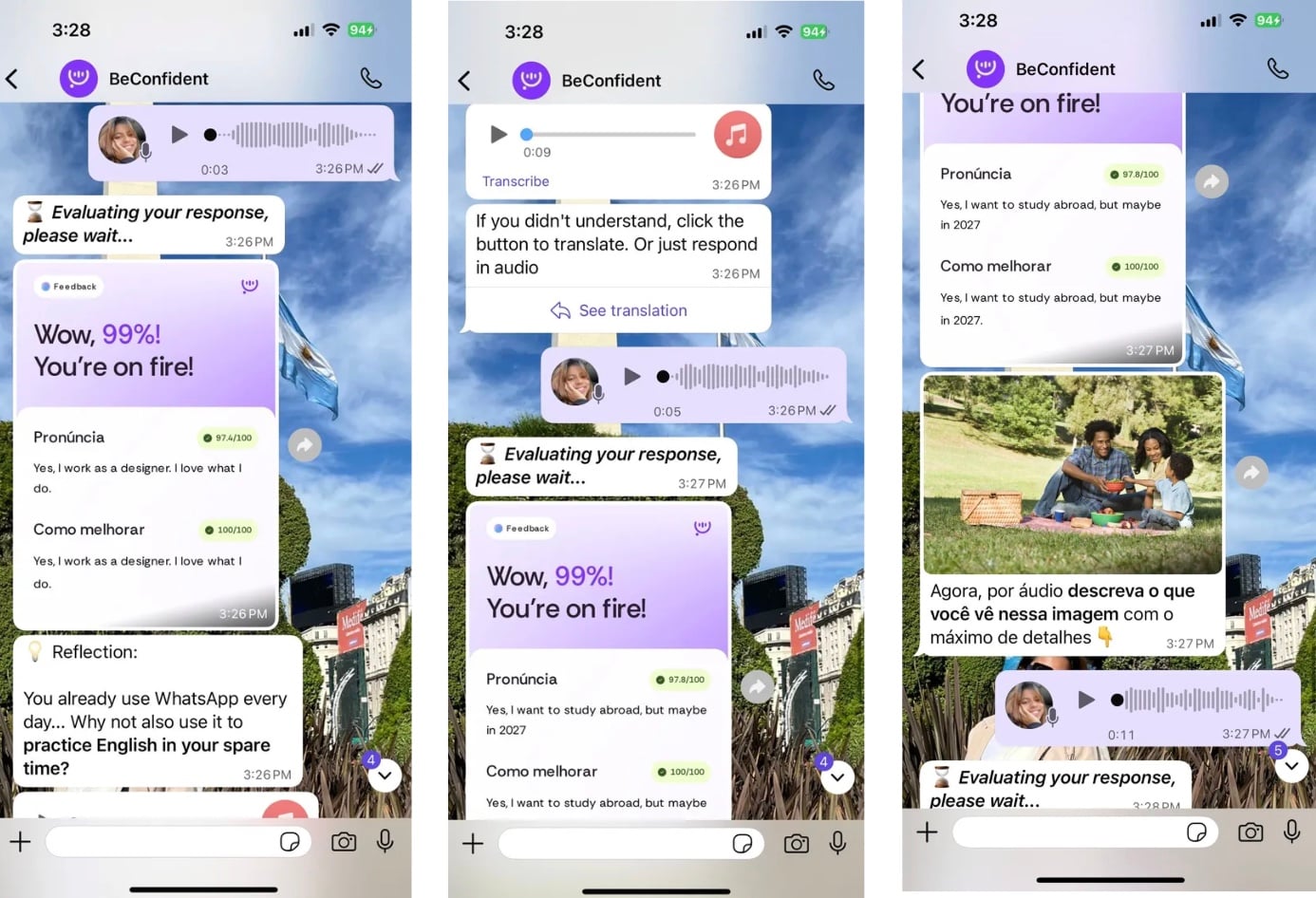
BeConfident offers artificial intelligence tutors with different accents, such as American, British, and Australian, along with varied personalities, structured tracks by level, and instant feedback. Unlike Duolingo, which focuses on gamification, or Cambly, which works with paid classes per hour, BeConfident's platform offers unlimited 24/7 practice.
Common problems and solutions
Problem | Cause | BeConfident's Solution |
|---|---|---|
Fear of speaking | Embarrassment of making mistakes | Use of judgment-free artificial intelligence, providing a secure environment to practice without feeling embarrassed |
Limited vocabulary | Lack of active practice | Thematic, personalized conversations that expose you to new words in context |
Incorrect pronunciation | Absence of feedback | Instant correction with clear pronunciation examples |
Lack of consistency | Rigid schedules | Flexible practice through the app and WhatsApp, with 24/7 access |
Next steps with BeConfident
Once you identify your level, BeConfident offers personalized tracks, conversation practice with Teacher Be, who is the main artificial intelligence, and progress tracking via the "My Progress" menu.
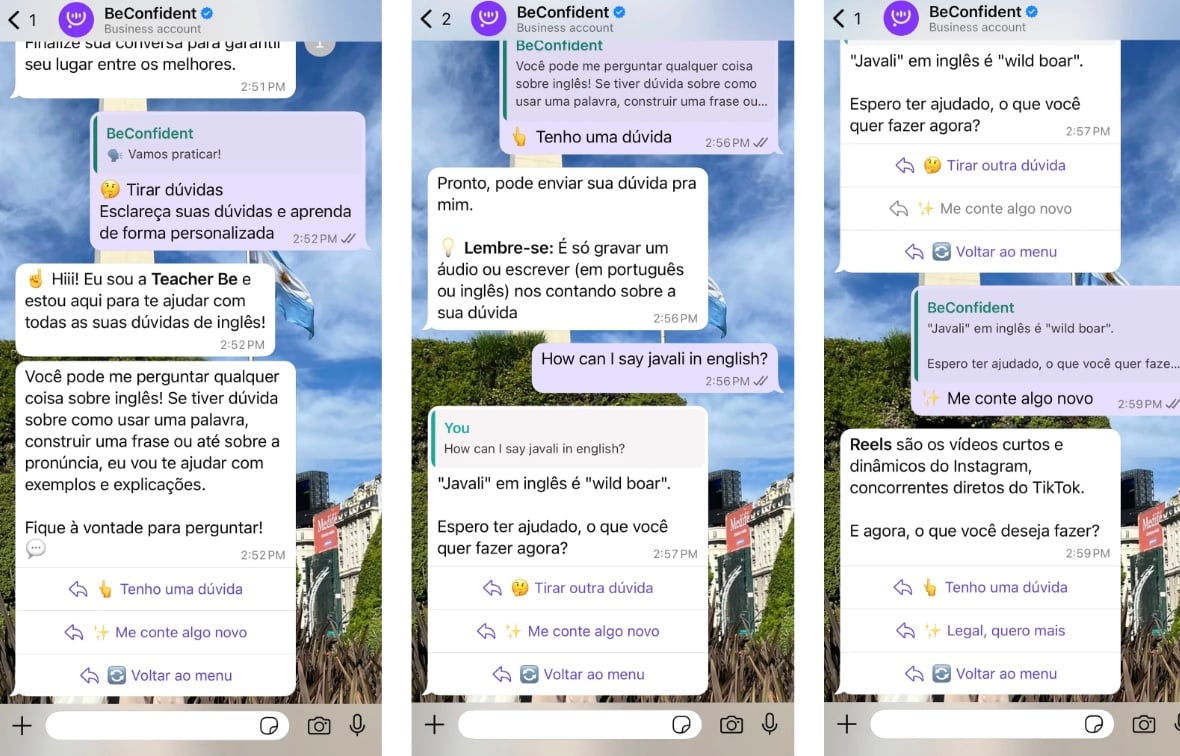
Start your free trial and begin studying today to use your free time in favor of conversational fluency.
Frequently Asked Questions
How do I know my English fluency level?
You can use the quick test in this article, which focuses on conversation, or take a complete assessment on BeConfident. The CEFR serves as the most reliable international standard because it evaluates what you can actually do in real communication situations, not just theoretical knowledge.
Is there a reliable free English level test?
Yes. BeConfident offers a free test that evaluates speaking, pronunciation, and comprehension with personalized feedback. Unlike generic online tests, this assessment uses artificial intelligence to identify specific strengths and areas for improvement.
Is B2 considered fluent for work?
Yes. The B2 level represents professional fluency sufficient to work in an international environment, participate in meetings, and deliver presentations. This level is usually the minimum required by most multinational companies for positions requiring English.
How long does it take to move up a CEFR level?
The time varies according to your current level and dedication. Moving from A2 to B1 usually requires about 150 to 200 hours of study. Transitioning from B1 to B2 usually requires approximately 150 hours. With daily practice on BeConfident, many students notice visible progress within 4 to 8 weeks.
What is the difference between fluency and proficiency?
Fluency relates to ease and speed of speech. Proficiency also includes grammatical accuracy and vocabulary range. The B2 level offers conversational fluency with some acceptable errors. The C1 and C2 levels combine fluency with high technical proficiency.
Conclusion
Classifying your CEFR level is the first step toward developing real conversational fluency. The quick test and the table in this guide offer a solid foundation, and progress happens with constant practice and personalized feedback.
BeConfident is the number 1 platform for English conversation in Brazil, with the user base and reputation mentioned earlier. BeConfident's artificial intelligence allows unlimited 24/7 practice, tailored to your level and your specific goals.
Discover your conversational potential with the free test and transform passive knowledge into active fluency.
Written by: Luan Cavallaro, Founder & CMO, BeConfident
Key takeaways from this article
The CEFR classifies English fluency into 6 levels (A1-C2) and organizes speaking progression, which is usually the main pain point for Brazilians who already have a good understanding of reading and listening.
The B2 level represents the threshold of professional fluency, as it allows running fluid conversations with native speakers and discussing abstract topics after a consistent period of guided study.
Practice with artificial intelligence reduces common issues such as fear of making mistakes, limited vocabulary, and pronunciation difficulties, because it offers instant feedback without judgment.
To progress quickly with unlimited 24/7 practice tailored to your level, take the free BeConfident test now and start building confidence in conversation.
Before you start: preparing for the test
An accurate assessment requires at least basic A1 level, 10 to 15 minutes in a quiet environment, and honesty in your self-assessment. The CEFR evaluates four skills: listening, reading, speaking, and writing.
This guide focuses on conversation, which is usually the biggest challenge for Brazilians. Avoid overestimating your level based solely on reading, because conversational fluency is different from passive comprehension.
The 6 English levels: A1, A2, B1, B2, C1, and C2 explained
The CEFR organizes proficiency into three main categories: basic user (A1-A2), independent user (B1-B2), and proficient user (C1-C2).
The table below shows how each level appears in conversation and how study hours increase as interactions become more complex, going from simple sentences to advanced communication in professional scenarios.
Level | General description | Conversation (speaking) | Study hours |
|---|---|---|---|
A1 | Absolute beginner | Forming simple sentences about personal details, requiring slow speech from the interlocutor | |
A2 | Elementary | Maintaining simple conversations about family, work, and immediate needs | |
B1 | Intermediate | Describing experiences, dreams, and opinions on familiar topics | |
B2 | Upper-intermediate | Participating in fluid conversations with native speakers and discussions on abstract topics | |
C1 | Advanced | Fluent and spontaneous expression, with flexible use for professional purposes | |
C2 | Proficient | Precise and natural communication in complex situations |
The B2 and C1 levels represent functional fluency for careers and international travels. Try BeConfident to practice speaking at all these levels with personalized feedback.
English level test: assess your level now
This quick test focuses on conversation to identify your current CEFR level. Answer honestly, based on what you can do without preparation.
1. Can you introduce yourself in English, saying your name, age, and profession, without long pauses?
2. Can you describe your daily routine in 5 complete sentences?
3. Do you participate in conversations about hobbies and personal interests?
4. Do you express opinions on movies, books, or news?
5. Do you discuss future plans and past experiences in detail?
6. Do you participate in work meetings in English with confidence?
7. Do you debate complex topics such as politics or economics?
8. Do you adapt your speaking style according to the context, between formal and informal?
9. Do you use idioms and slang naturally?
10. Do you communicate nuances and implicit meanings accurately?
Scoring: 1 to 3 "yes" answers indicate A1/A2, 4 to 6 indicate B1, 7 to 8 indicate B2, and 9 to 10 indicate C1/C2.
BeConfident offers a more precise assessment with artificial intelligence that analyzes pronunciation, grammar, and fluency in real-time. This approach identifies specific strengths and weaknesses, which generic tests do not do.
Is B2 considered fluent?
The B2 level is considered the "threshold of fluency" for professional and conversational use. At this level, you interact with native speakers without excessive effort, participate in discussions on abstract topics, and work in an international environment. This milestone usually requires the time investment shown in the study hours table.
The C1 level represents advanced fluency, with the ability to participate in complex debates and use the language in sophisticated academic and professional contexts. The C2 level approaches native-like proficiency, with precise communication in any context.
Other free and paid tests
There are several options to assess your level, such as EF SET, Cambridge Assessment, British Council, and language school tests.
Even so, it is worth starting with BeConfident, which offers assessment in Portuguese and English, a specific focus on conversation, and feedback validated by 200,000 paying students in Brazil, with a RA 1000 reputation.
How to measure and improve your English fluency?
Conversational fluency is measured by criteria such as response time, active vocabulary, speaking confidence, and the ability to maintain natural conversations.
To improve these criteria at your current level, focus on practices that build the skills required by the next level.
A1-A2: practice basic sentences daily to reduce response time and build fundamental active vocabulary.
B1: participate in conversations on familiar topics to gain confidence and expand vocabulary beyond the basics.
B2: discuss abstract and professional topics to develop natural conversations in more complex contexts.
C1-C2: refine nuances and idiomatic expressions to achieve the precision and naturalness of a proficient speaker.
BeConfident offers artificial intelligence tutors with different accents, such as American, British, and Australian, along with varied personalities, structured tracks by level, and instant feedback. Unlike Duolingo, which focuses on gamification, or Cambly, which works with paid classes per hour, BeConfident's platform offers unlimited 24/7 practice.
Common problems and solutions
Problem | Cause | BeConfident's Solution |
|---|---|---|
Fear of speaking | Embarrassment of making mistakes | Use of judgment-free artificial intelligence, providing a secure environment to practice without feeling embarrassed |
Limited vocabulary | Lack of active practice | Thematic, personalized conversations that expose you to new words in context |
Incorrect pronunciation | Absence of feedback | Instant correction with clear pronunciation examples |
Lack of consistency | Rigid schedules | Flexible practice through the app and WhatsApp, with 24/7 access |
Next steps with BeConfident
Once you identify your level, BeConfident offers personalized tracks, conversation practice with Teacher Be, who is the main artificial intelligence, and progress tracking via the "My Progress" menu.
Start your free trial and begin studying today to use your free time in favor of conversational fluency.
Frequently Asked Questions
How do I know my English fluency level?
You can use the quick test in this article, which focuses on conversation, or take a complete assessment on BeConfident. The CEFR serves as the most reliable international standard because it evaluates what you can actually do in real communication situations, not just theoretical knowledge.
Is there a reliable free English level test?
Yes. BeConfident offers a free test that evaluates speaking, pronunciation, and comprehension with personalized feedback. Unlike generic online tests, this assessment uses artificial intelligence to identify specific strengths and areas for improvement.
Is B2 considered fluent for work?
Yes. The B2 level represents professional fluency sufficient to work in an international environment, participate in meetings, and deliver presentations. This level is usually the minimum required by most multinational companies for positions requiring English.
How long does it take to move up a CEFR level?
The time varies according to your current level and dedication. Moving from A2 to B1 usually requires about 150 to 200 hours of study. Transitioning from B1 to B2 usually requires approximately 150 hours. With daily practice on BeConfident, many students notice visible progress within 4 to 8 weeks.
What is the difference between fluency and proficiency?
Fluency relates to ease and speed of speech. Proficiency also includes grammatical accuracy and vocabulary range. The B2 level offers conversational fluency with some acceptable errors. The C1 and C2 levels combine fluency with high technical proficiency.
Conclusion
Classifying your CEFR level is the first step toward developing real conversational fluency. The quick test and the table in this guide offer a solid foundation, and progress happens with constant practice and personalized feedback.
BeConfident is the number 1 platform for English conversation in Brazil, with the user base and reputation mentioned earlier. BeConfident's artificial intelligence allows unlimited 24/7 practice, tailored to your level and your specific goals.
Discover your conversational potential with the free test and transform passive knowledge into active fluency.