




How to start a conversation in basic English: 8 dialogues
How to start a conversation in basic English: 8 dialogues
How to start a conversation in basic English: 8 dialogues
Written by: Luan Cavallaro, Founder & CMO, BeConfident
Key takeaways from this article
Using simple greetings like "Hi! How are you?" and basic introductions is the starting point for any conversation in English.
Asking questions like "Where are you from?" works as an effective icebreaker in social or professional situations.
Using phrases to ask for repetition, such as "Could you repeat that, please?", keeps the conversation flowing even when you don't understand something.
Applying ready-made dialogues for work, travel, and hobbies covers most everyday situations for beginners.
Practicing consistently with BeConfident's AI helps turn knowledge into conversational fluency, with an initial free trial to practice these dialogues.
English conversation for beginners: why do you freeze?
The main challenge is not a lack of knowledge, but a lack of real practice. An app like Duolingo teaches vocabulary, but it does not develop the conversational fluency needed for everyday situations. The EF English Proficiency Index 2025 shows that speaking is the weakest skill in more than half of the countries evaluated, including Brazil.
BeConfident closes this gap with artificial intelligence tutors available 24/7 on the app, WhatsApp, or smartwatch, allowing you to practice whenever and wherever you prefer. This flexibility has already attracted more than 200,000 paying students and 3 million users looking for unlimited practice without shame or judgment. A free test identifies your CEFR level and creates a personalized plan that guides your progress from day one.
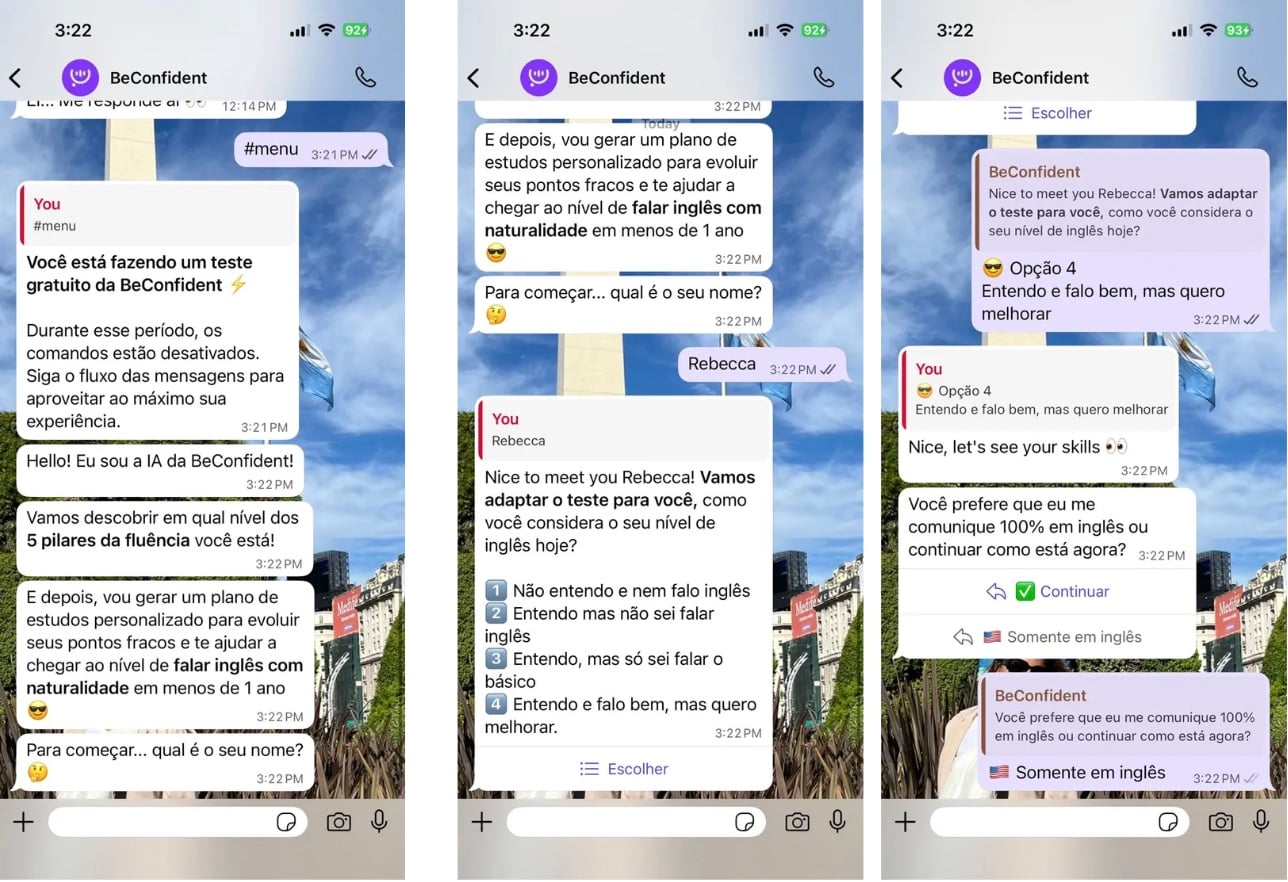
The methodology focuses on real conversation integrated into daily life. You practice while cooking, walking, or taking short breaks, instead of relying solely on long, theoretical classes.
1. Simple greetings (English phrases for beginners)
Mastering simple greetings allows you to start any interaction with confidence, in formal or informal contexts. These phrases pave the way to continue the conversation with basic questions.
English: "Hi! How are you?" Phonetics: "Hái! Rau ar iú?" Translation: "Hi! How are you?"
Full dialogue:
A: Hi! How are you?
B: I'm fine, thanks. And you? ("Áim fáin, fénks. Énd iú?")
A: I'm good, thank you! ("Áim gud, fénk iú!")
These basic greetings serve as a starting point for any conversation, with colleagues, teachers, or strangers. The intonation in "How are you?" usually rises slightly at the end.
2. Basic handshakes and introductions
Introducing your name and asking the other person's name is the natural next step after a greeting. This type of dialogue appears in interviews, meetings, and informal encounters.
English: "My name is Maria. What's your name?" Phonetics: "Mái nêim is Maria. Uóts iór nêim?" Translation: "My name is Maria. What is your name?"
Full dialogue:
A: My name is Carlos. What's your name?
B: I'm Ana. Nice to meet you! ("Áim Ana. Náis tu míit iú!")
A: Nice to meet you too! ("Náis tu míit iú tú!")
Pronunciation tip: "Nice" sounds like "náis", not "níce". The "th" in "thank you" comes out by placing your tongue between your teeth and gently releasing air.
3. Icebreakers: where are you from? (basic English conversation)
After the introduction, the next step is usually to deepen the conversation. Questions about origin work as icebreakers and help create a quick connection.
English: "Where are you from?" Phonetics: "Uér ar iú from?" Translation: "Where are you from?"
Full dialogue:
A: Where are you from?
B: I'm from Brazil. And you? ("Áim from Brézil. Énd iú?")
A: I'm from the United States. ("Áim from dê Iunáitid Stêits")
B: That's interesting! ("Déts íntresting!")
Questions about origin work well in social or networking events and open up space to talk about cities, travel, and culture.
4. Phrases to ask for repetition (English conversation tips)
Using phrases to ask for repetition allows you to keep the conversation going even when you don't understand everything. This resource avoids blockages and shows genuine interest in what the other person is saying.
English: "Could you repeat that, please?" Phonetics: "Cud iú ripíit dét, plíiz?" Translation: "Could you repeat that, please?"
Useful alternatives:
- "Sorry, I didn't catch that." ("Sóri, ái dídnt kétch dét")
- "Could you speak more slowly?" ("Cud iú spíik mor slóuli?")
- "What does that mean?" ("Uót dâz dét míin?")
These phrases keep the conversation flowing when something isn't clear. Natives also ask for repetition frequently, so using these expressions is part of natural communication.
5. Numbers and days of the week (how do you say numbers in English?)
Knowing numbers and days of the week helps in situations such as making appointments, talking about schedules, and understanding prices. These elements appear in almost every basic interaction.
Basic numbers: One (uân), Two (tú), Three (fríi), Four (fór), Five (fáiv), Six (síks), Seven (séven), Eight (êit), Nine (náin), Ten (tén)
Dialogue with numbers:
A: What time is it? ("Uót táim is it?")
B: It's three thirty. ("Its fríi férdi")
A: Thank you! ("Fénk iú!")
Days of the week: Monday (mândei), Tuesday (tiúzdei), Wednesday (uénzdei), Thursday (férzdei), Friday (fráidei), Saturday (séterdei), Sunday (sândei)
6. Dialogues for work (English conversations between two people)
Using simple phrases in the workplace helps build relationships with colleagues and participate in meetings with more confidence. Questions about the weekend are a common type of professional small talk.
English: "How was your weekend?" Phonetics: "Rau uóz iór uíkend?" Translation: "How was your weekend?"
Professional dialogue:
A: Good morning! How was your weekend?
B: It was great, thanks. I went to the beach. ("It uóz grêit, fénks. Ái uént tu dê bíitch")
A: That sounds nice! ("Dét saunds náis!")
B: How about you? ("Rau abáut iú?")
For meetings, useful phrases include "Could you explain that again?" ("Cud iú iksplêin dét agêin?") and "I have a question." ("Ái rév e cuéstchon"). These expressions help you actively participate in the conversation.
7. Travel conversation
Basic phrases for the airport, hotel, and restaurant allow you to resolve common travel situations without relying on translation all the time.
At the airport: "Excuse me, where is gate 15?" Phonetics: "Ikskiúz mi, uér is gêit fiftíin?" Translation: "Excuse me, where is gate 15?"
At the hotel:
A: I have a reservation. ("Ái rév e rezervêishon")
B: What's your name? ("Uóts iór nêim?")
A: It's under Carlos Silva. ("Its ândor Carlos Silva")
At the restaurant: "Could I have the menu, please?" ("Cud ái rév dê méniu, plíiz?") and "I'll have the chicken." ("Áil rév dê tchíken")
8. Hobbies and family (simple English dialogues)
Talking about hobbies and family helps keep dialogues light and find common interests. This type of topic appears in social gatherings, work, and travel.
English: "What do you like to do in your free time?" Phonetics: "Uót du iú láik tu du in iór frí táim?" Translation: "What do you like to do in your free time?"
Dialogue about hobbies:
A: What do you like to do in your free time?
B: I like to read and watch movies. ("Ái láik tu ríid énd uótch múvis")
A: What kind of movies? ("Uót káind óv múvis?")
B: I love action movies. ("Ái lâv ékshon múvis")
Questions about hobbies like "What kind of music do you enjoy?" work well in casual conversations and help discover common interests.
Free English conversation practice with BeConfident
The difference between knowing these phrases and using them confidently lies in frequent practice. The BeConfident community offers AI tutors with varied personalities and native accents, such as American, British, and Australian, who adapt to your interests and goals.
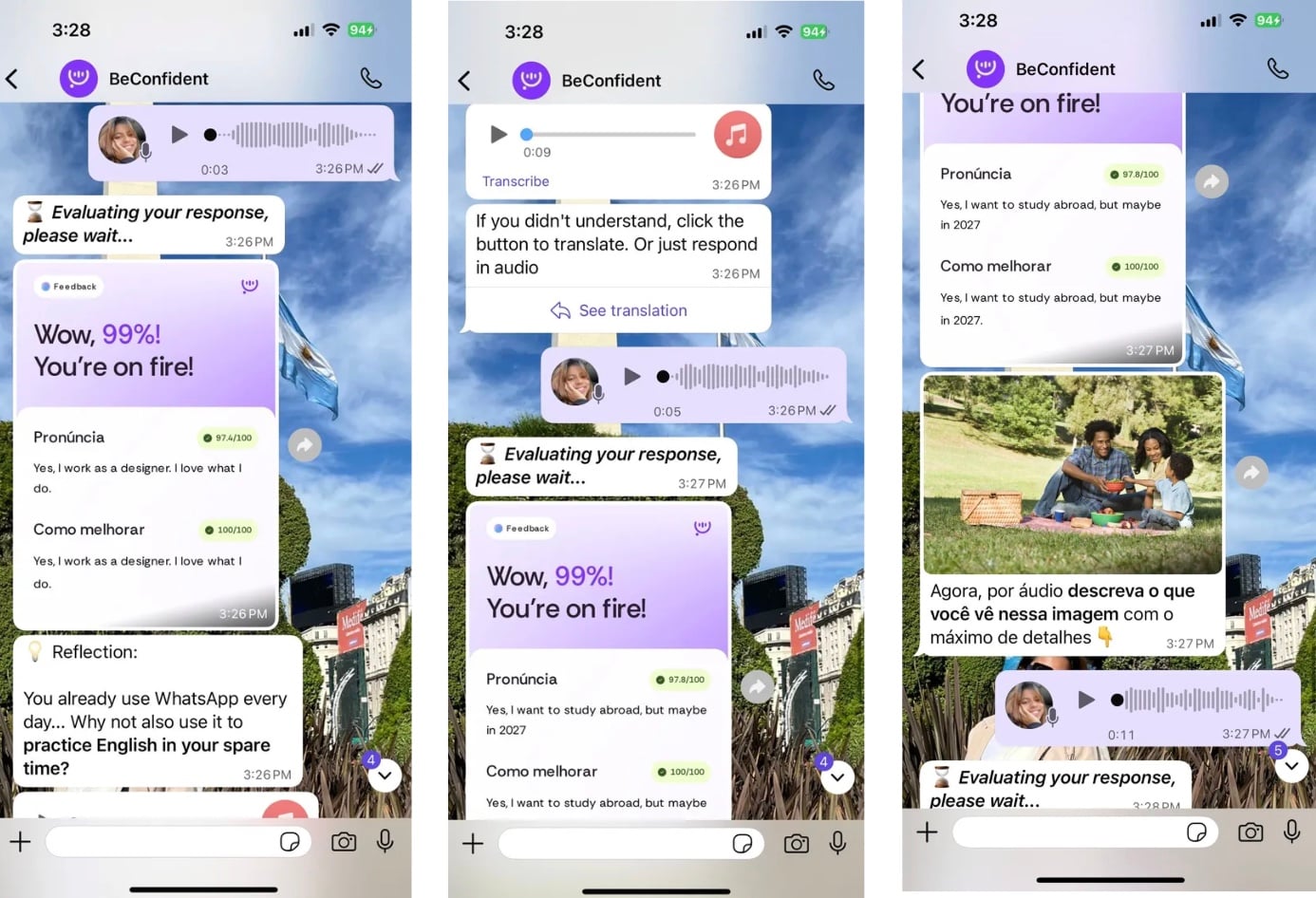
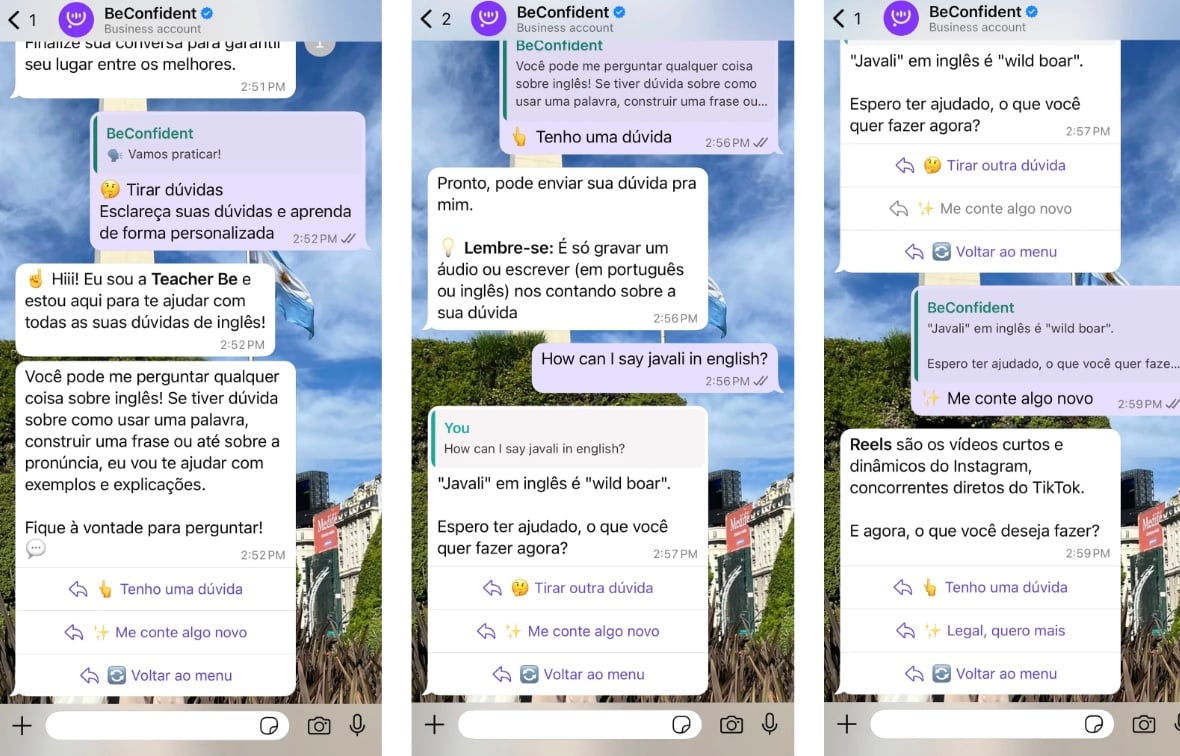
Features include real-time correction, review of recurring mistakes, and the "I have a question" option for immediate clarification. AI tools reduce speaking anxiety by allowing pressure-free practice, which makes it easier to keep the conversation flowing.
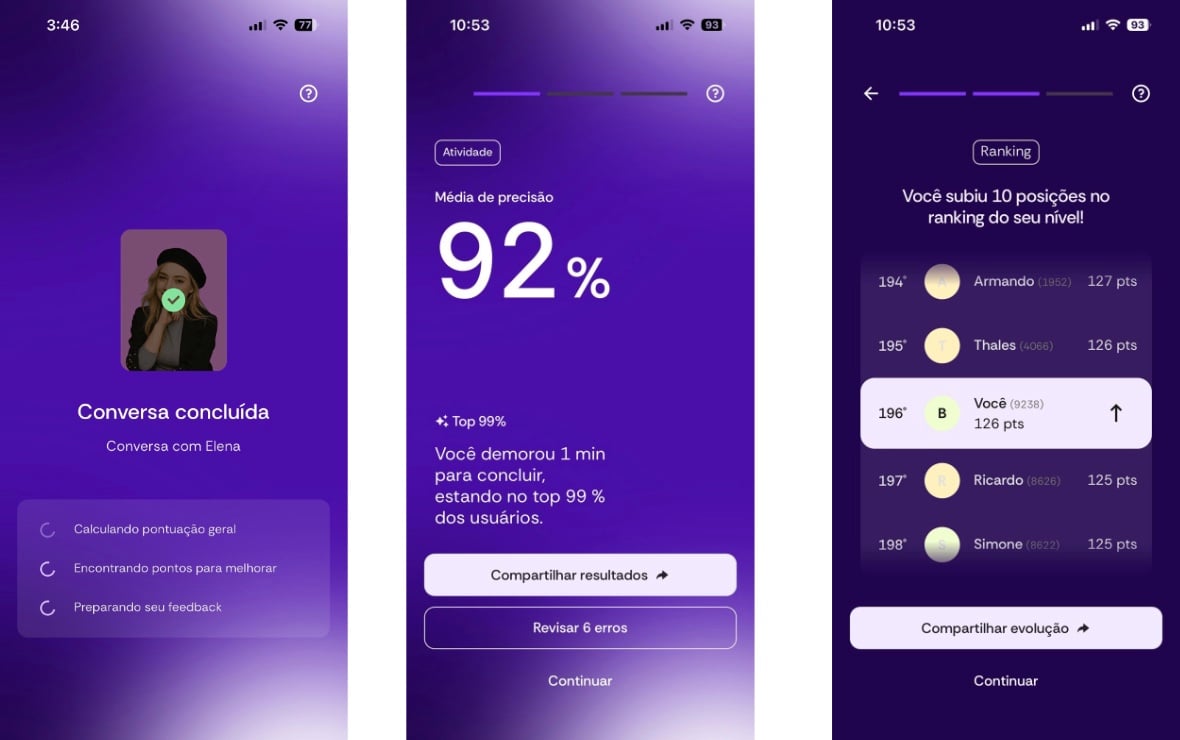
While Duolingo prioritizes gamification and Cambly charges by the hour of conversation, BeConfident offers unlimited conversational practice at a reduced monthly cost. The AI helps turn pronunciation insecurity into confidence through structured feedback on speaking.
Practice these dialogues now with AI tutors and track your evolution in real time with personalized feedback.
Frequently asked questions about basic English conversation
How do you say numbers in English?
The basic numbers are: one (uân), two (tú), three (fríi), four (fór), five (fáiv), six (síks), seven (séven), eight (êit), nine (náin), ten (tén). For larger numbers, you combine forms like eleven (iléven), twelve (tuélv), thirteen (fertíin), and twenty (tuénti). It is worth practicing with times, prices, and dates.
Where can I practice conversation for free?
BeConfident offers an initial free trial with AI tutors available 24/7 on the app, WhatsApp, or smartwatch. Unlike platforms that charge by the hour, you can practice as many times as you want, with no time limit and without embarrassment when you make mistakes.
Is BeConfident better than Duolingo?
Duolingo focuses on gamification and basic vocabulary, but it does not prioritize real-time conversation. BeConfident specializes in speaking with AI tutors who correct pronunciation, grammar, and fluency during the dialogue, which offers a type of practice that Duolingo does not cover.
How to start a simple English conversation?
You can start with basic greetings like "Hi, how are you?" and follow up with questions about origin, such as "Where are you from?". You can also use comments about the environment, like "Nice weather today!", or questions about hobbies, like "What do you like to do?". Repeating these phrases until they become automatic increases your confidence.
Which English phrases for beginners are essential?
Some essential phrases are: "Hi, how are you?", "My name is...", "Where are you from?", "Could you repeat that?", "Thank you", "Excuse me", "I don't understand", "How much is this?", "Where is...?", and "Nice to meet you". These expressions cover most basic situations.
Start speaking English tomorrow with these dialogues
Using these 8 essential dialogues in conjunction with continuous practice on BeConfident creates a solid foundation for speaking English with more confidence. Many Brazilians have already reduced their fear of speaking and have started to make better use of work, study, and travel opportunities.
Discover your level and accelerate your speaking with AI by practicing these dialogues with tutors who adapt to your pace and goal.
Written by: Luan Cavallaro, Founder & CMO, BeConfident
Key takeaways from this article
Using simple greetings like "Hi! How are you?" and basic introductions is the starting point for any conversation in English.
Asking questions like "Where are you from?" works as an effective icebreaker in social or professional situations.
Using phrases to ask for repetition, such as "Could you repeat that, please?", keeps the conversation flowing even when you don't understand something.
Applying ready-made dialogues for work, travel, and hobbies covers most everyday situations for beginners.
Practicing consistently with BeConfident's AI helps turn knowledge into conversational fluency, with an initial free trial to practice these dialogues.
English conversation for beginners: why do you freeze?
The main challenge is not a lack of knowledge, but a lack of real practice. An app like Duolingo teaches vocabulary, but it does not develop the conversational fluency needed for everyday situations. The EF English Proficiency Index 2025 shows that speaking is the weakest skill in more than half of the countries evaluated, including Brazil.
BeConfident closes this gap with artificial intelligence tutors available 24/7 on the app, WhatsApp, or smartwatch, allowing you to practice whenever and wherever you prefer. This flexibility has already attracted more than 200,000 paying students and 3 million users looking for unlimited practice without shame or judgment. A free test identifies your CEFR level and creates a personalized plan that guides your progress from day one.
The methodology focuses on real conversation integrated into daily life. You practice while cooking, walking, or taking short breaks, instead of relying solely on long, theoretical classes.
1. Simple greetings (English phrases for beginners)
Mastering simple greetings allows you to start any interaction with confidence, in formal or informal contexts. These phrases pave the way to continue the conversation with basic questions.
English: "Hi! How are you?" Phonetics: "Hái! Rau ar iú?" Translation: "Hi! How are you?"
Full dialogue:
A: Hi! How are you?
B: I'm fine, thanks. And you? ("Áim fáin, fénks. Énd iú?")
A: I'm good, thank you! ("Áim gud, fénk iú!")
These basic greetings serve as a starting point for any conversation, with colleagues, teachers, or strangers. The intonation in "How are you?" usually rises slightly at the end.
2. Basic handshakes and introductions
Introducing your name and asking the other person's name is the natural next step after a greeting. This type of dialogue appears in interviews, meetings, and informal encounters.
English: "My name is Maria. What's your name?" Phonetics: "Mái nêim is Maria. Uóts iór nêim?" Translation: "My name is Maria. What is your name?"
Full dialogue:
A: My name is Carlos. What's your name?
B: I'm Ana. Nice to meet you! ("Áim Ana. Náis tu míit iú!")
A: Nice to meet you too! ("Náis tu míit iú tú!")
Pronunciation tip: "Nice" sounds like "náis", not "níce". The "th" in "thank you" comes out by placing your tongue between your teeth and gently releasing air.
3. Icebreakers: where are you from? (basic English conversation)
After the introduction, the next step is usually to deepen the conversation. Questions about origin work as icebreakers and help create a quick connection.
English: "Where are you from?" Phonetics: "Uér ar iú from?" Translation: "Where are you from?"
Full dialogue:
A: Where are you from?
B: I'm from Brazil. And you? ("Áim from Brézil. Énd iú?")
A: I'm from the United States. ("Áim from dê Iunáitid Stêits")
B: That's interesting! ("Déts íntresting!")
Questions about origin work well in social or networking events and open up space to talk about cities, travel, and culture.
4. Phrases to ask for repetition (English conversation tips)
Using phrases to ask for repetition allows you to keep the conversation going even when you don't understand everything. This resource avoids blockages and shows genuine interest in what the other person is saying.
English: "Could you repeat that, please?" Phonetics: "Cud iú ripíit dét, plíiz?" Translation: "Could you repeat that, please?"
Useful alternatives:
- "Sorry, I didn't catch that." ("Sóri, ái dídnt kétch dét")
- "Could you speak more slowly?" ("Cud iú spíik mor slóuli?")
- "What does that mean?" ("Uót dâz dét míin?")
These phrases keep the conversation flowing when something isn't clear. Natives also ask for repetition frequently, so using these expressions is part of natural communication.
5. Numbers and days of the week (how do you say numbers in English?)
Knowing numbers and days of the week helps in situations such as making appointments, talking about schedules, and understanding prices. These elements appear in almost every basic interaction.
Basic numbers: One (uân), Two (tú), Three (fríi), Four (fór), Five (fáiv), Six (síks), Seven (séven), Eight (êit), Nine (náin), Ten (tén)
Dialogue with numbers:
A: What time is it? ("Uót táim is it?")
B: It's three thirty. ("Its fríi férdi")
A: Thank you! ("Fénk iú!")
Days of the week: Monday (mândei), Tuesday (tiúzdei), Wednesday (uénzdei), Thursday (férzdei), Friday (fráidei), Saturday (séterdei), Sunday (sândei)
6. Dialogues for work (English conversations between two people)
Using simple phrases in the workplace helps build relationships with colleagues and participate in meetings with more confidence. Questions about the weekend are a common type of professional small talk.
English: "How was your weekend?" Phonetics: "Rau uóz iór uíkend?" Translation: "How was your weekend?"
Professional dialogue:
A: Good morning! How was your weekend?
B: It was great, thanks. I went to the beach. ("It uóz grêit, fénks. Ái uént tu dê bíitch")
A: That sounds nice! ("Dét saunds náis!")
B: How about you? ("Rau abáut iú?")
For meetings, useful phrases include "Could you explain that again?" ("Cud iú iksplêin dét agêin?") and "I have a question." ("Ái rév e cuéstchon"). These expressions help you actively participate in the conversation.
7. Travel conversation
Basic phrases for the airport, hotel, and restaurant allow you to resolve common travel situations without relying on translation all the time.
At the airport: "Excuse me, where is gate 15?" Phonetics: "Ikskiúz mi, uér is gêit fiftíin?" Translation: "Excuse me, where is gate 15?"
At the hotel:
A: I have a reservation. ("Ái rév e rezervêishon")
B: What's your name? ("Uóts iór nêim?")
A: It's under Carlos Silva. ("Its ândor Carlos Silva")
At the restaurant: "Could I have the menu, please?" ("Cud ái rév dê méniu, plíiz?") and "I'll have the chicken." ("Áil rév dê tchíken")
8. Hobbies and family (simple English dialogues)
Talking about hobbies and family helps keep dialogues light and find common interests. This type of topic appears in social gatherings, work, and travel.
English: "What do you like to do in your free time?" Phonetics: "Uót du iú láik tu du in iór frí táim?" Translation: "What do you like to do in your free time?"
Dialogue about hobbies:
A: What do you like to do in your free time?
B: I like to read and watch movies. ("Ái láik tu ríid énd uótch múvis")
A: What kind of movies? ("Uót káind óv múvis?")
B: I love action movies. ("Ái lâv ékshon múvis")
Questions about hobbies like "What kind of music do you enjoy?" work well in casual conversations and help discover common interests.
Free English conversation practice with BeConfident
The difference between knowing these phrases and using them confidently lies in frequent practice. The BeConfident community offers AI tutors with varied personalities and native accents, such as American, British, and Australian, who adapt to your interests and goals.
Features include real-time correction, review of recurring mistakes, and the "I have a question" option for immediate clarification. AI tools reduce speaking anxiety by allowing pressure-free practice, which makes it easier to keep the conversation flowing.
While Duolingo prioritizes gamification and Cambly charges by the hour of conversation, BeConfident offers unlimited conversational practice at a reduced monthly cost. The AI helps turn pronunciation insecurity into confidence through structured feedback on speaking.
Practice these dialogues now with AI tutors and track your evolution in real time with personalized feedback.
Frequently asked questions about basic English conversation
How do you say numbers in English?
The basic numbers are: one (uân), two (tú), three (fríi), four (fór), five (fáiv), six (síks), seven (séven), eight (êit), nine (náin), ten (tén). For larger numbers, you combine forms like eleven (iléven), twelve (tuélv), thirteen (fertíin), and twenty (tuénti). It is worth practicing with times, prices, and dates.
Where can I practice conversation for free?
BeConfident offers an initial free trial with AI tutors available 24/7 on the app, WhatsApp, or smartwatch. Unlike platforms that charge by the hour, you can practice as many times as you want, with no time limit and without embarrassment when you make mistakes.
Is BeConfident better than Duolingo?
Duolingo focuses on gamification and basic vocabulary, but it does not prioritize real-time conversation. BeConfident specializes in speaking with AI tutors who correct pronunciation, grammar, and fluency during the dialogue, which offers a type of practice that Duolingo does not cover.
How to start a simple English conversation?
You can start with basic greetings like "Hi, how are you?" and follow up with questions about origin, such as "Where are you from?". You can also use comments about the environment, like "Nice weather today!", or questions about hobbies, like "What do you like to do?". Repeating these phrases until they become automatic increases your confidence.
Which English phrases for beginners are essential?
Some essential phrases are: "Hi, how are you?", "My name is...", "Where are you from?", "Could you repeat that?", "Thank you", "Excuse me", "I don't understand", "How much is this?", "Where is...?", and "Nice to meet you". These expressions cover most basic situations.
Start speaking English tomorrow with these dialogues
Using these 8 essential dialogues in conjunction with continuous practice on BeConfident creates a solid foundation for speaking English with more confidence. Many Brazilians have already reduced their fear of speaking and have started to make better use of work, study, and travel opportunities.
Discover your level and accelerate your speaking with AI by practicing these dialogues with tutors who adapt to your pace and goal.