




15 English conversation dialogues for beginners
15 English conversation dialogues for beginners
15 English conversation dialogues for beginners
Written by: Luan Cavallaro, Founder & CMO, BeConfident
Key takeaways from this article
Master the basics: learn greetings, introductions, and small talk with clear pronunciation of sounds like “th” and “r”, which usually cause difficulties for Brazilians.
Use real scenarios: practice dialogues in daily Brazilian contexts, such as remote work, the beach, soccer, and barbecues.
Personalize the lines: adapt each dialogue to your routine, hobbies, and city to gain confidence in real-life situations.
Practice actively: repeat out loud, record your own voice, and apply pronunciation tips to correct common mistakes.
Accelerate learning: use 24/7 interactive practice on BeConfident to receive immediate feedback from AI tutors.
Mastering English conversation starts with simple dialogues that reflect real-life situations. The following 15 dialogues appear in increasing order of difficulty, starting with basic greetings and advancing to typical scenarios in a Brazilian's routine, such as remote work, travel, and leisure.
Each dialogue includes a translation, pronunciation guidelines, and a practical tip to help you know how to practice. Read out loud, repeat several times, and personalize the sentences with your own details before moving on to the next dialogue.
1. English greetings dialogue for beginners
English:
A: Hello! How are you?
B: Hi! I'm fine, thank you. And you?
A: I'm good, thanks!
Portuguese:
A: Olá! Como você está?
B: Oi! Estou bem, obrigado(a). E você?
A: Estou bem, obrigado(a)!
Pronunciation: the “th” in “thank” should be pronounced by placing the tongue between the teeth, not like a “t”. Brazilians often struggle with the “th” sound, especially when it appears alongside other consonants.
Practical tip: repeat this dialogue 5 times out loud and record your voice to compare it with native pronunciation. Since the “th” sound is the biggest challenge here, practice it in isolation first, just “th-th-th”, and then use the sound in the full sentences of the dialogue.
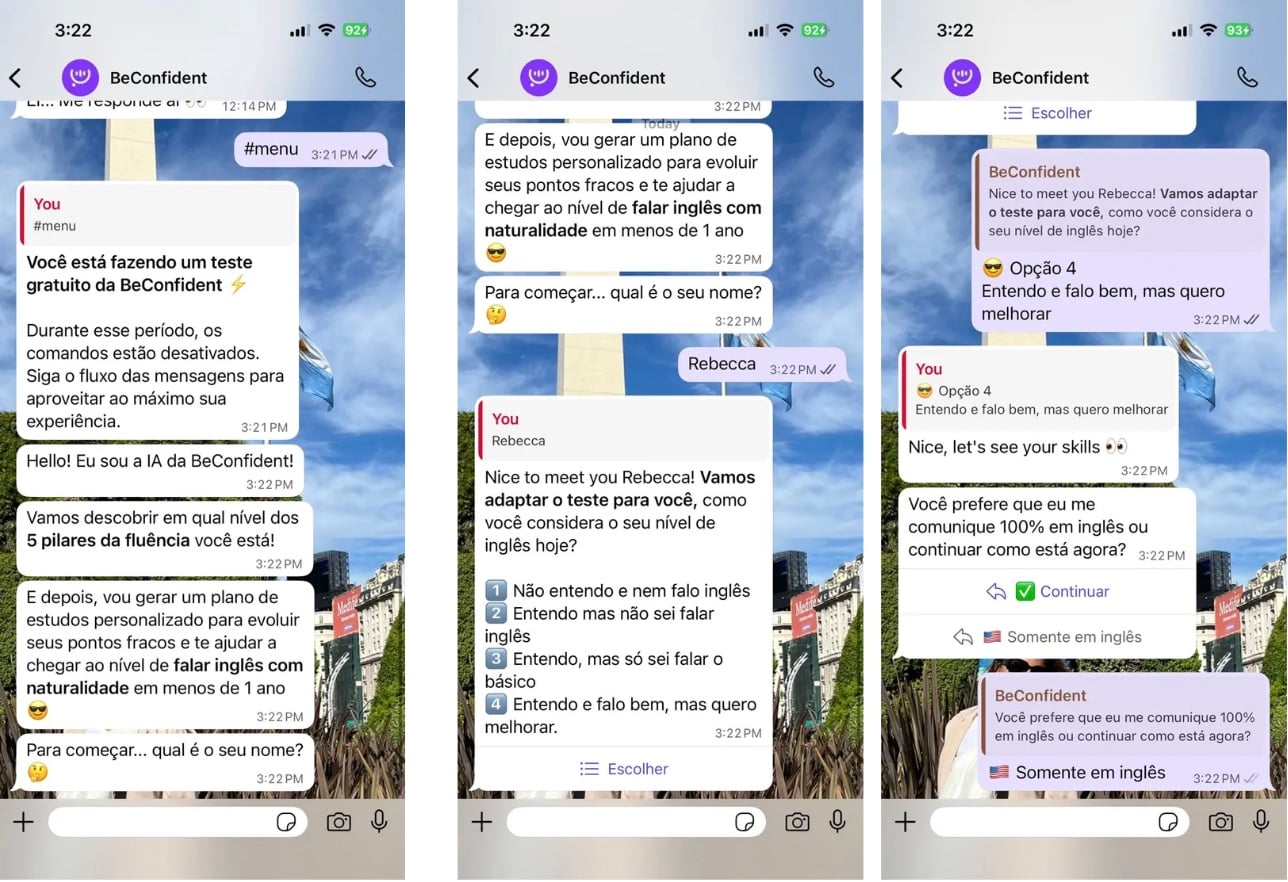
Practice on BeConfident: open the app or WhatsApp, choose an AI tutor with an American accent, and replicate this dialogue. Get real-time pronunciation corrections, without being exposed to other people.
2. English introductions dialogue for beginners
English:
A: Nice to meet you! What's your name?
B: Nice to meet you too! I'm Maria. What about you?
A: I'm João. Where are you from?
B: I'm from Brazil.
Portuguese:
A: Prazer em conhecê-la! Qual é seu nome?
B: Prazer em conhecê-lo também! Eu sou Maria. E você?
A: Eu sou João. De onde você é?
B: Eu sou do Brasil.
Pronunciation: in “Nice”, the sound is “nais”, not “nice” as in Portuguese. In “Brazil”, the “r” sounds softer, close to a light “h”, and not like the strong “r” of Brazilian Portuguese.
Practical tip: replace the names, country, and city with your real details. Practice introducing yourself as if you were meeting someone on a trip or at a work event.
3. Dialogue about origin in English for beginners
English:
A: Where do you live?
B: I live in São Paulo. It's a big city in Brazil.
A: That sounds interesting! Do you like it there?
B: Yes, I love it. There are many things to do.
Portuguese:
A: Onde você mora?
B: Eu moro em São Paulo. É uma cidade grande no Brasil.
A: Isso parece interessante! Você gosta de lá?
B: Sim, eu amo. Há muitas coisas para fazer.
Pronunciation: “live” has a short “liv” sound, not “laiv”. In “there”, use the “th” sound you practiced, followed by a soft “er”.
Practical tip: adapt the dialogue to your reality. If you live in a small town, use “I live in a small town near [larger city]” to better explain where you live.
4. Small talk: how to say “how are you” in English
English:
A: How's your day going?
B: It's going well, thanks! I'm a bit tired, but good.
A: Why are you tired?
B: I had a long day at work. How about you?
Portuguese:
A: Como está sendo seu dia?
B: Está indo bem, obrigado(a)! Estou um pouco cansado(a), mas bem.
A: Por que você está cansado(a)?
B: Tive um dia longo no trabalho. E você?
Pronunciation: “day” sounds like “dei”. In “work”, the end has a dry “k” sound, without the strong “r” that many Brazilians add.
Practical tip: vary your answers with expressions like “a bit tired”, “pretty good” and “not bad”. Use these combinations to avoid the automatic “fine” and sound more natural.
5. Dialogue about daily routine in English
English:
A: What time do you usually wake up?
B: I wake up at 7 AM. What about you?
A: I get up at 6:30. I like to exercise in the morning.
B: That's great! I prefer to exercise in the evening.
Portuguese:
A: Que horas você geralmente acorda?
B: Eu acordo às 7h. E você?
A: Eu levanto às 6h30. Gosto de me exercitar de manhã.
B: Isso é ótimo! Eu prefiro me exercitar à noite.
Pronunciation: in “wake up”, the “a” in “wake” sounds like “ei”. “Exercise” has three syllables, “EK-ser-saiz”, with the final sound of “saiz”.
Practical tip: use your actual routine. Combine “I usually”, “I always” and “I sometimes” with different activities to create multiple versions of the same dialogue.
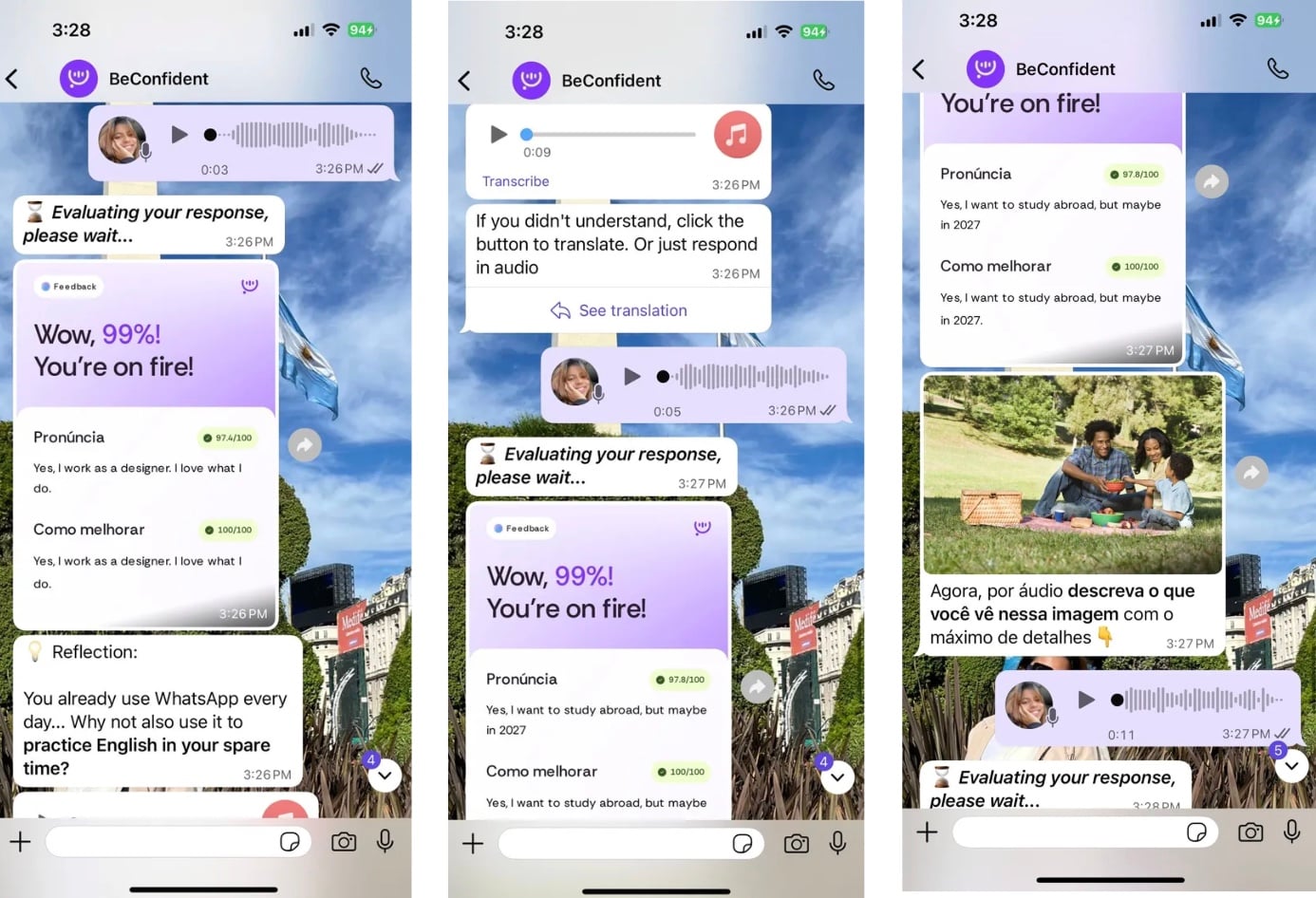
Practice these first 5 dialogues with personalized feedback, opening the BeConfident app to receive instant pronunciation corrections while chatting with AI tutors.
After mastering these basic dialogues, it's worth applying the same structures in situations that are part of your routine in Brazil. The next examples bring contexts like remote work, airport, beach, and soccer to make your study closer to your daily life.
6. Conversation in English about remote work
English:
A: Do you work from home?
B: Yes, I've been working remotely since 2020. Do you?
A: Sometimes. I go to the office twice a week.
B: That's a good balance. Remote work is very common in Brazil now.
Portuguese:
A: Você trabalha de casa?
B: Sim, trabalho remotamente desde 2020. E você?
A: Às vezes. Vou ao escritório duas vezes por semana.
B: É um bom equilíbrio. Trabalho remoto é muito comum no Brasil agora.
Pronunciation: “work” ends with a dry “k” sound. In “remote”, the stressed syllable is the second one, “ri-MOUT”.
Practical tip: expand your vocabulary with terms like “home office”, “video calls” and “flexible schedule”. Build new questions using these expressions.
7. Dialogue in a restaurant in English
English:
A: Good evening! Do you have a table for two?
B: Yes, right this way. Here's the menu.
A: Thank you. What do you recommend?
B: The grilled fish is very popular. Would you like something to drink?
Portuguese:
A: Boa noite! Vocês têm mesa para dois?
B: Sim, por aqui. Aqui está o cardápio.
A: Obrigado(a). O que você recomenda?
B: O peixe grelhado é muito popular. Gostaria de algo para beber?
Pronunciation: “table” sounds like “TEI-bul”. “Menu” is “MEN-yu”, different from “me-NU” in Portuguese.
Practical tip: memorize phrases like “I'd like...”, “Could I have...?” and “The check, please”. Practice ordering Brazilian dishes in English, like “grilled picanha” or “black beans”.
8. English conversation while shopping
English:
A: Excuse me, how much is this shirt?
B: It's 50 reais. Would you like to try it on?
A: Yes, please. Where's the fitting room?
B: It's over there, next to the cashier.
Portuguese:
A: Com licença, quanto custa esta camisa?
B: São 50 reais. Gostaria de experimentar?
A: Sim, por favor. Onde fica o provador?
B: É ali, ao lado do caixa.
Pronunciation: in “shirt”, the “ir” sounds like “er”. “Fitting” has a clearly pronounced “tt”.
Practical tip: use “reais” naturally, as many foreigners recognize the currency. Also practice sizes like “small”, “medium” and “large”.
9. Dialogue at the airport in English
English:
A: Excuse me, where is gate 15?
B: Go straight and turn left after the duty-free shop.
A: Thank you. What time does the flight to Miami leave?
B: It departs at 11:30 PM. You have about two hours.
Portuguese:
A: Com licença, onde fica o portão 15?
B: Vá em frente e vire à esquerda depois da loja duty-free.
A: Obrigado(a). Que horas sai o voo para Miami?
B: Parte às 23h30. Você tem cerca de duas horas.
Pronunciation: “gate” sounds like “geit”. In “flight”, the “gh” is silent, and the word sounds like “flait”.
Practical tip: swap “Miami” with other common destinations, like “New York”, “Orlando” and “Lisbon”, and repeat the dialogue with each city.
10. Conversation at the beach in English
English:
A: The beach is beautiful today! The water looks perfect.
B: Yes! Do you want to swim or just relax in the sun?
A: Let's swim first. The waves are not too big.
B: Great idea! I love Brazilian beaches.
Portuguese:
A: A praia está linda hoje! A água parece perfeita.
B: Sim! Você quer nadar ou apenas relaxar no sol?
A: Vamos nadar primeiro. As ondas não estão muito grandes.
B: Ótima ideia! Eu amo as praias brasileiras.
Pronunciation: “beach” has a long vowel, sounding like “biitch”. In “waves”, the ending has a “z” sound.
Practical tip: expand your vocabulary with “sunscreen”, “coconut water” and “beach volleyball”. Create new sentences describing your favorite beach.
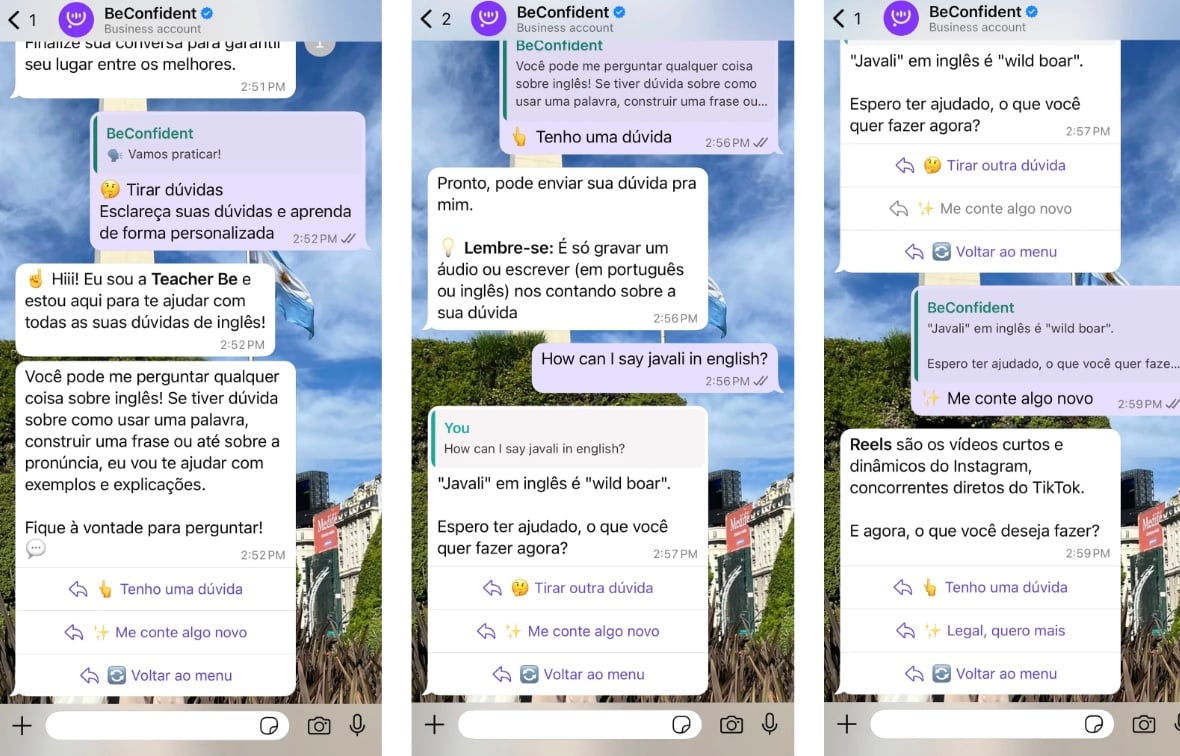
Master these Brazilian scenarios with unlimited practice, talking about the beach, soccer, and remote work with AI tutors who understand the Brazilian context.
11. Soccer dialogue in English
English:
A: Did you watch the game last night?
B: Yes! Brazil played really well. What did you think?
A: Amazing! The goals were incredible.
B: I agree. Brazilian football is always exciting to watch.
Portuguese:
A: Você assistiu ao jogo ontem à noite?
B: Sim! O Brasil jogou muito bem. O que você achou?
A: Incrível! Os gols foram incríveis.
B: Concordo. O futebol brasileiro é sempre emocionante de assistir.
Pronunciation: “game” sounds like “geim”. In “goals”, the “oa” sounds like “ou”.
Practical tip: use team names in English, like “Flamengo”, “Palmeiras” and “the national team”. Create questions about championships and players.
12. Pop culture conversation in English
English:
A: Do you watch Netflix series?
B: Yes, I love watching with English subtitles to practice.
A: That's smart! Which series do you recommend?
B: “Stranger Things” is great for learning everyday English.
Portuguese:
A: Você assiste séries da Netflix?
B: Sim, adoro assistir com legendas em inglês para praticar.
A: Isso é inteligente! Que série você recomenda?
B: “Stranger Things” é ótima para aprender inglês do dia a dia.
Pronunciation: “series” has the stress on the first syllable, “SIR-ies”. “Subtitles” sounds like “SUB-tai-tuls”.
Practical tip: use series you already watch. Write down short phrases from the episodes and try to fit them into the dialogues in this article.
13. Dialogue about hobbies in English
English:
A: What do you like to do in your free time?
B: I enjoy reading and listening to music. What about you?
A: I like playing guitar and cooking Brazilian food.
B: That sounds fun! Can you teach me a Brazilian recipe?
Portuguese:
A: O que você gosta de fazer no tempo livre?
B: Gosto de ler e ouvir música. E você?
A: Gosto de tocar violão e cozinhar comida brasileira.
B: Parece divertido! Você pode me ensinar uma receita brasileira?
Pronunciation: “guitar” sounds like “gi-TAR”. “Recipe” sounds like “RES-i-pi”.
Practical tip: talking about hobbies helps keep small talk natural. Replace the activities in the dialogue with your actual interests.
14. Making invitations conversation in English
English:
A: Would you like to have dinner with us tomorrow?
B: That sounds great! What time?
A: How about 7 PM? We're having a barbecue.
B: Perfect! Should I bring something?
Portuguese:
A: Gostaria de jantar conosco amanhã?
B: Parece ótimo! Que horas?
A: Que tal às 19h? Vamos fazer um churrasco.
B: Perfeito! Devo trazer alguma coisa?
Pronunciation: “would” sounds like “wud”. “Barbecue” sounds like “BAR-bi-kyu”.
Practical tip: use situations you actually experience, like a family barbecue or meeting up with friends. Create more formal and informal versions of the invitation.
15. Farewell dialogue in English
English:
A: It was great talking to you! I have to go now.
B: Same here! Thanks for the nice conversation.
A: See you soon. Have a great day!
B: You too! Take care!
Portuguese:
A: Foi ótimo conversar com você! Tenho que ir agora.
B: Também! Obrigado(a) pela conversa agradável.
A: Até logo. Tenha um ótimo dia!
B: Você também! Se cuide!
Pronunciation: “great” sounds like “greit”. In “take care”, the pronunciation is “teik ker”.
Practical tip: use variations like “See you later”, “Talk to you soon” and “Have a good one” to end conversations in different ways.
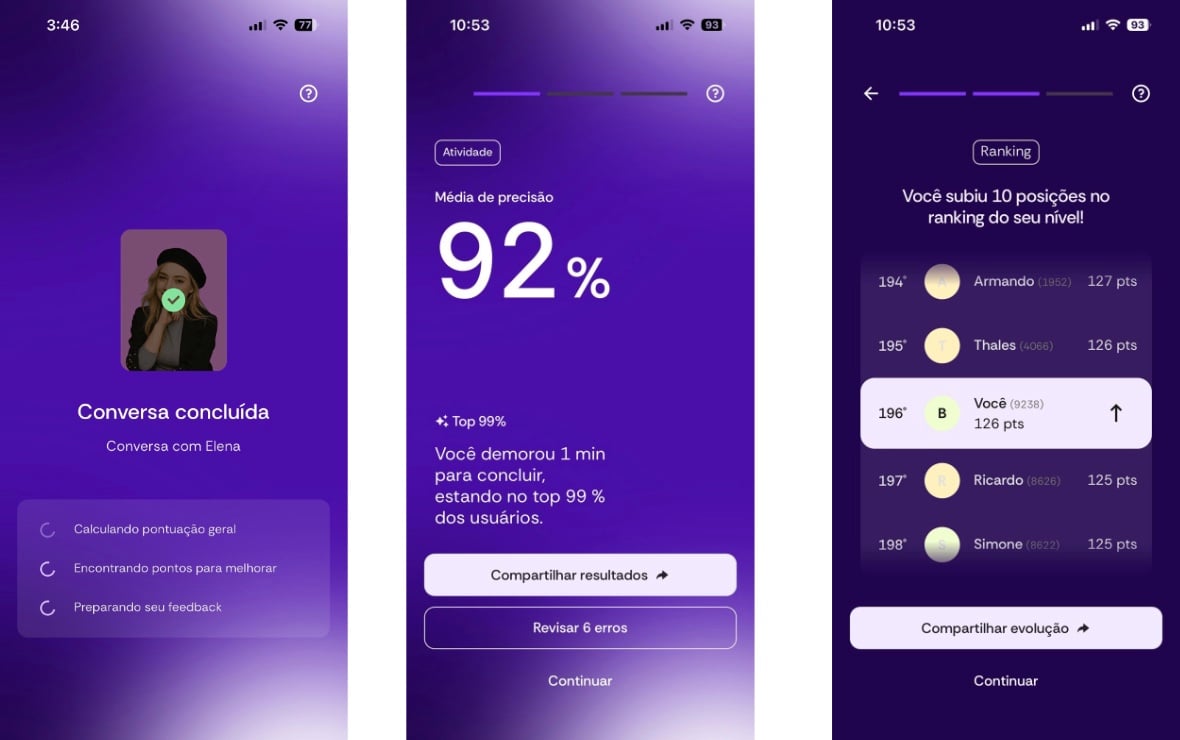
Turn these 15 dialogues into real fluency, starting your unlimited practice now and tracking your progress week by week.
FAQ: common questions about English conversation for beginners
How to start a conversation in simple English?
A simple conversation starts with greetings like “Hello, how are you?” or “Good morning!”. Next, use open-ended questions, for example “How's your day going?” or “What do you do for work?”. Repeating the dialogues in this article until the sentences come out automatically helps unlock these first interactions.
English dialogue between two people: what are good examples?
A good dialogue for beginners includes topics like introductions, routine, work, and hobbies. An example is: “Hi, I'm Ana.” / “Nice to meet you, Ana. I'm John.” / “Where are you from?” / “I'm from Brazil. What about you?”. Short, direct sentences make it easier to memorize and use daily.
English conversation between two friends: how to practice?
A good practice is to simulate conversations about the weekend, plans, movies, or sports. Using contractions like “I'm”, “don't” and “can't” makes speech sound more natural. For example: “What are you doing this weekend?” / “I'm going to the beach. Want to come?”.
How to practice English dialogue alone?
A practical way is to record both sides of the dialogue and repeat it until you gain fluency. Another option is to practice in front of the mirror to observe your facial expression. Practicing with technology, like BeConfident, adds real-time responses from AI tutors and immediate feedback, which accelerates learning compared to theoretical-only methods.
How to improve the pronunciation of “th” and “r” for Brazilians?
A good strategy is to focus daily on these sounds mentioned throughout the dialogues. Set aside 5 minutes to practice pairs like “think/sink” and “right/light”, recording your voice to identify where there is still confusion. Constant repetition helps make these sounds more natural over time.
Conclusion: how to transform these dialogues into real fluency
The 15 dialogues presented cover frequent situations for Brazilians speaking English, from basic introductions to specific contexts like the beach, soccer, and remote work. Interactive practice with AI is 3 times more effective than static lists for developing conversational fluency, which is why each dialogue included suggestions for active use.
With over 200,000 students and a RA 1000 reputation, BeConfident focuses on turning theory into daily practice. AI tutors with different accents offer immediate feedback 24 hours a day on channels like the app, WhatsApp, and smartwatch, allowing you to train during any break in your day.
Stop freezing when it's time to speak. Find out your current level and start practicing now, to transform these dialogues into natural conversations in just a few weeks.
Written by: Luan Cavallaro, Founder & CMO, BeConfident
Key takeaways from this article
Master the basics: learn greetings, introductions, and small talk with clear pronunciation of sounds like “th” and “r”, which usually cause difficulties for Brazilians.
Use real scenarios: practice dialogues in daily Brazilian contexts, such as remote work, the beach, soccer, and barbecues.
Personalize the lines: adapt each dialogue to your routine, hobbies, and city to gain confidence in real-life situations.
Practice actively: repeat out loud, record your own voice, and apply pronunciation tips to correct common mistakes.
Accelerate learning: use 24/7 interactive practice on BeConfident to receive immediate feedback from AI tutors.
Mastering English conversation starts with simple dialogues that reflect real-life situations. The following 15 dialogues appear in increasing order of difficulty, starting with basic greetings and advancing to typical scenarios in a Brazilian's routine, such as remote work, travel, and leisure.
Each dialogue includes a translation, pronunciation guidelines, and a practical tip to help you know how to practice. Read out loud, repeat several times, and personalize the sentences with your own details before moving on to the next dialogue.
1. English greetings dialogue for beginners
English:
A: Hello! How are you?
B: Hi! I'm fine, thank you. And you?
A: I'm good, thanks!
Portuguese:
A: Olá! Como você está?
B: Oi! Estou bem, obrigado(a). E você?
A: Estou bem, obrigado(a)!
Pronunciation: the “th” in “thank” should be pronounced by placing the tongue between the teeth, not like a “t”. Brazilians often struggle with the “th” sound, especially when it appears alongside other consonants.
Practical tip: repeat this dialogue 5 times out loud and record your voice to compare it with native pronunciation. Since the “th” sound is the biggest challenge here, practice it in isolation first, just “th-th-th”, and then use the sound in the full sentences of the dialogue.
Practice on BeConfident: open the app or WhatsApp, choose an AI tutor with an American accent, and replicate this dialogue. Get real-time pronunciation corrections, without being exposed to other people.
2. English introductions dialogue for beginners
English:
A: Nice to meet you! What's your name?
B: Nice to meet you too! I'm Maria. What about you?
A: I'm João. Where are you from?
B: I'm from Brazil.
Portuguese:
A: Prazer em conhecê-la! Qual é seu nome?
B: Prazer em conhecê-lo também! Eu sou Maria. E você?
A: Eu sou João. De onde você é?
B: Eu sou do Brasil.
Pronunciation: in “Nice”, the sound is “nais”, not “nice” as in Portuguese. In “Brazil”, the “r” sounds softer, close to a light “h”, and not like the strong “r” of Brazilian Portuguese.
Practical tip: replace the names, country, and city with your real details. Practice introducing yourself as if you were meeting someone on a trip or at a work event.
3. Dialogue about origin in English for beginners
English:
A: Where do you live?
B: I live in São Paulo. It's a big city in Brazil.
A: That sounds interesting! Do you like it there?
B: Yes, I love it. There are many things to do.
Portuguese:
A: Onde você mora?
B: Eu moro em São Paulo. É uma cidade grande no Brasil.
A: Isso parece interessante! Você gosta de lá?
B: Sim, eu amo. Há muitas coisas para fazer.
Pronunciation: “live” has a short “liv” sound, not “laiv”. In “there”, use the “th” sound you practiced, followed by a soft “er”.
Practical tip: adapt the dialogue to your reality. If you live in a small town, use “I live in a small town near [larger city]” to better explain where you live.
4. Small talk: how to say “how are you” in English
English:
A: How's your day going?
B: It's going well, thanks! I'm a bit tired, but good.
A: Why are you tired?
B: I had a long day at work. How about you?
Portuguese:
A: Como está sendo seu dia?
B: Está indo bem, obrigado(a)! Estou um pouco cansado(a), mas bem.
A: Por que você está cansado(a)?
B: Tive um dia longo no trabalho. E você?
Pronunciation: “day” sounds like “dei”. In “work”, the end has a dry “k” sound, without the strong “r” that many Brazilians add.
Practical tip: vary your answers with expressions like “a bit tired”, “pretty good” and “not bad”. Use these combinations to avoid the automatic “fine” and sound more natural.
5. Dialogue about daily routine in English
English:
A: What time do you usually wake up?
B: I wake up at 7 AM. What about you?
A: I get up at 6:30. I like to exercise in the morning.
B: That's great! I prefer to exercise in the evening.
Portuguese:
A: Que horas você geralmente acorda?
B: Eu acordo às 7h. E você?
A: Eu levanto às 6h30. Gosto de me exercitar de manhã.
B: Isso é ótimo! Eu prefiro me exercitar à noite.
Pronunciation: in “wake up”, the “a” in “wake” sounds like “ei”. “Exercise” has three syllables, “EK-ser-saiz”, with the final sound of “saiz”.
Practical tip: use your actual routine. Combine “I usually”, “I always” and “I sometimes” with different activities to create multiple versions of the same dialogue.
Practice these first 5 dialogues with personalized feedback, opening the BeConfident app to receive instant pronunciation corrections while chatting with AI tutors.
After mastering these basic dialogues, it's worth applying the same structures in situations that are part of your routine in Brazil. The next examples bring contexts like remote work, airport, beach, and soccer to make your study closer to your daily life.
6. Conversation in English about remote work
English:
A: Do you work from home?
B: Yes, I've been working remotely since 2020. Do you?
A: Sometimes. I go to the office twice a week.
B: That's a good balance. Remote work is very common in Brazil now.
Portuguese:
A: Você trabalha de casa?
B: Sim, trabalho remotamente desde 2020. E você?
A: Às vezes. Vou ao escritório duas vezes por semana.
B: É um bom equilíbrio. Trabalho remoto é muito comum no Brasil agora.
Pronunciation: “work” ends with a dry “k” sound. In “remote”, the stressed syllable is the second one, “ri-MOUT”.
Practical tip: expand your vocabulary with terms like “home office”, “video calls” and “flexible schedule”. Build new questions using these expressions.
7. Dialogue in a restaurant in English
English:
A: Good evening! Do you have a table for two?
B: Yes, right this way. Here's the menu.
A: Thank you. What do you recommend?
B: The grilled fish is very popular. Would you like something to drink?
Portuguese:
A: Boa noite! Vocês têm mesa para dois?
B: Sim, por aqui. Aqui está o cardápio.
A: Obrigado(a). O que você recomenda?
B: O peixe grelhado é muito popular. Gostaria de algo para beber?
Pronunciation: “table” sounds like “TEI-bul”. “Menu” is “MEN-yu”, different from “me-NU” in Portuguese.
Practical tip: memorize phrases like “I'd like...”, “Could I have...?” and “The check, please”. Practice ordering Brazilian dishes in English, like “grilled picanha” or “black beans”.
8. English conversation while shopping
English:
A: Excuse me, how much is this shirt?
B: It's 50 reais. Would you like to try it on?
A: Yes, please. Where's the fitting room?
B: It's over there, next to the cashier.
Portuguese:
A: Com licença, quanto custa esta camisa?
B: São 50 reais. Gostaria de experimentar?
A: Sim, por favor. Onde fica o provador?
B: É ali, ao lado do caixa.
Pronunciation: in “shirt”, the “ir” sounds like “er”. “Fitting” has a clearly pronounced “tt”.
Practical tip: use “reais” naturally, as many foreigners recognize the currency. Also practice sizes like “small”, “medium” and “large”.
9. Dialogue at the airport in English
English:
A: Excuse me, where is gate 15?
B: Go straight and turn left after the duty-free shop.
A: Thank you. What time does the flight to Miami leave?
B: It departs at 11:30 PM. You have about two hours.
Portuguese:
A: Com licença, onde fica o portão 15?
B: Vá em frente e vire à esquerda depois da loja duty-free.
A: Obrigado(a). Que horas sai o voo para Miami?
B: Parte às 23h30. Você tem cerca de duas horas.
Pronunciation: “gate” sounds like “geit”. In “flight”, the “gh” is silent, and the word sounds like “flait”.
Practical tip: swap “Miami” with other common destinations, like “New York”, “Orlando” and “Lisbon”, and repeat the dialogue with each city.
10. Conversation at the beach in English
English:
A: The beach is beautiful today! The water looks perfect.
B: Yes! Do you want to swim or just relax in the sun?
A: Let's swim first. The waves are not too big.
B: Great idea! I love Brazilian beaches.
Portuguese:
A: A praia está linda hoje! A água parece perfeita.
B: Sim! Você quer nadar ou apenas relaxar no sol?
A: Vamos nadar primeiro. As ondas não estão muito grandes.
B: Ótima ideia! Eu amo as praias brasileiras.
Pronunciation: “beach” has a long vowel, sounding like “biitch”. In “waves”, the ending has a “z” sound.
Practical tip: expand your vocabulary with “sunscreen”, “coconut water” and “beach volleyball”. Create new sentences describing your favorite beach.
Master these Brazilian scenarios with unlimited practice, talking about the beach, soccer, and remote work with AI tutors who understand the Brazilian context.
11. Soccer dialogue in English
English:
A: Did you watch the game last night?
B: Yes! Brazil played really well. What did you think?
A: Amazing! The goals were incredible.
B: I agree. Brazilian football is always exciting to watch.
Portuguese:
A: Você assistiu ao jogo ontem à noite?
B: Sim! O Brasil jogou muito bem. O que você achou?
A: Incrível! Os gols foram incríveis.
B: Concordo. O futebol brasileiro é sempre emocionante de assistir.
Pronunciation: “game” sounds like “geim”. In “goals”, the “oa” sounds like “ou”.
Practical tip: use team names in English, like “Flamengo”, “Palmeiras” and “the national team”. Create questions about championships and players.
12. Pop culture conversation in English
English:
A: Do you watch Netflix series?
B: Yes, I love watching with English subtitles to practice.
A: That's smart! Which series do you recommend?
B: “Stranger Things” is great for learning everyday English.
Portuguese:
A: Você assiste séries da Netflix?
B: Sim, adoro assistir com legendas em inglês para praticar.
A: Isso é inteligente! Que série você recomenda?
B: “Stranger Things” é ótima para aprender inglês do dia a dia.
Pronunciation: “series” has the stress on the first syllable, “SIR-ies”. “Subtitles” sounds like “SUB-tai-tuls”.
Practical tip: use series you already watch. Write down short phrases from the episodes and try to fit them into the dialogues in this article.
13. Dialogue about hobbies in English
English:
A: What do you like to do in your free time?
B: I enjoy reading and listening to music. What about you?
A: I like playing guitar and cooking Brazilian food.
B: That sounds fun! Can you teach me a Brazilian recipe?
Portuguese:
A: O que você gosta de fazer no tempo livre?
B: Gosto de ler e ouvir música. E você?
A: Gosto de tocar violão e cozinhar comida brasileira.
B: Parece divertido! Você pode me ensinar uma receita brasileira?
Pronunciation: “guitar” sounds like “gi-TAR”. “Recipe” sounds like “RES-i-pi”.
Practical tip: talking about hobbies helps keep small talk natural. Replace the activities in the dialogue with your actual interests.
14. Making invitations conversation in English
English:
A: Would you like to have dinner with us tomorrow?
B: That sounds great! What time?
A: How about 7 PM? We're having a barbecue.
B: Perfect! Should I bring something?
Portuguese:
A: Gostaria de jantar conosco amanhã?
B: Parece ótimo! Que horas?
A: Que tal às 19h? Vamos fazer um churrasco.
B: Perfeito! Devo trazer alguma coisa?
Pronunciation: “would” sounds like “wud”. “Barbecue” sounds like “BAR-bi-kyu”.
Practical tip: use situations you actually experience, like a family barbecue or meeting up with friends. Create more formal and informal versions of the invitation.
15. Farewell dialogue in English
English:
A: It was great talking to you! I have to go now.
B: Same here! Thanks for the nice conversation.
A: See you soon. Have a great day!
B: You too! Take care!
Portuguese:
A: Foi ótimo conversar com você! Tenho que ir agora.
B: Também! Obrigado(a) pela conversa agradável.
A: Até logo. Tenha um ótimo dia!
B: Você também! Se cuide!
Pronunciation: “great” sounds like “greit”. In “take care”, the pronunciation is “teik ker”.
Practical tip: use variations like “See you later”, “Talk to you soon” and “Have a good one” to end conversations in different ways.
Turn these 15 dialogues into real fluency, starting your unlimited practice now and tracking your progress week by week.
FAQ: common questions about English conversation for beginners
How to start a conversation in simple English?
A simple conversation starts with greetings like “Hello, how are you?” or “Good morning!”. Next, use open-ended questions, for example “How's your day going?” or “What do you do for work?”. Repeating the dialogues in this article until the sentences come out automatically helps unlock these first interactions.
English dialogue between two people: what are good examples?
A good dialogue for beginners includes topics like introductions, routine, work, and hobbies. An example is: “Hi, I'm Ana.” / “Nice to meet you, Ana. I'm John.” / “Where are you from?” / “I'm from Brazil. What about you?”. Short, direct sentences make it easier to memorize and use daily.
English conversation between two friends: how to practice?
A good practice is to simulate conversations about the weekend, plans, movies, or sports. Using contractions like “I'm”, “don't” and “can't” makes speech sound more natural. For example: “What are you doing this weekend?” / “I'm going to the beach. Want to come?”.
How to practice English dialogue alone?
A practical way is to record both sides of the dialogue and repeat it until you gain fluency. Another option is to practice in front of the mirror to observe your facial expression. Practicing with technology, like BeConfident, adds real-time responses from AI tutors and immediate feedback, which accelerates learning compared to theoretical-only methods.
How to improve the pronunciation of “th” and “r” for Brazilians?
A good strategy is to focus daily on these sounds mentioned throughout the dialogues. Set aside 5 minutes to practice pairs like “think/sink” and “right/light”, recording your voice to identify where there is still confusion. Constant repetition helps make these sounds more natural over time.
Conclusion: how to transform these dialogues into real fluency
The 15 dialogues presented cover frequent situations for Brazilians speaking English, from basic introductions to specific contexts like the beach, soccer, and remote work. Interactive practice with AI is 3 times more effective than static lists for developing conversational fluency, which is why each dialogue included suggestions for active use.
With over 200,000 students and a RA 1000 reputation, BeConfident focuses on turning theory into daily practice. AI tutors with different accents offer immediate feedback 24 hours a day on channels like the app, WhatsApp, and smartwatch, allowing you to train during any break in your day.
Stop freezing when it's time to speak. Find out your current level and start practicing now, to transform these dialogues into natural conversations in just a few weeks.