




12 common English mistakes made by beginners and how to avoid them
12 common English mistakes made by beginners and how to avoid them
12 common English mistakes made by beginners and how to avoid them
Written by: Luan Cavallaro, Founder & CMO, BeConfident
Key takeaways from this article
Use "I am 30 years old" instead of "I have 30 years old" to speak about age correctly.
Avoid literal translations from Portuguese, such as "make a dream", and prefer natural expressions like "fulfill a dream".
Prefer "there is/are" to indicate existence instead of "have", and use correct prepositions like "on Monday".
Differentiate verbs like "miss" (miss an opportunity or feel the loss of something/someone) and "lose" (lose an object or a game), and avoid progressive form with state verbs.
Correct these mistakes with unlimited conversational practice on BeConfident and speak English with natural confidence.
The 12 most common mistakes of Brazilian beginners in English
Mistake #1: confusing "have" and "be" for age
Brazilians often translate "eu tenho 30 anos" as "I have 30 years old". In English, the correct way to talk about age uses the verb "be", not "have".
❌ Incorrect: "I have 25 years old"
✅ Correct: "I am 25 years old"
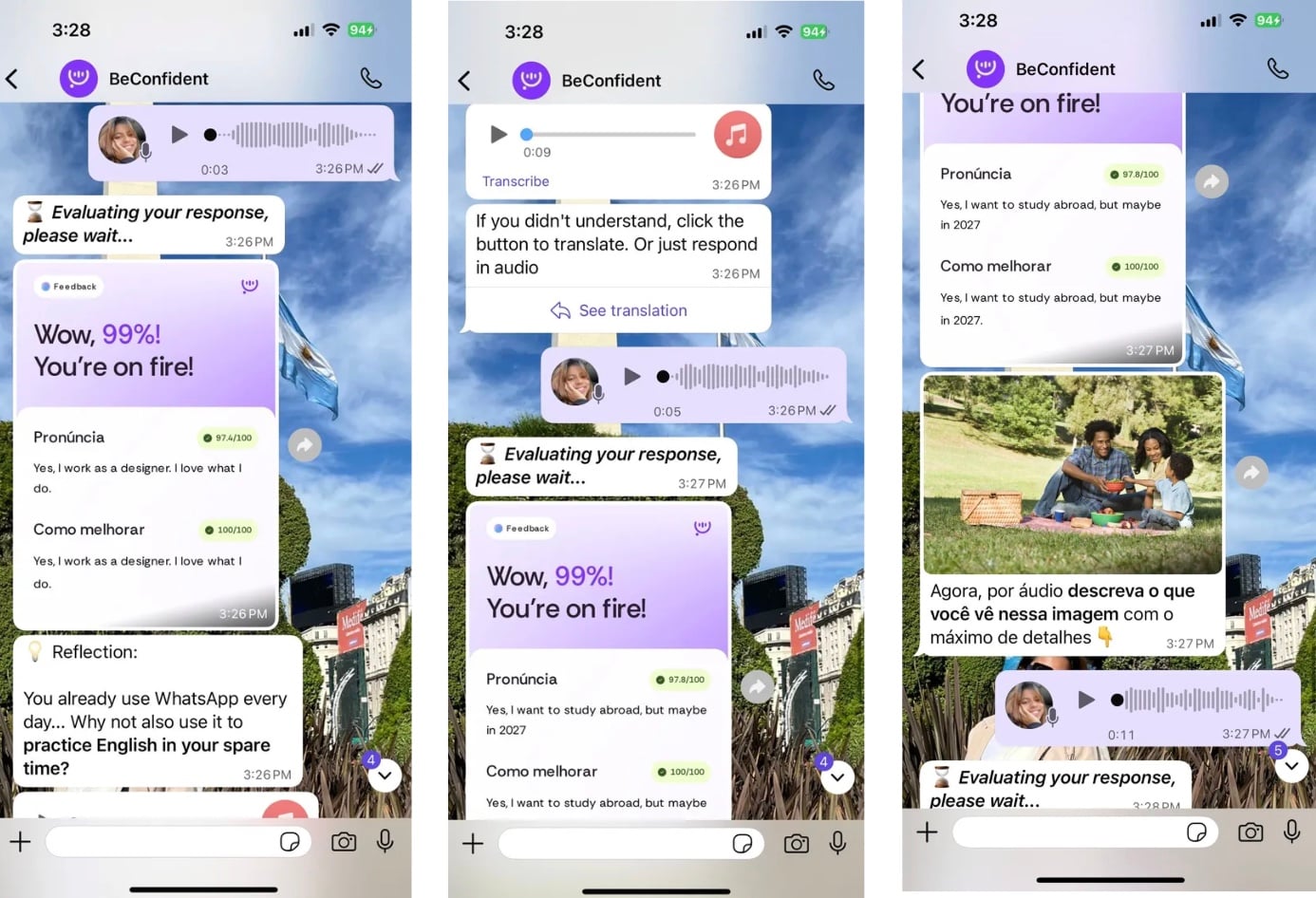
BeConfident Prompt: open the app and practice with an American tutor: "How old are you?". You receive instant feedback on your answer and pronunciation.
Mistake #2: translating too literally
Translating word-for-word from Portuguese creates sentences that sound strange to native speakers. This habit becomes one of the greatest obstacles to natural fluency.
❌ Incorrect: "I will make a dream"
✅ Correct: "I will fulfill a dream" or "I will achieve my dream"
BeConfident Prompt: talk about your personal goals with the AI. It automatically corrects literally translated expressions.
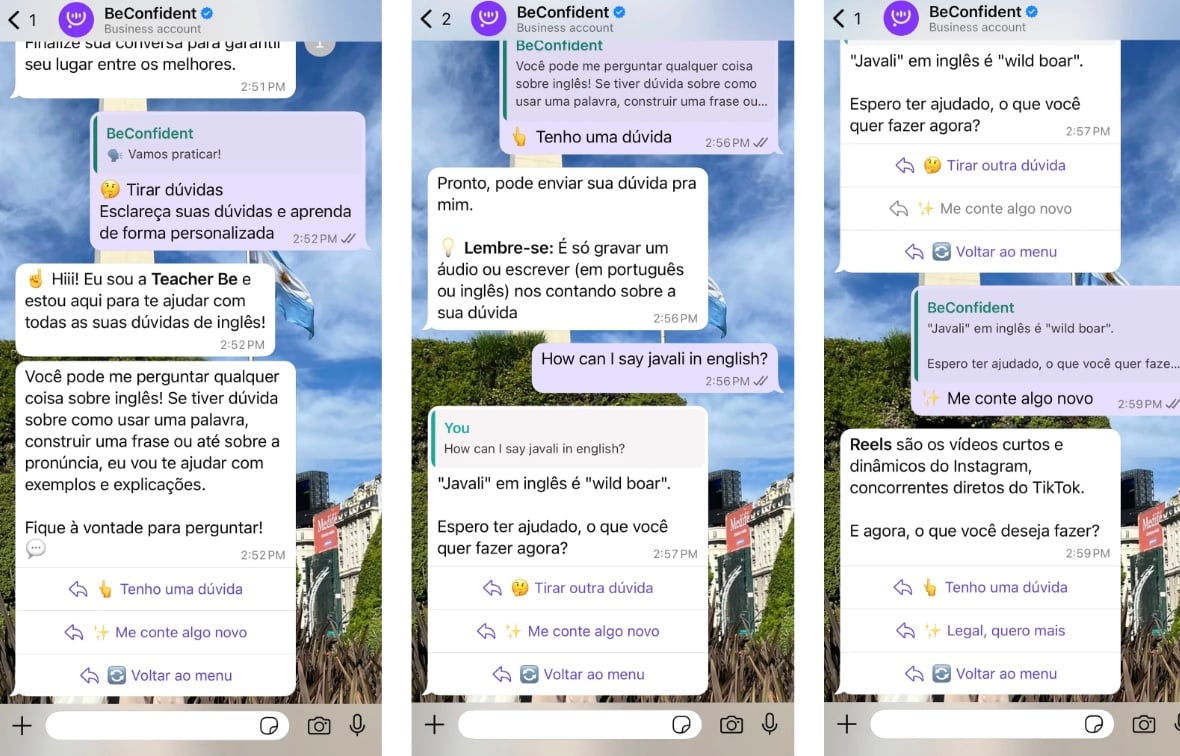
Mistake #3: confusing "there is/are" with "have"
Many Brazilians say "I have many places in my city" when they want to say "tem muitos lugares na minha cidade". In English, the correct way to indicate existence uses "there is/are".
❌ Incorrect: "I have many cars on the road today"
✅ Correct: "There are many cars on the road today"
Mistake #4: confusing "miss" and "lose"
The verbs "miss" and "lose" have different uses. "Miss" means to miss an opportunity or feel the lack of something/someone. "Lose" means to lose an object, a match, or a competition.
❌ Incorrect: "I lost the bus" (when you failed to catch it)
✅ Correct: "I missed the bus"
Mistake #5: using prepositions of time (in/on/at) incorrectly
Prepositions of time are a frequent source of doubt. Many Brazilians use "in" for almost everything, but each preposition has a specific context.
❌ Incorrect: "I arrived in Monday"
✅ Correct: "I arrived on Monday"
Quick rule: AT for specific hours, ON for days, IN for months and years.
Mistake #6: pronunciation that changes the meaning
Incorrect pronunciation can totally change the meaning of the sentence. Brazilians often add extra vowels or pronounce sounds that don't exist.
❌ Incorrect: "beach" pronounced as "bitch"
✅ Correct: "beach" with a long "i" sound
BeConfident Prompt: practice similar words with AI tutors that simulate different native accents in the app, such as American, British, and South African.
Mistake #7: falling for false cognates
False cognates are words that look similar in Portuguese and English, but have different meanings. They generate frequent confusion in speaking and writing.
❌ Incorrect: "I will pretend to be a doctor" (when meaning to have the intention)
✅ Correct: "I intend to be a doctor"
Mistake #8: using the present continuous with state verbs
Using the present continuous with state verbs is a recurring mistake. These verbs normally do not accept the continuous form.
❌ Incorrect: "I am knowing the answer"
✅ Correct: "I know the answer"
Mistake #9: thinking in Portuguese when speaking English
Thinking in Portuguese while speaking English hinders fluency. Mental translation reduces naturalness and slows down speech.
Solution: practice thinking directly in English through continuous conversation with BeConfident's AI, with no time to translate mentally.
Mistake #10: avoiding conversational practice
Focusing only on grammar and vocabulary and putting speaking aside limits progress. This habit creates the feeling of "understanding everything, but not being able to speak."
BeConfident Prompt: use the "simulated call" feature on WhatsApp to practice real conversations on topics of interest to you.
Mistake #11: ignoring different native accents
Studying with only one accent reduces comprehension in real-life situations. Native speakers from different countries speak with various rhythms, intonations, and vocabularies.
BeConfident Solution: Practice with AI tutors that simulate native accents like American, British, Australian, Canadian, South African, and Indian.
Mistake #12: not reviewing mistakes made
Repeating the same mistakes due to a lack of review delays fluency. A simple review system helps consolidate corrections and new speech patterns.
BeConfident Feature: use the "Review Mistakes" menu to access your personalized history of corrections in grammar, pronunciation, and natural expressions.
How to correct these mistakes with shame-free AI practice
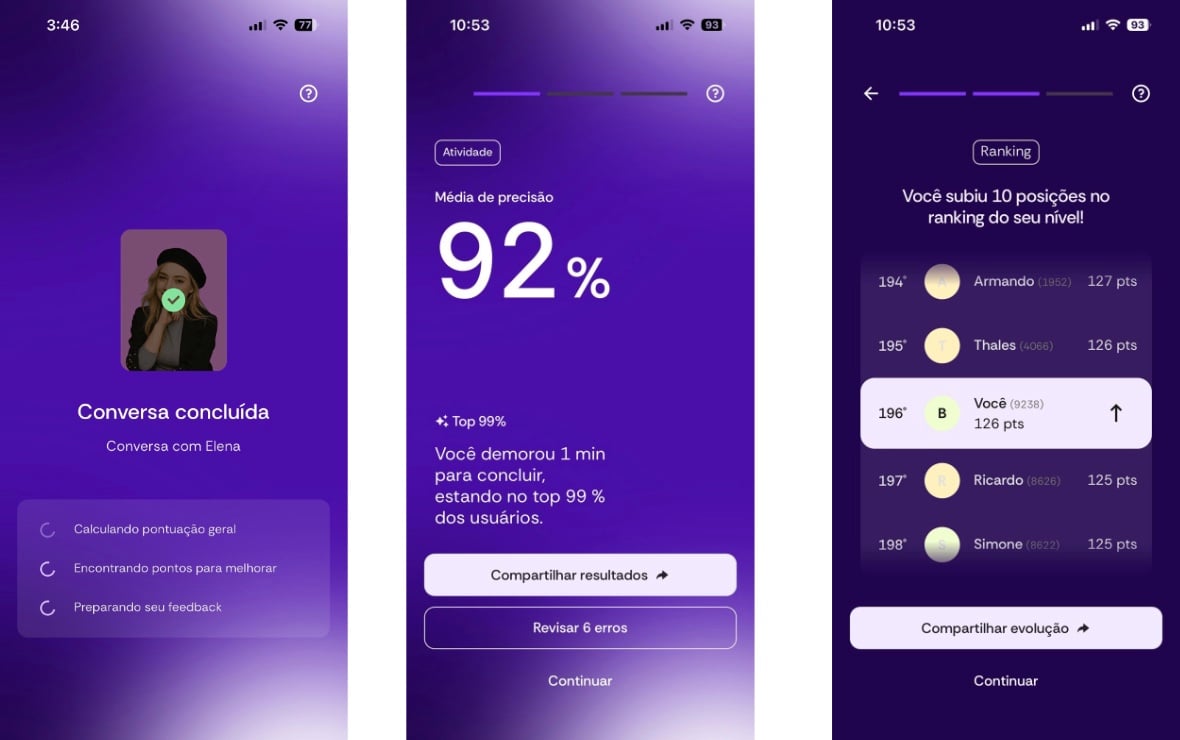
BeConfident offers unlimited conversational practice 24/7, focusing on real speech and immediate feedback. This approach complements gamified exercise apps and fixed-schedule courses.
With RA 1000 on Reclame Aqui and over 200,000 paying students, the platform structures learning through:
AI Tutors with personality: natural conversations about topics of your interest.
Instant feedback: real-time corrections without judgment.
Multiple accents: preparation for real-life situations with native speakers from different countries.
Flexible practice: use via the app, WhatsApp, or smartwatch.
BeConfident's AI allows busy professionals to practice during their commute to work, at home, or while exercising, without depending on fixed schedules.
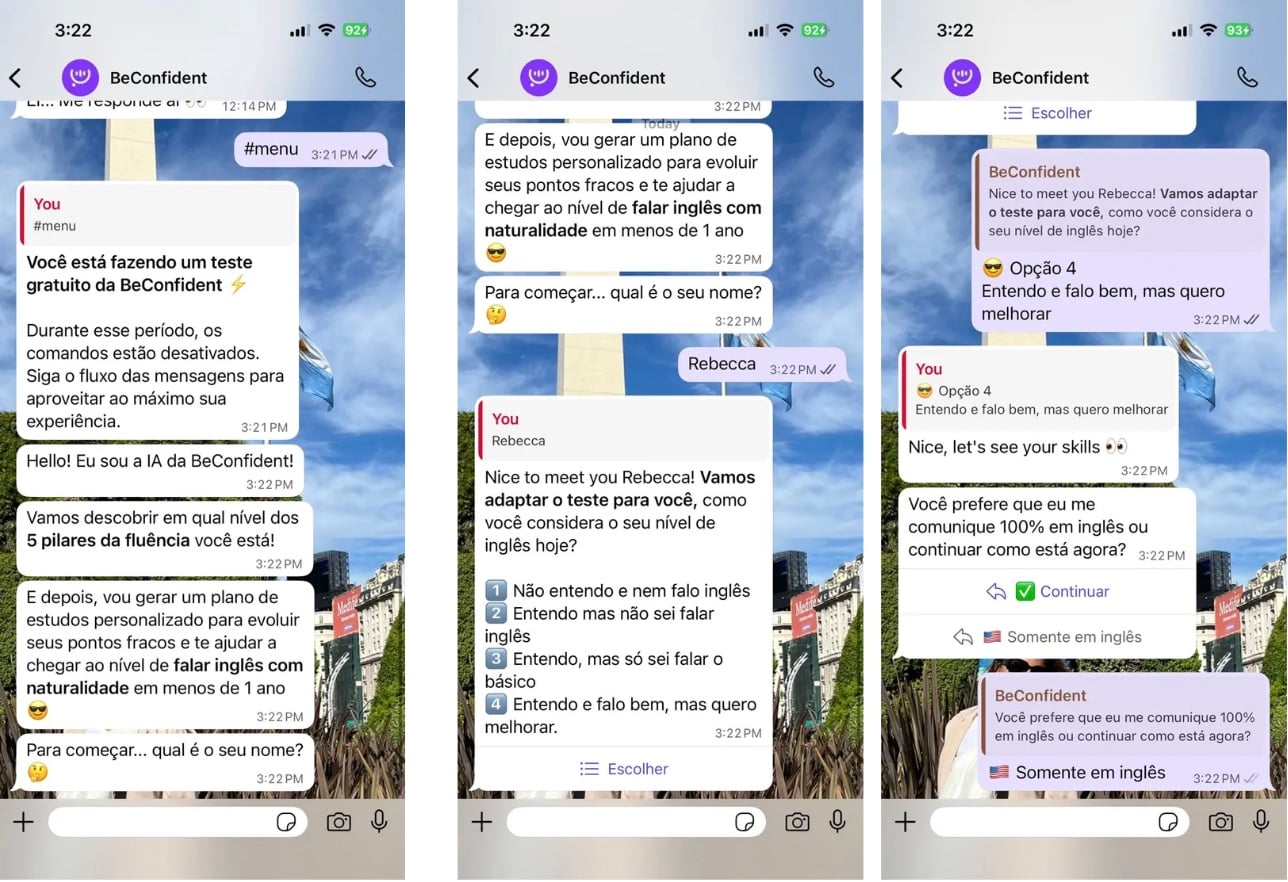
Start your free trial and begin learning English today. Find out your CEFR level and receive a personalized plan.
Frequently asked questions
What are the most common mistakes Brazilians make in English?
The most common mistakes include confusing "have" and "be" for age, translating too literally, using prepositions incorrectly, confusing "miss" and "lose", pronouncing words in a way that changes the meaning, falling for false cognates, using the present continuous with state verbs, thinking in Portuguese when speaking, avoiding conversation, ignoring native accents, not using "there is/are" correctly, and not reviewing mistakes made.
What is usually the hardest part for English beginners?
Conversation is usually the greatest challenge. Many Brazilians can read and understand English, but freeze when it comes to speaking due to fear of making mistakes, lack of practice, and interference from Portuguese. Constant conversational practice with immediate feedback, like BeConfident's AI offers, reduces this block.
How to practice pronunciation without feeling embarrassed?
AI tutors reduce embarrassment because they don't judge your mistakes. You can repeat words as many times as you need, practice at any time, and receive detailed corrections on pronunciation, intonation, and speech rhythm, building confidence gradually.
Does Duolingo correct speech mistakes?
Duolingo focuses mainly on vocabulary and basic grammar exercises, with little emphasis on fluent conversation. To correct speech mistakes and gain naturalness, a person needs intensive conversational practice with specialized feedback, as BeConfident offers.
How long does it take to reach fluency?
Daily personalized conversational practice generates noticeable improvements in a few weeks and can lead to conversational fluency in a few months. The time varies according to dedication, initial level, and quality of practice, but the AI accelerates the process with precise corrections and constant exposure to the language.
Conclusion
Avoiding the most common mistakes of those starting in English requires daily and targeted conversational practice. BeConfident uses your free time as a concrete opportunity to develop natural fluency, with continuous tracking and measurable results.
Professionals who need to stand out in international calls, travelers who want to communicate confidently abroad, and people who wish to master English benefit from frequent sessions with AI tutors, in an affordable and flexible format.
Start your free trial and begin learning English today. Identify your current level, receive personalized feedback, and move forward to speak English more naturally in less time.
Written by: Luan Cavallaro, Founder & CMO, BeConfident
Key takeaways from this article
Use "I am 30 years old" instead of "I have 30 years old" to speak about age correctly.
Avoid literal translations from Portuguese, such as "make a dream", and prefer natural expressions like "fulfill a dream".
Prefer "there is/are" to indicate existence instead of "have", and use correct prepositions like "on Monday".
Differentiate verbs like "miss" (miss an opportunity or feel the loss of something/someone) and "lose" (lose an object or a game), and avoid progressive form with state verbs.
Correct these mistakes with unlimited conversational practice on BeConfident and speak English with natural confidence.
The 12 most common mistakes of Brazilian beginners in English
Mistake #1: confusing "have" and "be" for age
Brazilians often translate "eu tenho 30 anos" as "I have 30 years old". In English, the correct way to talk about age uses the verb "be", not "have".
❌ Incorrect: "I have 25 years old"
✅ Correct: "I am 25 years old"
BeConfident Prompt: open the app and practice with an American tutor: "How old are you?". You receive instant feedback on your answer and pronunciation.
Mistake #2: translating too literally
Translating word-for-word from Portuguese creates sentences that sound strange to native speakers. This habit becomes one of the greatest obstacles to natural fluency.
❌ Incorrect: "I will make a dream"
✅ Correct: "I will fulfill a dream" or "I will achieve my dream"
BeConfident Prompt: talk about your personal goals with the AI. It automatically corrects literally translated expressions.
Mistake #3: confusing "there is/are" with "have"
Many Brazilians say "I have many places in my city" when they want to say "tem muitos lugares na minha cidade". In English, the correct way to indicate existence uses "there is/are".
❌ Incorrect: "I have many cars on the road today"
✅ Correct: "There are many cars on the road today"
Mistake #4: confusing "miss" and "lose"
The verbs "miss" and "lose" have different uses. "Miss" means to miss an opportunity or feel the lack of something/someone. "Lose" means to lose an object, a match, or a competition.
❌ Incorrect: "I lost the bus" (when you failed to catch it)
✅ Correct: "I missed the bus"
Mistake #5: using prepositions of time (in/on/at) incorrectly
Prepositions of time are a frequent source of doubt. Many Brazilians use "in" for almost everything, but each preposition has a specific context.
❌ Incorrect: "I arrived in Monday"
✅ Correct: "I arrived on Monday"
Quick rule: AT for specific hours, ON for days, IN for months and years.
Mistake #6: pronunciation that changes the meaning
Incorrect pronunciation can totally change the meaning of the sentence. Brazilians often add extra vowels or pronounce sounds that don't exist.
❌ Incorrect: "beach" pronounced as "bitch"
✅ Correct: "beach" with a long "i" sound
BeConfident Prompt: practice similar words with AI tutors that simulate different native accents in the app, such as American, British, and South African.
Mistake #7: falling for false cognates
False cognates are words that look similar in Portuguese and English, but have different meanings. They generate frequent confusion in speaking and writing.
❌ Incorrect: "I will pretend to be a doctor" (when meaning to have the intention)
✅ Correct: "I intend to be a doctor"
Mistake #8: using the present continuous with state verbs
Using the present continuous with state verbs is a recurring mistake. These verbs normally do not accept the continuous form.
❌ Incorrect: "I am knowing the answer"
✅ Correct: "I know the answer"
Mistake #9: thinking in Portuguese when speaking English
Thinking in Portuguese while speaking English hinders fluency. Mental translation reduces naturalness and slows down speech.
Solution: practice thinking directly in English through continuous conversation with BeConfident's AI, with no time to translate mentally.
Mistake #10: avoiding conversational practice
Focusing only on grammar and vocabulary and putting speaking aside limits progress. This habit creates the feeling of "understanding everything, but not being able to speak."
BeConfident Prompt: use the "simulated call" feature on WhatsApp to practice real conversations on topics of interest to you.
Mistake #11: ignoring different native accents
Studying with only one accent reduces comprehension in real-life situations. Native speakers from different countries speak with various rhythms, intonations, and vocabularies.
BeConfident Solution: Practice with AI tutors that simulate native accents like American, British, Australian, Canadian, South African, and Indian.
Mistake #12: not reviewing mistakes made
Repeating the same mistakes due to a lack of review delays fluency. A simple review system helps consolidate corrections and new speech patterns.
BeConfident Feature: use the "Review Mistakes" menu to access your personalized history of corrections in grammar, pronunciation, and natural expressions.
How to correct these mistakes with shame-free AI practice
BeConfident offers unlimited conversational practice 24/7, focusing on real speech and immediate feedback. This approach complements gamified exercise apps and fixed-schedule courses.
With RA 1000 on Reclame Aqui and over 200,000 paying students, the platform structures learning through:
AI Tutors with personality: natural conversations about topics of your interest.
Instant feedback: real-time corrections without judgment.
Multiple accents: preparation for real-life situations with native speakers from different countries.
Flexible practice: use via the app, WhatsApp, or smartwatch.
BeConfident's AI allows busy professionals to practice during their commute to work, at home, or while exercising, without depending on fixed schedules.
Start your free trial and begin learning English today. Find out your CEFR level and receive a personalized plan.
Frequently asked questions
What are the most common mistakes Brazilians make in English?
The most common mistakes include confusing "have" and "be" for age, translating too literally, using prepositions incorrectly, confusing "miss" and "lose", pronouncing words in a way that changes the meaning, falling for false cognates, using the present continuous with state verbs, thinking in Portuguese when speaking, avoiding conversation, ignoring native accents, not using "there is/are" correctly, and not reviewing mistakes made.
What is usually the hardest part for English beginners?
Conversation is usually the greatest challenge. Many Brazilians can read and understand English, but freeze when it comes to speaking due to fear of making mistakes, lack of practice, and interference from Portuguese. Constant conversational practice with immediate feedback, like BeConfident's AI offers, reduces this block.
How to practice pronunciation without feeling embarrassed?
AI tutors reduce embarrassment because they don't judge your mistakes. You can repeat words as many times as you need, practice at any time, and receive detailed corrections on pronunciation, intonation, and speech rhythm, building confidence gradually.
Does Duolingo correct speech mistakes?
Duolingo focuses mainly on vocabulary and basic grammar exercises, with little emphasis on fluent conversation. To correct speech mistakes and gain naturalness, a person needs intensive conversational practice with specialized feedback, as BeConfident offers.
How long does it take to reach fluency?
Daily personalized conversational practice generates noticeable improvements in a few weeks and can lead to conversational fluency in a few months. The time varies according to dedication, initial level, and quality of practice, but the AI accelerates the process with precise corrections and constant exposure to the language.
Conclusion
Avoiding the most common mistakes of those starting in English requires daily and targeted conversational practice. BeConfident uses your free time as a concrete opportunity to develop natural fluency, with continuous tracking and measurable results.
Professionals who need to stand out in international calls, travelers who want to communicate confidently abroad, and people who wish to master English benefit from frequent sessions with AI tutors, in an affordable and flexible format.
Start your free trial and begin learning English today. Identify your current level, receive personalized feedback, and move forward to speak English more naturally in less time.