



English phrases for restaurants: a travel guide
English phrases for restaurants: a travel guide
English phrases for restaurants: a travel guide
Written by: Luan Cavallaro, Founder & CMO, BeConfident
Key Takeaways from This Article
Mastering essential phrases for reserving a table, ordering food, and dealing with allergies in foreign restaurants prevents embarrassment when traveling.
Practicing the pronunciation of 40 expressions organized in practical categories, such as ordering, during the meal, and payment, makes daily use easier.
Using real dialogues from a romantic dinner, family meal, and vegan options helps simulate authentic situations and increases confidence.
Keeping up with 2026 trends, such as plant-based options and functional proteins, requires specific phrases for modern diets.
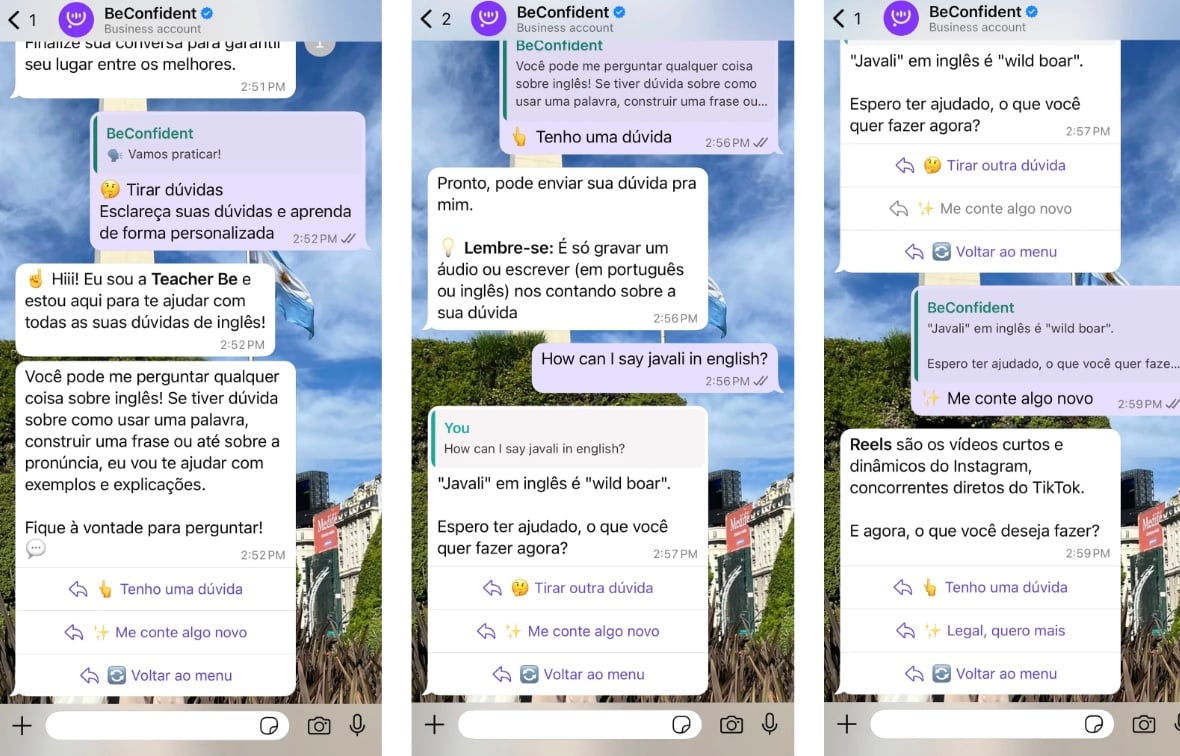
Accelerating learning with BeConfident allows you to practice with AI of native accents 24/7. Take a free test and experience it in practice.
1. Phrases for Arriving and Reserving a Table
First contact at the restaurant sets the tone for the experience. These 7 phrases help you arrive and settle in confidently:
1. "Good evening, I have a reservation under [your name]" (Good evening, I have a reservation in the name of [your name] | gud í-vning, ai hév a re-zer-véi-shon ân-der)
2. "Table for two, please" (Table for two, please | téi-bol for tu, pliz)
3. "How long is the wait?" (How long is the wait? | háu long iz dhi weit)
4. "Can we sit by the window?" (Can we sit near the window? | kén wi sit bai dhi wín-dou)
5. "Is this table available?" (Is this table available? | iz dhis téi-bol a-véi-la-bol)
6. "We'd prefer a quieter table" (We would prefer a quieter table | wid pri-fér a kwái-e-ter téi-bol)
7. "Thank you for seating us" (Thank you for seating us | thénk yu for sí-ting âs)
Speaking slowly and clearly makes understanding easier, even with an accent. Practicing these phrases out loud in BeConfident helps you arrive at the restaurant already confident.
2. Phrases for Ordering Menu and Food
Ordering clearly ensures a smoother meal. Master these 10 phrases to order food in English with confidence:
8. "Could I see the menu, please?" (Can I see the menu, please? | kud ai si dhi mén-yu, pliz)
9. "What do you recommend?" (What do you recommend? | wót du yu re-ko-ménd)
10. "I'll have the grilled salmon" (I'll have the grilled salmon | ail hév dhi grild sé-mon)
11. "How is the steak prepared?" (How is the steak prepared? | háu iz dhi steik pri-pérd)
12. "I'd like it medium rare, please" (I would like it medium rare, please | aid laik it mí-di-âm rér, pliz)
13. "Can I substitute the fries for salad?" (Can I exchange the potatoes for salad? | kén ai sâbs-ti-tut dhi frais for sé-lad)
14. "What's in this dish?" (What is in this dish? | wóts in dhis dish)
15. "Is this spicy?" (Is this spicy? | iz dhis spái-si)
16. "I'm ready to order" (I am ready to order | aim ré-di tu ór-der)
17. "Could you give us a few more minutes?" (Can you give us a few more minutes? | kud yu giv âs a fyu mor mí-nits)
These phrases cover everything from simple orders to adjustments on the dish. Practicing each expression in simulated situations on BeConfident helps you use these phrases naturally.
3. Phrases During the Meal
After placing your order, you may need additional help during the meal. These 7 phrases keep communication clear from start to finish:
18. "Excuse me, waiter" (Excuse me, waiter | eks-kyúz mi, wéi-ter)
19. "Could I have some more water?" (Could I have some more water? | kud ai hév sâm mor wó-ter)
20. "This is delicious!" (This is delicious! | dhis iz di-lí-shâs)
21. "Could I get some extra napkins?" (Could I get some extra napkins? | kud ai get sâm éks-tra nép-kins)
22. "The food is taking a long time" (The food is taking a long time | dhi fud iz téi-king a long taim)
23. "Could you bring us some bread?" (Can you bring us some bread? | kud yu bring âs sâm bred)
24. "Everything is perfect, thank you" (Everything is perfect, thank you | é-vri-thing iz pér-fekt, thénk yu)
Keeping a polite and patient tone makes service easier, even when things do not go as expected. These phrases help you resolve situations without conflict.
4. Phrases for Requesting the Bill and Paying
Ending the meal with clarity avoids misunderstandings when paying. These 7 phrases cover the moment from the bill to the tip:
25. "Could I have the check, please?" (Can I have the bill, please? | kud ai hév dhi chek, pliz)
26. "We'd like to pay separately" (We would like to pay separately | wid laik tu pei sé-pa-ret-li)
27. "Is service included?" (Is service included? | iz sér-vis in-klú-ded)
28. "Can I pay by card?" (Can I pay with a card? | kén ai pei bai kard)
29. "Do you accept credit cards?" (Do you accept credit cards? | du yu ak-sépt kré-dit kards)
30. "Keep the change" (You can keep the change | kip dhi cheinj)
31. "Thank you for the excellent service" (Thank you for the excellent service | thénk yu for dhi ék-se-lent sér-vis)
In countries like the United States and Canada, a 15 to 20% tip is usually expected. In places like the United Kingdom and Australia, 10% is usually sufficient. Train payment situations with AI and adjust your speech before the trip.
5. Phrases for Allergies, Vegan and Extras (2026 Trends)
The rise of plant-based options and focus on functional proteins in 2026 makes explaining restrictions and preferences clearly essential. These 9 phrases help travelers with specific diets:
32. "I'm allergic to nuts" (I'm allergic to nuts | aim a-lér-jik tu nâts)
33. "Do you have vegan options?" (Do you have vegan options? | du yu hév ví-gan óp-shons)
34. "Is this gluten-free?" (Is this gluten-free? | iz dhis glú-ten fri)
35. "I can't eat dairy products" (I cannot eat dairy products | ai ként it déi-ri pró-dâkts)
36. "What plant-based proteins do you have?" (What plant proteins do you have? | wót plant-beist pró-tins du yu hév)
37. "Is this dish suitable for vegetarians?" (Is this dish suitable for vegetarians? | iz dhis dish sú-ta-bol for ve-je-téi-ri-ans)
38. "Could you prepare it without oil?" (Can you prepare it without oil? | kud yu pri-pér it wi-dháut oil)
39. "Do you have any sugar-free desserts?" (Do you have any sugar-free desserts? | du yu hév é-ni shú-gar fri di-zérts)
40. "I'm following a high-protein diet" (I am following a high-protein diet | aim fó-lou-ing a hai-pró-tin dái-et)
Using these phrases protects your health and ensures options aligned with your preferences in different countries.
Which English phrases can I use in a restaurant? (top 10 essentials)
In emergency situations, prioritizing a few phrases makes communication easier. These 10 expressions form the basis of any restaurant interaction and have already appeared throughout the article:
1. Getting a table - "Table for two, please" (phrase 2)
2. Asking for a suggestion - "What do you recommend?" (phrase 9)
3. Placing the order - "I'll have the..." (phrase 10)
4. Asking for the bill - "Could I have the check?" (phrase 25)
5. Informing of an allergy - "I'm allergic to..." (variation of phrase 32)
6. Calling the waiter - "Excuse me, waiter" (phrase 18)
7. Asking if it's spicy - "Is this spicy?" (phrase 15)
8. Asking about the payment method - "Can I pay by card?" (phrase 28)
9. Complimenting the food - "This is delicious!" (phrase 20)
10. Showing gratitude - "Thank you very much" (variation of the thank you phrases)
6. Three Complete Restaurant Dialogues
Placing phrases in context helps stick the vocabulary. These three dialogues show common restaurant situations:
Dialogue 1: Romantic dinner
Waiter: "Good evening, do you have a reservation?"
You: "Yes, table for two under Silva."
Waiter: "Right this way. Here's your table by the window."
You: "Perfect, thank you. Could we see the wine menu?"
Waiter: "Of course. What would you like to drink while you decide?"
You: "Two glasses of your house red wine, please."
Waiter: "Excellent choice. I'll be back to take your order."
You: "We're ready now. I'll have the grilled salmon, medium."
Waiter: "Great selection. Enjoy your meal!"
Dialogue 2: Family with children
You: "Hi, table for four, please. Two adults, two children."
Waiter: "Of course! Do you need a high chair?"
You: "Yes, please. Do you have a kids' menu?"
Waiter: "Absolutely. Here are the regular and children's menus."
You: "The kids will have chicken nuggets and fries."
Waiter: "And for the adults?"
You: "Two pasta dishes, please. Is the marinara sauce spicy?"
Waiter: "Not at all, it's very mild. Perfect for families."
Dialogue 3: Vegan options
You: "Good afternoon. Do you have vegan options?"
Waiter: "Yes, we have several plant-based dishes. Are you completely vegan?"
You: "Yes, no animal products at all."
Waiter: "I recommend our quinoa bowl with roasted vegetables."
You: "That sounds perfect. Is it gluten-free too?"
Waiter: "Yes, it's both vegan and gluten-free."
You: "Excellent. And could I have sparkling water?"
Waiter: "Coming right up!"
Simulate these dialogues with AI and practice different accents before traveling.
Frequently Asked Questions (FAQ)
What are the most important phrases to order food in English?
The three most useful phrases are "I'll have the..." (I'll have the...), "What do you recommend?" (What do you recommend?) and "Could I see the menu?" (Can I see the menu?). These expressions cover most basic restaurant situations.
How to politely ask for the bill in English?
Using "Could I have the check, please?" in the United States or "Could I have the bill, please?" in the United Kingdom ensures a polite and clear tone. Expressions like just "Check!" or "Bill!" sound too direct in many contexts.
What to do if you don't understand the waiter?
Saying "Could you repeat that, please?" (Can you repeat that, please?) or "I'm sorry, I didn't understand" (Sorry, I didn't understand) shows respect and clarity. Most waiters in tourist areas are used to speaking with non-native speakers.
How to inform about food allergies in English?
Being direct increases safety. Use "I'm allergic to [food]" (I'm allergic to [food]). In severe cases, add "This is very serious" (This is very serious) and confirm with "Are you sure this dish doesn't contain...?" (Are you sure this dish doesn't contain...?).
What is the difference between "check" and "bill" to ask for the bill?
The term "check" appears more frequently in the United States and Canada. The word "bill" is more common in the United Kingdom, Australia, and New Zealand. Both terms are widely understood, so you can use whichever you find most comfortable.
Conclusion
Mastering these 40 restaurant English phrases makes the dining experience abroad smoother and more predictable. With regular practice in real dialogues and AI feedback with native accents, you reduce the risk of misunderstandings and enjoy each meal better.
BeConfident offers a practice environment with AI tutors available 24/7, allowing you to simulate restaurant scenarios with different accents before your trip. Start a free trial and train for these situations now.
Written by: Luan Cavallaro, Founder & CMO, BeConfident
Key Takeaways from This Article
Mastering essential phrases for reserving a table, ordering food, and dealing with allergies in foreign restaurants prevents embarrassment when traveling.
Practicing the pronunciation of 40 expressions organized in practical categories, such as ordering, during the meal, and payment, makes daily use easier.
Using real dialogues from a romantic dinner, family meal, and vegan options helps simulate authentic situations and increases confidence.
Keeping up with 2026 trends, such as plant-based options and functional proteins, requires specific phrases for modern diets.
Accelerating learning with BeConfident allows you to practice with AI of native accents 24/7. Take a free test and experience it in practice.
1. Phrases for Arriving and Reserving a Table
First contact at the restaurant sets the tone for the experience. These 7 phrases help you arrive and settle in confidently:
1. "Good evening, I have a reservation under [your name]" (Good evening, I have a reservation in the name of [your name] | gud í-vning, ai hév a re-zer-véi-shon ân-der)
2. "Table for two, please" (Table for two, please | téi-bol for tu, pliz)
3. "How long is the wait?" (How long is the wait? | háu long iz dhi weit)
4. "Can we sit by the window?" (Can we sit near the window? | kén wi sit bai dhi wín-dou)
5. "Is this table available?" (Is this table available? | iz dhis téi-bol a-véi-la-bol)
6. "We'd prefer a quieter table" (We would prefer a quieter table | wid pri-fér a kwái-e-ter téi-bol)
7. "Thank you for seating us" (Thank you for seating us | thénk yu for sí-ting âs)
Speaking slowly and clearly makes understanding easier, even with an accent. Practicing these phrases out loud in BeConfident helps you arrive at the restaurant already confident.
2. Phrases for Ordering Menu and Food
Ordering clearly ensures a smoother meal. Master these 10 phrases to order food in English with confidence:
8. "Could I see the menu, please?" (Can I see the menu, please? | kud ai si dhi mén-yu, pliz)
9. "What do you recommend?" (What do you recommend? | wót du yu re-ko-ménd)
10. "I'll have the grilled salmon" (I'll have the grilled salmon | ail hév dhi grild sé-mon)
11. "How is the steak prepared?" (How is the steak prepared? | háu iz dhi steik pri-pérd)
12. "I'd like it medium rare, please" (I would like it medium rare, please | aid laik it mí-di-âm rér, pliz)
13. "Can I substitute the fries for salad?" (Can I exchange the potatoes for salad? | kén ai sâbs-ti-tut dhi frais for sé-lad)
14. "What's in this dish?" (What is in this dish? | wóts in dhis dish)
15. "Is this spicy?" (Is this spicy? | iz dhis spái-si)
16. "I'm ready to order" (I am ready to order | aim ré-di tu ór-der)
17. "Could you give us a few more minutes?" (Can you give us a few more minutes? | kud yu giv âs a fyu mor mí-nits)
These phrases cover everything from simple orders to adjustments on the dish. Practicing each expression in simulated situations on BeConfident helps you use these phrases naturally.
3. Phrases During the Meal
After placing your order, you may need additional help during the meal. These 7 phrases keep communication clear from start to finish:
18. "Excuse me, waiter" (Excuse me, waiter | eks-kyúz mi, wéi-ter)
19. "Could I have some more water?" (Could I have some more water? | kud ai hév sâm mor wó-ter)
20. "This is delicious!" (This is delicious! | dhis iz di-lí-shâs)
21. "Could I get some extra napkins?" (Could I get some extra napkins? | kud ai get sâm éks-tra nép-kins)
22. "The food is taking a long time" (The food is taking a long time | dhi fud iz téi-king a long taim)
23. "Could you bring us some bread?" (Can you bring us some bread? | kud yu bring âs sâm bred)
24. "Everything is perfect, thank you" (Everything is perfect, thank you | é-vri-thing iz pér-fekt, thénk yu)
Keeping a polite and patient tone makes service easier, even when things do not go as expected. These phrases help you resolve situations without conflict.
4. Phrases for Requesting the Bill and Paying
Ending the meal with clarity avoids misunderstandings when paying. These 7 phrases cover the moment from the bill to the tip:
25. "Could I have the check, please?" (Can I have the bill, please? | kud ai hév dhi chek, pliz)
26. "We'd like to pay separately" (We would like to pay separately | wid laik tu pei sé-pa-ret-li)
27. "Is service included?" (Is service included? | iz sér-vis in-klú-ded)
28. "Can I pay by card?" (Can I pay with a card? | kén ai pei bai kard)
29. "Do you accept credit cards?" (Do you accept credit cards? | du yu ak-sépt kré-dit kards)
30. "Keep the change" (You can keep the change | kip dhi cheinj)
31. "Thank you for the excellent service" (Thank you for the excellent service | thénk yu for dhi ék-se-lent sér-vis)
In countries like the United States and Canada, a 15 to 20% tip is usually expected. In places like the United Kingdom and Australia, 10% is usually sufficient. Train payment situations with AI and adjust your speech before the trip.
5. Phrases for Allergies, Vegan and Extras (2026 Trends)
The rise of plant-based options and focus on functional proteins in 2026 makes explaining restrictions and preferences clearly essential. These 9 phrases help travelers with specific diets:
32. "I'm allergic to nuts" (I'm allergic to nuts | aim a-lér-jik tu nâts)
33. "Do you have vegan options?" (Do you have vegan options? | du yu hév ví-gan óp-shons)
34. "Is this gluten-free?" (Is this gluten-free? | iz dhis glú-ten fri)
35. "I can't eat dairy products" (I cannot eat dairy products | ai ként it déi-ri pró-dâkts)
36. "What plant-based proteins do you have?" (What plant proteins do you have? | wót plant-beist pró-tins du yu hév)
37. "Is this dish suitable for vegetarians?" (Is this dish suitable for vegetarians? | iz dhis dish sú-ta-bol for ve-je-téi-ri-ans)
38. "Could you prepare it without oil?" (Can you prepare it without oil? | kud yu pri-pér it wi-dháut oil)
39. "Do you have any sugar-free desserts?" (Do you have any sugar-free desserts? | du yu hév é-ni shú-gar fri di-zérts)
40. "I'm following a high-protein diet" (I am following a high-protein diet | aim fó-lou-ing a hai-pró-tin dái-et)
Using these phrases protects your health and ensures options aligned with your preferences in different countries.
Which English phrases can I use in a restaurant? (top 10 essentials)
In emergency situations, prioritizing a few phrases makes communication easier. These 10 expressions form the basis of any restaurant interaction and have already appeared throughout the article:
1. Getting a table - "Table for two, please" (phrase 2)
2. Asking for a suggestion - "What do you recommend?" (phrase 9)
3. Placing the order - "I'll have the..." (phrase 10)
4. Asking for the bill - "Could I have the check?" (phrase 25)
5. Informing of an allergy - "I'm allergic to..." (variation of phrase 32)
6. Calling the waiter - "Excuse me, waiter" (phrase 18)
7. Asking if it's spicy - "Is this spicy?" (phrase 15)
8. Asking about the payment method - "Can I pay by card?" (phrase 28)
9. Complimenting the food - "This is delicious!" (phrase 20)
10. Showing gratitude - "Thank you very much" (variation of the thank you phrases)
6. Three Complete Restaurant Dialogues
Placing phrases in context helps stick the vocabulary. These three dialogues show common restaurant situations:
Dialogue 1: Romantic dinner
Waiter: "Good evening, do you have a reservation?"
You: "Yes, table for two under Silva."
Waiter: "Right this way. Here's your table by the window."
You: "Perfect, thank you. Could we see the wine menu?"
Waiter: "Of course. What would you like to drink while you decide?"
You: "Two glasses of your house red wine, please."
Waiter: "Excellent choice. I'll be back to take your order."
You: "We're ready now. I'll have the grilled salmon, medium."
Waiter: "Great selection. Enjoy your meal!"
Dialogue 2: Family with children
You: "Hi, table for four, please. Two adults, two children."
Waiter: "Of course! Do you need a high chair?"
You: "Yes, please. Do you have a kids' menu?"
Waiter: "Absolutely. Here are the regular and children's menus."
You: "The kids will have chicken nuggets and fries."
Waiter: "And for the adults?"
You: "Two pasta dishes, please. Is the marinara sauce spicy?"
Waiter: "Not at all, it's very mild. Perfect for families."
Dialogue 3: Vegan options
You: "Good afternoon. Do you have vegan options?"
Waiter: "Yes, we have several plant-based dishes. Are you completely vegan?"
You: "Yes, no animal products at all."
Waiter: "I recommend our quinoa bowl with roasted vegetables."
You: "That sounds perfect. Is it gluten-free too?"
Waiter: "Yes, it's both vegan and gluten-free."
You: "Excellent. And could I have sparkling water?"
Waiter: "Coming right up!"
Simulate these dialogues with AI and practice different accents before traveling.
Frequently Asked Questions (FAQ)
What are the most important phrases to order food in English?
The three most useful phrases are "I'll have the..." (I'll have the...), "What do you recommend?" (What do you recommend?) and "Could I see the menu?" (Can I see the menu?). These expressions cover most basic restaurant situations.
How to politely ask for the bill in English?
Using "Could I have the check, please?" in the United States or "Could I have the bill, please?" in the United Kingdom ensures a polite and clear tone. Expressions like just "Check!" or "Bill!" sound too direct in many contexts.
What to do if you don't understand the waiter?
Saying "Could you repeat that, please?" (Can you repeat that, please?) or "I'm sorry, I didn't understand" (Sorry, I didn't understand) shows respect and clarity. Most waiters in tourist areas are used to speaking with non-native speakers.
How to inform about food allergies in English?
Being direct increases safety. Use "I'm allergic to [food]" (I'm allergic to [food]). In severe cases, add "This is very serious" (This is very serious) and confirm with "Are you sure this dish doesn't contain...?" (Are you sure this dish doesn't contain...?).
What is the difference between "check" and "bill" to ask for the bill?
The term "check" appears more frequently in the United States and Canada. The word "bill" is more common in the United Kingdom, Australia, and New Zealand. Both terms are widely understood, so you can use whichever you find most comfortable.
Conclusion
Mastering these 40 restaurant English phrases makes the dining experience abroad smoother and more predictable. With regular practice in real dialogues and AI feedback with native accents, you reduce the risk of misunderstandings and enjoy each meal better.
BeConfident offers a practice environment with AI tutors available 24/7, allowing you to simulate restaurant scenarios with different accents before your trip. Start a free trial and train for these situations now.