




Over 100 English phrases for asking for and giving directions
Over 100 English phrases for asking for and giving directions
Over 100 English phrases for asking for and giving directions
Written by: Luan Cavallaro, Founder & CMO, BeConfident
Key takeaways from this article
Mastering essential vocabulary like street, avenue, corner and direction terms like left, right and straight helps you find your way around any city.
Using polite phrases like "Excuse me, how do I get to...?" allows you to ask for directions naturally in airports, streets or meetings.
Learning to give clear directions with commands like "Go straight ahead" and "Turn left at the corner" makes it easier to communicate in American or British English.
Practicing real dialogues and the pronunciation of challenging sounds like "TH" and "R" improves your fluency in everyday and professional situations.
BeConfident offers 24/7 practice with AI that corrects pronunciation in real-time. Try it free now and gain confidence to ask for and give directions in English.
Basic vocabulary for directions in English (30 essential terms)
These 30 terms form the basis of any conversation about directions in English. They cover urban elements like street, avenue, and corner and navigation commands like left, right, and straight, which you will often use when traveling and in your professional daily life.
English Term | Translation | Pronunciation | Example |
Street | Street | /striːt/ | Turn left on Main Street |
Avenue | Avenue | /ˈævənjuː/ | Walk down Fifth Avenue |
Corner | Corner | /ˈkɔːrnər/ | Meet me at the corner |
Block | Block | /blɑːk/ | Go two blocks ahead |
Intersection | Intersection | /ˌɪntərˈsekʃən/ | Stop at the intersection |
Traffic lights | Traffic lights | /ˈtræfɪk laɪts/ | Turn right at the traffic lights |
Roundabout | Roundabout | /ˈraʊndəbaʊt/ | Take the second exit at the roundabout |
Bridge | Bridge | /brɪdʒ/ | Cross the bridge |
Straight | Straight, direct | /streɪt/ | Go straight for 500 meters |
Left | Left | /left/ | The library is on the left |
Right | Right | /raɪt/ | The store is to the right |
Opposite | Opposite | /ˈɑːpəzɪt/ | It's opposite the bank |
Next to | Next to | /nekst tuː/ | Next to the pharmacy |
Behind | Behind | /bɪˈhaɪnd/ | Behind the supermarket |
Landmark | Landmark | /ˈlændmɑːrk/ | Use the church as a landmark |
Phrases to ask for directions in English (35+ examples)
Mastering how to ask for directions is fundamental for any traveler or professional. The following phrases cover basic situations and more specific contexts.
Phrase in English | Translation | Pronunciation | Context |
Excuse me, where is...? | Excuse me, where is...? | /ɪkˈskjuːz miː, wer ɪz/ | Formal, polite |
How do I get to...? | How do I get to...? | /haʊ duː aɪ ɡet tuː/ | General |
Could you tell me the way to...? | Could you tell me the way to...? | /kʊd juː tel miː ðə weɪ tuː/ | Very formal |
I'm looking for... | I'm looking for... | /aɪm ˈlʊkɪŋ fɔːr/ | Casual |
Is it far from here? | Is it far from here? | /ɪz ɪt fɑːr frəm hɪr/ | Distance |
How long does it take to walk there? | How long does it take to walk there? | /haʊ lɔːŋ dʌz ɪt teɪk tuː wɔːk ðer/ | Time |
Can I walk there? | Can I walk there? | /kæn aɪ wɔːk ðer/ | Transportation |
Which way should I go? | Which way should I go? | /wɪtʃ weɪ ʃʊd aɪ ɡoʊ/ | Direction |
Am I going the right way? | Am I going the right way? | /æm aɪ ˈɡoʊɪŋ ðə raɪt weɪ/ | Confirmation |
I think I'm lost | I think I'm lost | /aɪ θɪŋk aɪm lɔːst/ | Emergency |
Practicing these phrases with BeConfident's AI tutors helps you gain confidence in conversation, without the pressure of a traditional classroom environment.
How to give directions in English (40+ phrases)
Knowing how to give directions is equally important, especially in professional contexts or when helping tourists. Directional phrases include imperative commands like "turn left" and "go straight", which are essential for clear communication.
Phrase in English | Translation | Pronunciation | Type |
Go straight ahead | Go straight ahead | /ɡoʊ streɪt əˈhed/ | Basic direction |
Turn left at the corner | Turn left at the corner | /tɜːrn left æt ðə ˈkɔːrnər/ | Specific command |
Take the first right | Take the first right | /teɪk ðə fɜːrst raɪt/ | Sequence |
Keep going until you reach... | Keep going until you reach... | /kiːp ˈɡoʊɪŋ ənˈtɪl juː riːtʃ/ | Continuity |
It's about 5 minutes on foot | It's about 5 minutes on foot | /ɪts əˈbaʊt faɪv ˈmɪnɪts ɑːn fʊt/ | Time, distance |
You can't miss it | You can't miss it | /juː kænt mɪs ɪt/ | Confirmation |
It's right in front of you | It's right in front of you | /ɪts raɪt ɪn frʌnt əv juː/ | Location |
Cross the street | Cross the street | /krɔːs ðə striːt/ | Action |
Go past the bank | Go past the bank | /ɡoʊ pæst ðə bæŋk/ | Reference |
It's on your left/right | It's on your left/right | /ɪts ɑːn jʊr left/raɪt/ | Position |
British English tends to use more indirect phrases, such as "If you go straight for about 5 minutes, the car park should be on the left", while American English is usually more direct, such as in "Go straight for 5 minutes and the parking lot is on the left".
3 practical dialogues for asking and giving directions
Dialogue 1: at the airport
Tourist: Excuse me, how do I get to Terminal 2?
Excuse me, how do I get to Terminal 2?
Staff: Go straight on, go past the traffic lights and take the second right. You'll see the signs for Terminal 2.
Go straight ahead, pass the traffic lights, and take the second right. You will see the signs for Terminal 2.
Tourist: How long does it take to walk there?
How long does it take to walk there?
Staff: About 10 minutes. You can't miss it!
About 10 minutes. You can't miss it.
Dialogue 2: in the city
Visitor: I'm looking for the nearest subway station.
I'm looking for the nearest subway station.
Local: Go straight on, go past the traffic lights and go straight on until you get to the roundabout. At the roundabout turn left.
Go straight ahead, pass the traffic lights and continue straight ahead until you reach the roundabout. At the roundabout, turn left.
Visitor: Is it far from here?
Is it far from here?
Local: No, it's just a 5-minute walk. It's the building next to the theatre, opposite the hospital.
No, it's just a 5-minute walk. It's the building next to the theater, opposite the hospital.
Dialogue 3: business meeting
Client: Could you tell me how to get to the conference room?
Could you tell me how to get to the conference room?
Receptionist: Take the elevator to the 15th floor, turn right when you exit, and it's the third door on your left.
Take the elevator to the 15th floor, turn right when you exit, and it's the third door on your left.
Using these dialogues as a model accelerates how naturally you speak. With BeConfident, you can repeat these situations as many times as you want with AI tutors specialized in different accents and professional contexts. Try it free and start learning English today.
Pronunciation tips and how to practice speaking naturally
Focusing on a few specific sounds makes your speech clearer when you give or receive directions in English. The three sounds below appear frequently in the phrases in this article.
"TH" Sound (/θ/): in words like "three blocks" and "the corner", place your tongue between your teeth and blow gently.
American "R" Sound (/r/): in "turn right" and "street", curl your tongue backward without touching the roof of your mouth. This sound helps to differentiate words like "right" and "light".
Difference between /i/ and /ɪ/: "Street" (/striːt/) has a long sound, while "this" (/ðɪs/) has a short sound. This distinction improves the understanding of your instructions.
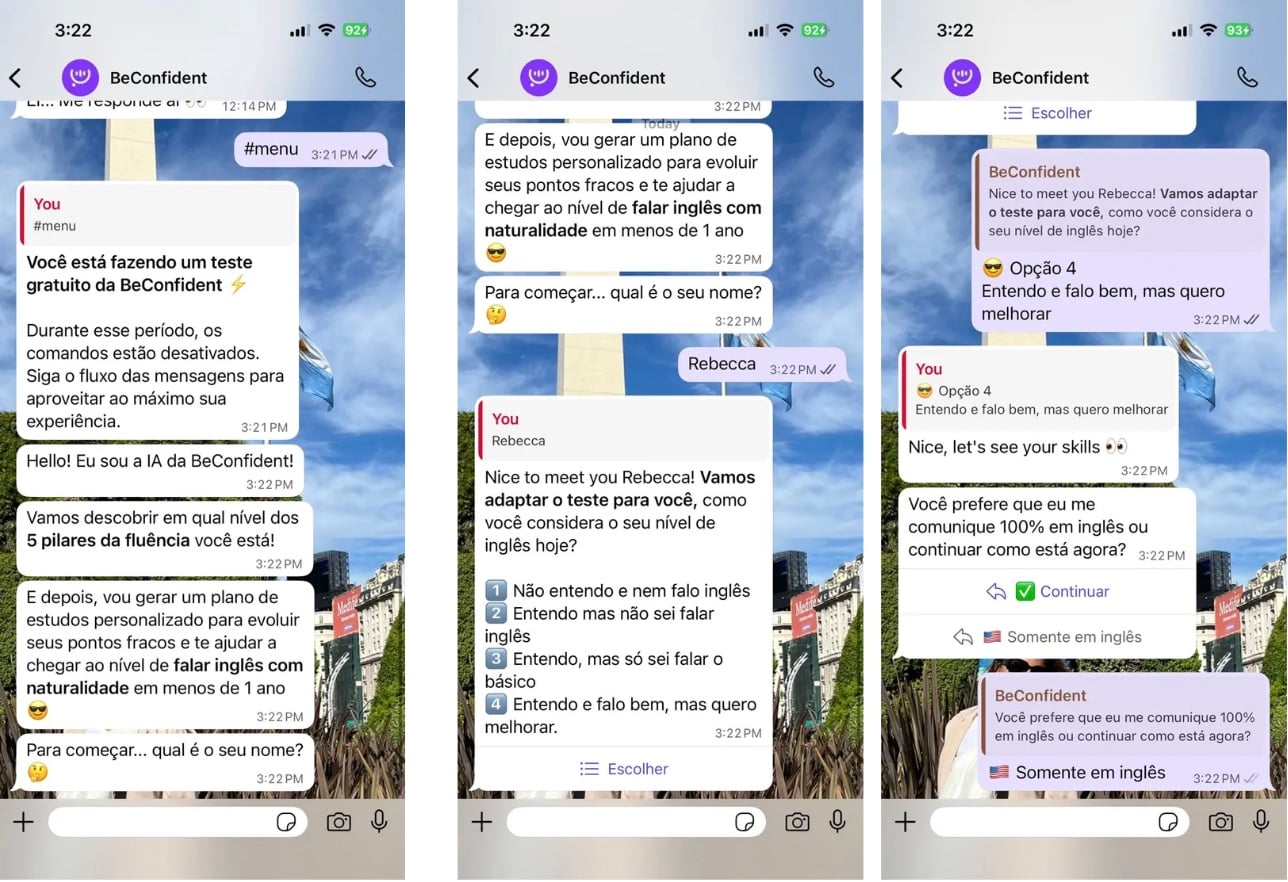
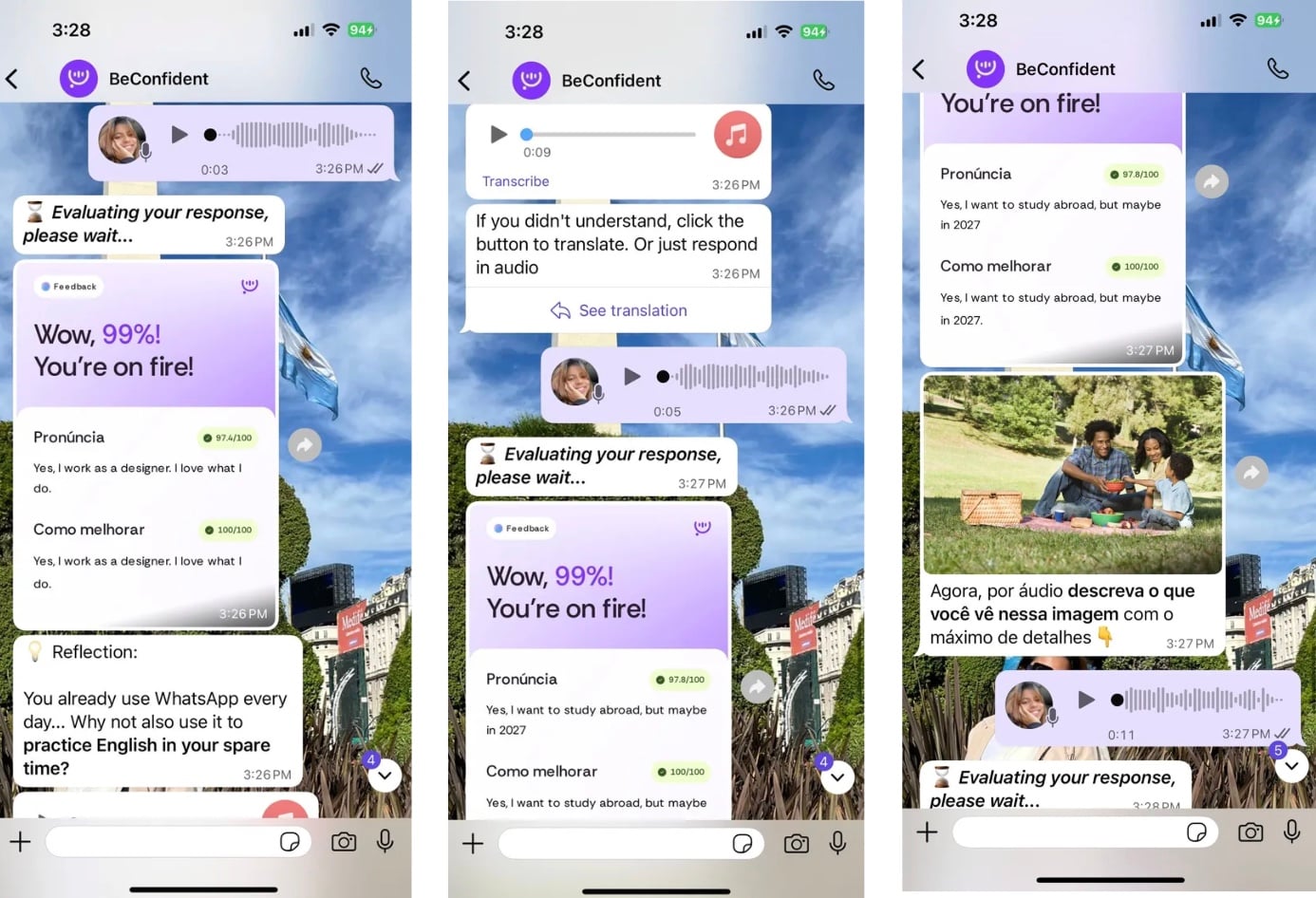
BeConfident offers instant feedback on pronunciation, unlike apps like Duolingo, which focus more on gamification than on speech correction. With over 200,000 paying students and 3 million total users in over 100 countries, the platform allows for continuous practice with AI tutors that adapt to your needs.
Thematic phrases: directions in travel and airport
The following phrases help with common stages of a trip, from check-in to transport to the city center.
Situation | Phrase in English | Translation | Pronunciation |
Check-in | Where is the check-in counter for American Airlines? | Where is the check-in counter for American Airlines? | /wer ɪz ðə tʃek ɪn ˈkaʊntər/ |
Luggage | How do I get to baggage claim? | How do I get to baggage claim? | /haʊ duː aɪ ɡet tuː ˈbæɡɪdʒ kleɪm/ |
Gate | Which way to gate B12? | Which way to gate B12? | /wɪtʃ weɪ tuː ɡeɪt/ |
Customs | Where is customs? | Where is customs? | /wer ɪz ˈkʌstəmz/ |
Transportation | How do I get to the city center from here? | How do I get to the city center from here? | /haʊ duː aɪ ɡet tuː ðə ˈsɪti ˈsentər/ |
Professional directions in meetings
Giving clear instructions inside an office conveys organization and professionalism. The phrases below cover common situations in corporate environments.
Context | Phrase in English | Translation | Usage |
Office | The meeting room is down the hall | The meeting room is down the hall | Guiding visitors |
Elevator | Take the elevator to the 10th floor | Take the elevator to the 10th floor | Vertical directions |
Reception | Check in at the front desk first | Check in at the front desk first | Protocol |
Parking | The parking garage is underneath the building | The parking garage is underneath the building | Location |
Exit | The emergency exit is at the end of this corridor | The emergency exit is at the end of this corridor | Safety |
Frequently Asked Questions
What is the best phrase to ask for directions in English?
The phrase "Excuse me, how do I get to...?" is the most polite and widely accepted form. It is formal enough for any situation, without sounding overly ceremonious. In more casual contexts, "Where is...?" also works well.
How to correctly pronounce "turn right" in English?
The correct pronunciation is /tɜːrn raɪt/. The "r" sound in "turn" should map gently, and the "r" in "right" usually sounds stronger in American English. Practice by curling your tongue back without touching the roof of your mouth.
Which apps help with practicing directions in English?
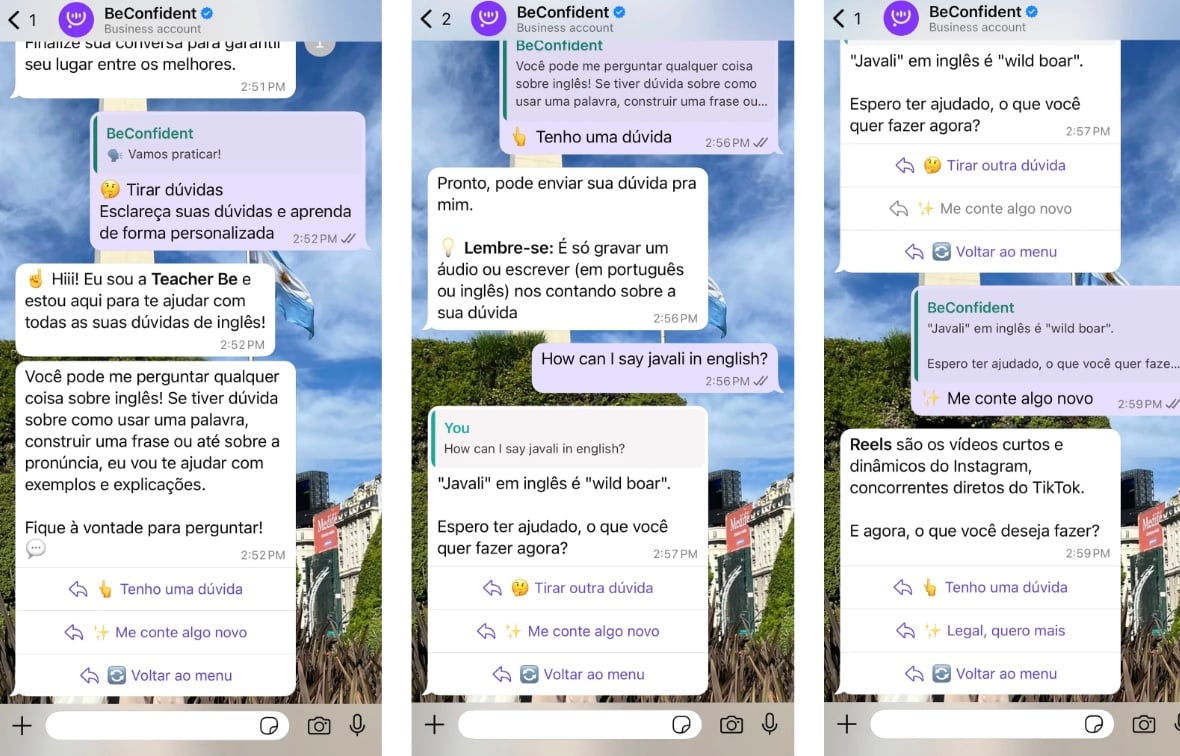
BeConfident stands out by offering conversation practice focused on real-life situations, such as asking for directions. Instead of just gamified exercises, you can simulate full dialogues with AI tutors that correct pronunciation in real-time, available 24/7 via app, WhatsApp, or smartwatch.
Is there a difference between American and British English for directions?
There are subtle differences in vocabulary and style. American English speakers tend to be more direct, as in "Go straight for 5 minutes", while British English speakers use more indirect language, as in "If you go straight for about 5 minutes". Some terms also vary, such as "parking lot" in American English and "car park" in British English.
How to overcome the fear of asking for directions in English?
Practicing in a judgment-free environment reduces the fear of making mistakes. Start by repeating basic phrases until you gain confidence. BeConfident offers realistic simulations where you can make mistakes and adjust your speech without embarrassment, developing naturalness in conversation with repetition and instant feedback.
Conclusion: master directions in English with confidence
Mastering more than 100 phrases to ask for and give directions in English is essential for anyone who wants to communicate securely in international travel or professional contexts. From basic vocabulary to more complete dialogues, frequent practice in speaking situations is what differentiates those who truly communicate in English from those who only know the theory.
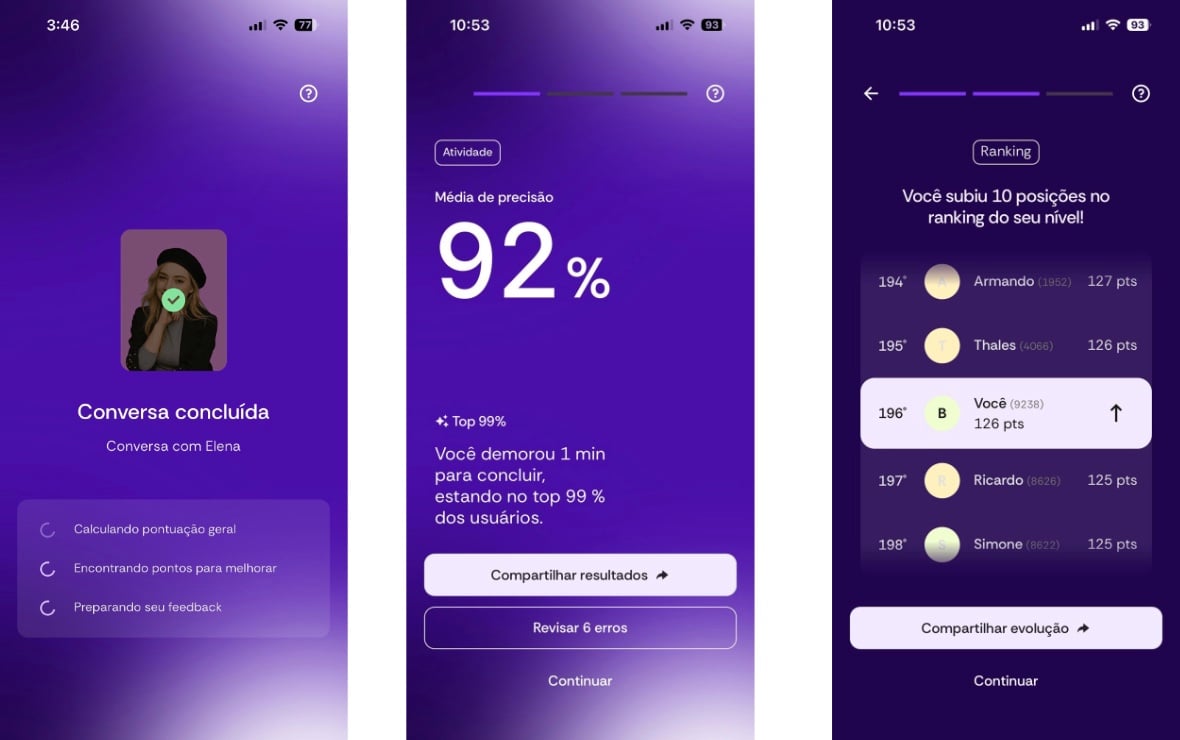
BeConfident, chosen by hundreds of thousands of students in more than 100 countries, offers a complete solution to develop this conversational fluency. Through the My Evolution Menu, you track your progress in real-time, record hours of practice, and access certificates that prove your development.
Not letting the lack of practice limit your opportunities expands your personal and professional possibilities. Try it free and start learning English today. Use your free time to develop the conversational fluency you want to achieve.
Written by: Luan Cavallaro, Founder & CMO, BeConfident
Key takeaways from this article
Mastering essential vocabulary like street, avenue, corner and direction terms like left, right and straight helps you find your way around any city.
Using polite phrases like "Excuse me, how do I get to...?" allows you to ask for directions naturally in airports, streets or meetings.
Learning to give clear directions with commands like "Go straight ahead" and "Turn left at the corner" makes it easier to communicate in American or British English.
Practicing real dialogues and the pronunciation of challenging sounds like "TH" and "R" improves your fluency in everyday and professional situations.
BeConfident offers 24/7 practice with AI that corrects pronunciation in real-time. Try it free now and gain confidence to ask for and give directions in English.
Basic vocabulary for directions in English (30 essential terms)
These 30 terms form the basis of any conversation about directions in English. They cover urban elements like street, avenue, and corner and navigation commands like left, right, and straight, which you will often use when traveling and in your professional daily life.
English Term | Translation | Pronunciation | Example |
Street | Street | /striːt/ | Turn left on Main Street |
Avenue | Avenue | /ˈævənjuː/ | Walk down Fifth Avenue |
Corner | Corner | /ˈkɔːrnər/ | Meet me at the corner |
Block | Block | /blɑːk/ | Go two blocks ahead |
Intersection | Intersection | /ˌɪntərˈsekʃən/ | Stop at the intersection |
Traffic lights | Traffic lights | /ˈtræfɪk laɪts/ | Turn right at the traffic lights |
Roundabout | Roundabout | /ˈraʊndəbaʊt/ | Take the second exit at the roundabout |
Bridge | Bridge | /brɪdʒ/ | Cross the bridge |
Straight | Straight, direct | /streɪt/ | Go straight for 500 meters |
Left | Left | /left/ | The library is on the left |
Right | Right | /raɪt/ | The store is to the right |
Opposite | Opposite | /ˈɑːpəzɪt/ | It's opposite the bank |
Next to | Next to | /nekst tuː/ | Next to the pharmacy |
Behind | Behind | /bɪˈhaɪnd/ | Behind the supermarket |
Landmark | Landmark | /ˈlændmɑːrk/ | Use the church as a landmark |
Phrases to ask for directions in English (35+ examples)
Mastering how to ask for directions is fundamental for any traveler or professional. The following phrases cover basic situations and more specific contexts.
Phrase in English | Translation | Pronunciation | Context |
Excuse me, where is...? | Excuse me, where is...? | /ɪkˈskjuːz miː, wer ɪz/ | Formal, polite |
How do I get to...? | How do I get to...? | /haʊ duː aɪ ɡet tuː/ | General |
Could you tell me the way to...? | Could you tell me the way to...? | /kʊd juː tel miː ðə weɪ tuː/ | Very formal |
I'm looking for... | I'm looking for... | /aɪm ˈlʊkɪŋ fɔːr/ | Casual |
Is it far from here? | Is it far from here? | /ɪz ɪt fɑːr frəm hɪr/ | Distance |
How long does it take to walk there? | How long does it take to walk there? | /haʊ lɔːŋ dʌz ɪt teɪk tuː wɔːk ðer/ | Time |
Can I walk there? | Can I walk there? | /kæn aɪ wɔːk ðer/ | Transportation |
Which way should I go? | Which way should I go? | /wɪtʃ weɪ ʃʊd aɪ ɡoʊ/ | Direction |
Am I going the right way? | Am I going the right way? | /æm aɪ ˈɡoʊɪŋ ðə raɪt weɪ/ | Confirmation |
I think I'm lost | I think I'm lost | /aɪ θɪŋk aɪm lɔːst/ | Emergency |
Practicing these phrases with BeConfident's AI tutors helps you gain confidence in conversation, without the pressure of a traditional classroom environment.
How to give directions in English (40+ phrases)
Knowing how to give directions is equally important, especially in professional contexts or when helping tourists. Directional phrases include imperative commands like "turn left" and "go straight", which are essential for clear communication.
Phrase in English | Translation | Pronunciation | Type |
Go straight ahead | Go straight ahead | /ɡoʊ streɪt əˈhed/ | Basic direction |
Turn left at the corner | Turn left at the corner | /tɜːrn left æt ðə ˈkɔːrnər/ | Specific command |
Take the first right | Take the first right | /teɪk ðə fɜːrst raɪt/ | Sequence |
Keep going until you reach... | Keep going until you reach... | /kiːp ˈɡoʊɪŋ ənˈtɪl juː riːtʃ/ | Continuity |
It's about 5 minutes on foot | It's about 5 minutes on foot | /ɪts əˈbaʊt faɪv ˈmɪnɪts ɑːn fʊt/ | Time, distance |
You can't miss it | You can't miss it | /juː kænt mɪs ɪt/ | Confirmation |
It's right in front of you | It's right in front of you | /ɪts raɪt ɪn frʌnt əv juː/ | Location |
Cross the street | Cross the street | /krɔːs ðə striːt/ | Action |
Go past the bank | Go past the bank | /ɡoʊ pæst ðə bæŋk/ | Reference |
It's on your left/right | It's on your left/right | /ɪts ɑːn jʊr left/raɪt/ | Position |
British English tends to use more indirect phrases, such as "If you go straight for about 5 minutes, the car park should be on the left", while American English is usually more direct, such as in "Go straight for 5 minutes and the parking lot is on the left".
3 practical dialogues for asking and giving directions
Dialogue 1: at the airport
Tourist: Excuse me, how do I get to Terminal 2?
Excuse me, how do I get to Terminal 2?
Staff: Go straight on, go past the traffic lights and take the second right. You'll see the signs for Terminal 2.
Go straight ahead, pass the traffic lights, and take the second right. You will see the signs for Terminal 2.
Tourist: How long does it take to walk there?
How long does it take to walk there?
Staff: About 10 minutes. You can't miss it!
About 10 minutes. You can't miss it.
Dialogue 2: in the city
Visitor: I'm looking for the nearest subway station.
I'm looking for the nearest subway station.
Local: Go straight on, go past the traffic lights and go straight on until you get to the roundabout. At the roundabout turn left.
Go straight ahead, pass the traffic lights and continue straight ahead until you reach the roundabout. At the roundabout, turn left.
Visitor: Is it far from here?
Is it far from here?
Local: No, it's just a 5-minute walk. It's the building next to the theatre, opposite the hospital.
No, it's just a 5-minute walk. It's the building next to the theater, opposite the hospital.
Dialogue 3: business meeting
Client: Could you tell me how to get to the conference room?
Could you tell me how to get to the conference room?
Receptionist: Take the elevator to the 15th floor, turn right when you exit, and it's the third door on your left.
Take the elevator to the 15th floor, turn right when you exit, and it's the third door on your left.
Using these dialogues as a model accelerates how naturally you speak. With BeConfident, you can repeat these situations as many times as you want with AI tutors specialized in different accents and professional contexts. Try it free and start learning English today.
Pronunciation tips and how to practice speaking naturally
Focusing on a few specific sounds makes your speech clearer when you give or receive directions in English. The three sounds below appear frequently in the phrases in this article.
"TH" Sound (/θ/): in words like "three blocks" and "the corner", place your tongue between your teeth and blow gently.
American "R" Sound (/r/): in "turn right" and "street", curl your tongue backward without touching the roof of your mouth. This sound helps to differentiate words like "right" and "light".
Difference between /i/ and /ɪ/: "Street" (/striːt/) has a long sound, while "this" (/ðɪs/) has a short sound. This distinction improves the understanding of your instructions.
BeConfident offers instant feedback on pronunciation, unlike apps like Duolingo, which focus more on gamification than on speech correction. With over 200,000 paying students and 3 million total users in over 100 countries, the platform allows for continuous practice with AI tutors that adapt to your needs.
Thematic phrases: directions in travel and airport
The following phrases help with common stages of a trip, from check-in to transport to the city center.
Situation | Phrase in English | Translation | Pronunciation |
Check-in | Where is the check-in counter for American Airlines? | Where is the check-in counter for American Airlines? | /wer ɪz ðə tʃek ɪn ˈkaʊntər/ |
Luggage | How do I get to baggage claim? | How do I get to baggage claim? | /haʊ duː aɪ ɡet tuː ˈbæɡɪdʒ kleɪm/ |
Gate | Which way to gate B12? | Which way to gate B12? | /wɪtʃ weɪ tuː ɡeɪt/ |
Customs | Where is customs? | Where is customs? | /wer ɪz ˈkʌstəmz/ |
Transportation | How do I get to the city center from here? | How do I get to the city center from here? | /haʊ duː aɪ ɡet tuː ðə ˈsɪti ˈsentər/ |
Professional directions in meetings
Giving clear instructions inside an office conveys organization and professionalism. The phrases below cover common situations in corporate environments.
Context | Phrase in English | Translation | Usage |
Office | The meeting room is down the hall | The meeting room is down the hall | Guiding visitors |
Elevator | Take the elevator to the 10th floor | Take the elevator to the 10th floor | Vertical directions |
Reception | Check in at the front desk first | Check in at the front desk first | Protocol |
Parking | The parking garage is underneath the building | The parking garage is underneath the building | Location |
Exit | The emergency exit is at the end of this corridor | The emergency exit is at the end of this corridor | Safety |
Frequently Asked Questions
What is the best phrase to ask for directions in English?
The phrase "Excuse me, how do I get to...?" is the most polite and widely accepted form. It is formal enough for any situation, without sounding overly ceremonious. In more casual contexts, "Where is...?" also works well.
How to correctly pronounce "turn right" in English?
The correct pronunciation is /tɜːrn raɪt/. The "r" sound in "turn" should map gently, and the "r" in "right" usually sounds stronger in American English. Practice by curling your tongue back without touching the roof of your mouth.
Which apps help with practicing directions in English?
BeConfident stands out by offering conversation practice focused on real-life situations, such as asking for directions. Instead of just gamified exercises, you can simulate full dialogues with AI tutors that correct pronunciation in real-time, available 24/7 via app, WhatsApp, or smartwatch.
Is there a difference between American and British English for directions?
There are subtle differences in vocabulary and style. American English speakers tend to be more direct, as in "Go straight for 5 minutes", while British English speakers use more indirect language, as in "If you go straight for about 5 minutes". Some terms also vary, such as "parking lot" in American English and "car park" in British English.
How to overcome the fear of asking for directions in English?
Practicing in a judgment-free environment reduces the fear of making mistakes. Start by repeating basic phrases until you gain confidence. BeConfident offers realistic simulations where you can make mistakes and adjust your speech without embarrassment, developing naturalness in conversation with repetition and instant feedback.
Conclusion: master directions in English with confidence
Mastering more than 100 phrases to ask for and give directions in English is essential for anyone who wants to communicate securely in international travel or professional contexts. From basic vocabulary to more complete dialogues, frequent practice in speaking situations is what differentiates those who truly communicate in English from those who only know the theory.
BeConfident, chosen by hundreds of thousands of students in more than 100 countries, offers a complete solution to develop this conversational fluency. Through the My Evolution Menu, you track your progress in real-time, record hours of practice, and access certificates that prove your development.
Not letting the lack of practice limit your opportunities expands your personal and professional possibilities. Try it free and start learning English today. Use your free time to develop the conversational fluency you want to achieve.