




English phrases for emergencies on international trips
English phrases for emergencies on international trips
English phrases for emergencies on international trips
Written by: Luan Cavallaro, Founder & CMO, BeConfident
Key takeaways from this article
Basic phrases like "Help!" and "I need help!" ensure quick communication in general emergencies in any country.
In medical crises, prioritize "Call an ambulance!" and detail symptoms like "I'm having a heart attack" or allergies to receive immediate care.
In cases of robbery or accident, say clearly "I've been robbed" and request a police report to activate insurance and embassies.
In situations of lost documents, contact the Brazilian consulate as soon as possible with phrases like "I lost my passport" and keep emergency numbers saved.
Practice these phrases with confidence on BeConfident: take a free trial and develop emergency English with AI tutors.
🚨 General emergencies
Direct phrases increase your chances of receiving quick help in any crisis abroad.
Use these options in situations of danger, confusion, or when you don't know exactly what is happening.
Help! - Socorro! (/help/)
I need help! - Preciso de ajuda! (/ai nid help/)
Emergency! - Emergência! (/imérgenci/)
Call the police! - Chame a polícia! (/kól de polís/)
I'm lost! - Estou perdido! (/aim lost/)
Where is the nearest hospital? - Onde fica o hospital mais próximo? (/wér is de nírest hóspital/)
I don't speak English well - Não falo inglês bem (/ai dont spík ínglish wel/)
Can you help me? - Você pode me ajudar? (/kén yu help mi/)
I'm in trouble - Estou com problemas (/aim in trábol/)
Please call someone who speaks Portuguese - Por favor, chame alguém que fale português (/plís kól sâmwan hu spíks portchugís/)
Role-play: practice this situation with BeConfident using a British accent: you are lost in the London underground at 11 PM. Approach an employee and say: "Excuse me, I need help. I'm lost. Where is the nearest exit to my hotel?"
🚑 Medical and health emergencies
Medical emergencies require specific vocabulary, because every second counts.
These phrases help you explain symptoms, ask for help, and indicate pre-existing conditions clearly. Expressions like "I need help" and "Where is the closest hospital?" facilitate communication in foreign medical care.
I need a doctor! - Preciso de um médico! (/ai nid a dóktor/)
Call an ambulance! - Chame uma ambulância! (/kól en émbiulens/)
I'm having a heart attack - Estou tendo um ataque cardíaco (/aim héving a hart aték/)
I can't breathe - Não consigo respirar (/ai ként brídh/)
I'm allergic to... - Sou alérgico a... (/aim alérjik tu/)
I have diabetes - Tenho diabetes (/ai hév daiabítis/)
Where is the pharmacy? - Onde fica a farmácia? (/wér is de fármaci/)
I need my medication - Preciso do meu remédio (/ai nid mai medikêishon/)
I'm bleeding - Estou sangrando (/aim blíding/)
I feel dizzy - Estou tonto (/ai fíl dízi/)
Role-play: BeConfident offers practice with an American accent and real-time pronunciation feedback. In the app, simulate that you feel chest pain in a hotel in Miami. Call the front desk and say: "This is an emergency. I need an ambulance. I'm having chest pains. Room 304."
🚓 Police, accidents, and theft
Clear communication with the police speeds up response in cases of theft, threat, or accident.
Use these phrases to report what happened, ask for protection, and reach out for legal or consular support.
Call the police! - Chame a polícia! (/kól de polís/)
I've been robbed - Fui roubado (/aiv bin robd/)
Someone stole my... - Alguém roubou meu/minha... (/sâmwan stôl mai/)
I witnessed an accident - Presenciei um acidente (/ai wítnesd en éksidant/)
I need to file a police report - Preciso fazer um boletim de ocorrência (/ai nid tu fail a polís ripórt/)
This person is following me - Esta pessoa está me seguindo (/dhis pérson is fólowing mi/)
I'm being threatened - Estou sendo ameaçado (/aim bíing thrétend/)
I need a lawyer - Preciso de um advogado (/ai nid a lóier/)
I want to contact my embassy - Quero contatar minha embaixada (/ai wónt tu kóntakt mai émbasi/)
I don't understand my rights - Não entendo meus direitos (/ai dont andersténd mai raits/)
Role-play: practice police scenarios with AI tutors on BeConfident: your cell phone was stolen in the Paris metro. At the police station, explain: "I've been robbed. Someone stole my phone on the metro. I need to file a police report."
📄 Lost documents and luggage
Losing your passport or luggage requires quick action with the airline, police, and consulate. These phrases help you register reports and request new documents:
I lost my passport - Perdi meu passaporte (/ai lost mai páspórt/)
My documents were stolen - Meus documentos foram roubados (/mai dókiumants wer stôlen/)
Where is the Brazilian consulate? - Onde fica o consulado brasileiro? (/wér is de brazílian kónsiuleit/)
I need an emergency passport - Preciso de um passaporte de emergência (/ai nid en imérgenci páspórt/)
My luggage is missing - Minha bagagem está perdida (/mai lágij is mísing/)
I need to report lost luggage - Preciso reportar bagagem perdida (/ai nid tu ripórt lost lágij/)
Can you help me contact my airline? - Pode me ajudar a contatar minha companhia aérea? (/kén yu help mi kóntakt mai érlain/)
I have travel insurance - Tenho seguro viagem (/ai hév trével inshúrens/)
I need a police report for insurance - Preciso de um boletim policial para o seguro (/ai nid a polís ripórt for inshúrens/)
When will I get my documents back? - Quando vou receber meus documentos de volta? (/wen wil ai get mai dókiumants bék/)
Role-play: practice with a free trial on BeConfident: at the airline counter in London, explain "My luggage is missing. Flight BA 247 from São Paulo. I need to report lost baggage and get a reference number."
✈️ Airport and immigration in crises
Problems at airports and immigration can create extra expenses and stress. These phrases help you rebook flights, resolve visa issues, and seek accommodation.
I missed my connecting flight - Perdi meu voo de conexão (/ai misd mai konékting flait/)
My flight was cancelled - Meu voo foi cancelado (/mai flait wós kénseld/)
I need to rebook my flight - Preciso remarcar meu voo (/ai nid tu ribúk mai flait/)
Where is the immigration office? - Onde fica o escritório de imigração? (/wér is dhi imigrêishon ófis/)
I have a visa problem - Tenho um problema com o visto (/ai hév a vísa próblem/)
I need to extend my stay - Preciso estender minha estadia (/ai nid tu eksténd mai stêi/)
My return ticket was changed - Meu bilhete de volta foi alterado (/mai ritérn tíket wós chêinjd/)
I'm stuck at the airport - Estou preso no aeroporto (/aim stâk ét dhi érpórt/)
Can you help me find accommodation? - Pode me ajudar a encontrar hospedagem? (/kén yu help mi faind akomodêishon/)
I need to contact my travel agent - Preciso contatar meu agente de viagens (/ai nid tu kóntakt mai trével êijent/)
Role-play: practice this type of conversation with AI tutors on BeConfident: your connecting flight in Frankfurt was canceled. At the airline counter, say: "My connecting flight to São Paulo was cancelled. I need to rebook and find a hotel for tonight. Can you help me?"
🗣️ Communication and asking for help
General communication phrases keep the conversation flowing even when you don't understand everything.
Use these expressions to ask the person to repeat, speak more slowly, or write down what they said.
I don't understand - Não entendo (/ai dont andersténd/)
Can you speak slowly? - Pode falar devagar? (/kén yu spík slôuli/)
Can you repeat that? - Pode repetir? (/kén yu ripít dhét/)
Do you speak Portuguese? - Você fala português? (/du yu spík portchugís/)
Can you write it down? - Pode escrever? (/kén yu rait it daun/)
I need a translator - Preciso de um tradutor (/ai nid a translêitor/)
Where can I find help? - Onde posso encontrar ajuda? (/wér kén ai faind help/)
Is there someone who can help me? - Há alguém que possa me ajudar? (/is dhér sâmwan hu kén help mi/)
I'm confused - Estou confuso (/aim konfiúzd/)
Thank you for your help - Obrigado pela ajuda (/thénk yu for yor help/)
Role-play: BeConfident offers practice with multiple accents to prepare you for these interactions. Simulate that you do not understand the instructions at a train station in Tokyo. Say: "Excuse me, I don't understand. Can you speak slowly? I need help finding platform 5."
Emergency numbers and Brazilian consulates by country (updated 2026)
Saving local emergency numbers and embassy contacts before your trip reduces response time in crises. Having the correct contacts on hand speeds up any crisis response.
The table below shows three critical contacts in each destination: general emergency number, specific police or ambulance contacts, and the Brazilian consulate telephone. Always keep these numbers saved in your cell phone.
Country/Region | General emergency | Police/Ambulance | Brazil Consulate |
United States | 911 | 911 | +1-202-238-2700 |
United Kingdom | 999 | 999 | +44-20-7399-9000 |
France | 112 | 17/15 | +33-1-4561-6300 |
Germany | 112 | 110/112 | +49-30-7262-8100 |
Essential phrase: "I need to contact the Brazilian consulate" (/ai nid tu kóntakt de brazílian kónsiuleit/).
BeConfident: complete solution for emergency English
Practicing phrases out loud is what transforms vocabulary into an automatic reaction in moments of stress.
BeConfident creates this environment of continuous practice with resources designed for real travel situations.
AI tutors with native accents: you practice with American, British, Australian, and other real accents. Instead of focusing only on gamification, BeConfident prioritizes fluent conversation in day-to-day scenarios.
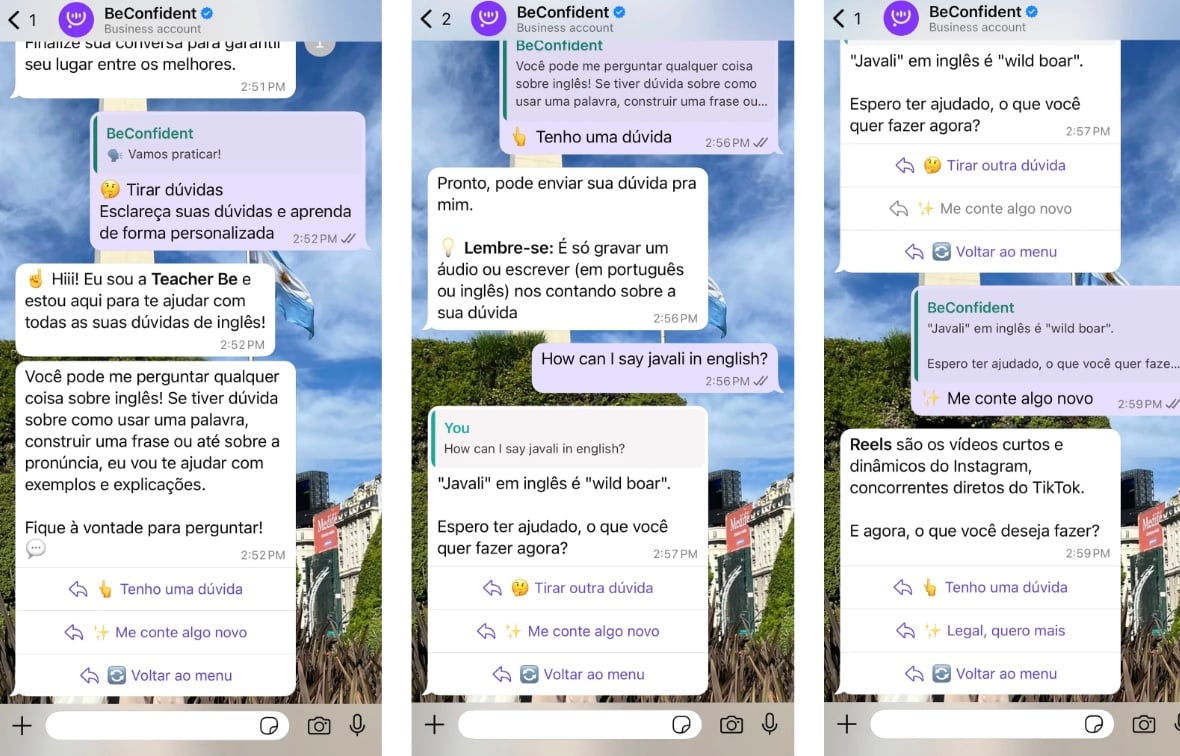
Specific travel modules: these modules organize study into themes such as emergencies, airports, hotels, and transportation. This way, you practice exactly the vocabulary you will use at each stage of the trip.
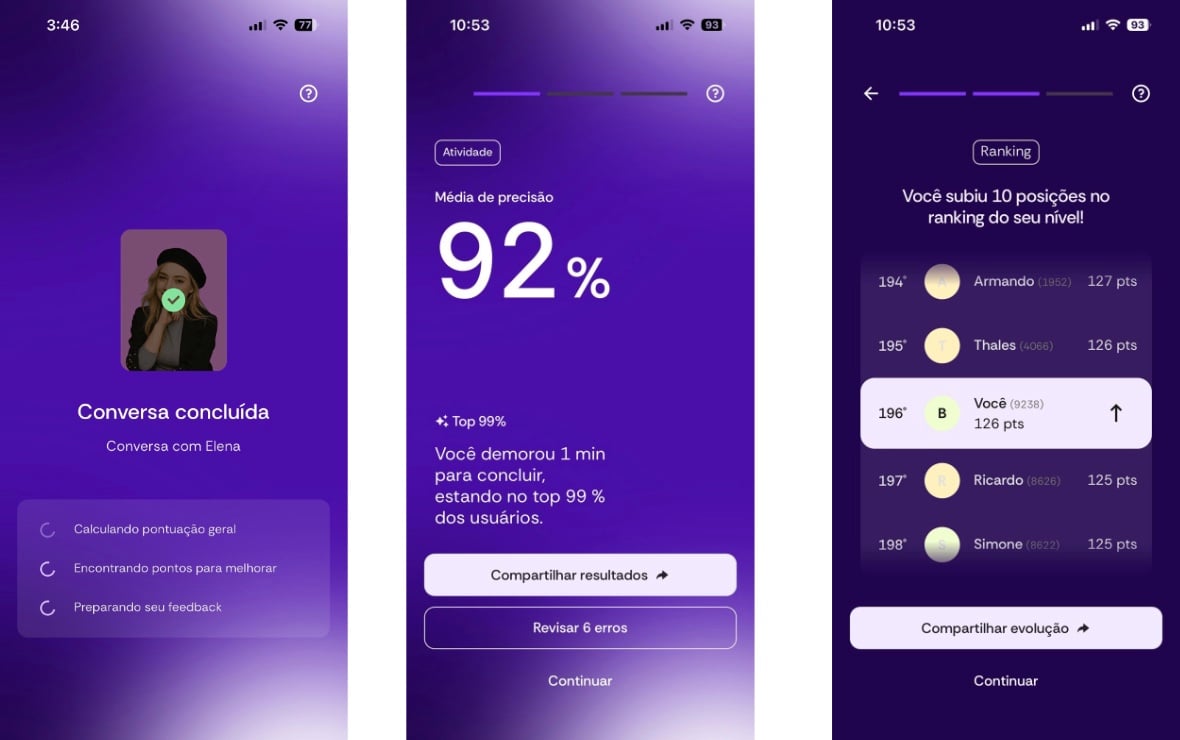
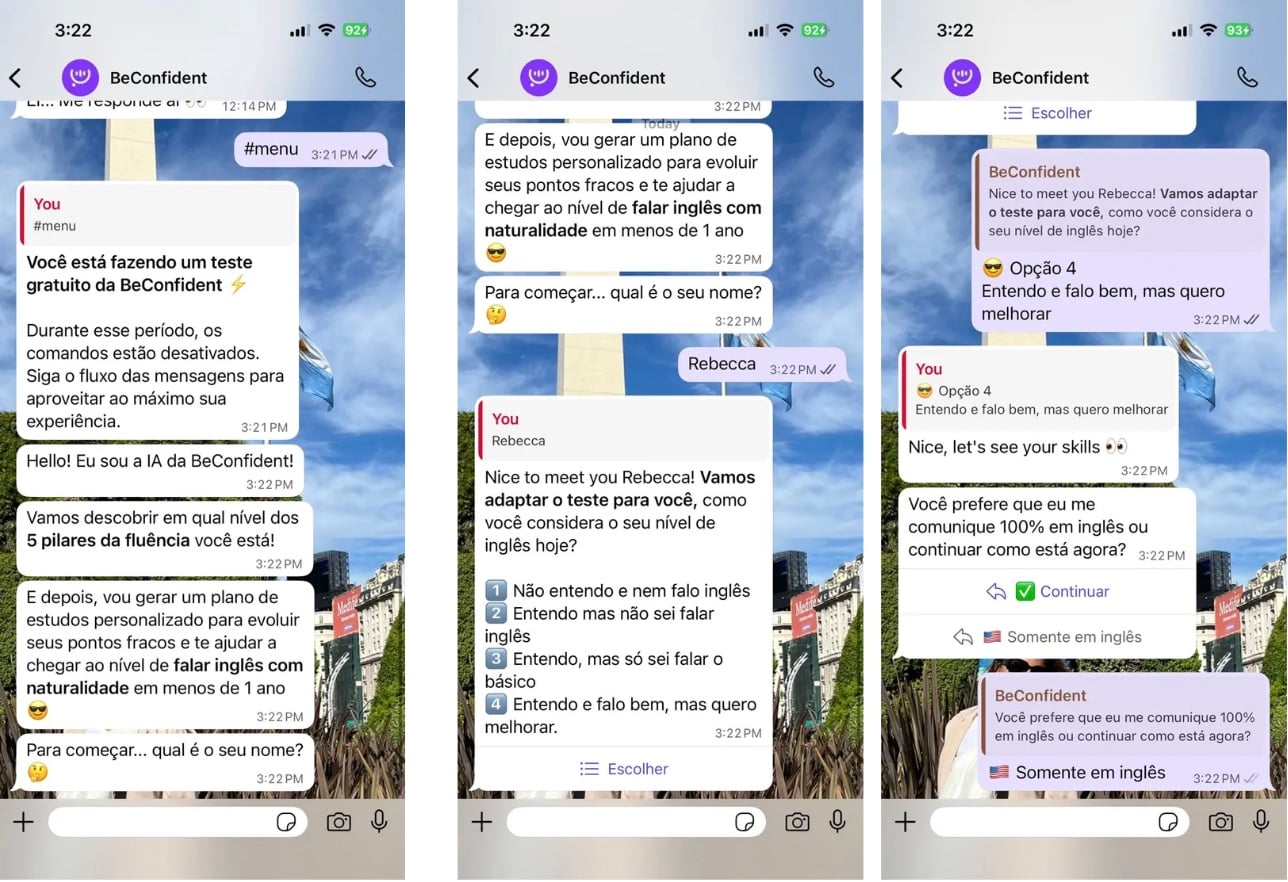
24/7 practice without embarrassment: you chat via the app, WhatsApp, or smartwatch at any time. There is no class, audience, or exposure, which reduces the block when speaking.
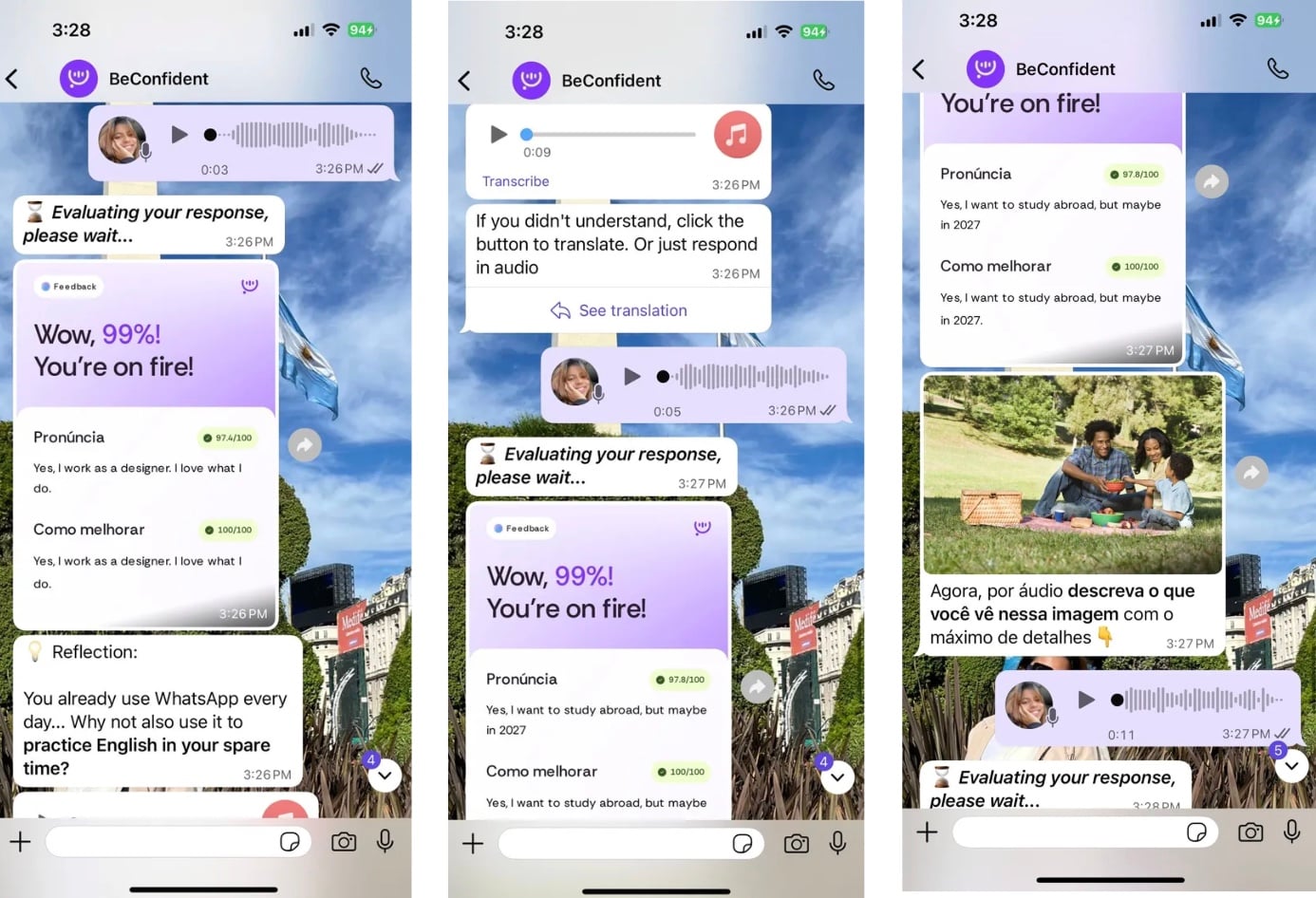
Instant feedback: correction of pronunciation, grammar, and expressions happens in real time, which speeds up the fine-tuning of speech compared to traditional courses.
With more than 200,000 students and an RA 1000 reputation on Reclame Aqui, BeConfident has already helped many Brazilians lose their fear of speaking English on trips. Start your free trial today and prepare your emergency English for your next trip.
Frequently asked questions
What are the most important phrases for emergency immigration?
Essential phrases include "I have a visa problem", "I need to extend my stay", "Where is the immigration office?" and "I need to contact the Brazilian consulate". Practicing pronunciation reduces misunderstandings in already stressful situations.
How to practice the pronunciation of these emergency phrases?
Practicing with AI tutors that simulate native accents is an efficient way. BeConfident offers unlimited conversation with instant feedback, which allows you to practice real emergency scenarios without embarrassment.
What are the most important emergency numbers for Brazilians abroad?
The main ones are 911 (US and Canada), 112 (Europe), 999 (UK), and the telephone numbers of the Brazilian consulates. Save these numbers before traveling and practice saying "This is an emergency" and "I need help" clearly.
Does BeConfident help in travel situations?
Yes. Travel-specific modules, practice with diverse accents, and emergency scenarios focus on the conversational fluency you actually use abroad, and not just on game exercises.
How long does it take to master these emergency phrases?
With daily practice of 15 to 20 minutes on BeConfident, many students gain confidence in 2 to 4 weeks. Consistency and pronunciation feedback help automate responses in stressful situations.
Conclusion
Mastering these top English phrases for emergencies on international travel makes crises more manageable and reduces risks.
The difference between knowing the phrases and using them confidently lies in constant practice. BeConfident offers a conversation-focused environment to turn study into actual fluency in emergencies.
Try BeConfident for free and travel with more security and peace of mind.
Written by: Luan Cavallaro, Founder & CMO, BeConfident
Key takeaways from this article
Basic phrases like "Help!" and "I need help!" ensure quick communication in general emergencies in any country.
In medical crises, prioritize "Call an ambulance!" and detail symptoms like "I'm having a heart attack" or allergies to receive immediate care.
In cases of robbery or accident, say clearly "I've been robbed" and request a police report to activate insurance and embassies.
In situations of lost documents, contact the Brazilian consulate as soon as possible with phrases like "I lost my passport" and keep emergency numbers saved.
Practice these phrases with confidence on BeConfident: take a free trial and develop emergency English with AI tutors.
🚨 General emergencies
Direct phrases increase your chances of receiving quick help in any crisis abroad.
Use these options in situations of danger, confusion, or when you don't know exactly what is happening.
Help! - Socorro! (/help/)
I need help! - Preciso de ajuda! (/ai nid help/)
Emergency! - Emergência! (/imérgenci/)
Call the police! - Chame a polícia! (/kól de polís/)
I'm lost! - Estou perdido! (/aim lost/)
Where is the nearest hospital? - Onde fica o hospital mais próximo? (/wér is de nírest hóspital/)
I don't speak English well - Não falo inglês bem (/ai dont spík ínglish wel/)
Can you help me? - Você pode me ajudar? (/kén yu help mi/)
I'm in trouble - Estou com problemas (/aim in trábol/)
Please call someone who speaks Portuguese - Por favor, chame alguém que fale português (/plís kól sâmwan hu spíks portchugís/)
Role-play: practice this situation with BeConfident using a British accent: you are lost in the London underground at 11 PM. Approach an employee and say: "Excuse me, I need help. I'm lost. Where is the nearest exit to my hotel?"
🚑 Medical and health emergencies
Medical emergencies require specific vocabulary, because every second counts.
These phrases help you explain symptoms, ask for help, and indicate pre-existing conditions clearly. Expressions like "I need help" and "Where is the closest hospital?" facilitate communication in foreign medical care.
I need a doctor! - Preciso de um médico! (/ai nid a dóktor/)
Call an ambulance! - Chame uma ambulância! (/kól en émbiulens/)
I'm having a heart attack - Estou tendo um ataque cardíaco (/aim héving a hart aték/)
I can't breathe - Não consigo respirar (/ai ként brídh/)
I'm allergic to... - Sou alérgico a... (/aim alérjik tu/)
I have diabetes - Tenho diabetes (/ai hév daiabítis/)
Where is the pharmacy? - Onde fica a farmácia? (/wér is de fármaci/)
I need my medication - Preciso do meu remédio (/ai nid mai medikêishon/)
I'm bleeding - Estou sangrando (/aim blíding/)
I feel dizzy - Estou tonto (/ai fíl dízi/)
Role-play: BeConfident offers practice with an American accent and real-time pronunciation feedback. In the app, simulate that you feel chest pain in a hotel in Miami. Call the front desk and say: "This is an emergency. I need an ambulance. I'm having chest pains. Room 304."
🚓 Police, accidents, and theft
Clear communication with the police speeds up response in cases of theft, threat, or accident.
Use these phrases to report what happened, ask for protection, and reach out for legal or consular support.
Call the police! - Chame a polícia! (/kól de polís/)
I've been robbed - Fui roubado (/aiv bin robd/)
Someone stole my... - Alguém roubou meu/minha... (/sâmwan stôl mai/)
I witnessed an accident - Presenciei um acidente (/ai wítnesd en éksidant/)
I need to file a police report - Preciso fazer um boletim de ocorrência (/ai nid tu fail a polís ripórt/)
This person is following me - Esta pessoa está me seguindo (/dhis pérson is fólowing mi/)
I'm being threatened - Estou sendo ameaçado (/aim bíing thrétend/)
I need a lawyer - Preciso de um advogado (/ai nid a lóier/)
I want to contact my embassy - Quero contatar minha embaixada (/ai wónt tu kóntakt mai émbasi/)
I don't understand my rights - Não entendo meus direitos (/ai dont andersténd mai raits/)
Role-play: practice police scenarios with AI tutors on BeConfident: your cell phone was stolen in the Paris metro. At the police station, explain: "I've been robbed. Someone stole my phone on the metro. I need to file a police report."
📄 Lost documents and luggage
Losing your passport or luggage requires quick action with the airline, police, and consulate. These phrases help you register reports and request new documents:
I lost my passport - Perdi meu passaporte (/ai lost mai páspórt/)
My documents were stolen - Meus documentos foram roubados (/mai dókiumants wer stôlen/)
Where is the Brazilian consulate? - Onde fica o consulado brasileiro? (/wér is de brazílian kónsiuleit/)
I need an emergency passport - Preciso de um passaporte de emergência (/ai nid en imérgenci páspórt/)
My luggage is missing - Minha bagagem está perdida (/mai lágij is mísing/)
I need to report lost luggage - Preciso reportar bagagem perdida (/ai nid tu ripórt lost lágij/)
Can you help me contact my airline? - Pode me ajudar a contatar minha companhia aérea? (/kén yu help mi kóntakt mai érlain/)
I have travel insurance - Tenho seguro viagem (/ai hév trével inshúrens/)
I need a police report for insurance - Preciso de um boletim policial para o seguro (/ai nid a polís ripórt for inshúrens/)
When will I get my documents back? - Quando vou receber meus documentos de volta? (/wen wil ai get mai dókiumants bék/)
Role-play: practice with a free trial on BeConfident: at the airline counter in London, explain "My luggage is missing. Flight BA 247 from São Paulo. I need to report lost baggage and get a reference number."
✈️ Airport and immigration in crises
Problems at airports and immigration can create extra expenses and stress. These phrases help you rebook flights, resolve visa issues, and seek accommodation.
I missed my connecting flight - Perdi meu voo de conexão (/ai misd mai konékting flait/)
My flight was cancelled - Meu voo foi cancelado (/mai flait wós kénseld/)
I need to rebook my flight - Preciso remarcar meu voo (/ai nid tu ribúk mai flait/)
Where is the immigration office? - Onde fica o escritório de imigração? (/wér is dhi imigrêishon ófis/)
I have a visa problem - Tenho um problema com o visto (/ai hév a vísa próblem/)
I need to extend my stay - Preciso estender minha estadia (/ai nid tu eksténd mai stêi/)
My return ticket was changed - Meu bilhete de volta foi alterado (/mai ritérn tíket wós chêinjd/)
I'm stuck at the airport - Estou preso no aeroporto (/aim stâk ét dhi érpórt/)
Can you help me find accommodation? - Pode me ajudar a encontrar hospedagem? (/kén yu help mi faind akomodêishon/)
I need to contact my travel agent - Preciso contatar meu agente de viagens (/ai nid tu kóntakt mai trével êijent/)
Role-play: practice this type of conversation with AI tutors on BeConfident: your connecting flight in Frankfurt was canceled. At the airline counter, say: "My connecting flight to São Paulo was cancelled. I need to rebook and find a hotel for tonight. Can you help me?"
🗣️ Communication and asking for help
General communication phrases keep the conversation flowing even when you don't understand everything.
Use these expressions to ask the person to repeat, speak more slowly, or write down what they said.
I don't understand - Não entendo (/ai dont andersténd/)
Can you speak slowly? - Pode falar devagar? (/kén yu spík slôuli/)
Can you repeat that? - Pode repetir? (/kén yu ripít dhét/)
Do you speak Portuguese? - Você fala português? (/du yu spík portchugís/)
Can you write it down? - Pode escrever? (/kén yu rait it daun/)
I need a translator - Preciso de um tradutor (/ai nid a translêitor/)
Where can I find help? - Onde posso encontrar ajuda? (/wér kén ai faind help/)
Is there someone who can help me? - Há alguém que possa me ajudar? (/is dhér sâmwan hu kén help mi/)
I'm confused - Estou confuso (/aim konfiúzd/)
Thank you for your help - Obrigado pela ajuda (/thénk yu for yor help/)
Role-play: BeConfident offers practice with multiple accents to prepare you for these interactions. Simulate that you do not understand the instructions at a train station in Tokyo. Say: "Excuse me, I don't understand. Can you speak slowly? I need help finding platform 5."
Emergency numbers and Brazilian consulates by country (updated 2026)
Saving local emergency numbers and embassy contacts before your trip reduces response time in crises. Having the correct contacts on hand speeds up any crisis response.
The table below shows three critical contacts in each destination: general emergency number, specific police or ambulance contacts, and the Brazilian consulate telephone. Always keep these numbers saved in your cell phone.
Country/Region | General emergency | Police/Ambulance | Brazil Consulate |
United States | 911 | 911 | +1-202-238-2700 |
United Kingdom | 999 | 999 | +44-20-7399-9000 |
France | 112 | 17/15 | +33-1-4561-6300 |
Germany | 112 | 110/112 | +49-30-7262-8100 |
Essential phrase: "I need to contact the Brazilian consulate" (/ai nid tu kóntakt de brazílian kónsiuleit/).
BeConfident: complete solution for emergency English
Practicing phrases out loud is what transforms vocabulary into an automatic reaction in moments of stress.
BeConfident creates this environment of continuous practice with resources designed for real travel situations.
AI tutors with native accents: you practice with American, British, Australian, and other real accents. Instead of focusing only on gamification, BeConfident prioritizes fluent conversation in day-to-day scenarios.
Specific travel modules: these modules organize study into themes such as emergencies, airports, hotels, and transportation. This way, you practice exactly the vocabulary you will use at each stage of the trip.
24/7 practice without embarrassment: you chat via the app, WhatsApp, or smartwatch at any time. There is no class, audience, or exposure, which reduces the block when speaking.
Instant feedback: correction of pronunciation, grammar, and expressions happens in real time, which speeds up the fine-tuning of speech compared to traditional courses.
With more than 200,000 students and an RA 1000 reputation on Reclame Aqui, BeConfident has already helped many Brazilians lose their fear of speaking English on trips. Start your free trial today and prepare your emergency English for your next trip.
Frequently asked questions
What are the most important phrases for emergency immigration?
Essential phrases include "I have a visa problem", "I need to extend my stay", "Where is the immigration office?" and "I need to contact the Brazilian consulate". Practicing pronunciation reduces misunderstandings in already stressful situations.
How to practice the pronunciation of these emergency phrases?
Practicing with AI tutors that simulate native accents is an efficient way. BeConfident offers unlimited conversation with instant feedback, which allows you to practice real emergency scenarios without embarrassment.
What are the most important emergency numbers for Brazilians abroad?
The main ones are 911 (US and Canada), 112 (Europe), 999 (UK), and the telephone numbers of the Brazilian consulates. Save these numbers before traveling and practice saying "This is an emergency" and "I need help" clearly.
Does BeConfident help in travel situations?
Yes. Travel-specific modules, practice with diverse accents, and emergency scenarios focus on the conversational fluency you actually use abroad, and not just on game exercises.
How long does it take to master these emergency phrases?
With daily practice of 15 to 20 minutes on BeConfident, many students gain confidence in 2 to 4 weeks. Consistency and pronunciation feedback help automate responses in stressful situations.
Conclusion
Mastering these top English phrases for emergencies on international travel makes crises more manageable and reduces risks.
The difference between knowing the phrases and using them confidently lies in constant practice. BeConfident offers a conversation-focused environment to turn study into actual fluency in emergencies.
Try BeConfident for free and travel with more security and peace of mind.