




How to improve English speaking with a British accent
How to improve English speaking with a British accent
How to improve English speaking with a British accent
Written by: Luan Cavallaro, Founder & CMO, BeConfident
Key takeaways from this article
The British accent differs from the American by more open vowels, silent final “r”, and varied intonation, which requires focused practice for comprehension and natural speech.
Short daily sessions with shadowing generate consistent improvements in just a few weeks and outperform sporadic studying.
Mastering 10 essential slang words like “knackered”, “chuffed”, and “cheers” makes conversations more natural in pubs, work, or casual situations.
Practicing real dialogues in roleplays and recording your own pronunciation helps to compare with natives and adjust key vowels like /ɑː/ in “bath”.
BeConfident offers British-accented AI tutors 24/7 for unlimited practice and instant feedback. Try British AI conversation for free and build confidence when speaking.
Understanding the British accent in conversation
The British accent has specific characteristics that directly influence conversation. The main differences appear in vowel pronunciation, where “water” sounds like “wo-tuh” instead of “wa-ter”, and in the silent “r” at the end of words, as in “car”, which sounds simply like “ca”.
British intonation also differs from American English. Words like “schedule” sound like “shed-yool”, not “sked-yool”. “Garage” sounds like “ga-rahj”, not “ga-raj”. “Advertisement” receives emphasis on the second syllable. The vocabulary also changes, using “lift” instead of “elevator”, “queue” instead of “line”, and slang like “cheers” to say thank you.
Imitating the rhythm and intonation in daily exercises works on the characteristic melody of British English, which tends to have a wider variation in pitch compared to American.
With this foundation of pronunciation, rhythm, and vocabulary, the next step is to apply this knowledge to a practical routine that develops daily speaking.
7 practical steps to improve your conversation with a British accent
The following seven steps form a progressive system that combines listening, imitation, and conversation. Each step reinforces the previous one and takes you from familiarization with the sounds to more natural production in real situations.
1. Listen to British podcasts for a few minutes a day
Choose BBC programs, British comedy podcasts, or news broadcasts. Focus on intonation and rhythm, not just the content. A good option is listening to BBC Radio 4 or the Guardian's podcasts.
2. Practice shadow speaking with British content
Play British audio and speak at the same time, imitating what you hear as accurately as possible. Start with a few minutes daily using YouTube videos of British presenters.
3. Master 10 essential British slang words
A more authentic vocabulary includes “knackered” (tired), “chuffed” (proud/pleased), “ace” (excellent), “gobsmacked” (shocked), “mate” (friend), “cheeky” (impudent/playful), “brilliant” (great), “proper” (very), “faffing” (wasting time), and “taking the piss” (mocking/joking).
4. Focus on the key vowels of British English
Practice the sounds /ɑː/ in “bath”, “dance”, “ask” and the sound /ɒ/ in “hot”, “lot”, “got”. Record your own voice pronouncing these words and compare with audio of native speakers.
5. Use roleplays with real dialogues
Simulate situations like asking for directions, ordering in pubs, or participating in work meetings. Repeat the sentences until they sound natural and fluid.
6. Record and compare your pronunciation
Use a recording app to register your speech and compare with native models. Identify patterns that need adjustment. This self-assessment shows where you need more frequent and detailed feedback.
7. Practice with AI without judgment
To receive this continuous feedback without relying on fixed schedules or human tutors, use artificial intelligence tutors specialized in the British accent. This practice offers unlimited conversation, immediate feedback, and personalized correction.
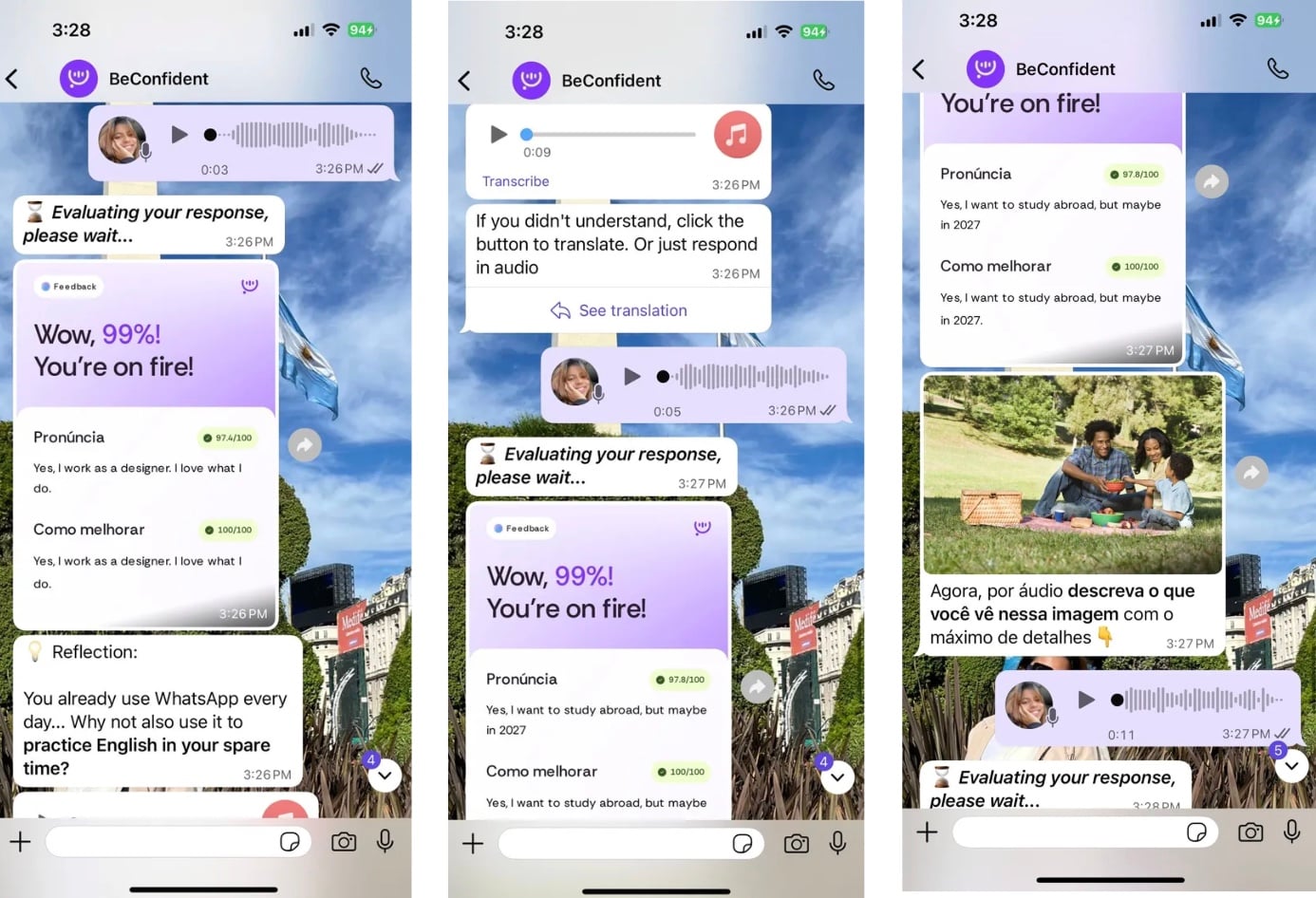
Much of the progress in language learning relies on daily consistency, and short sessions tend to be more effective than study marathons.
Examples of dialogues and phrases to practice British conversation
At the airport:
"Excuse me, where's the loo?" (Sorry, where is the toilet?), with “loo” pronounced as /luː/.
"Could you tell me where the queue for check-in is?" (Could you tell me where the line for check-in is?).
At the pub:
"I'll have a pint of bitter, please." (I would like a pint of bitter, please).
"Cheers, mate!" (Thanks, friend!), used as an informal thank you.
In a work meeting:
"That's brilliant! Shall we crack on with the next point?" (That's great! Shall we continue with the next point?).
"I'm proper chuffed with these results." (I am very proud of these results.).
In casual conversation:
"I'm absolutely knackered after that meeting." (I am completely exhausted after that meeting.).
"Don't be so cheeky!" (Don't be so sassy!), in a playful tone.
Repeating these phrases frequently and with attention to the typical descending intonation of British English and clear pronunciation of consonants helps to consolidate the sound pattern.
Keeping up this constant practice becomes easier when you have a training environment that offers repetition, correction, and a variety of speaking situations.
BeConfident: 24/7 British accent practice with AI
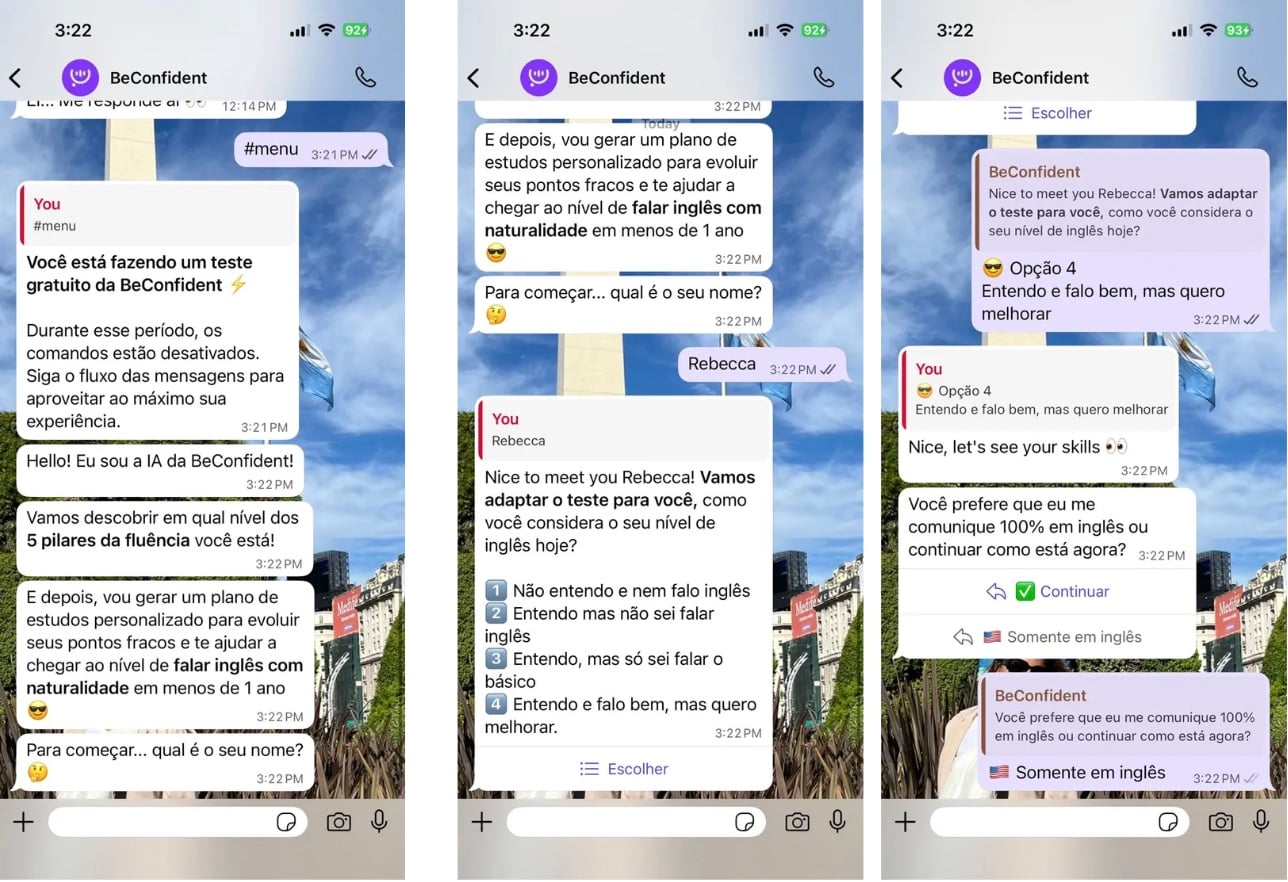
BeConfident offers British English conversation learning with AI tutors who use this accent and are available 24 hours a day. Instead of relying solely on traditional methods, you practice unlimited conversation via app, WhatsApp, or smartwatch, with immediate feedback on pronunciation, grammar, and naturalness.
The AI tutors have specific profiles, such as photographer, lawyer, or writer, and simulate native accents, including British. Features include structured tracks, personalized review of mistakes, and the “Tell me something new” option to expand vocabulary in context.
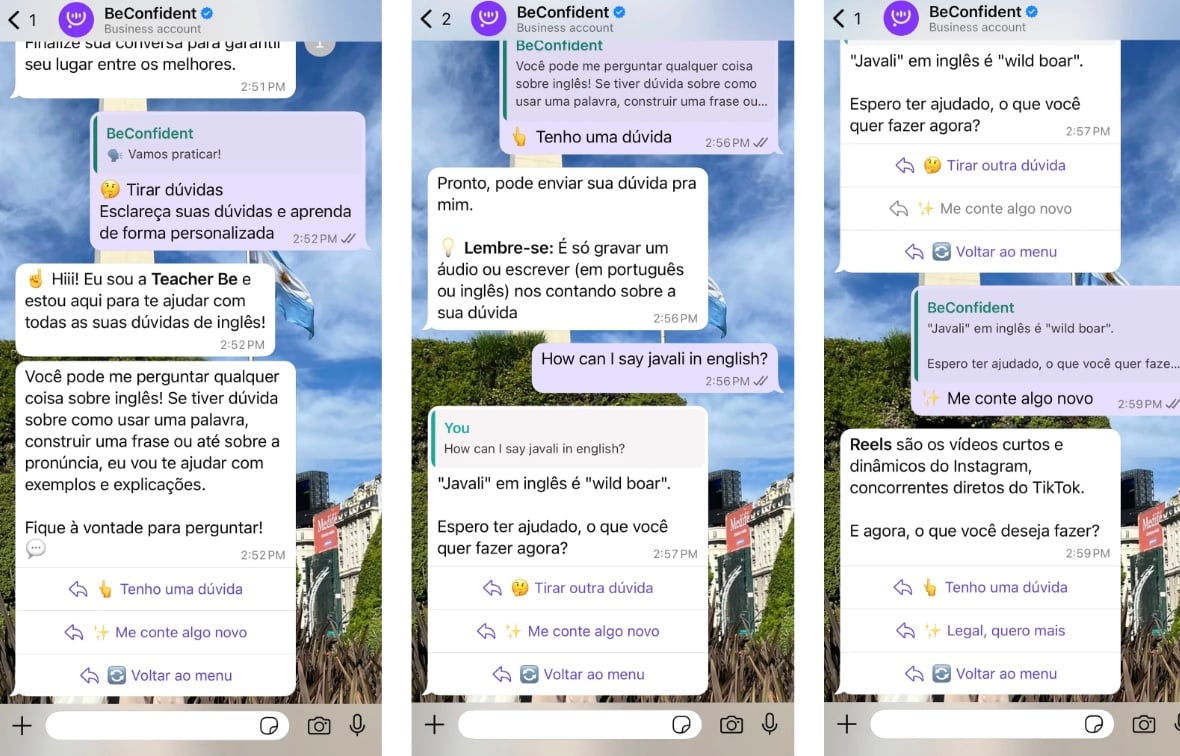
Compared to competitors, BeConfident solves the three main limitations in the market. Duolingo offers gamification but little real conversational practice. Cambly provides human tutors but charges by the hour and has variable quality of service. Traditional schools offer structure but require fixed hours and higher costs. BeConfident combines the best of these models, with unlimited conversational practice, consistent AI quality, and total schedule flexibility.
With over 200,000 paying students and an RA1000 reputation on Reclame Aqui, the platform demonstrates effectiveness at scale. Instant feedback supported by AI accelerates fluency development through real-time correction and adaptive practice.
Start your practice with a British accent now with AI tutors available all day.
Once you have established a practice routine, tracking your results helps maintain motivation and adjust your study plan.
Measuring your progress and advanced tips
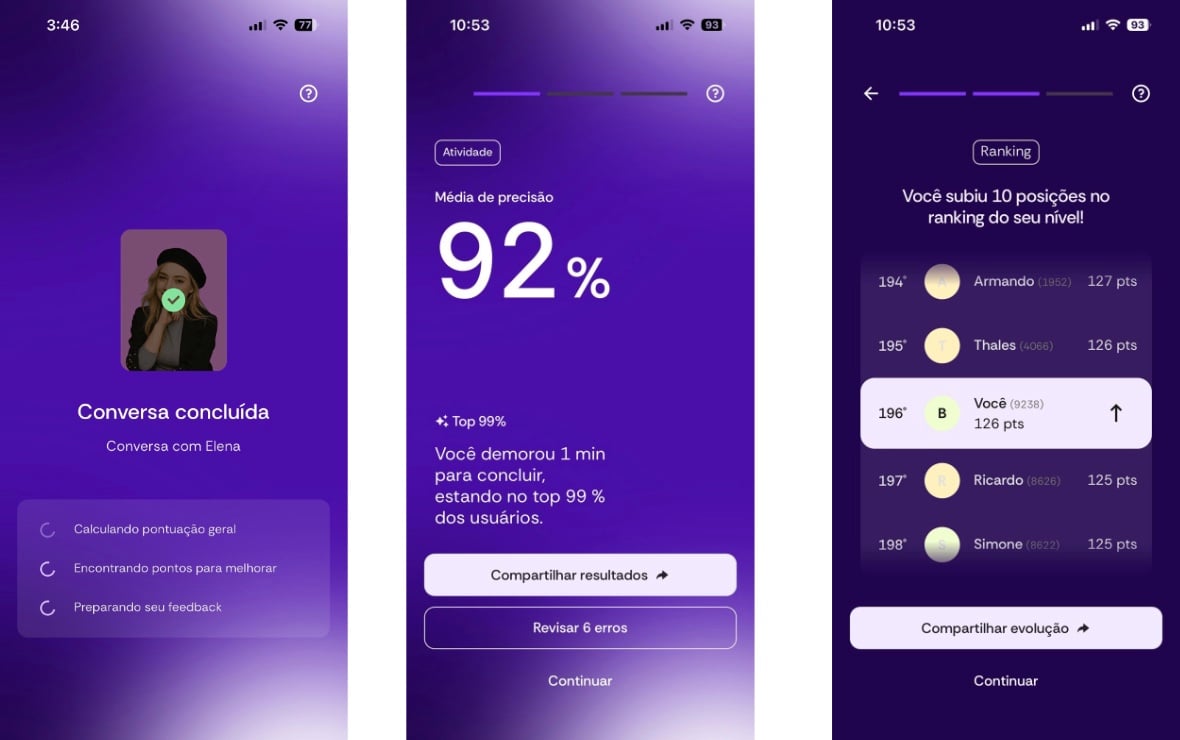
BeConfident's “My Evolution” feature allows you to track consecutive days of practice, ranking position, total conversation hours, and earned certificates. A realistic weekly goal is to distribute study across multiple short sessions throughout the week, rather than concentrating everything into a single day.
For more advanced levels, it's worth exploring regional accents like Received Pronunciation (RP) for formal contexts and Cockney for informal situations. BeConfident's AI adapts to your progress and begins to include professional technical vocabulary and more complex idioms as you evolve.
Focusing on specific themes that connect to your goals makes the practice more relevant. Some examples are corporate presentations, job interviews, or casual travel conversations. A non-judgmental practice environment reduces inhibition and accelerates the development of confidence when speaking.
FAQ
How to practice the British accent daily?
An efficient routine includes a few minutes of shadow speaking with authentic British content, followed by conversational practice with BeConfident's AI tutors. Daily regularity brings better results than long and sporadic sessions, because the brain gradually assimilates British pronunciation and intonation patterns.
What are the main differences between British and American conversation?
British English features more open vowels in words like “bath”, “dance”, and “ask”, as well as a silent final “r”, more varied intonation, and its own vocabulary, such as “lift” instead of “elevator” and “queue” instead of “line”. Slang like “cheers”, “brilliant”, and “proper” also characterizes informal British conversation.
Where to find audio to practice the British accent?
BBC podcasts, British news, series like Sherlock or The Crown, and BeConfident's AI tutors offer consistent exposure to the accent. The advantage of AI tutors lies in personalized feedback and the possibility of interactive conversational practice, not just passive listening.
What is the best app for learning a British accent?
BeConfident stands out by offering AI tutors specialized in authentic British accents, unlimited conversational practice, and immediate feedback. Unlike gamified apps that prioritize isolated vocabulary, BeConfident works on conversational fluency in contextualized dialogues.
British or American English: which is easier for Brazilians?
British English has a rhythm and intonation that many Brazilians find more musical and familiar. Each accent brings specific challenges, but practicing with AI tutors allows controlled exposure to both and develops conversational versatility for varied professional and personal contexts.
Conclusion
Mastering English conversation with a British accent becomes more feasible when you follow a structured practice and use appropriate tools. The seven steps presented, combined with BeConfident's AI technology, create a clear path to accelerate speaking development.
The key lies in the regularity of short sessions, focus on the specific features of the British accent, and conversational practice in a non-judgmental environment. Join the thousands of students who have already improved their conversation with this method and move forward toward a more natural fluency.
Transform your British conversation in weeks with daily AI-guided practice.
Written by: Luan Cavallaro, Founder & CMO, BeConfident
Key takeaways from this article
The British accent differs from the American by more open vowels, silent final “r”, and varied intonation, which requires focused practice for comprehension and natural speech.
Short daily sessions with shadowing generate consistent improvements in just a few weeks and outperform sporadic studying.
Mastering 10 essential slang words like “knackered”, “chuffed”, and “cheers” makes conversations more natural in pubs, work, or casual situations.
Practicing real dialogues in roleplays and recording your own pronunciation helps to compare with natives and adjust key vowels like /ɑː/ in “bath”.
BeConfident offers British-accented AI tutors 24/7 for unlimited practice and instant feedback. Try British AI conversation for free and build confidence when speaking.
Understanding the British accent in conversation
The British accent has specific characteristics that directly influence conversation. The main differences appear in vowel pronunciation, where “water” sounds like “wo-tuh” instead of “wa-ter”, and in the silent “r” at the end of words, as in “car”, which sounds simply like “ca”.
British intonation also differs from American English. Words like “schedule” sound like “shed-yool”, not “sked-yool”. “Garage” sounds like “ga-rahj”, not “ga-raj”. “Advertisement” receives emphasis on the second syllable. The vocabulary also changes, using “lift” instead of “elevator”, “queue” instead of “line”, and slang like “cheers” to say thank you.
Imitating the rhythm and intonation in daily exercises works on the characteristic melody of British English, which tends to have a wider variation in pitch compared to American.
With this foundation of pronunciation, rhythm, and vocabulary, the next step is to apply this knowledge to a practical routine that develops daily speaking.
7 practical steps to improve your conversation with a British accent
The following seven steps form a progressive system that combines listening, imitation, and conversation. Each step reinforces the previous one and takes you from familiarization with the sounds to more natural production in real situations.
1. Listen to British podcasts for a few minutes a day
Choose BBC programs, British comedy podcasts, or news broadcasts. Focus on intonation and rhythm, not just the content. A good option is listening to BBC Radio 4 or the Guardian's podcasts.
2. Practice shadow speaking with British content
Play British audio and speak at the same time, imitating what you hear as accurately as possible. Start with a few minutes daily using YouTube videos of British presenters.
3. Master 10 essential British slang words
A more authentic vocabulary includes “knackered” (tired), “chuffed” (proud/pleased), “ace” (excellent), “gobsmacked” (shocked), “mate” (friend), “cheeky” (impudent/playful), “brilliant” (great), “proper” (very), “faffing” (wasting time), and “taking the piss” (mocking/joking).
4. Focus on the key vowels of British English
Practice the sounds /ɑː/ in “bath”, “dance”, “ask” and the sound /ɒ/ in “hot”, “lot”, “got”. Record your own voice pronouncing these words and compare with audio of native speakers.
5. Use roleplays with real dialogues
Simulate situations like asking for directions, ordering in pubs, or participating in work meetings. Repeat the sentences until they sound natural and fluid.
6. Record and compare your pronunciation
Use a recording app to register your speech and compare with native models. Identify patterns that need adjustment. This self-assessment shows where you need more frequent and detailed feedback.
7. Practice with AI without judgment
To receive this continuous feedback without relying on fixed schedules or human tutors, use artificial intelligence tutors specialized in the British accent. This practice offers unlimited conversation, immediate feedback, and personalized correction.
Much of the progress in language learning relies on daily consistency, and short sessions tend to be more effective than study marathons.
Examples of dialogues and phrases to practice British conversation
At the airport:
"Excuse me, where's the loo?" (Sorry, where is the toilet?), with “loo” pronounced as /luː/.
"Could you tell me where the queue for check-in is?" (Could you tell me where the line for check-in is?).
At the pub:
"I'll have a pint of bitter, please." (I would like a pint of bitter, please).
"Cheers, mate!" (Thanks, friend!), used as an informal thank you.
In a work meeting:
"That's brilliant! Shall we crack on with the next point?" (That's great! Shall we continue with the next point?).
"I'm proper chuffed with these results." (I am very proud of these results.).
In casual conversation:
"I'm absolutely knackered after that meeting." (I am completely exhausted after that meeting.).
"Don't be so cheeky!" (Don't be so sassy!), in a playful tone.
Repeating these phrases frequently and with attention to the typical descending intonation of British English and clear pronunciation of consonants helps to consolidate the sound pattern.
Keeping up this constant practice becomes easier when you have a training environment that offers repetition, correction, and a variety of speaking situations.
BeConfident: 24/7 British accent practice with AI
BeConfident offers British English conversation learning with AI tutors who use this accent and are available 24 hours a day. Instead of relying solely on traditional methods, you practice unlimited conversation via app, WhatsApp, or smartwatch, with immediate feedback on pronunciation, grammar, and naturalness.
The AI tutors have specific profiles, such as photographer, lawyer, or writer, and simulate native accents, including British. Features include structured tracks, personalized review of mistakes, and the “Tell me something new” option to expand vocabulary in context.
Compared to competitors, BeConfident solves the three main limitations in the market. Duolingo offers gamification but little real conversational practice. Cambly provides human tutors but charges by the hour and has variable quality of service. Traditional schools offer structure but require fixed hours and higher costs. BeConfident combines the best of these models, with unlimited conversational practice, consistent AI quality, and total schedule flexibility.
With over 200,000 paying students and an RA1000 reputation on Reclame Aqui, the platform demonstrates effectiveness at scale. Instant feedback supported by AI accelerates fluency development through real-time correction and adaptive practice.
Start your practice with a British accent now with AI tutors available all day.
Once you have established a practice routine, tracking your results helps maintain motivation and adjust your study plan.
Measuring your progress and advanced tips
BeConfident's “My Evolution” feature allows you to track consecutive days of practice, ranking position, total conversation hours, and earned certificates. A realistic weekly goal is to distribute study across multiple short sessions throughout the week, rather than concentrating everything into a single day.
For more advanced levels, it's worth exploring regional accents like Received Pronunciation (RP) for formal contexts and Cockney for informal situations. BeConfident's AI adapts to your progress and begins to include professional technical vocabulary and more complex idioms as you evolve.
Focusing on specific themes that connect to your goals makes the practice more relevant. Some examples are corporate presentations, job interviews, or casual travel conversations. A non-judgmental practice environment reduces inhibition and accelerates the development of confidence when speaking.
FAQ
How to practice the British accent daily?
An efficient routine includes a few minutes of shadow speaking with authentic British content, followed by conversational practice with BeConfident's AI tutors. Daily regularity brings better results than long and sporadic sessions, because the brain gradually assimilates British pronunciation and intonation patterns.
What are the main differences between British and American conversation?
British English features more open vowels in words like “bath”, “dance”, and “ask”, as well as a silent final “r”, more varied intonation, and its own vocabulary, such as “lift” instead of “elevator” and “queue” instead of “line”. Slang like “cheers”, “brilliant”, and “proper” also characterizes informal British conversation.
Where to find audio to practice the British accent?
BBC podcasts, British news, series like Sherlock or The Crown, and BeConfident's AI tutors offer consistent exposure to the accent. The advantage of AI tutors lies in personalized feedback and the possibility of interactive conversational practice, not just passive listening.
What is the best app for learning a British accent?
BeConfident stands out by offering AI tutors specialized in authentic British accents, unlimited conversational practice, and immediate feedback. Unlike gamified apps that prioritize isolated vocabulary, BeConfident works on conversational fluency in contextualized dialogues.
British or American English: which is easier for Brazilians?
British English has a rhythm and intonation that many Brazilians find more musical and familiar. Each accent brings specific challenges, but practicing with AI tutors allows controlled exposure to both and develops conversational versatility for varied professional and personal contexts.
Conclusion
Mastering English conversation with a British accent becomes more feasible when you follow a structured practice and use appropriate tools. The seven steps presented, combined with BeConfident's AI technology, create a clear path to accelerate speaking development.
The key lies in the regularity of short sessions, focus on the specific features of the British accent, and conversational practice in a non-judgmental environment. Join the thousands of students who have already improved their conversation with this method and move forward toward a more natural fluency.
Transform your British conversation in weeks with daily AI-guided practice.