




How to improve English conversation with an American accent
How to improve English conversation with an American accent
How to improve English conversation with an American accent
Written by: Luan Cavallaro, Founder & CMO, BeConfident
Key takeaways from this article
Mastering the American accent requires focusing on key sounds, such as the strong R, T as D, and relaxed vowels, to sound natural in conversation.
Practicing shadowing with series like Friends and podcasts like Joe Rogan for 5 to 10 minutes daily helps build muscle memory in speech.
Doing drills focused on sounds that are difficult for Brazilians, such as R, TH, and vowels, and learning contractions like "gonna" and "wanna" in real dialogue increases naturalness.
Investing in 24/7 immersion, changing your phone's language to English, and practicing with AI tutors allows for unlimited conversation without embarrassment.
Tracking progress with metrics like speaking time without pausing and using BeConfident accelerates results with instant feedback, including a free trial option.
Step 1: Understand the characteristics of the American accent
The American accent has specific characteristics that differ from British English and other variants. Mastering these details is essential to sounding natural. These features work together to create the relaxed and fluid sound typical of American English:
Strong R (rhotic): Pronounce the R in all positions, "car" sounds like /kɑr/, not /kɑ/. This marked R is one of the most recognizable traits of the American accent.
Intervocalic T as D: "water" becomes /wɑɾər/ and "better" sounds like /beɾər/. This softening contributes to a more continuous rhythm.
Natural contractions: "going to" becomes "gonna" and "want to" becomes "wanna". These reductions make speech faster and more spontaneous.
Linking sounds: Words connect, and "not at all" can sound like a single word, "notatall".
Relaxed vowels: "cut" /kʌt/ is different from "caught" /kɔt/, and these distinctions completely change the meaning.
At BeConfident, pronunciation learning paths target these sounds directly and offer instant feedback for every attempt. This creates the solid foundation needed to get closer to a native speaker's phrasing.
Step 2: Master shadowing with American series and podcasts
Shadowing trains your brain and your speech system through neuromuscular conditioning, transforming speech into automatic muscle memory.
Here is how to practice shadowing efficiently:
Choose American content, such as Friends, The Office, and Joe Rogan podcasts.
Start with short phrases, like "I’m gonna go", and repeat, imitating the rhythm and intonation.
Use transcripts to follow the audio visually.
Record your voice and compare it to the original audio.
Practice historical shadowing for 5 to 10 minutes daily to build muscle memory.
Common mistake: speaking too slowly. The goal is to get closer to native speed, even if you make mistakes in the beginning.
Expected results: with a week of consistent practice, you tend to notice a clear improvement in the natural rhythm of American speech.
Step 3: Practice key sounds with daily drills
After working on rhythm with shadowing, the next step is to refine specific sounds that usually cause difficulty for Brazilians. Three sounds are crucial to mastering the American accent:
Strong R sound:
Practice words like "bird" /bɜrd/, "work" /wɜrk/, and "car" /kɑr/.
Tip: Curl your tongue slightly backward without touching the roof of your mouth.
TH sound:
Practice words like "think" /θɪŋk/, "this" /ðɪs/, and "three" /θri/.
Tip: Place your tongue between your teeth and blow air gently.
American vowels:
Practice pairs like "cut" /kʌt/ and "caught" /kɔt/, "bat" /bæt/ and "bet" /bet/.
Tip: Open your mouth wider for the /æ/ sound in words like "cat".
At BeConfident, pronunciation feedback helps you reach about 80% accuracy on these key sounds, with personalized real-time corrections.
Step 4: Learn contractions and expressions in real dialogues
Americans use contractions all the time in informal conversation. Practicing real dialogues helps internalize these reduced forms.
Work meeting:
"I’m gonna need those reports by Friday. Can you handle that?"
"Sure, I’ll get ’em done by Thursday."
At the airport:
"Where’s the gate for flight 245?"
"It’s gonna be gate C12, but they haven’t started boarding yet."
Ordering coffee:
"Wanna grab coffee after the meeting?"
"I’d love to, but I gotta finish this presentation first."
Expert tip: notice how "going to" naturally becomes "gonna", "want to" becomes "wanna", and "got to" becomes "gotta" within the flow of conversation.
Step 5: Use 24/7 immersion with media and active practice
Using the entire day as an opportunity to connect with English accelerates learning.
Change your phone's language to American English.
Watch Netflix with English audio and English subtitles.
Listen to American podcasts during exercises or commutes.
Record your voice reading American news aloud.
Practice linking sounds, for example, making "pick it up" sound like "pickitup".
The core point is to combine constant exposure with active practice. Don't just consume content; repeat phrases, imitate intonations, and try to reproduce the rhythm.
Step 6: Practice with native speakers for free using BeConfident AI tutors
BeConfident offers AI tutors with a native American accent and various profiles. You can chat with a New York lawyer, a California photographer, or a Chicago writer, all available 24/7 on the channels already mentioned.
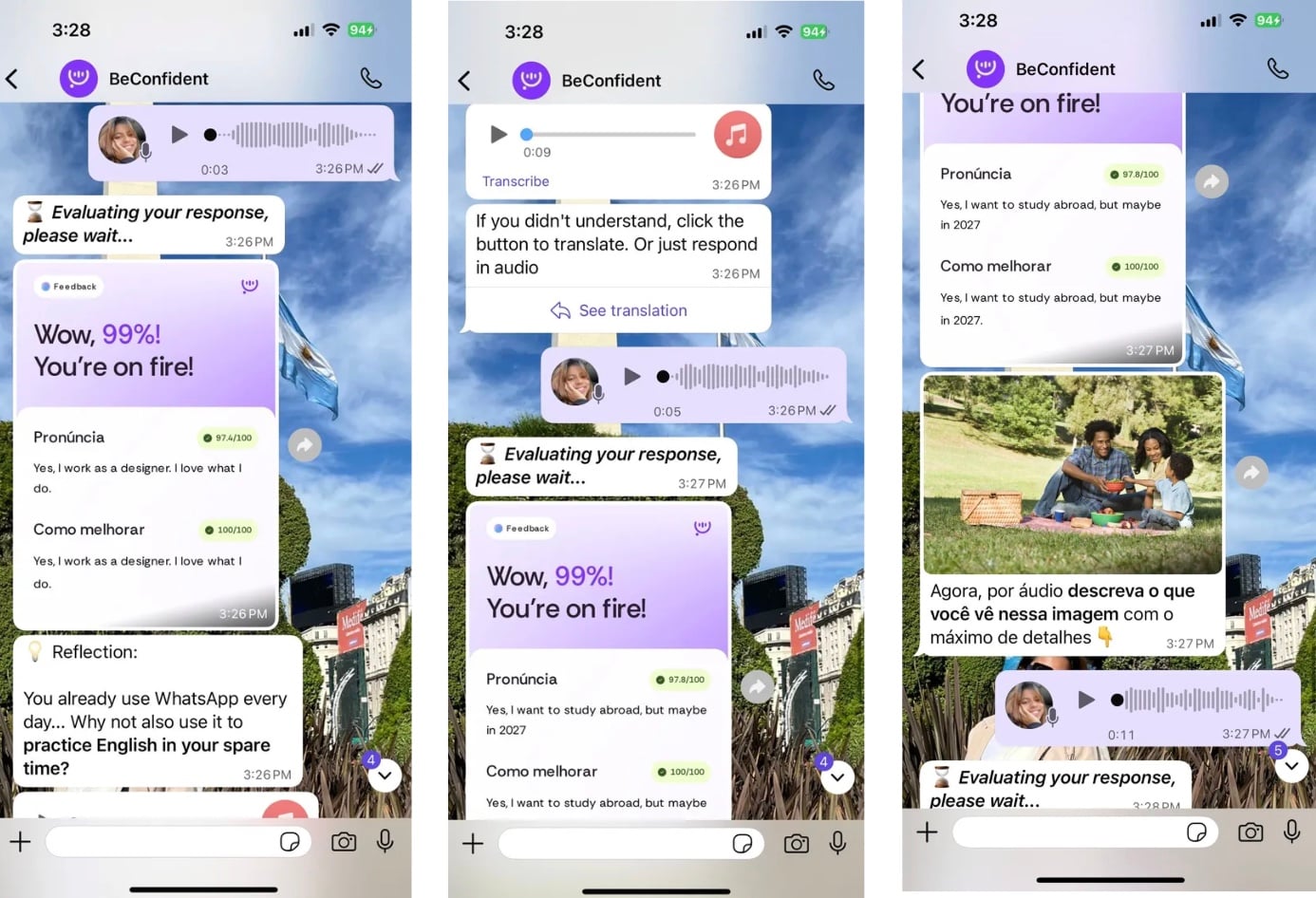
Comparison with alternatives:
Duolingo: focuses on gamification and basic vocabulary, with little real conversation practice.
Traditional schools: have fixed hours, higher costs, and little individual speaking time per student.
Cambly: charges per minute of conversation, with variable quality among tutors.
BeConfident: offers unlimited practice, instant feedback, and a judgment-free environment.
Expert tip: alternate between different tutors to expose yourself to regional variations of the American accent and specific professional topics.
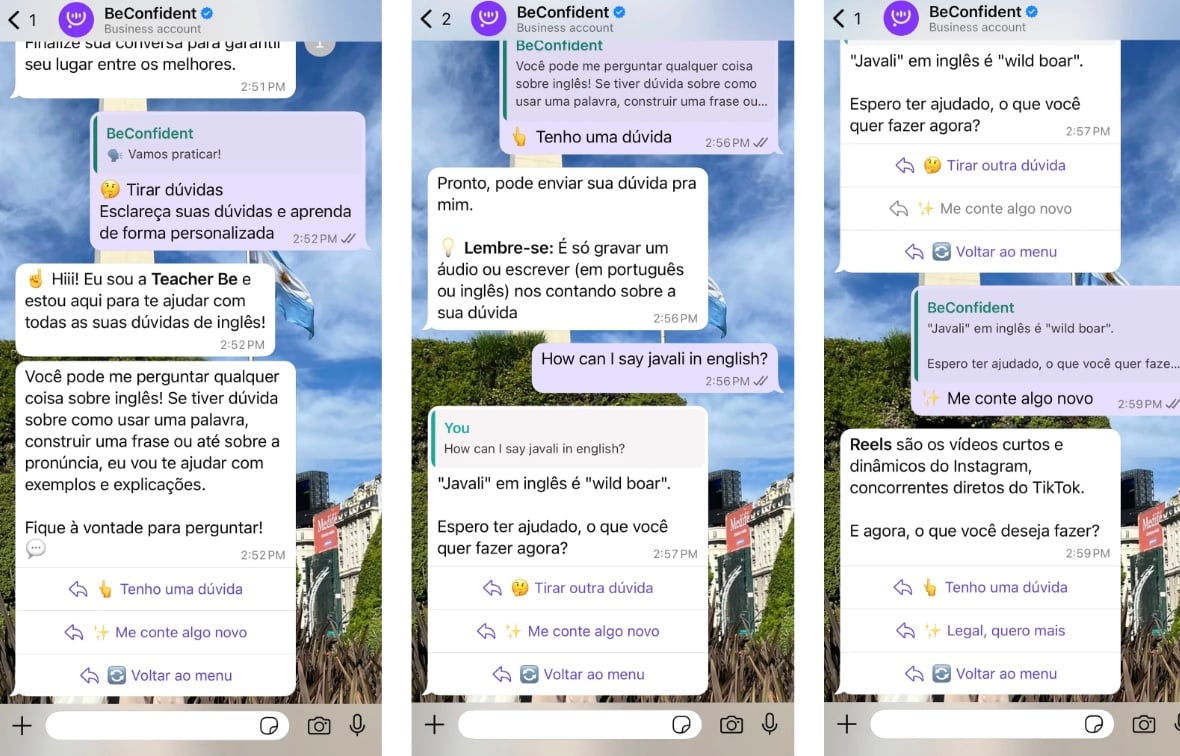
Try unlimited conversation with AI tutors; take a free trial.
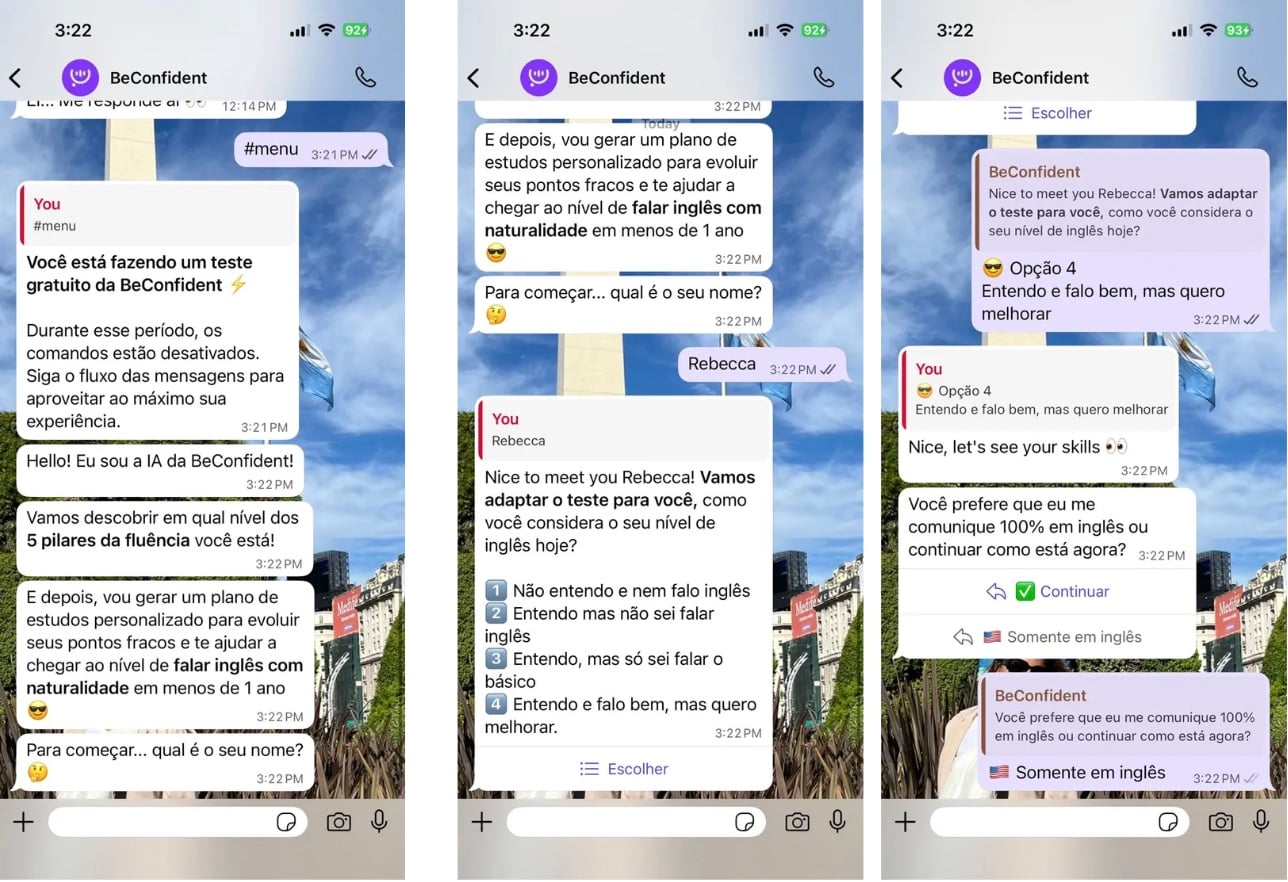
Step 7: Review mistakes and track your progress
Measuring progress helps maintain motivation and adjust your studies.
Important metrics:
Streak of consecutive days practicing.
Speaking time without freezing, with a goal of 5 minutes in 2 weeks.
Accuracy percentage in pronunciation, with a goal of 80%.
Specific feedback on grammar and naturalness.
At BeConfident, the "My Progress" section presents this data in an organized way, and Teacher Be is available to resolve specific questions about pronunciation or grammar.
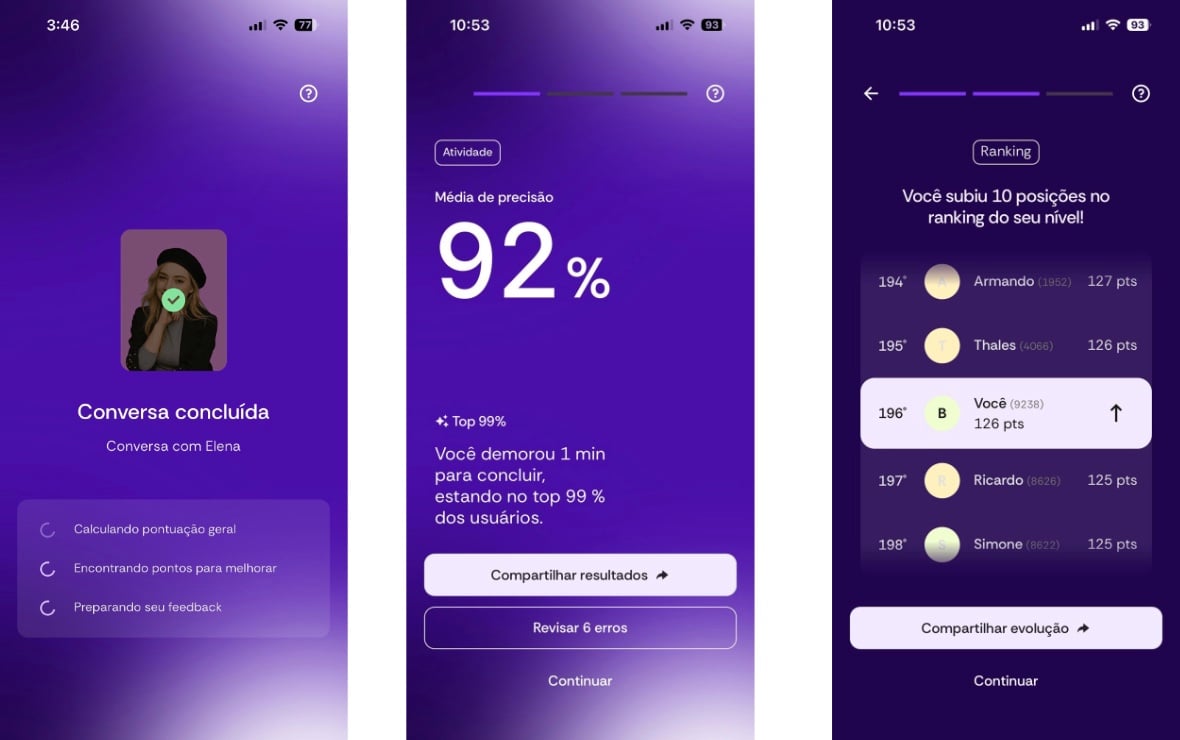
Success indicator: being able to speak for 5 consecutive minutes about a familiar topic without freezing and without mentally translating.
Practical dialogues with an American accent
Practicing full dialogues in real situations consolidates vocabulary, rhythm, and contractions.
Engineer in an international meeting:
"So we’re gonna need to optimize the database performance. I’m thinking we could implement caching strategies."
"That sounds great. How long d’you think it’ll take to see results?"
"Probably a couple weeks if we start this Monday."
Tourist asking for directions:
"Excuse me, d’you know how to get to Times Square from here?"
"Sure! You’re gonna wanna take the subway. The red line’ll get you there in about 15 minutes."
Calling a taxi:
"I need a ride to JFK airport, please."
"No problem. What time’s your flight?"
"It’s at 3 PM, so I’m thinking we should leave around noon."
These examples show natural contractions, linking sounds, and the more relaxed rhythm typical of conversational American English.
Comparisons: why BeConfident stands out
BeConfident sets itself apart by combining advanced technology with a conversation-centered methodology.
Compared to traditional methods: while schools charge high prices and require fixed classroom schedules, BeConfident offers unlimited practice across multiple platforms, at a lower cost than in-person courses.
Compared to gamified apps: Duolingo maintains streaks with basic exercises but offers little conversational fluency development.
Compared to human tutors: platforms like Cambly charge per hour of conversation, with variable quality among tutors.
Frequently Asked Questions
How to improve your American accent quickly?
A routine that combines 5 to 10 minutes of daily shadowing, drills on specific sounds like R, TH, and vowels, and conversation with instant feedback accelerates progress. At BeConfident, many students notice improvement in 2 to 3 weeks of consistent practice.
How to chat with native Americans for free?
BeConfident offers unlimited conversation with AI tutors that simulate a native American accent. Unlike platforms that charge per minute, you can practice for several hours at no additional cost, with 24/7 access through the channels already mentioned.
What is the difference between an American and British accent?
The American accent is rhotic, meaning the R is pronounced in all positions, uses intervocalic T as D in words like "water," and tends to have more relaxed vowels. The British accent generally omits the final R, keeps the T clearer, and uses tenser vowels. For many Brazilians, the American accent is usually easier to reproduce.
How long does it take to reach conversational fluency?
With a total daily practice of 15 to 30 minutes, including shadowing, drills, and conversation, most intermediate students can speak for 5 minutes without pausing in 2 to 4 weeks. Most natural fluency in complex conversations typically requires 3 to 6 months of consistent practice.
Does BeConfident work for beginners?
BeConfident best serves intermediate levels, such as B1 and B2, who already have basic vocabulary but freeze during conversation. Beginners can use the structured paths to build a foundation, but the main focus is on releasing the potential of those who have studied English before.
Conclusion: your path to natural fluency
Mastering the American accent depends on a clear method and consistent practice, not talent. The 7 steps presented, from understanding phonetic characteristics to practicing with AI, form a structured plan to overcome conversation barriers.
BeConfident reduces obstacles such as embarrassment over making mistakes, lack of conversation partners, rigid schedules, and high costs. With AI tutors available 24/7 and personalized feedback, you practice at your own pace until you gain confidence.
Setting a plan and starting today greatly increases your chance of achieving conversational fluency in American English.
Written by: Luan Cavallaro, Founder & CMO, BeConfident
Key takeaways from this article
Mastering the American accent requires focusing on key sounds, such as the strong R, T as D, and relaxed vowels, to sound natural in conversation.
Practicing shadowing with series like Friends and podcasts like Joe Rogan for 5 to 10 minutes daily helps build muscle memory in speech.
Doing drills focused on sounds that are difficult for Brazilians, such as R, TH, and vowels, and learning contractions like "gonna" and "wanna" in real dialogue increases naturalness.
Investing in 24/7 immersion, changing your phone's language to English, and practicing with AI tutors allows for unlimited conversation without embarrassment.
Tracking progress with metrics like speaking time without pausing and using BeConfident accelerates results with instant feedback, including a free trial option.
Step 1: Understand the characteristics of the American accent
The American accent has specific characteristics that differ from British English and other variants. Mastering these details is essential to sounding natural. These features work together to create the relaxed and fluid sound typical of American English:
Strong R (rhotic): Pronounce the R in all positions, "car" sounds like /kɑr/, not /kɑ/. This marked R is one of the most recognizable traits of the American accent.
Intervocalic T as D: "water" becomes /wɑɾər/ and "better" sounds like /beɾər/. This softening contributes to a more continuous rhythm.
Natural contractions: "going to" becomes "gonna" and "want to" becomes "wanna". These reductions make speech faster and more spontaneous.
Linking sounds: Words connect, and "not at all" can sound like a single word, "notatall".
Relaxed vowels: "cut" /kʌt/ is different from "caught" /kɔt/, and these distinctions completely change the meaning.
At BeConfident, pronunciation learning paths target these sounds directly and offer instant feedback for every attempt. This creates the solid foundation needed to get closer to a native speaker's phrasing.
Step 2: Master shadowing with American series and podcasts
Shadowing trains your brain and your speech system through neuromuscular conditioning, transforming speech into automatic muscle memory.
Here is how to practice shadowing efficiently:
Choose American content, such as Friends, The Office, and Joe Rogan podcasts.
Start with short phrases, like "I’m gonna go", and repeat, imitating the rhythm and intonation.
Use transcripts to follow the audio visually.
Record your voice and compare it to the original audio.
Practice historical shadowing for 5 to 10 minutes daily to build muscle memory.
Common mistake: speaking too slowly. The goal is to get closer to native speed, even if you make mistakes in the beginning.
Expected results: with a week of consistent practice, you tend to notice a clear improvement in the natural rhythm of American speech.
Step 3: Practice key sounds with daily drills
After working on rhythm with shadowing, the next step is to refine specific sounds that usually cause difficulty for Brazilians. Three sounds are crucial to mastering the American accent:
Strong R sound:
Practice words like "bird" /bɜrd/, "work" /wɜrk/, and "car" /kɑr/.
Tip: Curl your tongue slightly backward without touching the roof of your mouth.
TH sound:
Practice words like "think" /θɪŋk/, "this" /ðɪs/, and "three" /θri/.
Tip: Place your tongue between your teeth and blow air gently.
American vowels:
Practice pairs like "cut" /kʌt/ and "caught" /kɔt/, "bat" /bæt/ and "bet" /bet/.
Tip: Open your mouth wider for the /æ/ sound in words like "cat".
At BeConfident, pronunciation feedback helps you reach about 80% accuracy on these key sounds, with personalized real-time corrections.
Step 4: Learn contractions and expressions in real dialogues
Americans use contractions all the time in informal conversation. Practicing real dialogues helps internalize these reduced forms.
Work meeting:
"I’m gonna need those reports by Friday. Can you handle that?"
"Sure, I’ll get ’em done by Thursday."
At the airport:
"Where’s the gate for flight 245?"
"It’s gonna be gate C12, but they haven’t started boarding yet."
Ordering coffee:
"Wanna grab coffee after the meeting?"
"I’d love to, but I gotta finish this presentation first."
Expert tip: notice how "going to" naturally becomes "gonna", "want to" becomes "wanna", and "got to" becomes "gotta" within the flow of conversation.
Step 5: Use 24/7 immersion with media and active practice
Using the entire day as an opportunity to connect with English accelerates learning.
Change your phone's language to American English.
Watch Netflix with English audio and English subtitles.
Listen to American podcasts during exercises or commutes.
Record your voice reading American news aloud.
Practice linking sounds, for example, making "pick it up" sound like "pickitup".
The core point is to combine constant exposure with active practice. Don't just consume content; repeat phrases, imitate intonations, and try to reproduce the rhythm.
Step 6: Practice with native speakers for free using BeConfident AI tutors
BeConfident offers AI tutors with a native American accent and various profiles. You can chat with a New York lawyer, a California photographer, or a Chicago writer, all available 24/7 on the channels already mentioned.
Comparison with alternatives:
Duolingo: focuses on gamification and basic vocabulary, with little real conversation practice.
Traditional schools: have fixed hours, higher costs, and little individual speaking time per student.
Cambly: charges per minute of conversation, with variable quality among tutors.
BeConfident: offers unlimited practice, instant feedback, and a judgment-free environment.
Expert tip: alternate between different tutors to expose yourself to regional variations of the American accent and specific professional topics.
Try unlimited conversation with AI tutors; take a free trial.
Step 7: Review mistakes and track your progress
Measuring progress helps maintain motivation and adjust your studies.
Important metrics:
Streak of consecutive days practicing.
Speaking time without freezing, with a goal of 5 minutes in 2 weeks.
Accuracy percentage in pronunciation, with a goal of 80%.
Specific feedback on grammar and naturalness.
At BeConfident, the "My Progress" section presents this data in an organized way, and Teacher Be is available to resolve specific questions about pronunciation or grammar.
Success indicator: being able to speak for 5 consecutive minutes about a familiar topic without freezing and without mentally translating.
Practical dialogues with an American accent
Practicing full dialogues in real situations consolidates vocabulary, rhythm, and contractions.
Engineer in an international meeting:
"So we’re gonna need to optimize the database performance. I’m thinking we could implement caching strategies."
"That sounds great. How long d’you think it’ll take to see results?"
"Probably a couple weeks if we start this Monday."
Tourist asking for directions:
"Excuse me, d’you know how to get to Times Square from here?"
"Sure! You’re gonna wanna take the subway. The red line’ll get you there in about 15 minutes."
Calling a taxi:
"I need a ride to JFK airport, please."
"No problem. What time’s your flight?"
"It’s at 3 PM, so I’m thinking we should leave around noon."
These examples show natural contractions, linking sounds, and the more relaxed rhythm typical of conversational American English.
Comparisons: why BeConfident stands out
BeConfident sets itself apart by combining advanced technology with a conversation-centered methodology.
Compared to traditional methods: while schools charge high prices and require fixed classroom schedules, BeConfident offers unlimited practice across multiple platforms, at a lower cost than in-person courses.
Compared to gamified apps: Duolingo maintains streaks with basic exercises but offers little conversational fluency development.
Compared to human tutors: platforms like Cambly charge per hour of conversation, with variable quality among tutors.
Frequently Asked Questions
How to improve your American accent quickly?
A routine that combines 5 to 10 minutes of daily shadowing, drills on specific sounds like R, TH, and vowels, and conversation with instant feedback accelerates progress. At BeConfident, many students notice improvement in 2 to 3 weeks of consistent practice.
How to chat with native Americans for free?
BeConfident offers unlimited conversation with AI tutors that simulate a native American accent. Unlike platforms that charge per minute, you can practice for several hours at no additional cost, with 24/7 access through the channels already mentioned.
What is the difference between an American and British accent?
The American accent is rhotic, meaning the R is pronounced in all positions, uses intervocalic T as D in words like "water," and tends to have more relaxed vowels. The British accent generally omits the final R, keeps the T clearer, and uses tenser vowels. For many Brazilians, the American accent is usually easier to reproduce.
How long does it take to reach conversational fluency?
With a total daily practice of 15 to 30 minutes, including shadowing, drills, and conversation, most intermediate students can speak for 5 minutes without pausing in 2 to 4 weeks. Most natural fluency in complex conversations typically requires 3 to 6 months of consistent practice.
Does BeConfident work for beginners?
BeConfident best serves intermediate levels, such as B1 and B2, who already have basic vocabulary but freeze during conversation. Beginners can use the structured paths to build a foundation, but the main focus is on releasing the potential of those who have studied English before.
Conclusion: your path to natural fluency
Mastering the American accent depends on a clear method and consistent practice, not talent. The 7 steps presented, from understanding phonetic characteristics to practicing with AI, form a structured plan to overcome conversation barriers.
BeConfident reduces obstacles such as embarrassment over making mistakes, lack of conversation partners, rigid schedules, and high costs. With AI tutors available 24/7 and personalized feedback, you practice at your own pace until you gain confidence.
Setting a plan and starting today greatly increases your chance of achieving conversational fluency in American English.