




How to improve your English pronunciation: 7 steps for Brazilians
How to improve your English pronunciation: 7 steps for Brazilians
How to improve your English pronunciation: 7 steps for Brazilians
Written by: Luan Cavallaro, Founder & CMO, BeConfident
Key takeaways from this article
Brazilians repeat mistakes such as "th" turning into "tchi", "r" turning into "h" and adding "i" at the end of words. The table helps to identify these patterns and correct them with quick exercises.
Shadowing practice with podcasts like "6 Minute English" and using sentence chunking develop natural rhythm and fluency with 10 minutes daily.
Recording your own speech and comparing it with natives facilitate self-assessment. Practicing intonation with series like "Friends" and songs accelerates improvement.
AI tools offer instant feedback on pronunciation, intonation, and rhythm. This allows frequent and embarrassment-free practice with native accent tutors.
A weekly routine of 10 minutes a day and measuring progress maintain consistency. The free trial of BeConfident accelerates your progress in pronunciation.
Most common pronunciation mistakes made by Brazilians
Problematic sound | Wrong/correct example | Quick exercise | Tip |
TH as "tchi" | think/tink → think | Place the tongue between the teeth | Practice "the, this, that" |
R as "h" | red/hed → red | Curl the tongue backward | Avoid touching the roof of the mouth |
Short/long vowels | confused ship/sheep | Exaggerate the difference | Ship is a quick "i" sound |
Adding "i" at the end | cat/cati → cat | Stop the sound abruptly | Avoid adding a vowel |
Weak intonation | Monotone speech | Imitate the melody of natives | Vary your tone of voice |
ED as "edi" | worked/workedi → worked | Use only "t" or "d" sound | Avoid extra vowel |
V as "f" | very/fery → very | Vibrate the lower lip | Touch the upper teeth |
Incorrect chunking | Portuguese syllable rhythm | Group words into blocks | Treat "I would like to" as a block |
7 tips to improve English pronunciation for Brazilian beginners
Tip 1: use the table to identify your main mistakes
The English sounds that most confuse Brazilians follow predictable patterns. Use the table to choose two or three problematic sounds and focus 10 minutes a day on those points.
Practical exercise: read aloud five words from the "Wrong/correct example" column, record your speech and compare it with audio from native speakers. Repeat until you notice a clear difference between the incorrect and correct versions.
Tip 2: practice shadowing with simple podcasts
Shadowing is one of the most effective English pronunciation tips. Regular conversation practice develops a natural rhythm, intonation, and clearer pronunciation.
Choose a short podcast like BBC's "6 Minute English" and repeat what you hear at the same time, imitating rhythm and intonation. Start at a reduced speed and gradually increase. Spend 10 minutes a day focusing more on the melody of the sentence than on each isolated word.
Tip 3: record and compare your audio
English pronunciation exercises for beginners are most efficient when they include self-evaluation. Recording conversations and comparing them with native pronunciation develops awareness of one's own mistakes.
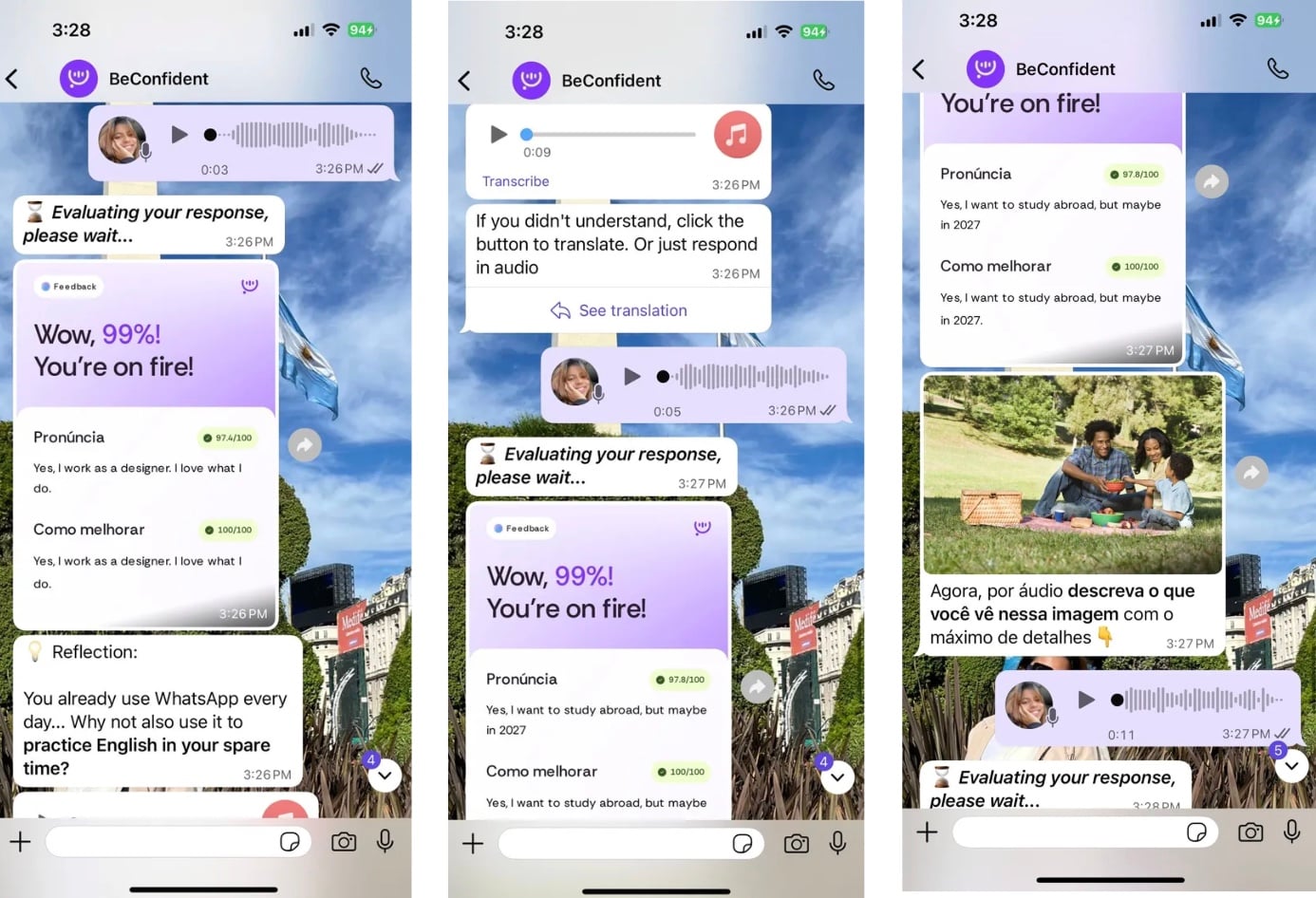
Use a tool like BeConfident, which offers instant AI feedback on your pronunciation. Record simple sentences like "How are you?" and compare them with native versions, adjusting rhythm, intonation, and specific sounds. Take the free trial and start your guided practice.
Tip 4: practice sentence chunking to gain fluency
English groups words into chunks, or sound blocks, instead of separating everything into syllables as in Portuguese. Sentences like "I would like to" sound better as a single, continuous unit, not as four separate words.
Exercise: practice common expressions as single blocks, for example, "How are you doing", "What do you think" and "I'm going to". Record yourself saying these expressions as if they were one long, fluid word.
Tip 5: train intonation with songs and series
Intonation has a direct impact on the clarity and naturalness of pronunciation. Using programs with English subtitles connects the written form to the actual sound used by native speakers.
Watch a show like "Friends" with English subtitles, pause short dialogues, and repeat, imitating the actors' melody. Use songs in English to sing along, focusing on the natural rhythm of the words and the rises and falls in pitch.
Tip 6: use AI to get immediate feedback
Using artificial intelligence makes it easier to practice English pronunciation alone. AI conversation partners offer continuous availability and detailed real-time feedback on pronunciation errors.
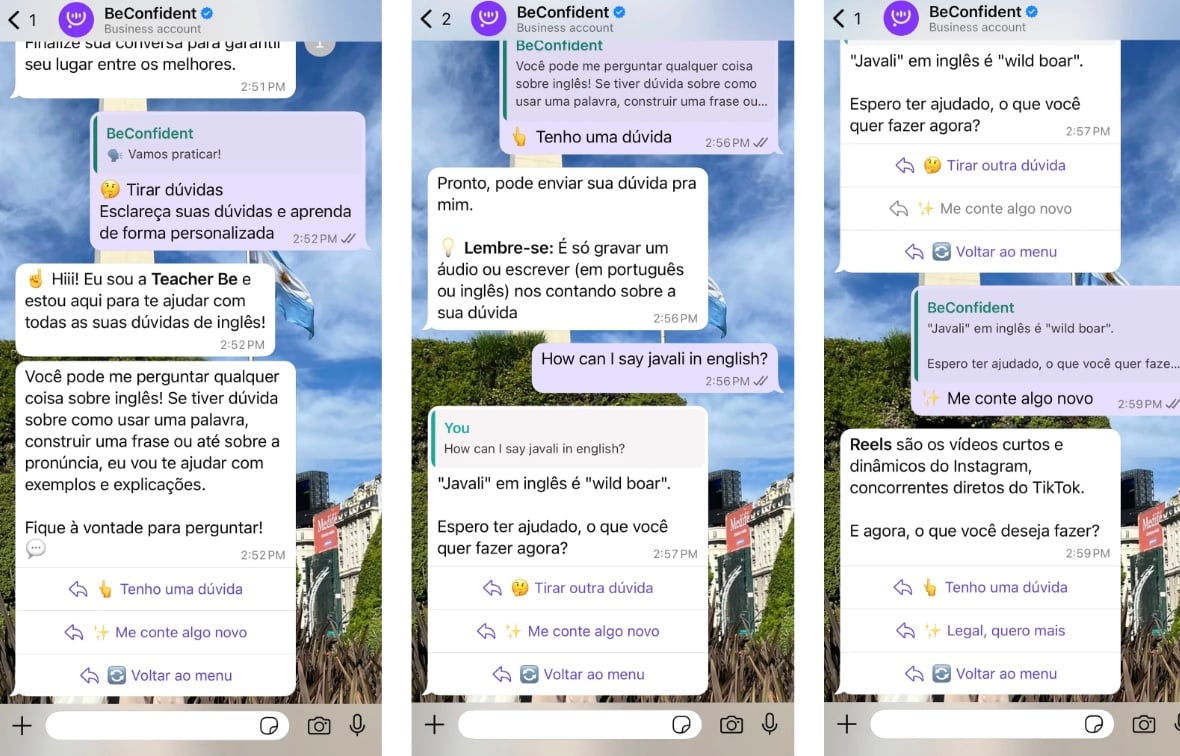
BeConfident offers AI tutors with varied native accents who correct your pronunciation instantly via app or WhatsApp. AI tools analyze phonemes, intonation, and rhythm to point out specific errors, allowing for focused and embarrassment-free practice.
Tip 7: maintain a daily routine and measure progress
A consistent routine of at least 10 minutes a day solidifies the learning of the previous techniques. The "My Progress" feature on BeConfident tracks streaks, practice hours, and certificates, helping to maintain consistency.
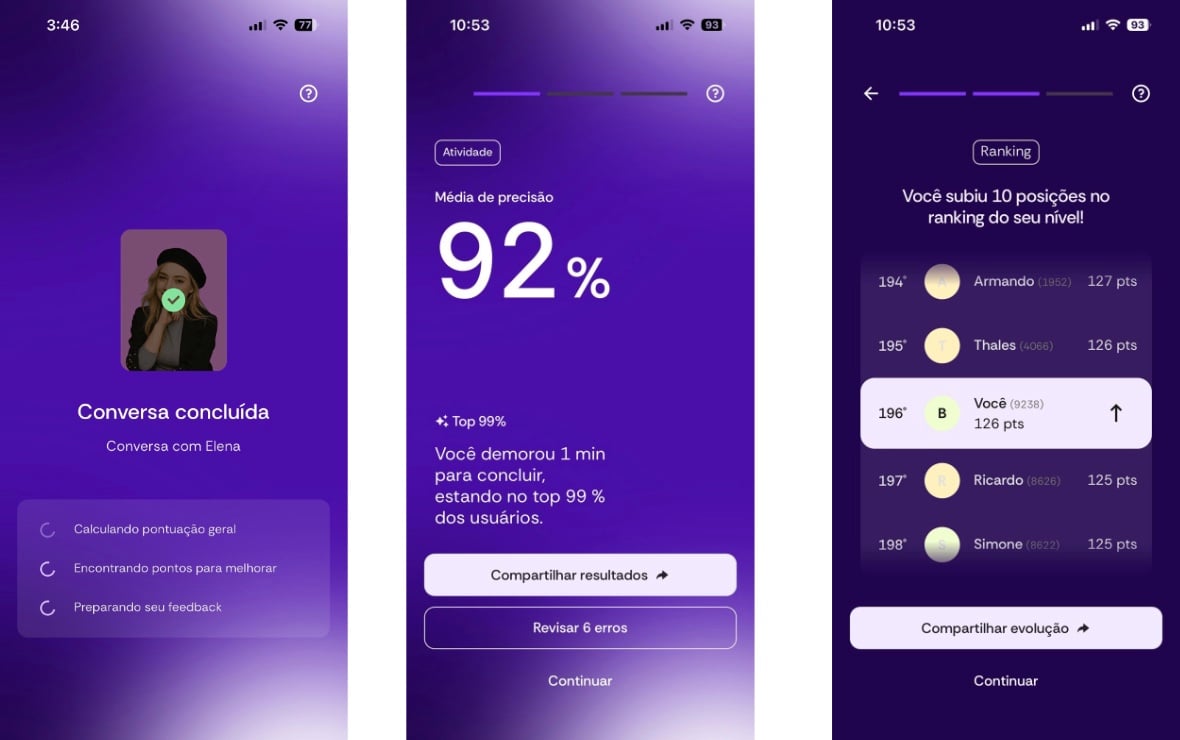
Daily checklist: 3 minutes of shadowing, 4 minutes recording problem sentences, and 3 minutes chatting with an AI. Measure progress weekly by recording the same sentence and comparing evolution over time.
BeConfident as support for shy Brazilians
BeConfident focuses on real conversation with AI feedback, whereas an app like Duolingo prioritizes gamification, and traditional schools tend to have higher costs and rigid schedules. The platform offers unlimited conversation practice with corrections tailored to the difficulties faced by Brazilians.
With a RA 1000 reputation on Reclame Aqui, the platform gathers AI tutors with native accents, structured lesson paths, and instant correction via app, WhatsApp, or smartwatch. A hybrid approach that uses AI for high practice volume and detailed feedback increases learning efficiency.
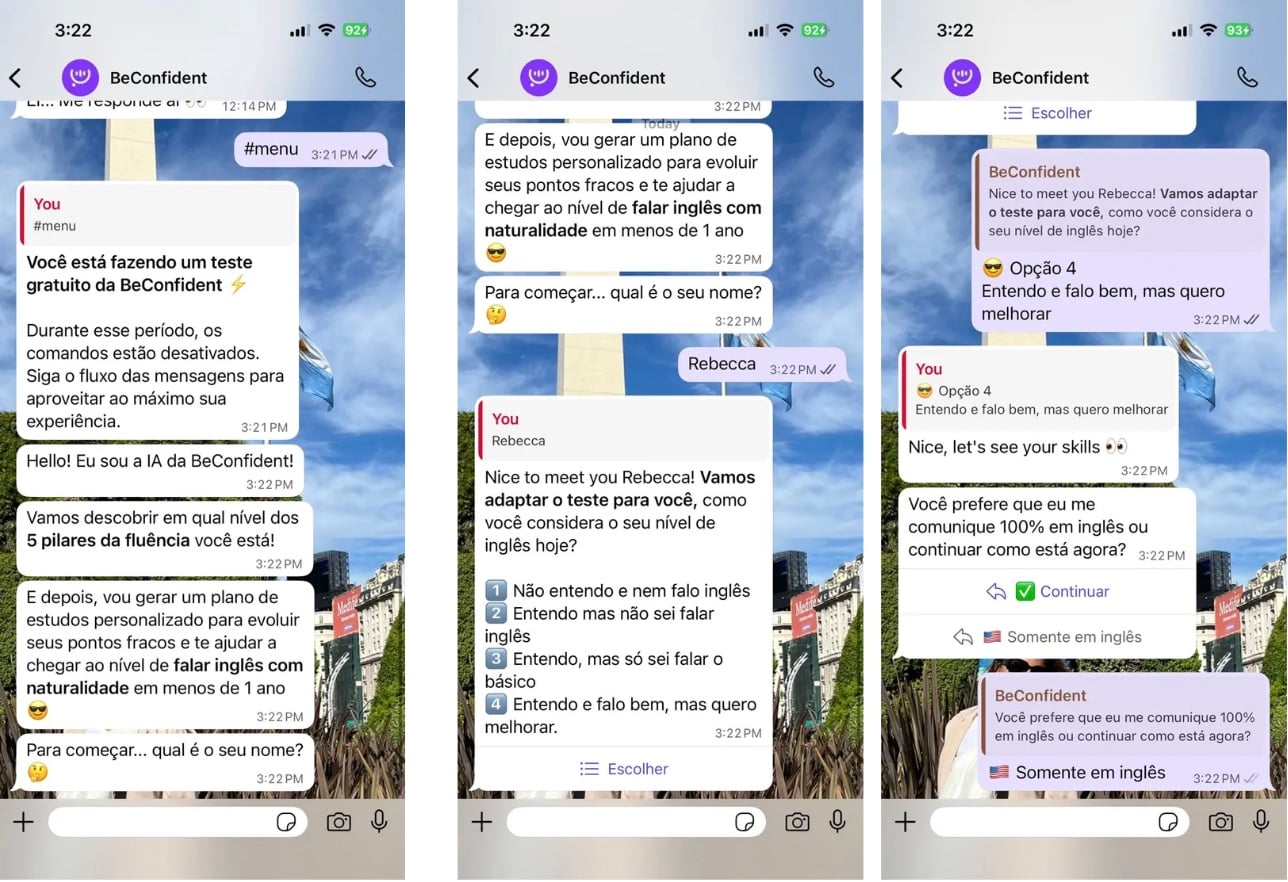
The free trial allows students to answer questions in English or Portuguese and do exercises covering the main pillars of fluency. At the end, students receive an analysis of strengths and areas to develop. Take the free trial and start your pronunciation practice.
Weekly routine and progress measurement
A clear weekly routine facilitates discipline and ensures daily contact with the language. Use the suggestion below as a basis and adjust it to your reality.
Day | Main activity | Focus | Time goal |
Monday | Error table and shadowing | Problematic sounds | 10 min |
Tuesday | Recording and comparison | Self-evaluation | 10 min |
Wednesday | Sentence chunking | Fluency | 10 min |
Thursday | Series with subtitles | Intonation | 10 min |
Friday | AI conversation | Free practice | 10 min |
Saturday | Error review | Corrections | 10 min |
Sunday | Weekly evaluation | Progress | 10 min |
Frequently asked questions
How to practice English pronunciation alone without a teacher?
Using AI technology like BeConfident allows you to practice pronunciation at any time with immediate feedback. Combine shadowing with podcasts, audio recording for self-evaluation, and conversations with AI tutors. A daily 10-minute practice with instant feedback replaces part of traditional classes and reduces the need for fixed schedules.
Which English sounds most confuse Brazilian beginners?
The main challenges include the "th" sound turning into "tchi", the American "r" coming close to "h", the confusion between short and long vowels as in ship and sheep, adding "i" at the end of words like cat (cati), and monotone intonation. Many Brazilians also substitute the "v" sound with "f" and apply the same Portuguese syllable pattern to English, which hinders chunking.
How long does it take to improve English pronunciation?
A structured routine of 10 minutes a day usually generates a noticeable improvement in 4 to 6 weeks. Specific sounds can become clearer in 2 or 3 weeks of targeted focus. Fluency with a more natural rhythm and intonation closer to that of native speakers tends to require 3 to 6 months of consistent practice, depending on the starting level and regularity.
Do pronunciation apps work better than in-person classes?
Apps with AI like BeConfident offer 24-hour availability, instant feedback, unlimited practice, and lower cost per hour of study. The combination of AI for daily practice volume and occasional human interaction for cultural aspects usually yields good results. For shy Brazilians, using apps reduces the fear of making mistakes in public and accelerates progress.
Is it possible to reduce a Brazilian accent in English?
Reducing a Brazilian accent is possible to a certain extent, but the main goal should be clarity. Techniques like shadowing, imitating natives, and AI feedback reduce Portuguese interference that hinders comprehension. A slight accent is common and acceptable, and the focus can remain on efficient communication instead of striving for a completely neutral pronunciation.
Conclusion
Improving English pronunciation for Brazilian beginners depends on structured daily practice with the seven techniques presented: identifying common mistakes, shadowing, recording and comparing, chunking, intonation training, using AI, and maintaining a consistent routine.
BeConfident gathers these strategies into a single platform aimed at the typical difficulties Brazilians face. With AI tutors available virtually anytime and personalized feedback, students can practice without embarrassment and gain real confidence in conversation.
Starting with small daily steps reduces the fear of making mistakes and creates a sustainable study habit. Take the free trial and start your 10-minute pronunciation routine today.
Written by: Luan Cavallaro, Founder & CMO, BeConfident
Key takeaways from this article
Brazilians repeat mistakes such as "th" turning into "tchi", "r" turning into "h" and adding "i" at the end of words. The table helps to identify these patterns and correct them with quick exercises.
Shadowing practice with podcasts like "6 Minute English" and using sentence chunking develop natural rhythm and fluency with 10 minutes daily.
Recording your own speech and comparing it with natives facilitate self-assessment. Practicing intonation with series like "Friends" and songs accelerates improvement.
AI tools offer instant feedback on pronunciation, intonation, and rhythm. This allows frequent and embarrassment-free practice with native accent tutors.
A weekly routine of 10 minutes a day and measuring progress maintain consistency. The free trial of BeConfident accelerates your progress in pronunciation.
Most common pronunciation mistakes made by Brazilians
Problematic sound | Wrong/correct example | Quick exercise | Tip |
TH as "tchi" | think/tink → think | Place the tongue between the teeth | Practice "the, this, that" |
R as "h" | red/hed → red | Curl the tongue backward | Avoid touching the roof of the mouth |
Short/long vowels | confused ship/sheep | Exaggerate the difference | Ship is a quick "i" sound |
Adding "i" at the end | cat/cati → cat | Stop the sound abruptly | Avoid adding a vowel |
Weak intonation | Monotone speech | Imitate the melody of natives | Vary your tone of voice |
ED as "edi" | worked/workedi → worked | Use only "t" or "d" sound | Avoid extra vowel |
V as "f" | very/fery → very | Vibrate the lower lip | Touch the upper teeth |
Incorrect chunking | Portuguese syllable rhythm | Group words into blocks | Treat "I would like to" as a block |
7 tips to improve English pronunciation for Brazilian beginners
Tip 1: use the table to identify your main mistakes
The English sounds that most confuse Brazilians follow predictable patterns. Use the table to choose two or three problematic sounds and focus 10 minutes a day on those points.
Practical exercise: read aloud five words from the "Wrong/correct example" column, record your speech and compare it with audio from native speakers. Repeat until you notice a clear difference between the incorrect and correct versions.
Tip 2: practice shadowing with simple podcasts
Shadowing is one of the most effective English pronunciation tips. Regular conversation practice develops a natural rhythm, intonation, and clearer pronunciation.
Choose a short podcast like BBC's "6 Minute English" and repeat what you hear at the same time, imitating rhythm and intonation. Start at a reduced speed and gradually increase. Spend 10 minutes a day focusing more on the melody of the sentence than on each isolated word.
Tip 3: record and compare your audio
English pronunciation exercises for beginners are most efficient when they include self-evaluation. Recording conversations and comparing them with native pronunciation develops awareness of one's own mistakes.
Use a tool like BeConfident, which offers instant AI feedback on your pronunciation. Record simple sentences like "How are you?" and compare them with native versions, adjusting rhythm, intonation, and specific sounds. Take the free trial and start your guided practice.
Tip 4: practice sentence chunking to gain fluency
English groups words into chunks, or sound blocks, instead of separating everything into syllables as in Portuguese. Sentences like "I would like to" sound better as a single, continuous unit, not as four separate words.
Exercise: practice common expressions as single blocks, for example, "How are you doing", "What do you think" and "I'm going to". Record yourself saying these expressions as if they were one long, fluid word.
Tip 5: train intonation with songs and series
Intonation has a direct impact on the clarity and naturalness of pronunciation. Using programs with English subtitles connects the written form to the actual sound used by native speakers.
Watch a show like "Friends" with English subtitles, pause short dialogues, and repeat, imitating the actors' melody. Use songs in English to sing along, focusing on the natural rhythm of the words and the rises and falls in pitch.
Tip 6: use AI to get immediate feedback
Using artificial intelligence makes it easier to practice English pronunciation alone. AI conversation partners offer continuous availability and detailed real-time feedback on pronunciation errors.
BeConfident offers AI tutors with varied native accents who correct your pronunciation instantly via app or WhatsApp. AI tools analyze phonemes, intonation, and rhythm to point out specific errors, allowing for focused and embarrassment-free practice.
Tip 7: maintain a daily routine and measure progress
A consistent routine of at least 10 minutes a day solidifies the learning of the previous techniques. The "My Progress" feature on BeConfident tracks streaks, practice hours, and certificates, helping to maintain consistency.
Daily checklist: 3 minutes of shadowing, 4 minutes recording problem sentences, and 3 minutes chatting with an AI. Measure progress weekly by recording the same sentence and comparing evolution over time.
BeConfident as support for shy Brazilians
BeConfident focuses on real conversation with AI feedback, whereas an app like Duolingo prioritizes gamification, and traditional schools tend to have higher costs and rigid schedules. The platform offers unlimited conversation practice with corrections tailored to the difficulties faced by Brazilians.
With a RA 1000 reputation on Reclame Aqui, the platform gathers AI tutors with native accents, structured lesson paths, and instant correction via app, WhatsApp, or smartwatch. A hybrid approach that uses AI for high practice volume and detailed feedback increases learning efficiency.
The free trial allows students to answer questions in English or Portuguese and do exercises covering the main pillars of fluency. At the end, students receive an analysis of strengths and areas to develop. Take the free trial and start your pronunciation practice.
Weekly routine and progress measurement
A clear weekly routine facilitates discipline and ensures daily contact with the language. Use the suggestion below as a basis and adjust it to your reality.
Day | Main activity | Focus | Time goal |
Monday | Error table and shadowing | Problematic sounds | 10 min |
Tuesday | Recording and comparison | Self-evaluation | 10 min |
Wednesday | Sentence chunking | Fluency | 10 min |
Thursday | Series with subtitles | Intonation | 10 min |
Friday | AI conversation | Free practice | 10 min |
Saturday | Error review | Corrections | 10 min |
Sunday | Weekly evaluation | Progress | 10 min |
Frequently asked questions
How to practice English pronunciation alone without a teacher?
Using AI technology like BeConfident allows you to practice pronunciation at any time with immediate feedback. Combine shadowing with podcasts, audio recording for self-evaluation, and conversations with AI tutors. A daily 10-minute practice with instant feedback replaces part of traditional classes and reduces the need for fixed schedules.
Which English sounds most confuse Brazilian beginners?
The main challenges include the "th" sound turning into "tchi", the American "r" coming close to "h", the confusion between short and long vowels as in ship and sheep, adding "i" at the end of words like cat (cati), and monotone intonation. Many Brazilians also substitute the "v" sound with "f" and apply the same Portuguese syllable pattern to English, which hinders chunking.
How long does it take to improve English pronunciation?
A structured routine of 10 minutes a day usually generates a noticeable improvement in 4 to 6 weeks. Specific sounds can become clearer in 2 or 3 weeks of targeted focus. Fluency with a more natural rhythm and intonation closer to that of native speakers tends to require 3 to 6 months of consistent practice, depending on the starting level and regularity.
Do pronunciation apps work better than in-person classes?
Apps with AI like BeConfident offer 24-hour availability, instant feedback, unlimited practice, and lower cost per hour of study. The combination of AI for daily practice volume and occasional human interaction for cultural aspects usually yields good results. For shy Brazilians, using apps reduces the fear of making mistakes in public and accelerates progress.
Is it possible to reduce a Brazilian accent in English?
Reducing a Brazilian accent is possible to a certain extent, but the main goal should be clarity. Techniques like shadowing, imitating natives, and AI feedback reduce Portuguese interference that hinders comprehension. A slight accent is common and acceptable, and the focus can remain on efficient communication instead of striving for a completely neutral pronunciation.
Conclusion
Improving English pronunciation for Brazilian beginners depends on structured daily practice with the seven techniques presented: identifying common mistakes, shadowing, recording and comparing, chunking, intonation training, using AI, and maintaining a consistent routine.
BeConfident gathers these strategies into a single platform aimed at the typical difficulties Brazilians face. With AI tutors available virtually anytime and personalized feedback, students can practice without embarrassment and gain real confidence in conversation.
Starting with small daily steps reduces the fear of making mistakes and creates a sustainable study habit. Take the free trial and start your 10-minute pronunciation routine today.