




Correct order to study English grammar from scratch
Correct order to study English grammar from scratch
Correct order to study English grammar from scratch
Written by: Luan Cavallaro, Founder & CMO, BeConfident
Key takeaways from this article
Start English grammar with the verb "to be" along with pronouns to build identity and basic descriptions, applying it in professional sentences from the beginning.
Master the Present Simple with do/does auxiliaries for routines and habits, paying attention to the "-s" rule in the third person.
Advance to basic past and future with will/going to, taking advantage of simpler conjugations compared to Portuguese.
Include tenses like the continuous and prepositions for actions in progress and everyday situations, keeping in mind the adjective-noun order which is different from Portuguese.
Integrate each topic with conversational practice using BeConfident, with a free trial and 24/7 AI tutors.
Correct order to study English grammar from scratch
A 4-level sequence makes studying English grammar from scratch easier and reduces the feeling of being overwhelmed by rules.
1. Verb "to be" with personal pronouns (weeks 1 and 2)
Start with am, is, and are for identity, location, and description. Examples: "I am an engineer" for work, "She is at the hotel" for travel, "We are ready for the meeting" for professional routine. In Portuguese, there are "ser" and "estar". In English, the verb "to be" covers both of these functions.
Quick exercise: complete: "I ___ Brazilian", "You ___ at home", "He ___ a doctor".
2. Present Simple with do/does auxiliaries (weeks 3 and 4)
Use the Present Simple for habits and facts, focusing on the "-s" rule in the third person. Examples: "I work every day", "She plays tennis on weekends", "Do you speak English?". Compared to Portuguese, verbs in English have fewer conjugation variations.
Quick exercise: turn into a question: "You like coffee" → "Do you like coffee?".
3. Basic past and future (weeks 5 and 6)
Use the Past Simple with "did" and the future with "will" or "going to". Examples: "I worked yesterday", "She will travel tomorrow", "We are going to study tonight". Portuguese has more verb tenses. In English, the structure is usually more straightforward.
Quick exercise: change to the past tense: "I eat breakfast" → "I ate breakfast".
4. Continuous with connectors and prepositions (weeks 7 and 8)
Use Present Continuous and Past Continuous with "-ing" and essential connectors. Examples: "I am working now", "She was studying when I called", "The meeting is on Monday at 3 PM". In English, adjectives come before the noun, as in "red car".
Quick exercise: complete with prepositions: "The book is ___ the table" (on), "I have class ___ 2 PM" (at).
This order prioritizes immediate application in conversation instead of focusing solely on theory.
What to study at the A1 level in English
The A1 level covers the first two levels of the sequence and focuses on essential vocabulary and simple structures to build confidence.
30-day timeline for A1:
Week 1: verb "to be" and personal introductions.
Week 2: articles a, an, the and possessive adjectives my, your.
Week 3: Present Simple for routines.
Week 4: demonstratives this, that and prepositions of place.
Key A1 milestones include introducing yourself, asking basic questions about location and family, and describing simple routines. The goal is to handle basic tasks like asking for directions or ordering food.
BeConfident's A1 tracks combine each grammatical topic with practical conversation so that the student uses the structures in speech, not just in written exercises.
How to start English grammar for beginners
Brazilians face specific challenges because of the differences between Portuguese and English.
Prepositions: Portuguese uses prepositions more frequently, which leads to interference. Incorrect example: "I am in the work". Correct form: "I am at work".
Adjective order: in Portuguese, the adjective usually comes after the noun, as in "carro vermelho". In English, it comes before, as in "red car".
Question structure: in Portuguese, the subject-verb-object order remains the same in many questions, changes being made just in intonation. In English, questions use auxiliaries and invert the word order.
Grammatical gender: English does not use gender in nouns, which simplifies things compared to Portuguese, which requires agreement.
A good practice for independent study is to create sentences with each structure in real-life situations. Instead of just repeating "Do you like...?", use variations like "Do you like your job?" and "Do you like traveling?".
Order to study English from scratch on your own
An efficient self-study routine combines the grammar sequence with a clear daily structure.
Suggested daily structure:
15 minutes: theory of the current topic, such as Present Simple.
20 minutes: written exercises focusing on complete sentences.
15 minutes: conversation applying the daily topic.
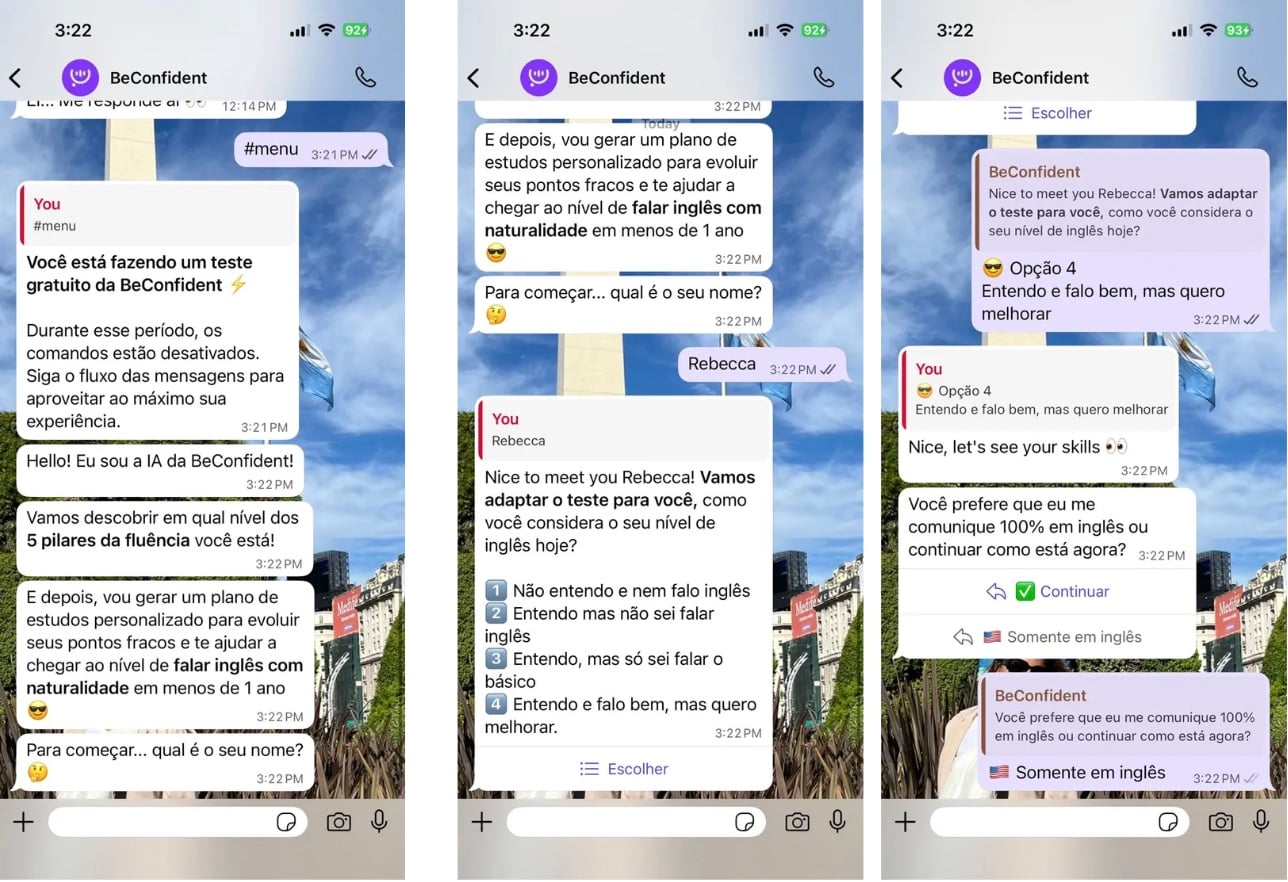
BeConfident organizes this process into learning tracks that combine explanation, guided practice, and immediate conversation. AI tutors adjust the level, correct mistakes in real-time, and maintain a judgment-free environment.
While many gamified apps prioritize "streaks" and points, BeConfident's proposal is to reinforce each grammatical concept through consistent conversational use.
Take a free trial and start learning English today with this methodology.
Why conversational practice makes grammar stick
Frequent conversational practice consolidates grammar because spaced and repeated exposure in varied contexts favors retention and converts passive knowledge into active use.
Traditional methods separate theory from practice. Many schools dedicate most of their class time to explanations and very little to conversation. Apps like Duolingo prioritize game elements instead of communicative fluency.
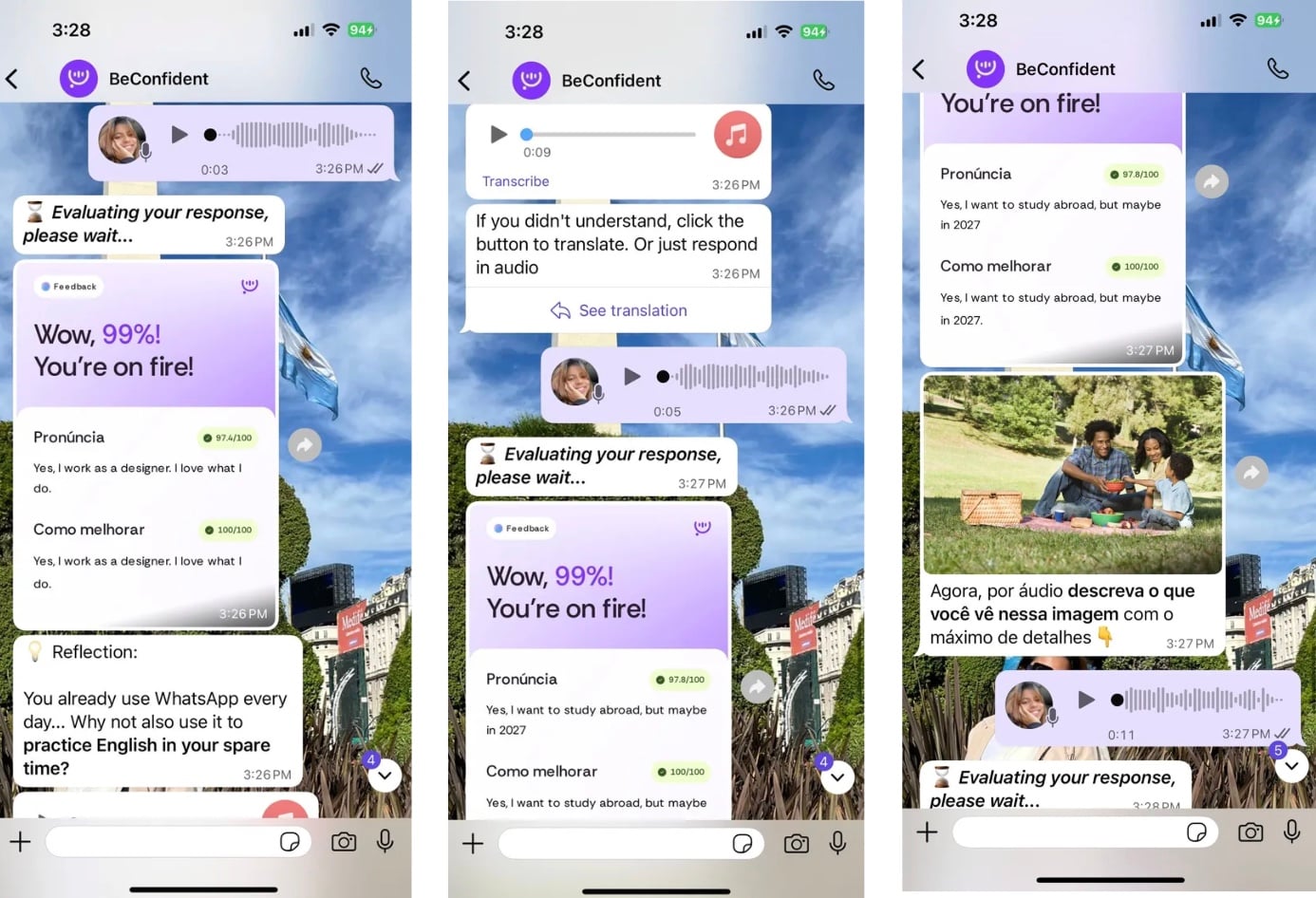
BeConfident flips this logic and offers AI-powered feedback on grammar and vocabulary while speaking.
This model tends to generate noticeable progress in weeks or a few months compared to approaches focused solely on theory.
BeConfident as a practical way to follow this grammatical order
BeConfident's AI tutors help turn theory into daily speech.
Structured CEFR tracks: follow the A1 and A2 order with a focus on immediate use.
Tutors with personality: practice with AIs that simulate native accents, such as American, British, and South African.
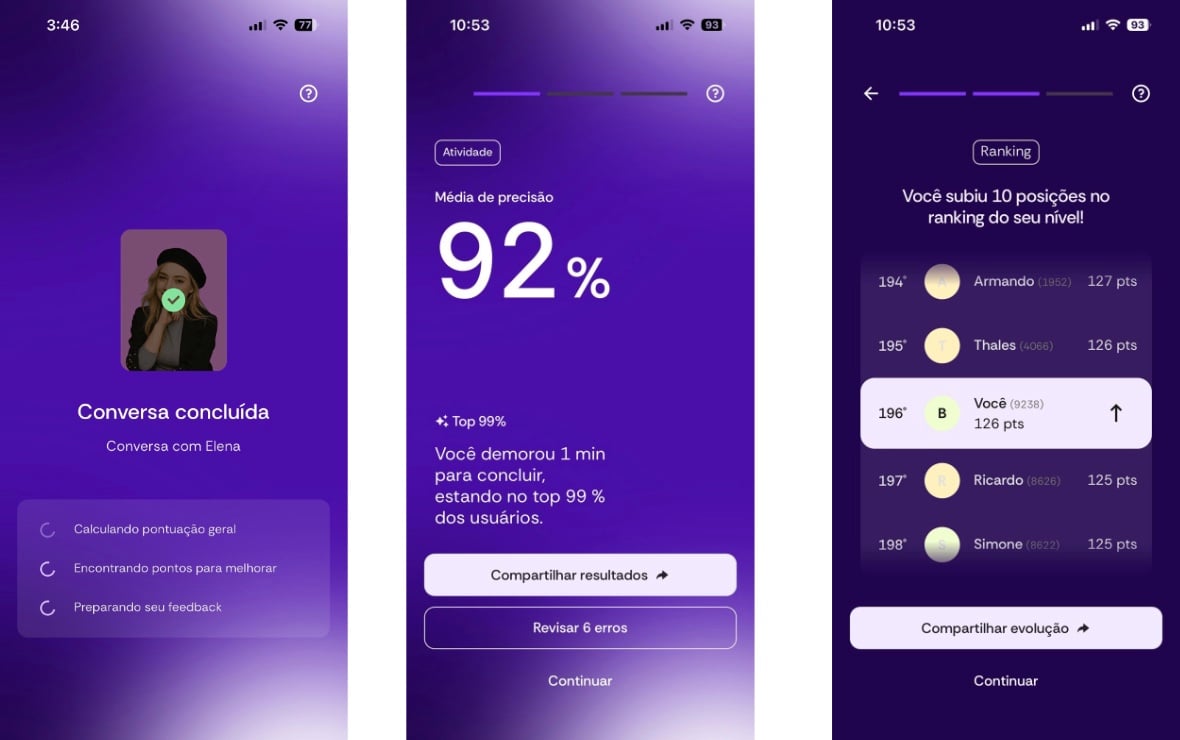
Review of mistakes: receive detailed feedback on grammar and pronunciation.
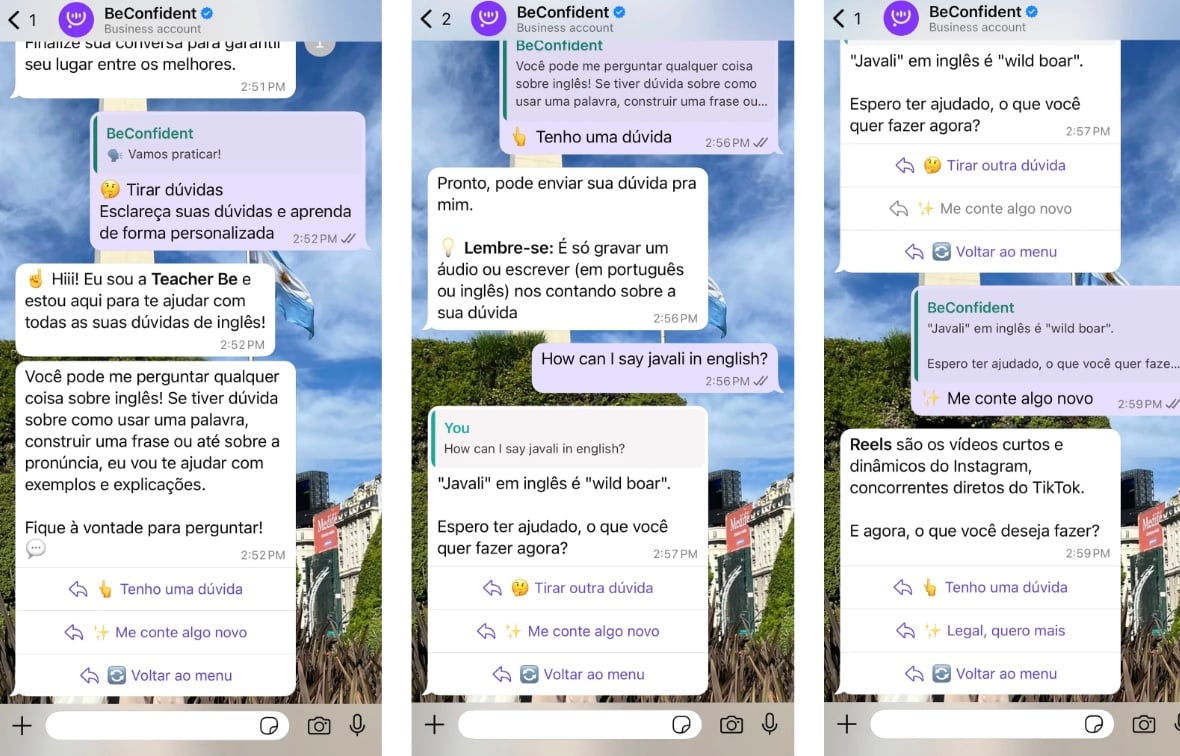
"I have a question" feature: send grammar questions at any time.
Free trial with analysis: identify your current level and areas for improvement.
More than 200,000 paying students, 3 million users, and an RA 1000 rating on Reclame Aqui indicate consistency in results.
Take the free trial at beconfident.app and evaluate how the methodology supports your fluency.
30-day plan for basic grammar with practice
Week | Grammar Topics | BeConfident Practice (15 min/day) |
1 and 2 | Verb "to be" with pronouns | Chat about personal routines |
3 and 4 | Present Simple with do/does | Conversations about work and hobbies |
5 and 6 | Past Simple and future | Sharing experiences and plans |
7 and 8 | Continuous and prepositions | Description of actions in progress |
Each week combines organized theory with conversation, promoting natural retention of concepts.
FAQ
What is the order to study English grammar?
The recommended order is: the verb "to be" with pronouns, Present Simple with auxiliaries do and does, basic past and future, and continuous tenses with connectors. This sequence aligned with CEFR A1 and A2 creates a progressive foundation. Conversational practice at each stage increases retention.
How to study English alone from scratch?
A simple routine includes 15 minutes of theory, 20 minutes of exercises, and 15 minutes of conversation per day. Resources that combine grammar with immediate oral practice tend to generate better results. Methods that separate theory and use reduce fluency.
Do I need a foundation in grammar to speak?
A minimal foundation in grammar helps, as long as it comes with practice. The four basic levels, with "to be"; Present Simple; past and future; and tenses like continuous, already offer enough structure for many conversational situations. Immediate application in real contexts is the central point.
What to study at the A1 level?
The A1 level includes the verb "to be", articles a, an, the, possessive pronouns, demonstratives, prepositions of place, and basic Present Simple. The focus is on personal introductions, simple descriptions, and routines. The goal is to perform basic interactions, like asking for directions and introducing oneself.
How to start English grammar for beginners?
The starting point is the verb "to be" with speaking practice from day one. Brazilians need special attention on adjective order, question structures, and the use of prepositions. Methods with real-time feedback and a judgment-free environment help build confidence.
Following this order to study English grammar from scratch, with constant conversational practice on BeConfident, increases the chances of developing fluency in less time. Take the free trial and start learning English today with AI tutors available 24 hours a day.
Written by: Luan Cavallaro, Founder & CMO, BeConfident
Key takeaways from this article
Start English grammar with the verb "to be" along with pronouns to build identity and basic descriptions, applying it in professional sentences from the beginning.
Master the Present Simple with do/does auxiliaries for routines and habits, paying attention to the "-s" rule in the third person.
Advance to basic past and future with will/going to, taking advantage of simpler conjugations compared to Portuguese.
Include tenses like the continuous and prepositions for actions in progress and everyday situations, keeping in mind the adjective-noun order which is different from Portuguese.
Integrate each topic with conversational practice using BeConfident, with a free trial and 24/7 AI tutors.
Correct order to study English grammar from scratch
A 4-level sequence makes studying English grammar from scratch easier and reduces the feeling of being overwhelmed by rules.
1. Verb "to be" with personal pronouns (weeks 1 and 2)
Start with am, is, and are for identity, location, and description. Examples: "I am an engineer" for work, "She is at the hotel" for travel, "We are ready for the meeting" for professional routine. In Portuguese, there are "ser" and "estar". In English, the verb "to be" covers both of these functions.
Quick exercise: complete: "I ___ Brazilian", "You ___ at home", "He ___ a doctor".
2. Present Simple with do/does auxiliaries (weeks 3 and 4)
Use the Present Simple for habits and facts, focusing on the "-s" rule in the third person. Examples: "I work every day", "She plays tennis on weekends", "Do you speak English?". Compared to Portuguese, verbs in English have fewer conjugation variations.
Quick exercise: turn into a question: "You like coffee" → "Do you like coffee?".
3. Basic past and future (weeks 5 and 6)
Use the Past Simple with "did" and the future with "will" or "going to". Examples: "I worked yesterday", "She will travel tomorrow", "We are going to study tonight". Portuguese has more verb tenses. In English, the structure is usually more straightforward.
Quick exercise: change to the past tense: "I eat breakfast" → "I ate breakfast".
4. Continuous with connectors and prepositions (weeks 7 and 8)
Use Present Continuous and Past Continuous with "-ing" and essential connectors. Examples: "I am working now", "She was studying when I called", "The meeting is on Monday at 3 PM". In English, adjectives come before the noun, as in "red car".
Quick exercise: complete with prepositions: "The book is ___ the table" (on), "I have class ___ 2 PM" (at).
This order prioritizes immediate application in conversation instead of focusing solely on theory.
What to study at the A1 level in English
The A1 level covers the first two levels of the sequence and focuses on essential vocabulary and simple structures to build confidence.
30-day timeline for A1:
Week 1: verb "to be" and personal introductions.
Week 2: articles a, an, the and possessive adjectives my, your.
Week 3: Present Simple for routines.
Week 4: demonstratives this, that and prepositions of place.
Key A1 milestones include introducing yourself, asking basic questions about location and family, and describing simple routines. The goal is to handle basic tasks like asking for directions or ordering food.
BeConfident's A1 tracks combine each grammatical topic with practical conversation so that the student uses the structures in speech, not just in written exercises.
How to start English grammar for beginners
Brazilians face specific challenges because of the differences between Portuguese and English.
Prepositions: Portuguese uses prepositions more frequently, which leads to interference. Incorrect example: "I am in the work". Correct form: "I am at work".
Adjective order: in Portuguese, the adjective usually comes after the noun, as in "carro vermelho". In English, it comes before, as in "red car".
Question structure: in Portuguese, the subject-verb-object order remains the same in many questions, changes being made just in intonation. In English, questions use auxiliaries and invert the word order.
Grammatical gender: English does not use gender in nouns, which simplifies things compared to Portuguese, which requires agreement.
A good practice for independent study is to create sentences with each structure in real-life situations. Instead of just repeating "Do you like...?", use variations like "Do you like your job?" and "Do you like traveling?".
Order to study English from scratch on your own
An efficient self-study routine combines the grammar sequence with a clear daily structure.
Suggested daily structure:
15 minutes: theory of the current topic, such as Present Simple.
20 minutes: written exercises focusing on complete sentences.
15 minutes: conversation applying the daily topic.
BeConfident organizes this process into learning tracks that combine explanation, guided practice, and immediate conversation. AI tutors adjust the level, correct mistakes in real-time, and maintain a judgment-free environment.
While many gamified apps prioritize "streaks" and points, BeConfident's proposal is to reinforce each grammatical concept through consistent conversational use.
Take a free trial and start learning English today with this methodology.
Why conversational practice makes grammar stick
Frequent conversational practice consolidates grammar because spaced and repeated exposure in varied contexts favors retention and converts passive knowledge into active use.
Traditional methods separate theory from practice. Many schools dedicate most of their class time to explanations and very little to conversation. Apps like Duolingo prioritize game elements instead of communicative fluency.
BeConfident flips this logic and offers AI-powered feedback on grammar and vocabulary while speaking.
This model tends to generate noticeable progress in weeks or a few months compared to approaches focused solely on theory.
BeConfident as a practical way to follow this grammatical order
BeConfident's AI tutors help turn theory into daily speech.
Structured CEFR tracks: follow the A1 and A2 order with a focus on immediate use.
Tutors with personality: practice with AIs that simulate native accents, such as American, British, and South African.
Review of mistakes: receive detailed feedback on grammar and pronunciation.
"I have a question" feature: send grammar questions at any time.
Free trial with analysis: identify your current level and areas for improvement.
More than 200,000 paying students, 3 million users, and an RA 1000 rating on Reclame Aqui indicate consistency in results.
Take the free trial at beconfident.app and evaluate how the methodology supports your fluency.
30-day plan for basic grammar with practice
Week | Grammar Topics | BeConfident Practice (15 min/day) |
1 and 2 | Verb "to be" with pronouns | Chat about personal routines |
3 and 4 | Present Simple with do/does | Conversations about work and hobbies |
5 and 6 | Past Simple and future | Sharing experiences and plans |
7 and 8 | Continuous and prepositions | Description of actions in progress |
Each week combines organized theory with conversation, promoting natural retention of concepts.
FAQ
What is the order to study English grammar?
The recommended order is: the verb "to be" with pronouns, Present Simple with auxiliaries do and does, basic past and future, and continuous tenses with connectors. This sequence aligned with CEFR A1 and A2 creates a progressive foundation. Conversational practice at each stage increases retention.
How to study English alone from scratch?
A simple routine includes 15 minutes of theory, 20 minutes of exercises, and 15 minutes of conversation per day. Resources that combine grammar with immediate oral practice tend to generate better results. Methods that separate theory and use reduce fluency.
Do I need a foundation in grammar to speak?
A minimal foundation in grammar helps, as long as it comes with practice. The four basic levels, with "to be"; Present Simple; past and future; and tenses like continuous, already offer enough structure for many conversational situations. Immediate application in real contexts is the central point.
What to study at the A1 level?
The A1 level includes the verb "to be", articles a, an, the, possessive pronouns, demonstratives, prepositions of place, and basic Present Simple. The focus is on personal introductions, simple descriptions, and routines. The goal is to perform basic interactions, like asking for directions and introducing oneself.
How to start English grammar for beginners?
The starting point is the verb "to be" with speaking practice from day one. Brazilians need special attention on adjective order, question structures, and the use of prepositions. Methods with real-time feedback and a judgment-free environment help build confidence.
Following this order to study English grammar from scratch, with constant conversational practice on BeConfident, increases the chances of developing fluency in less time. Take the free trial and start learning English today with AI tutors available 24 hours a day.