




How to overcome the fear of speaking English while traveling?
How to overcome the fear of speaking English while traveling?
How to overcome the fear of speaking English while traveling?
Written by: Luan Cavallaro, Founder & CMO, BeConfident
Key takeaways from this article
Accept errors as part of the learning process and change your mindset: the focus is on being understood, not being perfect.
Keep a kit of essential phrases for common situations such as airports, hotels, and restaurants to gain immediate safety.
Practice daily with AI tutors to simulate real travel scenarios, receiving instant feedback on pronunciation and grammar.
Expose yourself to different accents and slang with consistent practice, tracking your evolution to maintain motivation.
Use BeConfident for unlimited 24/7 practice and shed the shyness for good: start your practice with no commitment.
8 steps to overcome the shyness of speaking English on a trip
1. Accept errors and change your mindset
Overcoming the shyness of speaking English begins with the idea that you don't need to speak perfect English. The main goal is to be understood, because people care more about your message than flawless grammar.
Furthermore, mistakes serve as proof of learning, as even native speakers make errors daily.
To put this mindset shift into practice, it is worth using simple techniques before speaking English. Practice breathing and visualization exercises before conversation situations. These exercises reduce immediate anxiety and help you focus on communication rather than worrying about every mistake, which is often more useful than just studying for exams.
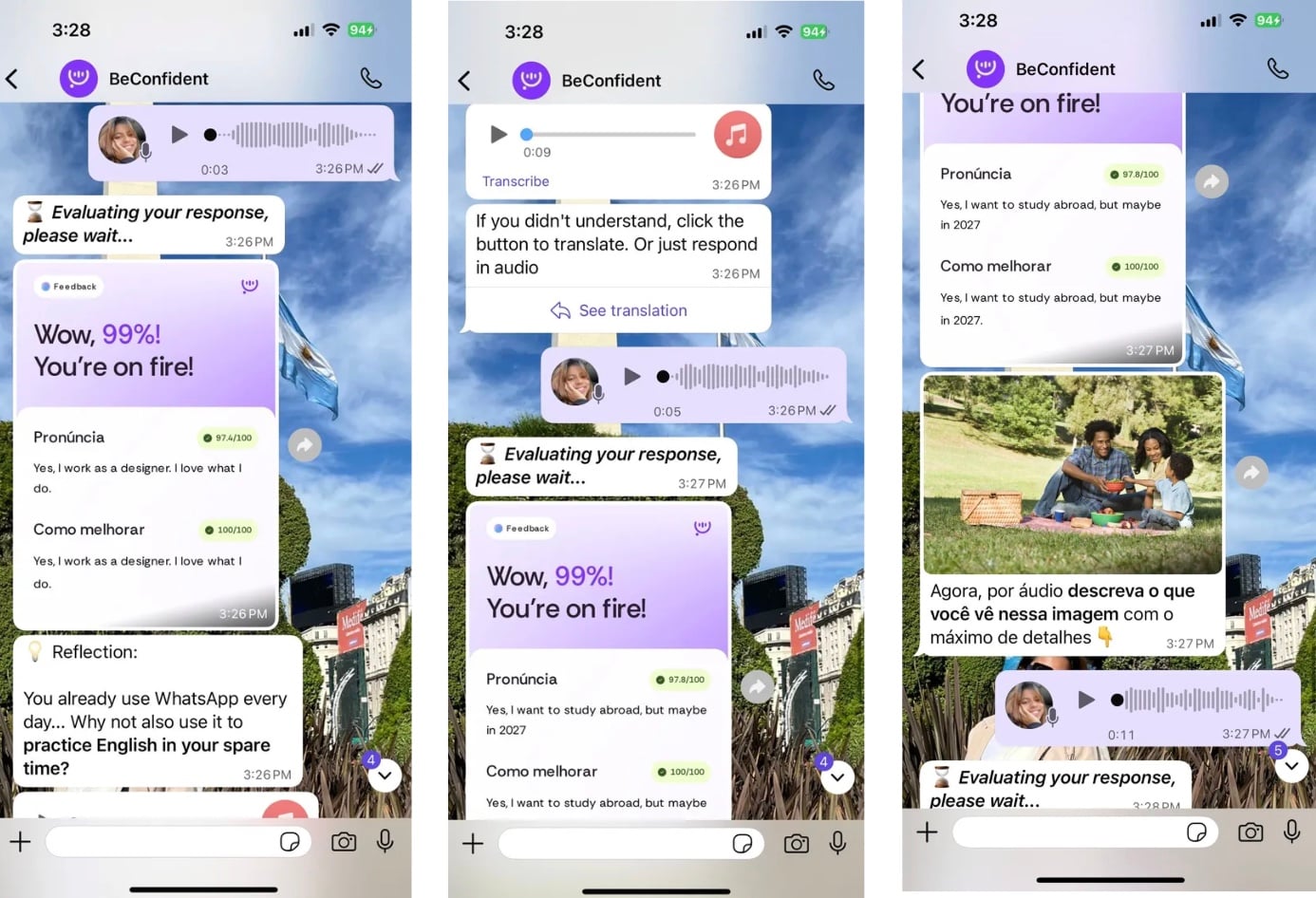
BeConfident offers a suitable environment for this practice, with AI tutors who do not judge your mistakes. This allows you to build confidence gradually before facing real travel situations.
2. Build your kit of essential travel phrases
Having a repertoire of ready-made phrases increases the feeling of security during the trip. Here are some essential expressions organized by situation.
General survival phrases: "Excuse me", "Could you help me, please?", "I don't understand", "Could you repeat that?", "How much does this cost?", "Where is the bathroom?".
At the airport: "Where is the check-in counter?", "I'd like a window seat, please", "Where is gate number...?", "Has the flight been delayed?".
At the hotel: "I have a reservation under...", "What time is checkout?", "The WiFi isn't working in my room", "Could you recommend a good restaurant nearby?".
At the restaurant: "A table for two, please", "What do you recommend?", "I'm allergic to...", "Could I have the check, please?".
3. Practice alone with focused daily exercises
Individual practice helps unlock speech, even with limitations. You can talk to yourself in front of the mirror, record audio to listen to later, or repeat dialogues from movies and TV series. These exercises strengthen the speech muscles and increase familiarity with the sounds of English.
Distributed practice, with sessions spaced out over time, favors phonetic learning and is usually more effective than concentrated practice on a single day.
Despite these benefits of spaced practice, the main drawback of solo practice is the lack of immediate feedback and error correction. Therefore, it is worth complementing these exercises with tools that offer instant feedback on pronunciation and grammar.
4. Train with AI for real travel scenarios
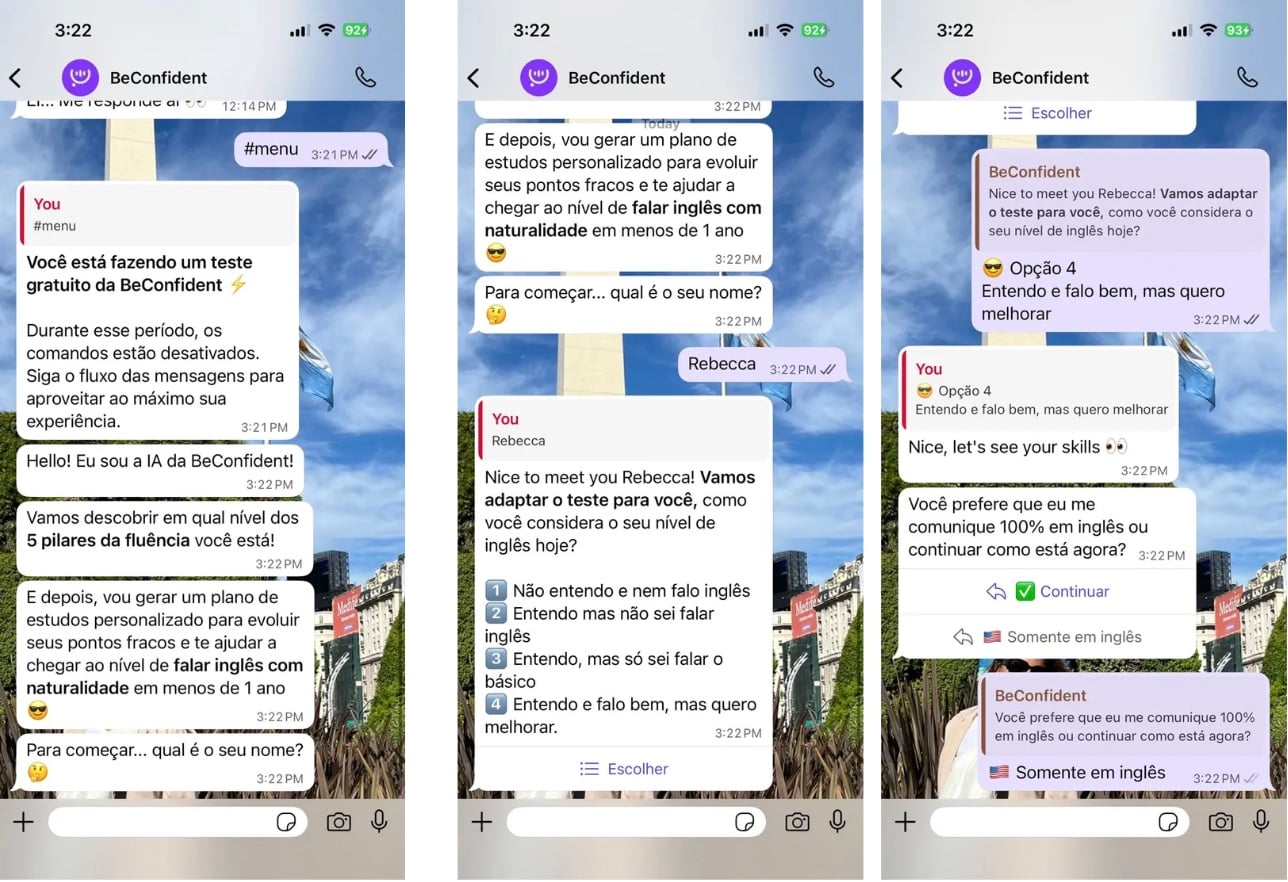
These instant-feedback tools play a major role in artificial intelligence practice, which has transformed language learning for travelers. BeConfident offers AI tutors with different native accents, such as American, British, and South African, as well as specific personalities, allowing you to practice real travel scenarios 24 hours a day.
You can simulate immigration conversations, price negotiations in markets, restaurant orders, or emergency situations. The central point lies in the immediate feedback on pronunciation and grammar, something that traditional solo practice does not offer.
Flexibility also helps maintain the routine. You can practice via the app, WhatsApp, or smartwatch, integrating learning into your daily life without depending on fixed schedules like in traditional schools.
Try the AI tutors for free and practice your travel scenarios now, with CEFR analysis of your current level.
5. Simulate travel conversations with ready-to-use dialogues
Using structured dialogues for specific situations increases confidence when speaking. The five golden phrases of polite travel conversation include "Excuse me", "I don't understand", "Could you please speak slowly?", "Thank you so much", and "Where is the...?"
Dialogue at the airport:
Officer: "Purpose of your visit?"
You: "Tourism. I'm here for vacation."
Officer: "How long will you stay?"
You: "Two weeks."
Officer: "Where will you be staying?"
You: "At the Marriott Hotel downtown."
Dialogue in the taxi:
You: "Could you take me to this address, please?" (showing on phone)
Driver: "Sure, it will take about 20 minutes."
You: "How much will it cost approximately?"
Driver: "Around 25 dollars."
You: "Thank you, that is fine."
It is worth repeating these dialogues until the phrases come out naturally. Pause to think, go back when necessary, and prioritize clarity in communication.
6. Dealing with accents and slang on the trip
The diversity of accents and local expressions is usually one of the biggest challenges for foreigners on trips. Gamified apps like Duolingo typically present a standardized version of English, but exposure to different accents is essential to understand what people really say.
BeConfident addresses this point with AI tutors using authentic accents from different countries. You can practice with an American tutor in the morning, a British tutor in the afternoon, and an Australian tutor at night, broadening your preparation for various destinations.
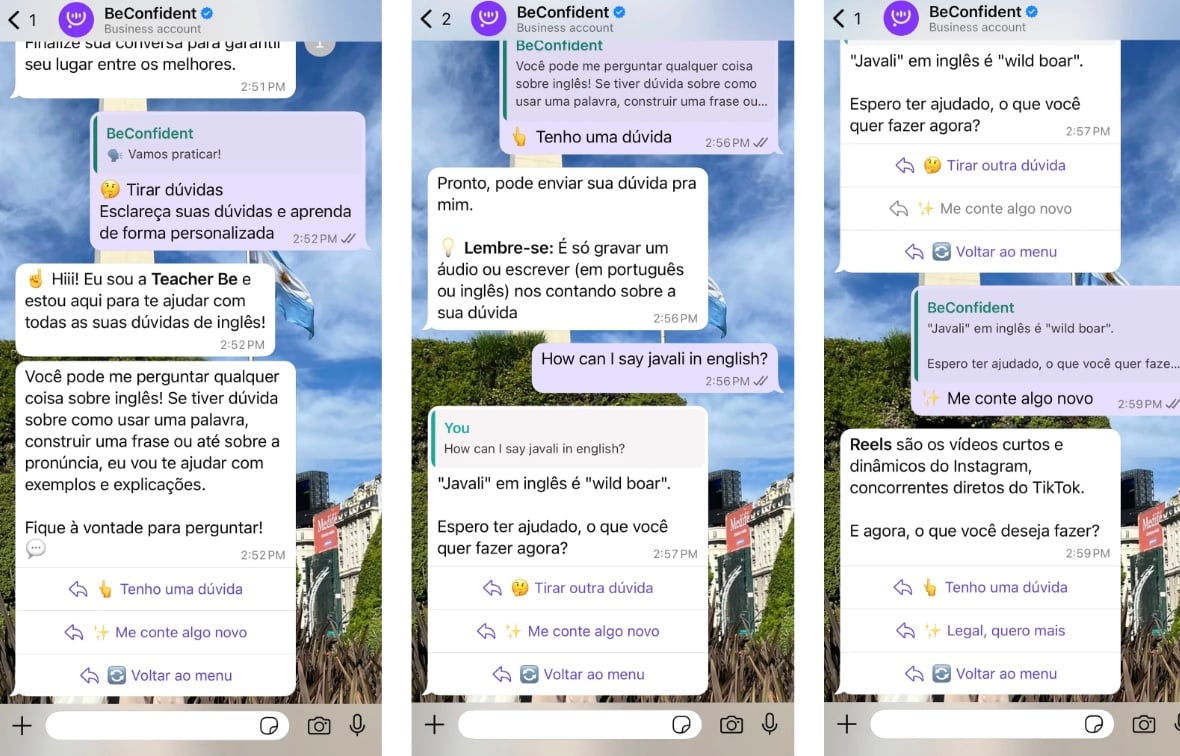
Tutors also use slang and typical expressions from each region, which is rare in traditional teaching methods. This prior exposure reduces linguistic shock during the trip.
7. Track your progress and maintain consistency
Tracking your own progress helps maintain motivation and discipline. BeConfident offers a monitoring system in the My Progress Menu, where you can see your consecutive days of practice, position on the list, accumulated practice hours, and certificates earned.
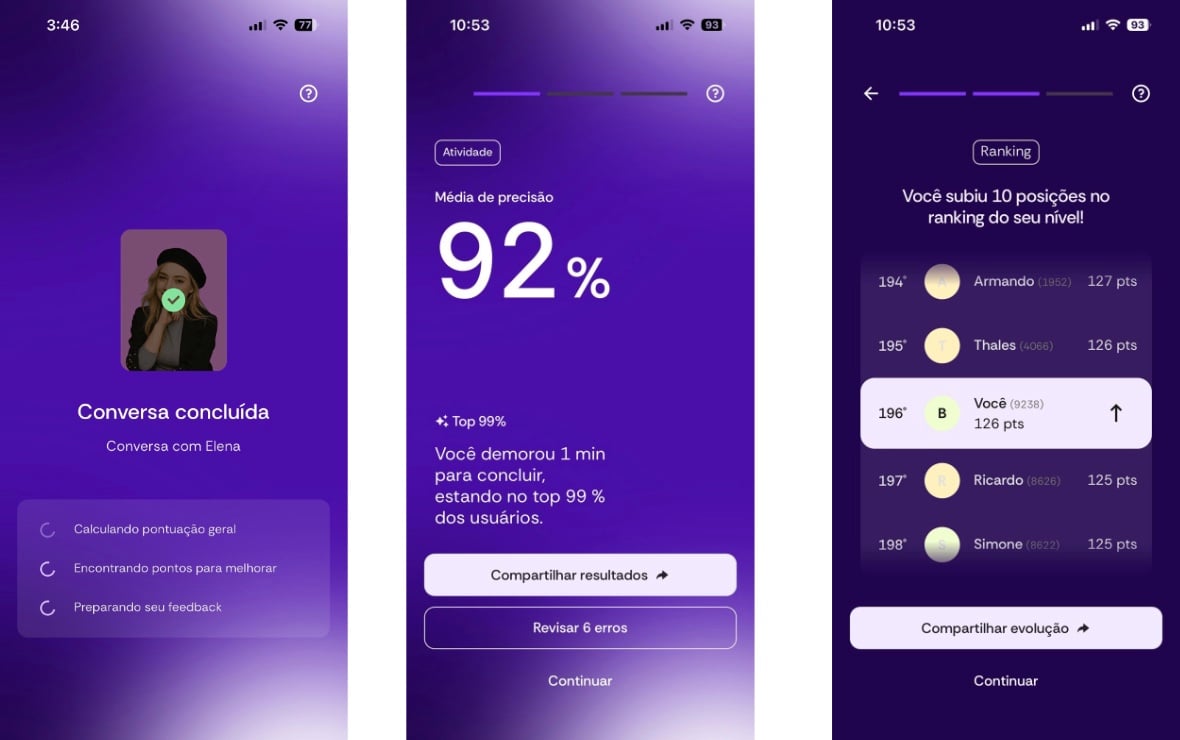
With over 200,000 paying students and 3 million total users, BeConfident maintains an RA 1000 reputation on Reclame Aqui, which reinforces the consistency of the methodology. The gamification system aims to encourage daily practice without focusing solely on superficial rewards.
A realistic goal is to reserve 15 minutes daily for conversation focused on travel scenarios. Regularity yields better results than long, sporadic sessions.
8. Use tips during the trip: gestures, support apps, and continuous practice
During the trip, it is worth combining prior preparation with support tools. Having Google Translate installed helps in emergencies, but the ideal is to use the app as a last resort. Gestures and mime also help, although the goal is to develop linguistic independence.
Maintaining practice even during the trip consolidates what you have studied. Use free moments in the hotel or on transport to review the day's conversations with BeConfident's AI tutors. This review reinforces learning and prepares you for similar situations in the following days.
Asking someone to speak slower is not impolite in travel interactions, so use "Could you speak a bit more slowly, please?" whenever you need to.
Comparison: BeConfident vs. other methods
Method | Conversational practice | Cost/Accessibility | Instant feedback |
|---|---|---|---|
BeConfident | Unlimited with 24/7 AI, personalized | Affordable, app/WhatsApp | Pronunciation and grammar |
Traditional schools | Fixed schedules, limited practice | High cost, low flexibility | Limited feedback |
Duolingo | Basic gamification | Low cost, but superficial content | Basic feedback |
Cambly | Conversations with humans paid hourly | High cost per use | Variable quality |
Practical implementation
Applying this guide day-to-day is simpler with a clear checklist. Reserve 15 minutes for conversation with BeConfident's AI tutors, focus on specific scenarios of your next trip, review and practice the mistakes highlighted in the feedback, and keep a notebook with newly learned phrases.
Starting today yields better results than waiting for the trip to approach. Practice distributed over time is significantly more effective than intensive sessions concentrated in just a few days.
Frequently Asked Questions
How to practice English for travel efficiently?
An efficient way is to combine studying essential phrases with daily conversational practice using AI tutors. Focus on specific scenarios of your trip, such as airport, hotel, and restaurant, and practice real dialogues with instant feedback. Dedicate at least 15 minutes daily to conversation and prioritize consistency over long and rare sessions. Use apps that offer different accents to prepare for various destinations.
How long does it take to lose the shyness to speak English?
With consistent daily practice, many people start to feel more confident in 2 to 4 weeks. The exact time varies depending on the current level, frequency of practice, and the method used. Practice with AI tutors usually accelerates this process because it creates a judgment-free environment where you can make mistakes freely. The central point is to maintain regularity, as 15 minutes a day tend to generate more results than 2 hours once a week.
Does BeConfident really work for travel preparation?
BeConfident tends to work well for travelers because it offers practice with AI tutors who simulate different accents, such as American, British, and Australian, and real travel scenarios. You can train for specific situations like going through immigration, ordering in restaurants, or asking for directions. With the user base and reputation mentioned earlier, the platform demonstrates efficacy through concrete student results.
What is the difference between BeConfident and Duolingo for travel?
The main difference lies in the focus of each tool. While Duolingo prioritizes gamification and basic vocabulary lessons to maintain streaks, BeConfident concentrates the effort on fluent conversation. For travel, the main need is to practice real dialogues, and not just translate isolated phrases. BeConfident offers AI tutors with diverse personalities and accents, instant feedback on pronunciation, and the possibility to practice 24/7 via the app, WhatsApp, or smartwatch.
What if I freeze at immigration even after studying?
Having emergency phrases ready helps deal with this moment. Use options like "Could you repeat that slowly, please?" or "I'm sorry, I don't understand. Could you speak more slowly?". Immigration officers are used to dealing with people who do not speak fluent English. Keep documents organized and recall basic memorized answers, such as purpose of travel, length of stay, and place of accommodation. If you need, show the information on your phone or paper. Staying calm and remembering that making mistakes is normal makes communication easier.
Conclusion
Overcoming the shyness of speaking English on a trip depends on strategic preparation and consistent practice. The 8 steps in this guide outline a direct path, from changing mindset to practicing with AI tutors, building a repertoire of essential phrases, and simulating real scenarios.
BeConfident stands out for Brazilian travelers by offering unlimited conversational practice, tutors with different accents, instant feedback, and total scheduling flexibility. With thousands of students proving the effectiveness of the methodology, you can develop the necessary confidence to get the most out of your international travels.
Try BeConfident for free and start practicing your travel scenarios today, reducing language barriers and speaking English with more confidence.
Written by: Luan Cavallaro, Founder & CMO, BeConfident
Key takeaways from this article
Accept errors as part of the learning process and change your mindset: the focus is on being understood, not being perfect.
Keep a kit of essential phrases for common situations such as airports, hotels, and restaurants to gain immediate safety.
Practice daily with AI tutors to simulate real travel scenarios, receiving instant feedback on pronunciation and grammar.
Expose yourself to different accents and slang with consistent practice, tracking your evolution to maintain motivation.
Use BeConfident for unlimited 24/7 practice and shed the shyness for good: start your practice with no commitment.
8 steps to overcome the shyness of speaking English on a trip
1. Accept errors and change your mindset
Overcoming the shyness of speaking English begins with the idea that you don't need to speak perfect English. The main goal is to be understood, because people care more about your message than flawless grammar.
Furthermore, mistakes serve as proof of learning, as even native speakers make errors daily.
To put this mindset shift into practice, it is worth using simple techniques before speaking English. Practice breathing and visualization exercises before conversation situations. These exercises reduce immediate anxiety and help you focus on communication rather than worrying about every mistake, which is often more useful than just studying for exams.
BeConfident offers a suitable environment for this practice, with AI tutors who do not judge your mistakes. This allows you to build confidence gradually before facing real travel situations.
2. Build your kit of essential travel phrases
Having a repertoire of ready-made phrases increases the feeling of security during the trip. Here are some essential expressions organized by situation.
General survival phrases: "Excuse me", "Could you help me, please?", "I don't understand", "Could you repeat that?", "How much does this cost?", "Where is the bathroom?".
At the airport: "Where is the check-in counter?", "I'd like a window seat, please", "Where is gate number...?", "Has the flight been delayed?".
At the hotel: "I have a reservation under...", "What time is checkout?", "The WiFi isn't working in my room", "Could you recommend a good restaurant nearby?".
At the restaurant: "A table for two, please", "What do you recommend?", "I'm allergic to...", "Could I have the check, please?".
3. Practice alone with focused daily exercises
Individual practice helps unlock speech, even with limitations. You can talk to yourself in front of the mirror, record audio to listen to later, or repeat dialogues from movies and TV series. These exercises strengthen the speech muscles and increase familiarity with the sounds of English.
Distributed practice, with sessions spaced out over time, favors phonetic learning and is usually more effective than concentrated practice on a single day.
Despite these benefits of spaced practice, the main drawback of solo practice is the lack of immediate feedback and error correction. Therefore, it is worth complementing these exercises with tools that offer instant feedback on pronunciation and grammar.
4. Train with AI for real travel scenarios
These instant-feedback tools play a major role in artificial intelligence practice, which has transformed language learning for travelers. BeConfident offers AI tutors with different native accents, such as American, British, and South African, as well as specific personalities, allowing you to practice real travel scenarios 24 hours a day.
You can simulate immigration conversations, price negotiations in markets, restaurant orders, or emergency situations. The central point lies in the immediate feedback on pronunciation and grammar, something that traditional solo practice does not offer.
Flexibility also helps maintain the routine. You can practice via the app, WhatsApp, or smartwatch, integrating learning into your daily life without depending on fixed schedules like in traditional schools.
Try the AI tutors for free and practice your travel scenarios now, with CEFR analysis of your current level.
5. Simulate travel conversations with ready-to-use dialogues
Using structured dialogues for specific situations increases confidence when speaking. The five golden phrases of polite travel conversation include "Excuse me", "I don't understand", "Could you please speak slowly?", "Thank you so much", and "Where is the...?"
Dialogue at the airport:
Officer: "Purpose of your visit?"
You: "Tourism. I'm here for vacation."
Officer: "How long will you stay?"
You: "Two weeks."
Officer: "Where will you be staying?"
You: "At the Marriott Hotel downtown."
Dialogue in the taxi:
You: "Could you take me to this address, please?" (showing on phone)
Driver: "Sure, it will take about 20 minutes."
You: "How much will it cost approximately?"
Driver: "Around 25 dollars."
You: "Thank you, that is fine."
It is worth repeating these dialogues until the phrases come out naturally. Pause to think, go back when necessary, and prioritize clarity in communication.
6. Dealing with accents and slang on the trip
The diversity of accents and local expressions is usually one of the biggest challenges for foreigners on trips. Gamified apps like Duolingo typically present a standardized version of English, but exposure to different accents is essential to understand what people really say.
BeConfident addresses this point with AI tutors using authentic accents from different countries. You can practice with an American tutor in the morning, a British tutor in the afternoon, and an Australian tutor at night, broadening your preparation for various destinations.
Tutors also use slang and typical expressions from each region, which is rare in traditional teaching methods. This prior exposure reduces linguistic shock during the trip.
7. Track your progress and maintain consistency
Tracking your own progress helps maintain motivation and discipline. BeConfident offers a monitoring system in the My Progress Menu, where you can see your consecutive days of practice, position on the list, accumulated practice hours, and certificates earned.
With over 200,000 paying students and 3 million total users, BeConfident maintains an RA 1000 reputation on Reclame Aqui, which reinforces the consistency of the methodology. The gamification system aims to encourage daily practice without focusing solely on superficial rewards.
A realistic goal is to reserve 15 minutes daily for conversation focused on travel scenarios. Regularity yields better results than long, sporadic sessions.
8. Use tips during the trip: gestures, support apps, and continuous practice
During the trip, it is worth combining prior preparation with support tools. Having Google Translate installed helps in emergencies, but the ideal is to use the app as a last resort. Gestures and mime also help, although the goal is to develop linguistic independence.
Maintaining practice even during the trip consolidates what you have studied. Use free moments in the hotel or on transport to review the day's conversations with BeConfident's AI tutors. This review reinforces learning and prepares you for similar situations in the following days.
Asking someone to speak slower is not impolite in travel interactions, so use "Could you speak a bit more slowly, please?" whenever you need to.
Comparison: BeConfident vs. other methods
Method | Conversational practice | Cost/Accessibility | Instant feedback |
|---|---|---|---|
BeConfident | Unlimited with 24/7 AI, personalized | Affordable, app/WhatsApp | Pronunciation and grammar |
Traditional schools | Fixed schedules, limited practice | High cost, low flexibility | Limited feedback |
Duolingo | Basic gamification | Low cost, but superficial content | Basic feedback |
Cambly | Conversations with humans paid hourly | High cost per use | Variable quality |
Practical implementation
Applying this guide day-to-day is simpler with a clear checklist. Reserve 15 minutes for conversation with BeConfident's AI tutors, focus on specific scenarios of your next trip, review and practice the mistakes highlighted in the feedback, and keep a notebook with newly learned phrases.
Starting today yields better results than waiting for the trip to approach. Practice distributed over time is significantly more effective than intensive sessions concentrated in just a few days.
Frequently Asked Questions
How to practice English for travel efficiently?
An efficient way is to combine studying essential phrases with daily conversational practice using AI tutors. Focus on specific scenarios of your trip, such as airport, hotel, and restaurant, and practice real dialogues with instant feedback. Dedicate at least 15 minutes daily to conversation and prioritize consistency over long and rare sessions. Use apps that offer different accents to prepare for various destinations.
How long does it take to lose the shyness to speak English?
With consistent daily practice, many people start to feel more confident in 2 to 4 weeks. The exact time varies depending on the current level, frequency of practice, and the method used. Practice with AI tutors usually accelerates this process because it creates a judgment-free environment where you can make mistakes freely. The central point is to maintain regularity, as 15 minutes a day tend to generate more results than 2 hours once a week.
Does BeConfident really work for travel preparation?
BeConfident tends to work well for travelers because it offers practice with AI tutors who simulate different accents, such as American, British, and Australian, and real travel scenarios. You can train for specific situations like going through immigration, ordering in restaurants, or asking for directions. With the user base and reputation mentioned earlier, the platform demonstrates efficacy through concrete student results.
What is the difference between BeConfident and Duolingo for travel?
The main difference lies in the focus of each tool. While Duolingo prioritizes gamification and basic vocabulary lessons to maintain streaks, BeConfident concentrates the effort on fluent conversation. For travel, the main need is to practice real dialogues, and not just translate isolated phrases. BeConfident offers AI tutors with diverse personalities and accents, instant feedback on pronunciation, and the possibility to practice 24/7 via the app, WhatsApp, or smartwatch.
What if I freeze at immigration even after studying?
Having emergency phrases ready helps deal with this moment. Use options like "Could you repeat that slowly, please?" or "I'm sorry, I don't understand. Could you speak more slowly?". Immigration officers are used to dealing with people who do not speak fluent English. Keep documents organized and recall basic memorized answers, such as purpose of travel, length of stay, and place of accommodation. If you need, show the information on your phone or paper. Staying calm and remembering that making mistakes is normal makes communication easier.
Conclusion
Overcoming the shyness of speaking English on a trip depends on strategic preparation and consistent practice. The 8 steps in this guide outline a direct path, from changing mindset to practicing with AI tutors, building a repertoire of essential phrases, and simulating real scenarios.
BeConfident stands out for Brazilian travelers by offering unlimited conversational practice, tutors with different accents, instant feedback, and total scheduling flexibility. With thousands of students proving the effectiveness of the methodology, you can develop the necessary confidence to get the most out of your international travels.
Try BeConfident for free and start practicing your travel scenarios today, reducing language barriers and speaking English with more confidence.