




8 platforms for English grammar and fluency in 2026
8 platforms for English grammar and fluency in 2026
8 platforms for English grammar and fluency in 2026
Written by: Luan Cavallaro, Founder & CMO, BeConfident
Key takeaways from this article
Integrating grammar into daily conversation with AI feedback accelerates the practical application of rules in real-world contexts.
Practicing prepositions and irregular plurals in real dialogues fixes common mistakes naturally.
Mastering verb tenses and verbs of appearance through personal narratives and history review automates correct patterns.
Applying grammar in professional and travel topics with specialized tutors improves contextualized fluency.
BeConfident offers the complete solution with personalized AI for instant correction and unlimited conversation; take the free test now.
8 strategies and platforms to combine correct grammar and English fluency
1. Integrate grammar into daily conversation with AI feedback
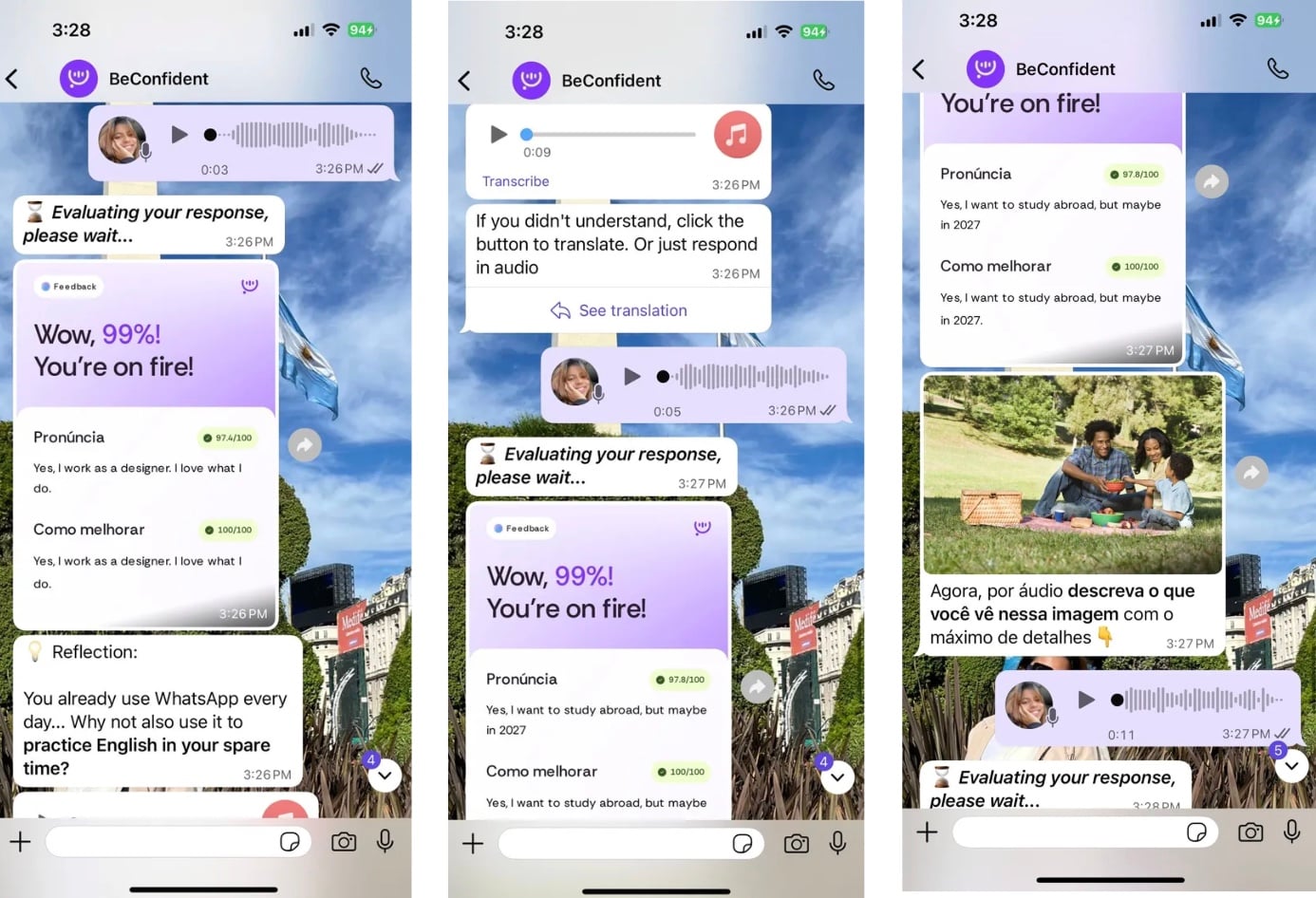
BeConfident corrects grammatical errors during natural conversations with AI tutors. Instead of separating theory and practice, the student learns grammar applied in real contexts.
The AI tutors identify and correct common mistakes made by Portuguese speakers, such as "commit a mistake" instead of "make a mistake", instantly and without judgment. The student can converse via text, audio, or simulated calls in the app or WhatsApp, with corrections adapted to their current level.
Practical steps:
Choose your tutor: select an AI tutor with a personality aligned with your interests.
Day-to-day conversations: talk about your routine, not just textbook topics.
Immediate application: use the corrections you receive in new sentences within the same conversation.
Review errors: check your error history to reinforce learning throughout the week.
2. Practice prepositions in real dialogues
Prepositions generate many errors, especially the confusion between "in" and "on" for days of the week. Making the mistake of saying "in Monday" instead of "on Monday" is extremely common and affects the natural flow of speech.
Apps like BeConfident use AI to teach prepositions in short, practical dialogues. The key difference is practicing prepositions within full sentences, not in isolation. Instead of memorizing rules, the student practices sentences like "I have a meeting on Monday morning" in simulated conversations.
Practical steps:
Identify difficulties: list the prepositions that cause you the most confusion.
Real sentences: create sentences using daily situations, like work, studies, and leisure.
Practice with AI: use these sentences in conversations with AI and repeat them until they sound natural.
Targeted correction: ask for specific corrections whenever you use prepositions incorrectly.
3. Correct irregular plurals with oral repetition
Irregular plurals like "people" or "phenomena" confuse many learners. Mistakes such as using "campy" as the plural of "campus" appear frequently and reveal a lack of oral practice in context.
Memorizing isolated lists has little effect. Real progress comes from using irregular plurals in spoken sentences. When the student repeats "There are many people here" in different situations, the brain starts to recognize the correct form automatically.
Practical steps:
Short list: select about 10 irregular plurals that appear in your routine.
Personal sentences: create sentences that speak about your life, work, and interests.
Repeat out loud: repeat these sentences daily, out loud.
Validation with AI: use the sentences in conversations with AI and adjust your pronunciation and grammar with the feedback.
4. Master verb tenses with personal narratives
Many face difficulties with mixing verb tenses when telling stories, especially with "since" and "for". The confusion between "since" (starting point) and "for" (duration) breaks fluency and makes speech less natural.
BeConfident offers structured tracks that work on verb tenses in personal narratives. The student practices the Present Perfect with real stories, such as "I have lived here for 5 years" and "I have lived here since 2019".
Practical steps:
Choose the verb tense: select a verb tense that causes you the most mistakes.
Real story: tell a personal experience using that verb tense.
Recording: record your story in audio or video.
Correction and repetition: identify errors with the help of AI and repeat until the pattern becomes automatic.
Use grammar in real stories and not just in exercises. Try a free test with our AI and see how this accelerates your fluency. Try it for free and start learning English today.
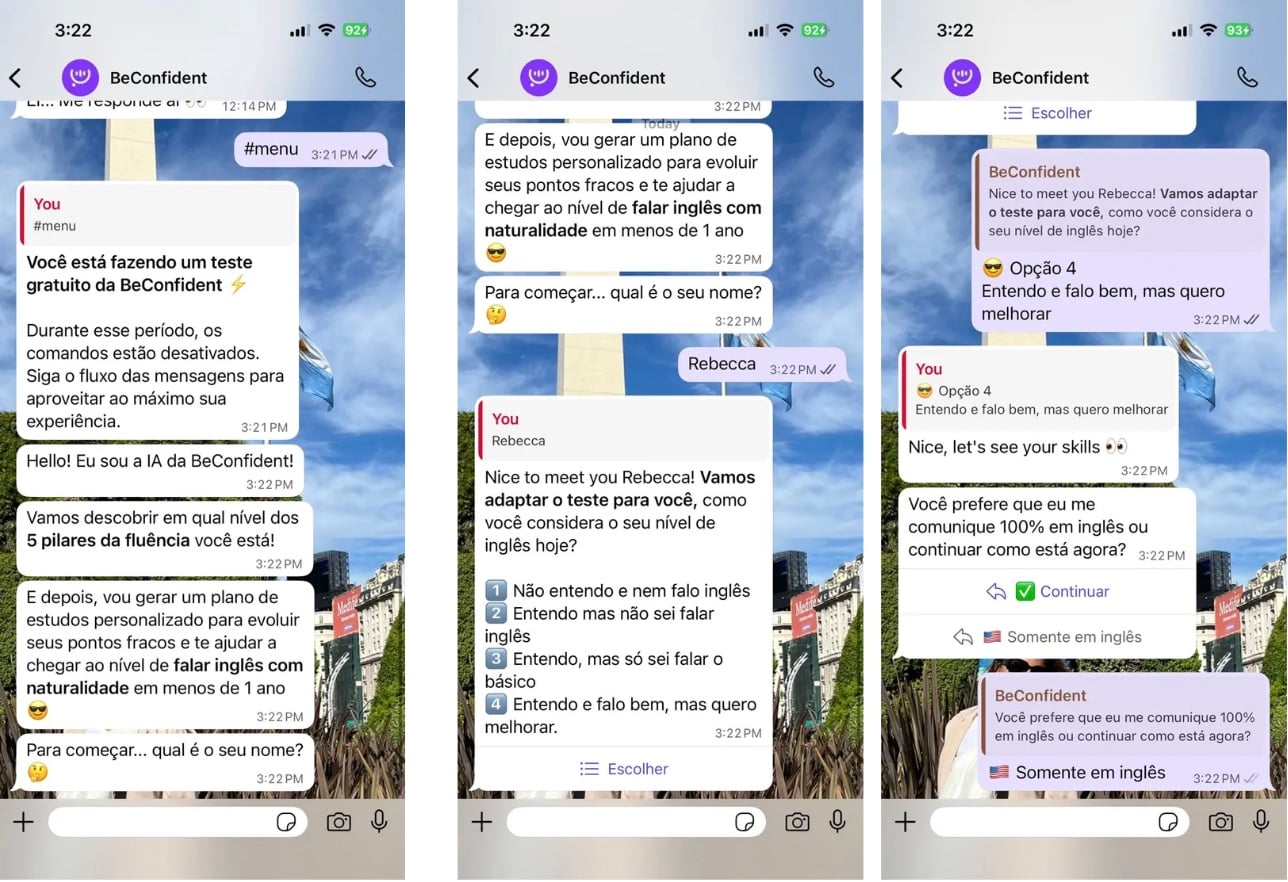
5. Use AI for verbs of appearance and complex expressions
Verbs like "look", "sound", and "seem" follow specific rules that many learners ignore. The presence or absence of "like" is a recurring mistake: "you look mad" (without like) and "you sound like your brother" (with like).
While ChatGPT allows customization with detailed instructions, BeConfident adapts corrections to the student's error history and goals. The AI identifies phrases like "You look like tired" instead of "You look tired" and explains the rule in the exact context where the error occurred.
Practical steps:
List of structures: write down common combinations with "look", "sound", and "seem".
Daily practice: create and speak new sentences every day using these verbs.
Test with AI: send the sentences to the AI and ask for detailed correction.
Conscious reuse: apply the corrections in new conversations until correct use becomes automatic.
6. Apply grammar in professional and travel topics
Grammar learning becomes more consistent when the student practices in situations they actually experience. Contexts such as professional presentations, meetings, negotiations, and travel require specific structures.
BeConfident offers specialized tutors with native accents—such as American, British, and Australian—to train grammar in concrete scenarios. A "lawyer" tutor corrects legal grammar. A "photographer" tutor works on vocabulary and structures related to creativity.
Practical steps:
Define your scenarios: choose three situations where you need English the most.
Select tutors: choose AI tutors focused on these topics.
Specific simulations: practice dialogues typical of each situation.
Context-based review: review the most frequent grammatical errors in each type of conversation.
7. Review errors with the AI's personalized history
Repeating the same grammatical errors prevents real progress. Focusing exclusively on theory without speaking practice keeps the student stuck in passive knowledge.
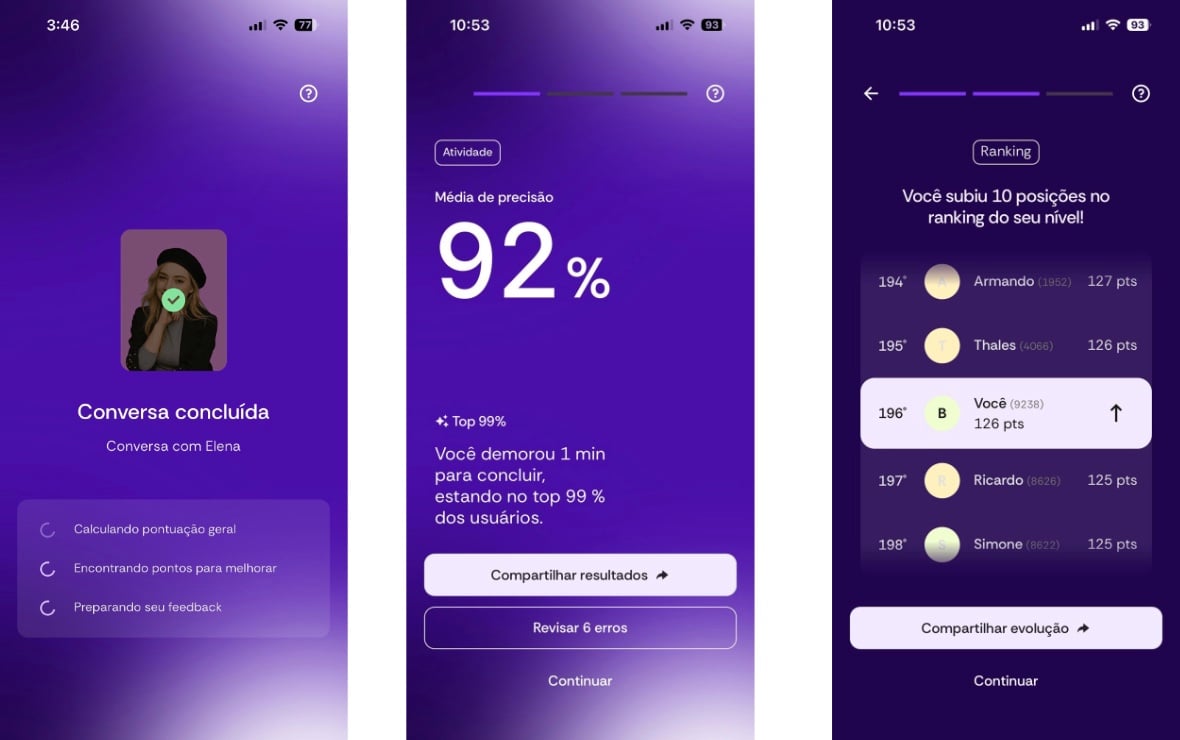
BeConfident's "Review Errors" feature gathers your history of corrections in grammar, pronunciation, and naturalness. The student reviews specific mistakes, bypasses already mastered topics, and focuses their study on the points that hinder fluency the most.
Practical steps:
Weekly routine: access your error history at least once a week.
Identify patterns: observe which types of errors are repeated the most.
Targeted practice: repeat corrected sentences until you no longer make the same mistake.
Progress test: validate your evolution in new conversations with different AI tutors.
8. Reach C1-C2 naturalness with Teacher Be
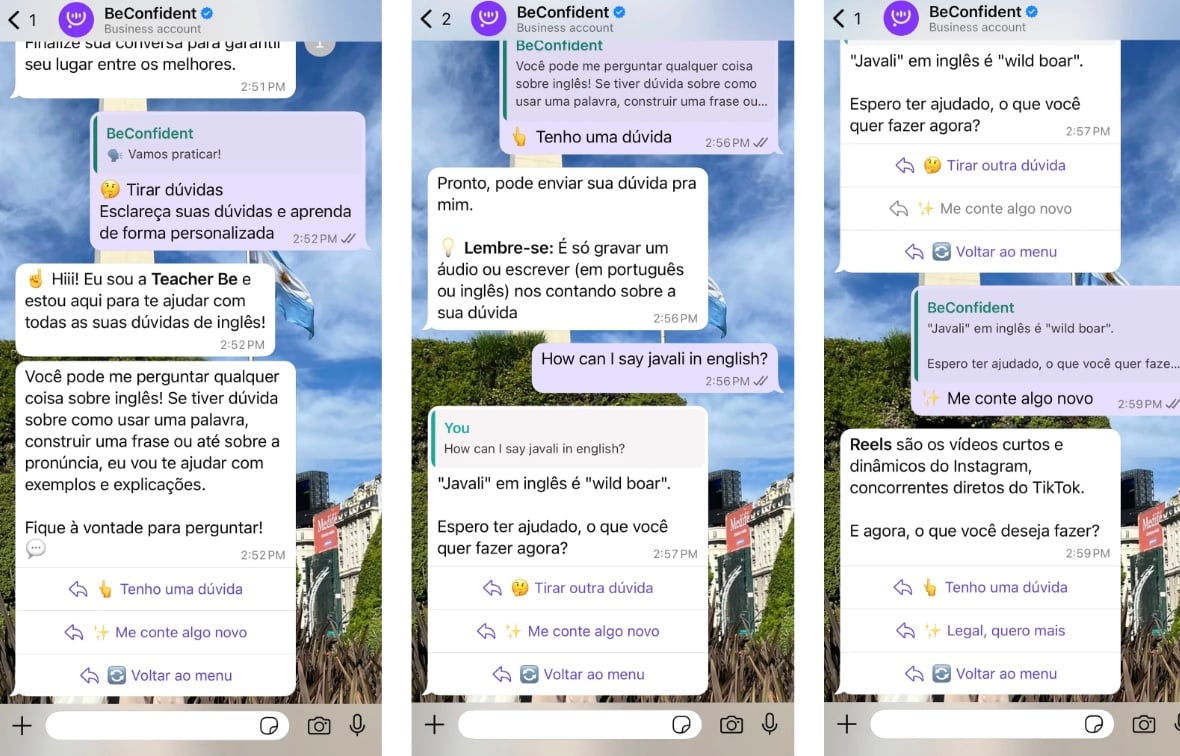
Advanced fluency requires more than just correct grammar. The student needs to sound natural in different contexts. Teacher Be, a feature of BeConfident, answers instant questions during conversations and explains nuances that distinguish a student from an advanced speaker.
BeConfident serves more than 140,000 paying students and maintains a top-tier reputation on customer service platforms, indicating consistency in delivering results. Testimonials report overcoming specific grammatical difficulties and gaining confidence for promotions and professional opportunities.
Practical steps:
Use the question feature: click "I have a question" whenever a phrase sounds off.
Explore expressions: ask for explanations of idioms and more natural alternatives.
Train naturalness: use commands like "Tell me something new" to expose yourself to advanced structures.
Continuous application: bring Teacher Be's tips into future conversations until the new pattern is incorporated.
Comparison: BeConfident and main alternatives
BeConfident and Duolingo: Duolingo keeps the student in basic gamified exercises with little grammatical depth. Gamified apps deliver vocabulary, but they do not guarantee the correction and confidence needed for fluid conversation. BeConfident integrates grammar and conversation from day one.
BeConfident and Cambly: Cambly charges per minute of conversation with human tutors of varying quality. BeConfident offers unlimited conversation 24/7 with personalized AI for a fraction of the cost.
BeConfident and ChatGPT: ChatGPT allows customization through detailed instructions. BeConfident, on the other hand, automatically adapts corrections to the student's level, error history, and goals, using specialized tutors in different accents and topics.
FAQ: common questions about correct grammar and English fluency
What is the best AI to practice English conversation?
BeConfident stands out by combining real-time grammar correction and natural conversation. Instead of a generic AI, the platform offers specialized tutors with specific characters and accents, feedback based on error history, and constant integration between grammar and conversational fluency. A base of over 140,000 paying students reinforces its practical effectiveness.
How to improve English fluency quickly?
Rapid progress comes from combining daily conversational practice with instant grammar correction. The student needs to apply grammar in real contexts of interest, review recurring errors with the support of a personalized history, and practice with an AI that offers feedback without judgment. Integrating theory and practice from the beginning prevents freezing up when speaking.
Is it possible to become fluent in English in 1 year?
Fluency in 1 year is possible with a daily dedication of 20 to 30 minutes and an efficient method. Structured schedules show consistent progression when the student combines applied grammar with regular conversation. Artificial intelligence accelerates this process with instant feedback and unlimited practice, free from barriers of embarrassment or fixed schedules.
What do B1 and B2 levels mean in English?
The B1 level (Intermediate) indicates the ability to describe events, experiences, and justify ideas in a simple way. The B2 level (Upper-Intermediate) represents sufficient fluency for more complex discussions and technical texts. These CEFR levels show a concrete progression: B1 allows for daily conversations, while B2 already enables professional use of the language.
Are Duolingo or Babbel enough for fluency?
Duolingo and Babbel are usually not enough to reach fluency. Gamified apps help with basic vocabulary, but they do not offer deep, personalized conversation and correction. For real fluency, the student needs platforms that integrate grammar into conversational practice, such as BeConfident, which delivers real-time correction and unlimited conversation with specialized AI.
Conclusion: BeConfident as a complete solution for grammar with fluency
The 8 strategies presented show that real fluency depends on the integration of correct grammar and constant conversational practice. Traditional methods that separate theory and application keep the student stuck in passive knowledge.
BeConfident solves this problem by offering instant grammar correction during natural conversations, AI tutors specialized in different contexts and accents, and a personalized history to review recurring errors. With an outstanding reputation and over 140,000 active students, the platform demonstrates that it is possible to unlock fluency without embarrassment and without depending on fixed schedules.
The next step is to apply grammar in real conversations, not just in exercises. Start practicing with AI support and track your progress week by week.
Replace memorizing rules with real conversations featuring real-time correction. Take a free test with our AI and see how to unlock your English in a few days. Try it for free and start learning English today.
Written by: Luan Cavallaro, Founder & CMO, BeConfident
Key takeaways from this article
Integrating grammar into daily conversation with AI feedback accelerates the practical application of rules in real-world contexts.
Practicing prepositions and irregular plurals in real dialogues fixes common mistakes naturally.
Mastering verb tenses and verbs of appearance through personal narratives and history review automates correct patterns.
Applying grammar in professional and travel topics with specialized tutors improves contextualized fluency.
BeConfident offers the complete solution with personalized AI for instant correction and unlimited conversation; take the free test now.
8 strategies and platforms to combine correct grammar and English fluency
1. Integrate grammar into daily conversation with AI feedback
BeConfident corrects grammatical errors during natural conversations with AI tutors. Instead of separating theory and practice, the student learns grammar applied in real contexts.
The AI tutors identify and correct common mistakes made by Portuguese speakers, such as "commit a mistake" instead of "make a mistake", instantly and without judgment. The student can converse via text, audio, or simulated calls in the app or WhatsApp, with corrections adapted to their current level.
Practical steps:
Choose your tutor: select an AI tutor with a personality aligned with your interests.
Day-to-day conversations: talk about your routine, not just textbook topics.
Immediate application: use the corrections you receive in new sentences within the same conversation.
Review errors: check your error history to reinforce learning throughout the week.
2. Practice prepositions in real dialogues
Prepositions generate many errors, especially the confusion between "in" and "on" for days of the week. Making the mistake of saying "in Monday" instead of "on Monday" is extremely common and affects the natural flow of speech.
Apps like BeConfident use AI to teach prepositions in short, practical dialogues. The key difference is practicing prepositions within full sentences, not in isolation. Instead of memorizing rules, the student practices sentences like "I have a meeting on Monday morning" in simulated conversations.
Practical steps:
Identify difficulties: list the prepositions that cause you the most confusion.
Real sentences: create sentences using daily situations, like work, studies, and leisure.
Practice with AI: use these sentences in conversations with AI and repeat them until they sound natural.
Targeted correction: ask for specific corrections whenever you use prepositions incorrectly.
3. Correct irregular plurals with oral repetition
Irregular plurals like "people" or "phenomena" confuse many learners. Mistakes such as using "campy" as the plural of "campus" appear frequently and reveal a lack of oral practice in context.
Memorizing isolated lists has little effect. Real progress comes from using irregular plurals in spoken sentences. When the student repeats "There are many people here" in different situations, the brain starts to recognize the correct form automatically.
Practical steps:
Short list: select about 10 irregular plurals that appear in your routine.
Personal sentences: create sentences that speak about your life, work, and interests.
Repeat out loud: repeat these sentences daily, out loud.
Validation with AI: use the sentences in conversations with AI and adjust your pronunciation and grammar with the feedback.
4. Master verb tenses with personal narratives
Many face difficulties with mixing verb tenses when telling stories, especially with "since" and "for". The confusion between "since" (starting point) and "for" (duration) breaks fluency and makes speech less natural.
BeConfident offers structured tracks that work on verb tenses in personal narratives. The student practices the Present Perfect with real stories, such as "I have lived here for 5 years" and "I have lived here since 2019".
Practical steps:
Choose the verb tense: select a verb tense that causes you the most mistakes.
Real story: tell a personal experience using that verb tense.
Recording: record your story in audio or video.
Correction and repetition: identify errors with the help of AI and repeat until the pattern becomes automatic.
Use grammar in real stories and not just in exercises. Try a free test with our AI and see how this accelerates your fluency. Try it for free and start learning English today.
5. Use AI for verbs of appearance and complex expressions
Verbs like "look", "sound", and "seem" follow specific rules that many learners ignore. The presence or absence of "like" is a recurring mistake: "you look mad" (without like) and "you sound like your brother" (with like).
While ChatGPT allows customization with detailed instructions, BeConfident adapts corrections to the student's error history and goals. The AI identifies phrases like "You look like tired" instead of "You look tired" and explains the rule in the exact context where the error occurred.
Practical steps:
List of structures: write down common combinations with "look", "sound", and "seem".
Daily practice: create and speak new sentences every day using these verbs.
Test with AI: send the sentences to the AI and ask for detailed correction.
Conscious reuse: apply the corrections in new conversations until correct use becomes automatic.
6. Apply grammar in professional and travel topics
Grammar learning becomes more consistent when the student practices in situations they actually experience. Contexts such as professional presentations, meetings, negotiations, and travel require specific structures.
BeConfident offers specialized tutors with native accents—such as American, British, and Australian—to train grammar in concrete scenarios. A "lawyer" tutor corrects legal grammar. A "photographer" tutor works on vocabulary and structures related to creativity.
Practical steps:
Define your scenarios: choose three situations where you need English the most.
Select tutors: choose AI tutors focused on these topics.
Specific simulations: practice dialogues typical of each situation.
Context-based review: review the most frequent grammatical errors in each type of conversation.
7. Review errors with the AI's personalized history
Repeating the same grammatical errors prevents real progress. Focusing exclusively on theory without speaking practice keeps the student stuck in passive knowledge.
BeConfident's "Review Errors" feature gathers your history of corrections in grammar, pronunciation, and naturalness. The student reviews specific mistakes, bypasses already mastered topics, and focuses their study on the points that hinder fluency the most.
Practical steps:
Weekly routine: access your error history at least once a week.
Identify patterns: observe which types of errors are repeated the most.
Targeted practice: repeat corrected sentences until you no longer make the same mistake.
Progress test: validate your evolution in new conversations with different AI tutors.
8. Reach C1-C2 naturalness with Teacher Be
Advanced fluency requires more than just correct grammar. The student needs to sound natural in different contexts. Teacher Be, a feature of BeConfident, answers instant questions during conversations and explains nuances that distinguish a student from an advanced speaker.
BeConfident serves more than 140,000 paying students and maintains a top-tier reputation on customer service platforms, indicating consistency in delivering results. Testimonials report overcoming specific grammatical difficulties and gaining confidence for promotions and professional opportunities.
Practical steps:
Use the question feature: click "I have a question" whenever a phrase sounds off.
Explore expressions: ask for explanations of idioms and more natural alternatives.
Train naturalness: use commands like "Tell me something new" to expose yourself to advanced structures.
Continuous application: bring Teacher Be's tips into future conversations until the new pattern is incorporated.
Comparison: BeConfident and main alternatives
BeConfident and Duolingo: Duolingo keeps the student in basic gamified exercises with little grammatical depth. Gamified apps deliver vocabulary, but they do not guarantee the correction and confidence needed for fluid conversation. BeConfident integrates grammar and conversation from day one.
BeConfident and Cambly: Cambly charges per minute of conversation with human tutors of varying quality. BeConfident offers unlimited conversation 24/7 with personalized AI for a fraction of the cost.
BeConfident and ChatGPT: ChatGPT allows customization through detailed instructions. BeConfident, on the other hand, automatically adapts corrections to the student's level, error history, and goals, using specialized tutors in different accents and topics.
FAQ: common questions about correct grammar and English fluency
What is the best AI to practice English conversation?
BeConfident stands out by combining real-time grammar correction and natural conversation. Instead of a generic AI, the platform offers specialized tutors with specific characters and accents, feedback based on error history, and constant integration between grammar and conversational fluency. A base of over 140,000 paying students reinforces its practical effectiveness.
How to improve English fluency quickly?
Rapid progress comes from combining daily conversational practice with instant grammar correction. The student needs to apply grammar in real contexts of interest, review recurring errors with the support of a personalized history, and practice with an AI that offers feedback without judgment. Integrating theory and practice from the beginning prevents freezing up when speaking.
Is it possible to become fluent in English in 1 year?
Fluency in 1 year is possible with a daily dedication of 20 to 30 minutes and an efficient method. Structured schedules show consistent progression when the student combines applied grammar with regular conversation. Artificial intelligence accelerates this process with instant feedback and unlimited practice, free from barriers of embarrassment or fixed schedules.
What do B1 and B2 levels mean in English?
The B1 level (Intermediate) indicates the ability to describe events, experiences, and justify ideas in a simple way. The B2 level (Upper-Intermediate) represents sufficient fluency for more complex discussions and technical texts. These CEFR levels show a concrete progression: B1 allows for daily conversations, while B2 already enables professional use of the language.
Are Duolingo or Babbel enough for fluency?
Duolingo and Babbel are usually not enough to reach fluency. Gamified apps help with basic vocabulary, but they do not offer deep, personalized conversation and correction. For real fluency, the student needs platforms that integrate grammar into conversational practice, such as BeConfident, which delivers real-time correction and unlimited conversation with specialized AI.
Conclusion: BeConfident as a complete solution for grammar with fluency
The 8 strategies presented show that real fluency depends on the integration of correct grammar and constant conversational practice. Traditional methods that separate theory and application keep the student stuck in passive knowledge.
BeConfident solves this problem by offering instant grammar correction during natural conversations, AI tutors specialized in different contexts and accents, and a personalized history to review recurring errors. With an outstanding reputation and over 140,000 active students, the platform demonstrates that it is possible to unlock fluency without embarrassment and without depending on fixed schedules.
The next step is to apply grammar in real conversations, not just in exercises. Start practicing with AI support and track your progress week by week.
Replace memorizing rules with real conversations featuring real-time correction. Take a free test with our AI and see how to unlock your English in a few days. Try it for free and start learning English today.