



English fluency: how long does it actually take
English fluency: how long does it actually take
English fluency: how long does it actually take
Written by: Luan Cavallaro, Founder & CMO, BeConfident
Key takeaways from this article
Achieving functional fluency (B2) requires daily practice focused on conversation, not years of purely theoretical study.
Setting aside thirty minutes a day for active conversation yields better results than long and sporadic sessions in building pronunciation, vocabulary, and confidence.
Traditional methods and gamified apps offer little speaking practice, while AI platforms like BeConfident allow for unlimited conversation and instant feedback 24 hours a day.
With 30 to 60 minutes daily, busy professionals can reach the B2 level in 3 to 12 months, depending on their initial level.
Find out your current level and start practicing today with BeConfident.
What does functional fluency (B2) mean in practice?
Achieving functional fluency does not mean speaking like a native speaker. The CEFR B2 level allows you to interact with native speakers with pressure-free spontaneity and fluency, without excessive strain for either party. In practice, this level allows you to:
Participate in work meetings in English
Travel with total autonomy
Watch movies with natural comprehension
Express complex opinions on a variety of topics
The CEFR describes B2 as an independent user who can produce clear, detailed texts on a wide range of subjects. This is the point where you stop "studying English" and start "living in English".
How does daily conversation practice accelerate your progress?
Consistent conversation practice improves fluency and pronunciation more than occasional long sessions, especially when it simulates real-life situations like meetings or travel. This frequent practice activates and reinforces the language production pathways.
Starting conversation from day one simultaneously develops:
Pronunciation, supported by immediate feedback
Vocabulary applied in a real context
Grammar used naturally, not memorized
Confidence to express yourself without feeling embarrassed
Thirty minutes of daily focused conversation beats two hours a week because fluency depends on regular activation, not just volume accumulated over a few days.
Current landscape: traditional methods, apps, and AI solutions
The English learning market offers different approaches, and each presents specific limitations for those seeking conversational fluency.
Traditional schools: require fixed hours, have high costs, and offer little individual speaking time in class. The environment often generates anxiety and self-consciousness, which reduces speaking practice.
Gamified apps: prioritize entertainment and maintaining daily streaks with basic vocabulary lessons, not real conversational fluency.
Online human tutors: work through hourly payments, generally with high rates and variable quality, depending on the chosen teacher.
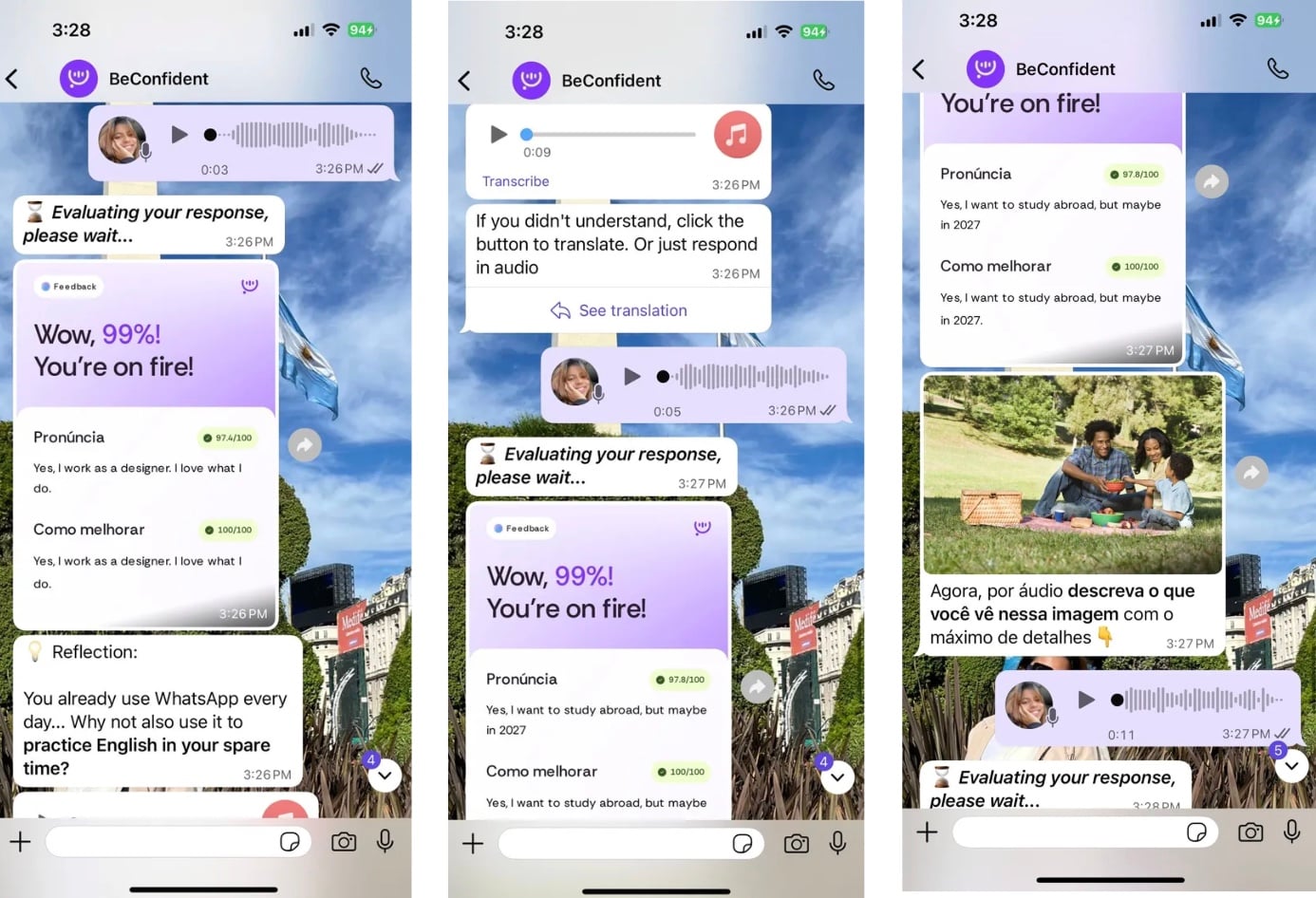
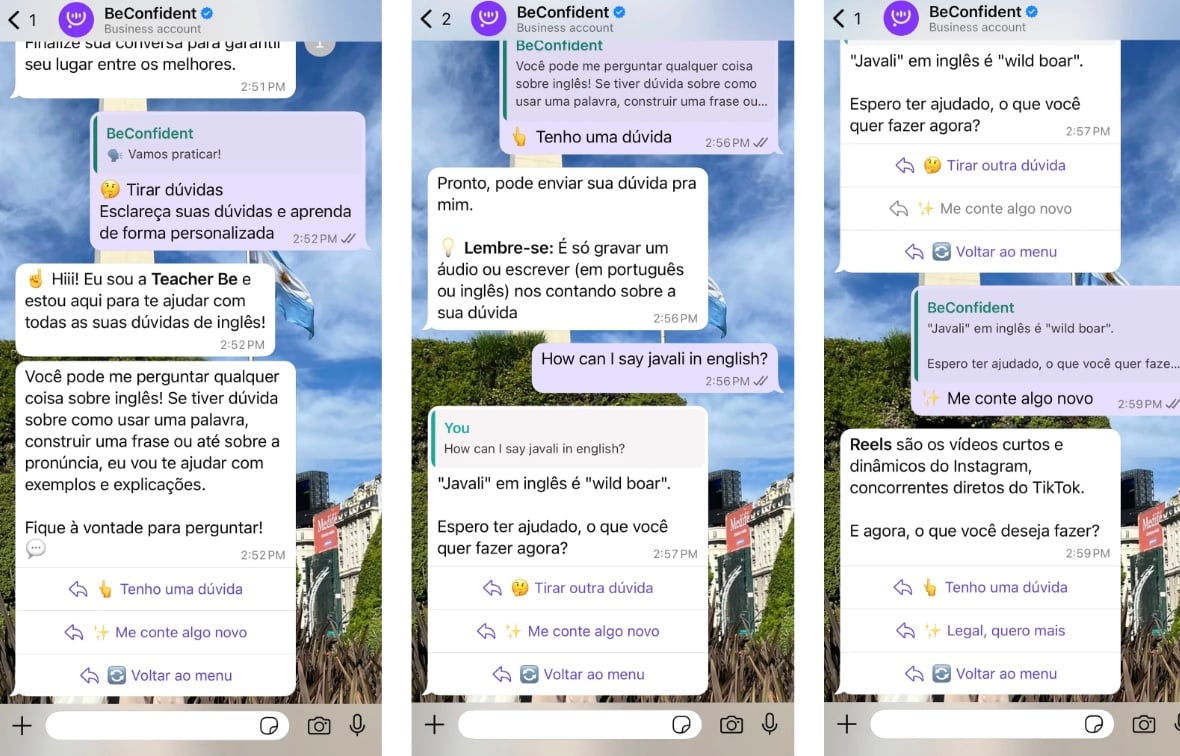
AI Platforms: BeConfident uses artificial intelligence to serve 200,000 paying students and 3 million total users, offering unlimited conversation 24 hours a day via app, WhatsApp, or smartwatch, for an affordable annual subscription.
How to choose the best option for your time and goals?
Defining the right method requires aligning your routine, budget, and the amount of actual speaking practice you will get.
Available time: assess whether you need total flexibility or if you can follow fixed schedules.
Speaking practice: calculate how many actual minutes of speaking you will have in each session.
Budget: check which investment fits your annual planning.
Personalization: confirm that the method adapts to your topics of interest.
Feedback: notice whether you receive immediate and specific corrections.
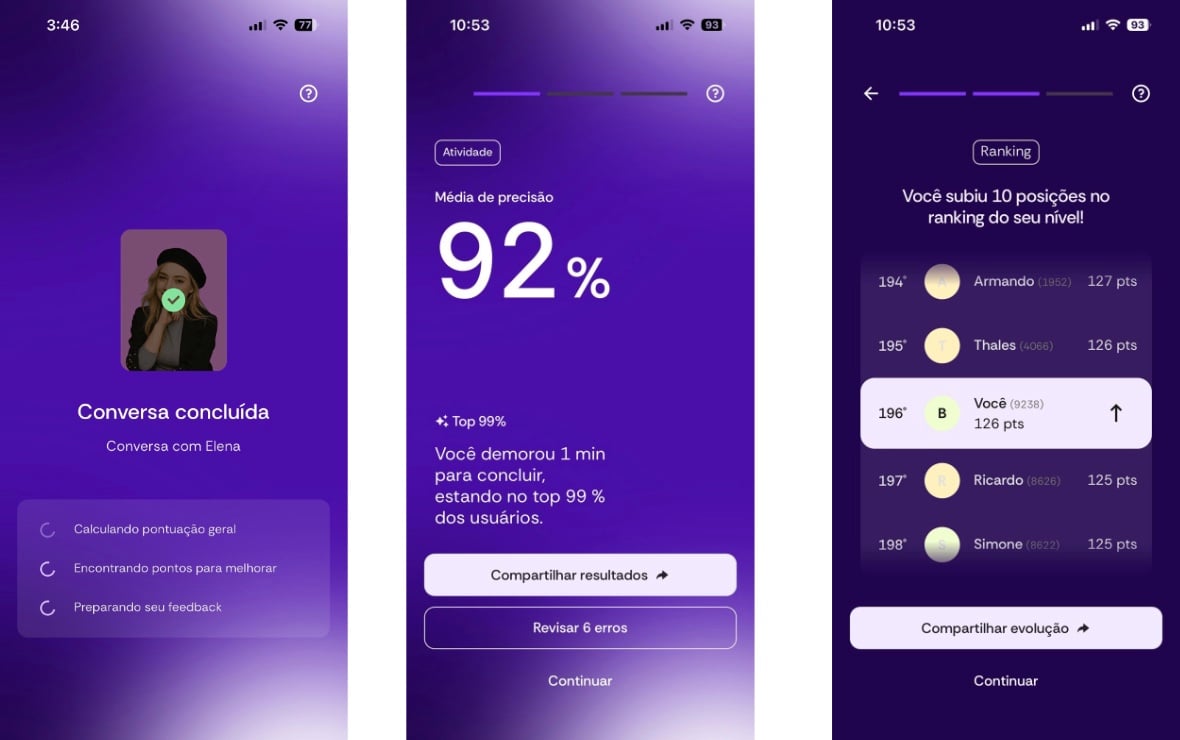
BeConfident meets these criteria with personalized AI tutors that adapt to your professional and personal interests, offering instant feedback and a safe environment to practice without feeling embarrassed.
Signs that you are ready to advance
Tracking monthly milestones helps measure if you are getting closer to functional fluency.
Months 1 to 2: you can hold basic conversations of 5 to 10 minutes on familiar topics with fewer long pauses.
Months 3 to 4: you express opinions and explain experiences with a more varied vocabulary, even though you still make grammatical errors.
Months 5 to 6: you participate in discussions on more abstract topics and can rephrase ideas when you can't find the exact word.
Months 7 to 8: you maintain natural conversations with native speakers without excessive effort and understand different accents.
Common mistakes that delay fluency
Avoiding certain specific behaviors reduces the time to fluency and increases the return on every minute of study.
Too much theory: studying grammar for months before trying to speak delays the development of fluency. Real fluency requires extensive practice in thinking on your feet, responding in real-time, and refining pronunciation with feedback.
Lack of speaking practice: focusing only on reading and listening limits progress. The brain processes production and comprehension differently, which is why speaking needs to be part of the routine.
Inconsistency: studying intensively for a few weeks and then stopping reduces retention. For busy adults, just a few minutes a day builds confidence and clearer pronunciation when maintained regularly.
Fear of making mistakes: avoiding conversations out of fear of making mistakes slows down progress. Mistakes are part of learning and indicate that you are testing new resources of the language.
Best practices and principles for measurable results
Structuring a clear routine makes consistency easier and allows you to adapt your study to the time available at each phase of your life.
Choose the routine that fits your daily availability, because each option has been structured to maximize progress within the time you have.
30-minute routine: recommended for beginners or those with tight schedules. Spend 5 minutes describing your day, 15 minutes talking about B2-level topics, and 10 minutes listening to and repeating native content.
60-minute routine: suitable for those who can dedicate one hour a day. Set aside 10 minutes for warm-up, 30 minutes for structured conversation, 10 minutes for repeating out loud, and 10 minutes to review identified mistakes.
120-minute routine: recommended for those seeking faster progress. Set aside 20 minutes for applied theory, 60 minutes for free conversation, 20 minutes for immersion with podcasts or videos, and 20 minutes to work on specific weak areas.
Take the free trial and experience these routines with AI tutors that adapt to your level and interests.
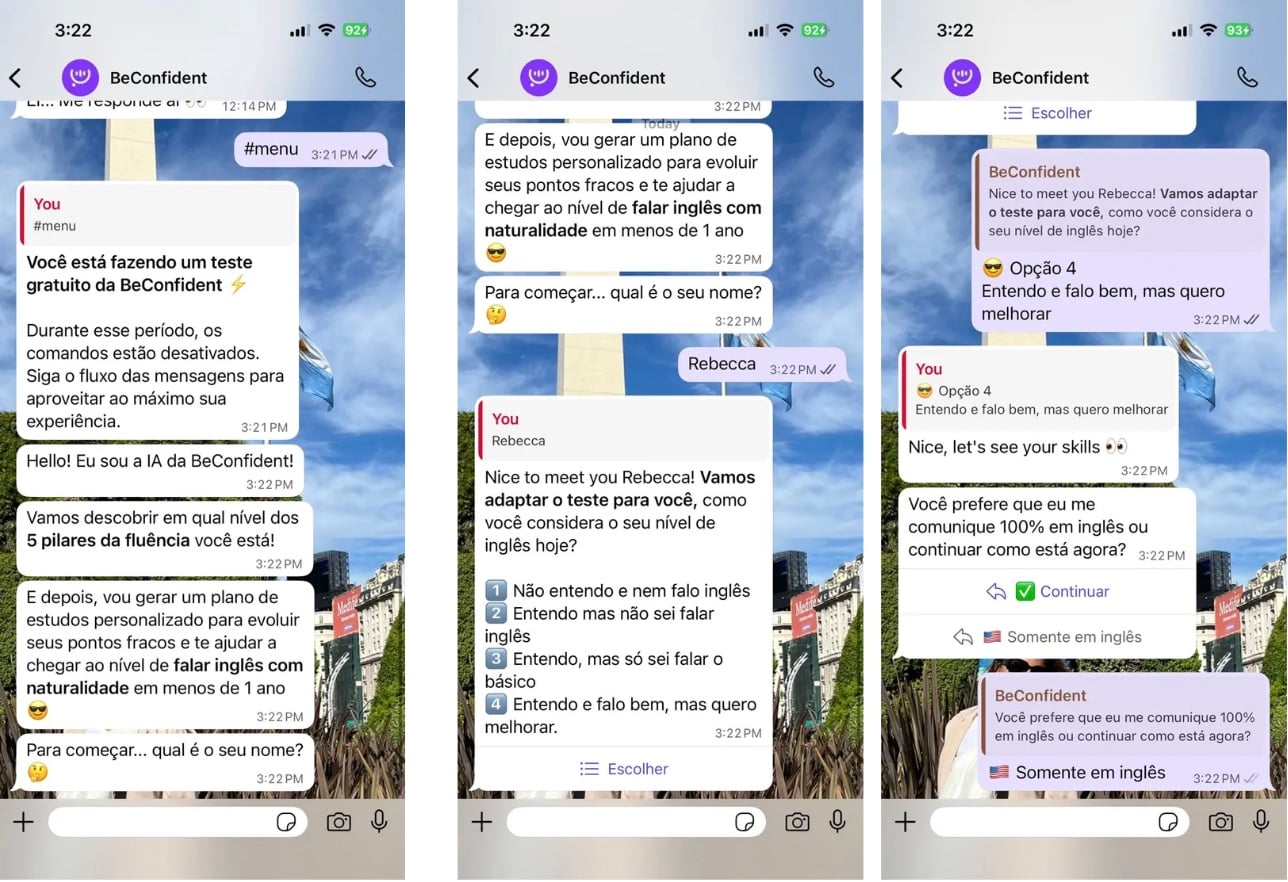
Table: daily minutes and months to B2
The following table shows how daily practice time influences the speed to reach the B2 level, starting from different starting points. Use these intervals as a reference to plan your routine.
Daily minutes | Starting from A2 | Starting from B1 | What you can achieve |
|---|---|---|---|
30 minutes | 3 to 4 months | Basic work and travel conversations | |
60 minutes | 2 to 3 months | Professional meetings and complex discussions | |
120 minutes | 1 to 2 months | Natural fluency in social and professional contexts |
Conclusion: use your free time to build real fluency
Achieving functional English fluency doesn't take years of theoretical study. With daily practice focused on conversation, busy professionals can reach B2 level in months. Consistency, immediate feedback, and constant exposure to real communication situations form the foundation of this result.
BeConfident offers an affordable and flexible solution for this journey, with unlimited conversation with AI tutors available 24 hours a day via app, WhatsApp, or smartwatch. The user base mentioned earlier demonstrates the effectiveness of the method and shows that it is possible to unlock fluency without fixed schedules or prohibitive costs.
Take the free trial and start learning English today to discover your current level and begin your journey toward functional fluency.
Frequently asked questions about time and fluency
Is it possible to become fluent in English in 1 year?
Achieving functional fluency (B2) in 1 year is a realistic goal with consistent dedication. Starting from the A2 level and practicing 60 minutes daily focused on conversation, most adults reach B2 in 8 to 12 months. The deciding factor is prioritizing speaking practice from day one, rather than just theoretical study. BeConfident facilitates this routine by offering unlimited conversation with AI tutors that adapt to your pace and interests.
Is 1 hour of study a day enough for fluency?
One well-structured hour a day is enough to reach functional fluency. The key lies in how you use that time. Sixty minutes focused on conversation, feedback, and oral practice yields better results than several hours of passive grammar study. The quality of the practice beats the quantity of content consumed. With BeConfident, you make the most of every minute in personalized conversations that work on specific areas of improvement.
How can I accelerate my English fluency?
Accelerating fluency requires prioritizing daily conversation, even if only for a few minutes. Exposing yourself to different accents, practicing topics relevant to your goals, and seeking immediate feedback on pronunciation and grammar speeds up your progress. Applying what you learn in real conversations solidifies the content and reduces forgetting. Daily consistency mentioned throughout the article is more effective than occasional study marathons. BeConfident supports this process with 24/7 conversational practice with AI tutors specialized in different professional contexts.
What is the difference between fluency and native level?
Functional fluency (B2) allows for effective communication in professional and social situations, while native level (C2) involves complete mastery of the language and finer cultural nuances. For most work and travel goals, B2 is sufficient. At this level, you participate in meetings, negotiate, travel independently, and express complex ideas. Focusing on reaching B2 first is more practical and motivating than aiming for native perfection from the start.
Can I learn English using apps only?
Using apps as a supplement helps, but relying solely on them rarely develops real conversational fluency. Traditional apps prioritize gamification and isolated vocabulary over fluid communication. To build fluency, you need regular conversation practice with personalized feedback. BeConfident combines the convenience of an app with the role of specialized tutors, offering real conversation through AI that corrects errors instantly and adapts to your goals.
Written by: Luan Cavallaro, Founder & CMO, BeConfident
Key takeaways from this article
Achieving functional fluency (B2) requires daily practice focused on conversation, not years of purely theoretical study.
Setting aside thirty minutes a day for active conversation yields better results than long and sporadic sessions in building pronunciation, vocabulary, and confidence.
Traditional methods and gamified apps offer little speaking practice, while AI platforms like BeConfident allow for unlimited conversation and instant feedback 24 hours a day.
With 30 to 60 minutes daily, busy professionals can reach the B2 level in 3 to 12 months, depending on their initial level.
Find out your current level and start practicing today with BeConfident.
What does functional fluency (B2) mean in practice?
Achieving functional fluency does not mean speaking like a native speaker. The CEFR B2 level allows you to interact with native speakers with pressure-free spontaneity and fluency, without excessive strain for either party. In practice, this level allows you to:
Participate in work meetings in English
Travel with total autonomy
Watch movies with natural comprehension
Express complex opinions on a variety of topics
The CEFR describes B2 as an independent user who can produce clear, detailed texts on a wide range of subjects. This is the point where you stop "studying English" and start "living in English".
How does daily conversation practice accelerate your progress?
Consistent conversation practice improves fluency and pronunciation more than occasional long sessions, especially when it simulates real-life situations like meetings or travel. This frequent practice activates and reinforces the language production pathways.
Starting conversation from day one simultaneously develops:
Pronunciation, supported by immediate feedback
Vocabulary applied in a real context
Grammar used naturally, not memorized
Confidence to express yourself without feeling embarrassed
Thirty minutes of daily focused conversation beats two hours a week because fluency depends on regular activation, not just volume accumulated over a few days.
Current landscape: traditional methods, apps, and AI solutions
The English learning market offers different approaches, and each presents specific limitations for those seeking conversational fluency.
Traditional schools: require fixed hours, have high costs, and offer little individual speaking time in class. The environment often generates anxiety and self-consciousness, which reduces speaking practice.
Gamified apps: prioritize entertainment and maintaining daily streaks with basic vocabulary lessons, not real conversational fluency.
Online human tutors: work through hourly payments, generally with high rates and variable quality, depending on the chosen teacher.
AI Platforms: BeConfident uses artificial intelligence to serve 200,000 paying students and 3 million total users, offering unlimited conversation 24 hours a day via app, WhatsApp, or smartwatch, for an affordable annual subscription.
How to choose the best option for your time and goals?
Defining the right method requires aligning your routine, budget, and the amount of actual speaking practice you will get.
Available time: assess whether you need total flexibility or if you can follow fixed schedules.
Speaking practice: calculate how many actual minutes of speaking you will have in each session.
Budget: check which investment fits your annual planning.
Personalization: confirm that the method adapts to your topics of interest.
Feedback: notice whether you receive immediate and specific corrections.
BeConfident meets these criteria with personalized AI tutors that adapt to your professional and personal interests, offering instant feedback and a safe environment to practice without feeling embarrassed.
Signs that you are ready to advance
Tracking monthly milestones helps measure if you are getting closer to functional fluency.
Months 1 to 2: you can hold basic conversations of 5 to 10 minutes on familiar topics with fewer long pauses.
Months 3 to 4: you express opinions and explain experiences with a more varied vocabulary, even though you still make grammatical errors.
Months 5 to 6: you participate in discussions on more abstract topics and can rephrase ideas when you can't find the exact word.
Months 7 to 8: you maintain natural conversations with native speakers without excessive effort and understand different accents.
Common mistakes that delay fluency
Avoiding certain specific behaviors reduces the time to fluency and increases the return on every minute of study.
Too much theory: studying grammar for months before trying to speak delays the development of fluency. Real fluency requires extensive practice in thinking on your feet, responding in real-time, and refining pronunciation with feedback.
Lack of speaking practice: focusing only on reading and listening limits progress. The brain processes production and comprehension differently, which is why speaking needs to be part of the routine.
Inconsistency: studying intensively for a few weeks and then stopping reduces retention. For busy adults, just a few minutes a day builds confidence and clearer pronunciation when maintained regularly.
Fear of making mistakes: avoiding conversations out of fear of making mistakes slows down progress. Mistakes are part of learning and indicate that you are testing new resources of the language.
Best practices and principles for measurable results
Structuring a clear routine makes consistency easier and allows you to adapt your study to the time available at each phase of your life.
Choose the routine that fits your daily availability, because each option has been structured to maximize progress within the time you have.
30-minute routine: recommended for beginners or those with tight schedules. Spend 5 minutes describing your day, 15 minutes talking about B2-level topics, and 10 minutes listening to and repeating native content.
60-minute routine: suitable for those who can dedicate one hour a day. Set aside 10 minutes for warm-up, 30 minutes for structured conversation, 10 minutes for repeating out loud, and 10 minutes to review identified mistakes.
120-minute routine: recommended for those seeking faster progress. Set aside 20 minutes for applied theory, 60 minutes for free conversation, 20 minutes for immersion with podcasts or videos, and 20 minutes to work on specific weak areas.
Take the free trial and experience these routines with AI tutors that adapt to your level and interests.
Table: daily minutes and months to B2
The following table shows how daily practice time influences the speed to reach the B2 level, starting from different starting points. Use these intervals as a reference to plan your routine.
Daily minutes | Starting from A2 | Starting from B1 | What you can achieve |
|---|---|---|---|
30 minutes | 3 to 4 months | Basic work and travel conversations | |
60 minutes | 2 to 3 months | Professional meetings and complex discussions | |
120 minutes | 1 to 2 months | Natural fluency in social and professional contexts |
Conclusion: use your free time to build real fluency
Achieving functional English fluency doesn't take years of theoretical study. With daily practice focused on conversation, busy professionals can reach B2 level in months. Consistency, immediate feedback, and constant exposure to real communication situations form the foundation of this result.
BeConfident offers an affordable and flexible solution for this journey, with unlimited conversation with AI tutors available 24 hours a day via app, WhatsApp, or smartwatch. The user base mentioned earlier demonstrates the effectiveness of the method and shows that it is possible to unlock fluency without fixed schedules or prohibitive costs.
Take the free trial and start learning English today to discover your current level and begin your journey toward functional fluency.
Frequently asked questions about time and fluency
Is it possible to become fluent in English in 1 year?
Achieving functional fluency (B2) in 1 year is a realistic goal with consistent dedication. Starting from the A2 level and practicing 60 minutes daily focused on conversation, most adults reach B2 in 8 to 12 months. The deciding factor is prioritizing speaking practice from day one, rather than just theoretical study. BeConfident facilitates this routine by offering unlimited conversation with AI tutors that adapt to your pace and interests.
Is 1 hour of study a day enough for fluency?
One well-structured hour a day is enough to reach functional fluency. The key lies in how you use that time. Sixty minutes focused on conversation, feedback, and oral practice yields better results than several hours of passive grammar study. The quality of the practice beats the quantity of content consumed. With BeConfident, you make the most of every minute in personalized conversations that work on specific areas of improvement.
How can I accelerate my English fluency?
Accelerating fluency requires prioritizing daily conversation, even if only for a few minutes. Exposing yourself to different accents, practicing topics relevant to your goals, and seeking immediate feedback on pronunciation and grammar speeds up your progress. Applying what you learn in real conversations solidifies the content and reduces forgetting. Daily consistency mentioned throughout the article is more effective than occasional study marathons. BeConfident supports this process with 24/7 conversational practice with AI tutors specialized in different professional contexts.
What is the difference between fluency and native level?
Functional fluency (B2) allows for effective communication in professional and social situations, while native level (C2) involves complete mastery of the language and finer cultural nuances. For most work and travel goals, B2 is sufficient. At this level, you participate in meetings, negotiate, travel independently, and express complex ideas. Focusing on reaching B2 first is more practical and motivating than aiming for native perfection from the start.
Can I learn English using apps only?
Using apps as a supplement helps, but relying solely on them rarely develops real conversational fluency. Traditional apps prioritize gamification and isolated vocabulary over fluid communication. To build fluency, you need regular conversation practice with personalized feedback. BeConfident combines the convenience of an app with the role of specialized tutors, offering real conversation through AI that corrects errors instantly and adapts to your goals.