




How to use shadowing to speak fluent English: a complete guide
How to use shadowing to speak fluent English: a complete guide
How to use shadowing to speak fluent English: a complete guide
Written by: Luan Cavallaro, Founder & CMO, BeConfident
Key takeaways from this article
The shadowing technique automates English rhythm, intonation, and pronunciation by training your ears and mouth at the same time.
Practicing 15 minutes a day, for 30 days, increases naturalness and confidence when speaking.
The protocol is divided into four steps: preparation, prosodic shadowing, shadowing with meaning, and independent production.
Choosing appropriate audio, between 30 and 60 seconds long with around 80% comprehension, and maintaining daily consistency are decisive factors for progress.
Combining shadowing with unlimited conversation on BeConfident accelerates fluency: start your free trial.
Why you still freeze when speaking English (even if you understand it well)
The difficulty usually lies in speech production, not comprehension. Speech goes through four stages: conceptualization, formulation, articulation, and self-monitoring. When you try to speak English, the brain needs to execute all these steps at the same time, which overloads working memory.
The shadowing technique reduces this overload by automating auditory perception and motor production. Research by Professor Shuhei Kadota indicates that prosodic repetition improves phonological processing and working memory in second language acquisition. As a result, spoken English begins to seem slower and simpler to process.
Discover your current level and practice shadowing with personalized feedback.
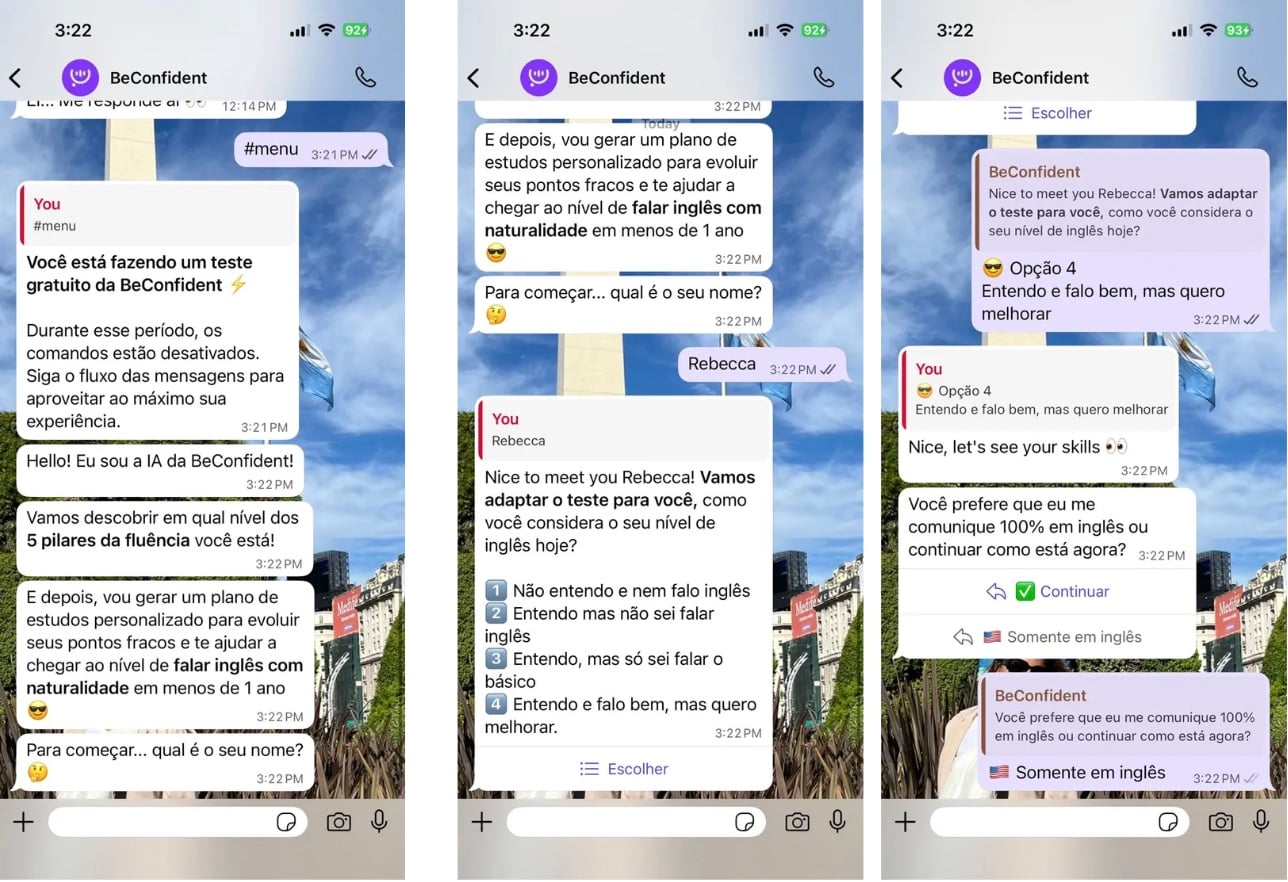
Before you start: what do you need?
To practice shadowing consistently, you need a few clear prerequisites.
Minimum level: lower-intermediate level (B1-B2), with comprehension of at least 80% of the chosen audio.
Equipment: headphones and a smartphone or computer.
Daily time: 15 uninterrupted minutes.
Material: 30 to 60-second audio clips, with transcript available.
Realistic expectations: in the first 7 days, you tend to find it difficult to keep up with the speed. Between days 8 and 21, synchronization with the rhythm improves. After 30 days of daily practice, spontaneous English speech tends to become more natural.
Common mistake: choosing material that is too difficult. If you don't understand at least 80% of the vocabulary, the brain begins to treat the audio as noise, as shown by Cognitive Load Theory.
Overview: the 4 stages of shadowing in a visual checklist
Daily shadowing checklist (15 minutes):
Preparation (2 min): listen to the audio with the transcript and identify unfamiliar words.
Prosodic shadowing (8 min): repeat 2 or 3 words behind the audio, focusing only on sounds.
Shadowing with meaning (4 min): repeat while understanding the content.
Self-assessment (1 min): record a sentence from the audio independently.
Step-by-step: how to practice shadowing every day
Step 1: preparation and familiarization
Goal: eliminate vocabulary and grammar barriers.
Action: listen to the full audio while following the transcript to identify vocabulary gaps. When you find unfamiliar words or expressions, write them down and look up their meanings. This avoids pauses for mental translation in the following steps.
Example: if you chose a TED Talk about technology, identify terms like "breakthrough" or "cutting-edge" before you begin.
Expected result: understand about 90% of the content without having to interrupt the flow to translate.
Step 2: prosodic shadowing
Goal: automate rhythm, intonation, and connected speech.
Action: speak sentences aloud, 2 or 3 words behind the audio, without focusing on the meaning. Concentrate on imitating sounds, speed, and melody.
Practical tip: after about 10 repetitions of the same clip, the mouth tends to produce the schwa sound /ə/, the intrusion of /w/, and assimilation patterns with less conscious effort.
Common mistake: trying to understand the meaning at this stage. This attempt increases the load on working memory and hinders the automation of sound patterns.
Step 3: shadowing with meaning
Goal: integrate comprehension and fluent production.
Action: repeat the audio keeping the focus on the meaning, but preserve the rhythm and intonation trained in the previous step.
Sign of progress: being able to keep up with the audio without losing understanding of the content.
Step 4: independent production
Goal: check if patterns have been internalized.
Action: record yourself reproducing a sentence from the audio without accompaniment and compare your recording with the original.
Course correction: if your version sounds very different, go back to step 2 with that specific segment.
Practice shadowing with instant pronunciation correction.
Frequent problems and how to solve them
Audio too fast
Cause: material above your current level or little prior familiarization.
Solution: reduce the speed to 0.8x for the first few days and increase it gradually. Educational videos like TED Talks can support second language learning.
L1 pronunciation interference
Cause: tendency to apply phonetic patterns of your native language to English.
Solution: studies indicate that pronunciation tends to adjust toward the received acoustic target, even without conscious effort to copy the accent. Therefore, keep up consistent practice.
Lack of consistency
Cause: unrealistic expectations or sessions that are too long.
Solution: improvement in conversational fluency comes from consistent daily practice, not long sporadic sessions. Choose 15 minutes a day over a single long weekly session.
How to measure if shadowing is working
Observable indicators of progress:
Weeks 1 and 2: you follow about 50% of the audio without pauses.
Weeks 3 and 4: rhythm and intonation become more natural and less robotic.
After 30 days: you speak spontaneous English with less hesitation and fewer long pauses.
Studies by Derwing and Munro show that listeners can understand speakers with some imperfect sounds when prosody is appropriate. Inappropriate rhythm, however, can cause difficulty even with well-articulated consonants and vowels.
Next steps: from shadowing to real conversation without feeling embarrassed
Shadowing builds the necessary muscular and auditory base, but conversational fluency requires active dialogue practice.
Many students stagnate because they master the technique but have no one to practice with regularly. BeConfident fills this gap by offering unlimited conversation with artificial intelligence tutors available 24 hours a day via app, WhatsApp, or smartwatch. With over 200,000 paying students and 3 million users, the platform allows you to immediately apply the gains from shadowing in real conversations, with instant corrections, without feeling embarrassed and without relying on fixed schedules.
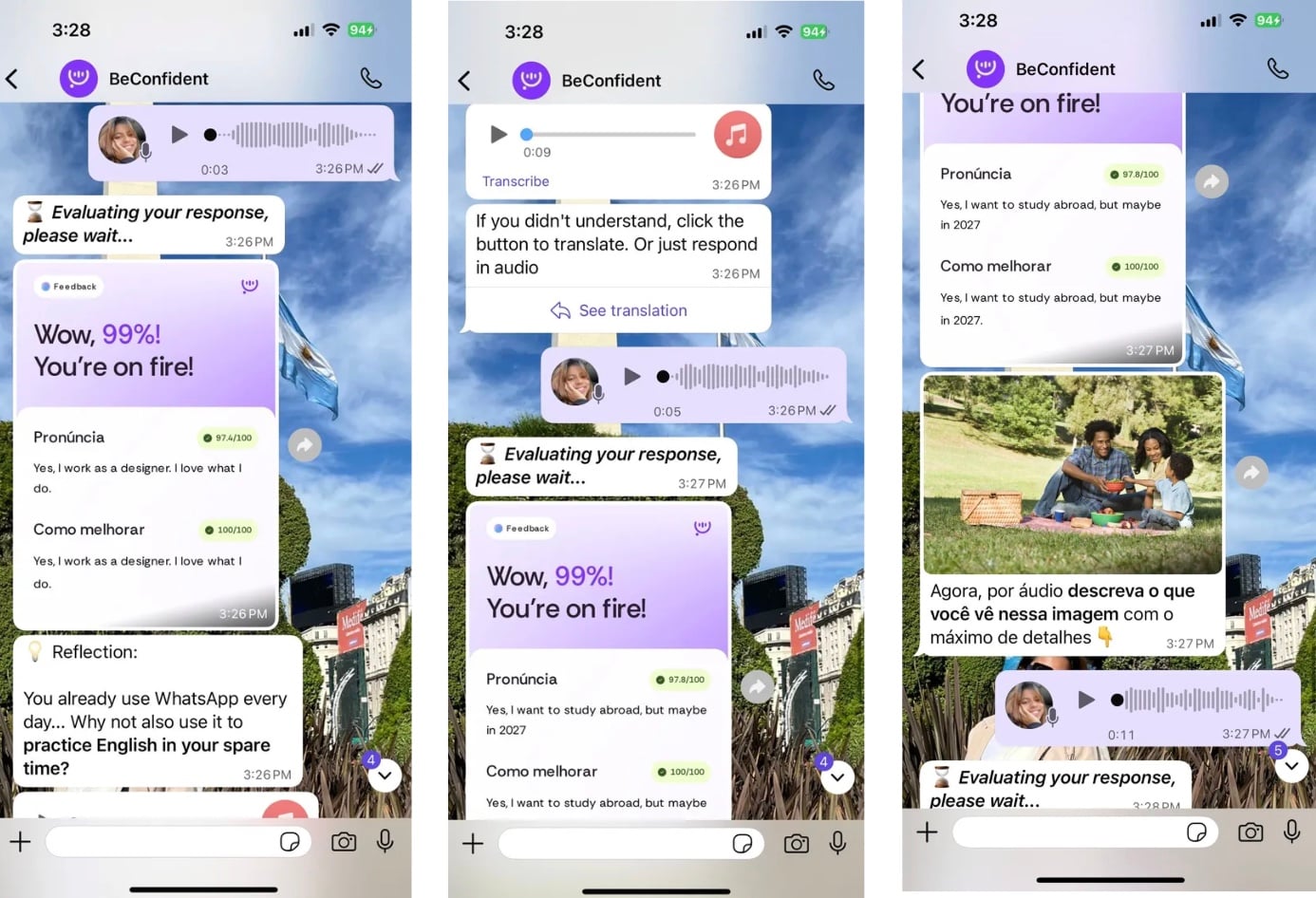
The AI tutors simulate various native accents, such as American, British, and Australian, and adapt to your professional or personal topics of interest. This way, you practice exactly the type of conversation you need for your goals.
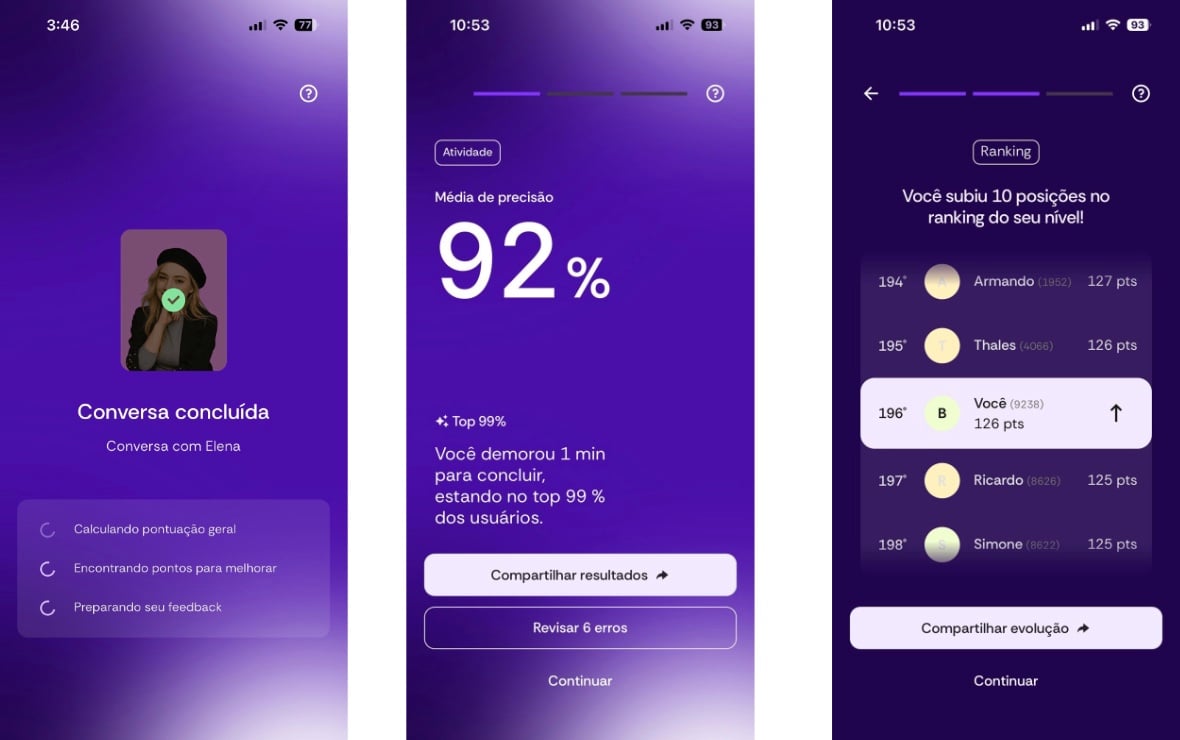
Combine shadowing with unlimited conversation to accelerate your fluency.
Frequently asked questions about shadowing
How much time a day do I need to practice shadowing?
The recommended protocol calls for 15 daily minutes. This time is usually sufficient to automate prosodic patterns without overloading concentration. Longer sessions do not accelerate the process, because automation depends on consistent repetition over time, rather than the isolated duration of each practice.
What kind of audio should I use for shadowing?
Prioritize educational materials like TED Talks, documentaries, or business podcasts over movies or series. The ideal content is between 30 and 60 seconds long, has a transcript available, and requires comprehension of at least 80% of the vocabulary. Avoid materials with multiple speakers or loud background noise.
Can I do shadowing if I am a beginner in English?
Shadowing works best for students at lower-intermediate level (B1) and above. Beginners should first build a foundation of vocabulary and simple structures before automating prosodic patterns. If you understand basic English conversations, you can already start with materials adapted to your level.
How to adapt shadowing if I have ADHD or concentration difficulties?
Reduce sessions to 5 to 10 minutes and use shorter clips of 15 to 30 seconds. Practice in a quiet environment and, if possible, use noise-canceling headphones. The core point is to maintain daily practice, even with short sessions, and gradually increase duration as focus improves.
How long does it take to see results in my spoken English?
The first signs usually appear between 7 and 14 days, with greater ease in following the rhythm of the audio. Improvements in spontaneous fluency tend to become clear after 3 or 4 weeks of daily practice. More consistent results in naturalness and confidence when speaking generally emerge after 6 to 8 weeks of shadowing combined with regular conversational practice.
Conclusion: consistency is what separates those who speak from those who only understand
The shadowing technique offers a direct path to automate the English prosodic patterns that the brain needs to produce fluent speech. With just 15 minutes a day, you build the muscular and auditory foundation needed to reduce the barrier between comprehension and production.
Fluency comes from automation through repeated practice, not just theoretical knowledge. Shadowing creates this automation, and regular conversation with immediate feedback consolidates the gains in confidence to speak.
Written by: Luan Cavallaro, Founder & CMO, BeConfident
Key takeaways from this article
The shadowing technique automates English rhythm, intonation, and pronunciation by training your ears and mouth at the same time.
Practicing 15 minutes a day, for 30 days, increases naturalness and confidence when speaking.
The protocol is divided into four steps: preparation, prosodic shadowing, shadowing with meaning, and independent production.
Choosing appropriate audio, between 30 and 60 seconds long with around 80% comprehension, and maintaining daily consistency are decisive factors for progress.
Combining shadowing with unlimited conversation on BeConfident accelerates fluency: start your free trial.
Why you still freeze when speaking English (even if you understand it well)
The difficulty usually lies in speech production, not comprehension. Speech goes through four stages: conceptualization, formulation, articulation, and self-monitoring. When you try to speak English, the brain needs to execute all these steps at the same time, which overloads working memory.
The shadowing technique reduces this overload by automating auditory perception and motor production. Research by Professor Shuhei Kadota indicates that prosodic repetition improves phonological processing and working memory in second language acquisition. As a result, spoken English begins to seem slower and simpler to process.
Discover your current level and practice shadowing with personalized feedback.
Before you start: what do you need?
To practice shadowing consistently, you need a few clear prerequisites.
Minimum level: lower-intermediate level (B1-B2), with comprehension of at least 80% of the chosen audio.
Equipment: headphones and a smartphone or computer.
Daily time: 15 uninterrupted minutes.
Material: 30 to 60-second audio clips, with transcript available.
Realistic expectations: in the first 7 days, you tend to find it difficult to keep up with the speed. Between days 8 and 21, synchronization with the rhythm improves. After 30 days of daily practice, spontaneous English speech tends to become more natural.
Common mistake: choosing material that is too difficult. If you don't understand at least 80% of the vocabulary, the brain begins to treat the audio as noise, as shown by Cognitive Load Theory.
Overview: the 4 stages of shadowing in a visual checklist
Daily shadowing checklist (15 minutes):
Preparation (2 min): listen to the audio with the transcript and identify unfamiliar words.
Prosodic shadowing (8 min): repeat 2 or 3 words behind the audio, focusing only on sounds.
Shadowing with meaning (4 min): repeat while understanding the content.
Self-assessment (1 min): record a sentence from the audio independently.
Step-by-step: how to practice shadowing every day
Step 1: preparation and familiarization
Goal: eliminate vocabulary and grammar barriers.
Action: listen to the full audio while following the transcript to identify vocabulary gaps. When you find unfamiliar words or expressions, write them down and look up their meanings. This avoids pauses for mental translation in the following steps.
Example: if you chose a TED Talk about technology, identify terms like "breakthrough" or "cutting-edge" before you begin.
Expected result: understand about 90% of the content without having to interrupt the flow to translate.
Step 2: prosodic shadowing
Goal: automate rhythm, intonation, and connected speech.
Action: speak sentences aloud, 2 or 3 words behind the audio, without focusing on the meaning. Concentrate on imitating sounds, speed, and melody.
Practical tip: after about 10 repetitions of the same clip, the mouth tends to produce the schwa sound /ə/, the intrusion of /w/, and assimilation patterns with less conscious effort.
Common mistake: trying to understand the meaning at this stage. This attempt increases the load on working memory and hinders the automation of sound patterns.
Step 3: shadowing with meaning
Goal: integrate comprehension and fluent production.
Action: repeat the audio keeping the focus on the meaning, but preserve the rhythm and intonation trained in the previous step.
Sign of progress: being able to keep up with the audio without losing understanding of the content.
Step 4: independent production
Goal: check if patterns have been internalized.
Action: record yourself reproducing a sentence from the audio without accompaniment and compare your recording with the original.
Course correction: if your version sounds very different, go back to step 2 with that specific segment.
Practice shadowing with instant pronunciation correction.
Frequent problems and how to solve them
Audio too fast
Cause: material above your current level or little prior familiarization.
Solution: reduce the speed to 0.8x for the first few days and increase it gradually. Educational videos like TED Talks can support second language learning.
L1 pronunciation interference
Cause: tendency to apply phonetic patterns of your native language to English.
Solution: studies indicate that pronunciation tends to adjust toward the received acoustic target, even without conscious effort to copy the accent. Therefore, keep up consistent practice.
Lack of consistency
Cause: unrealistic expectations or sessions that are too long.
Solution: improvement in conversational fluency comes from consistent daily practice, not long sporadic sessions. Choose 15 minutes a day over a single long weekly session.
How to measure if shadowing is working
Observable indicators of progress:
Weeks 1 and 2: you follow about 50% of the audio without pauses.
Weeks 3 and 4: rhythm and intonation become more natural and less robotic.
After 30 days: you speak spontaneous English with less hesitation and fewer long pauses.
Studies by Derwing and Munro show that listeners can understand speakers with some imperfect sounds when prosody is appropriate. Inappropriate rhythm, however, can cause difficulty even with well-articulated consonants and vowels.
Next steps: from shadowing to real conversation without feeling embarrassed
Shadowing builds the necessary muscular and auditory base, but conversational fluency requires active dialogue practice.
Many students stagnate because they master the technique but have no one to practice with regularly. BeConfident fills this gap by offering unlimited conversation with artificial intelligence tutors available 24 hours a day via app, WhatsApp, or smartwatch. With over 200,000 paying students and 3 million users, the platform allows you to immediately apply the gains from shadowing in real conversations, with instant corrections, without feeling embarrassed and without relying on fixed schedules.
The AI tutors simulate various native accents, such as American, British, and Australian, and adapt to your professional or personal topics of interest. This way, you practice exactly the type of conversation you need for your goals.
Combine shadowing with unlimited conversation to accelerate your fluency.
Frequently asked questions about shadowing
How much time a day do I need to practice shadowing?
The recommended protocol calls for 15 daily minutes. This time is usually sufficient to automate prosodic patterns without overloading concentration. Longer sessions do not accelerate the process, because automation depends on consistent repetition over time, rather than the isolated duration of each practice.
What kind of audio should I use for shadowing?
Prioritize educational materials like TED Talks, documentaries, or business podcasts over movies or series. The ideal content is between 30 and 60 seconds long, has a transcript available, and requires comprehension of at least 80% of the vocabulary. Avoid materials with multiple speakers or loud background noise.
Can I do shadowing if I am a beginner in English?
Shadowing works best for students at lower-intermediate level (B1) and above. Beginners should first build a foundation of vocabulary and simple structures before automating prosodic patterns. If you understand basic English conversations, you can already start with materials adapted to your level.
How to adapt shadowing if I have ADHD or concentration difficulties?
Reduce sessions to 5 to 10 minutes and use shorter clips of 15 to 30 seconds. Practice in a quiet environment and, if possible, use noise-canceling headphones. The core point is to maintain daily practice, even with short sessions, and gradually increase duration as focus improves.
How long does it take to see results in my spoken English?
The first signs usually appear between 7 and 14 days, with greater ease in following the rhythm of the audio. Improvements in spontaneous fluency tend to become clear after 3 or 4 weeks of daily practice. More consistent results in naturalness and confidence when speaking generally emerge after 6 to 8 weeks of shadowing combined with regular conversational practice.
Conclusion: consistency is what separates those who speak from those who only understand
The shadowing technique offers a direct path to automate the English prosodic patterns that the brain needs to produce fluent speech. With just 15 minutes a day, you build the muscular and auditory foundation needed to reduce the barrier between comprehension and production.
Fluency comes from automation through repeated practice, not just theoretical knowledge. Shadowing creates this automation, and regular conversation with immediate feedback consolidates the gains in confidence to speak.