




How to train your ear to understand native English speakers?
How to train your ear to understand native English speakers?
How to train your ear to understand native English speakers?
Written by: Luan Cavallaro, Founder & CMO, BeConfident
Key takeaways from this article
Daily exposure to native audio for 20 minutes builds familiarity with natural rhythm and intonation, even without understanding 100% at first.
Practicing active shadowing, repeating audio simultaneously, improves synchronization and pronunciation, especially with short, progressive clips.
Gradually transitioning from Portuguese subtitles to English and then to none over 30 days increases listening independence, using familiar series.
Mastering chunks and reductions like "gonna", "wanna", and elisions is essential for understanding fast native speech.
Using an AI like BeConfident accelerates the process with varied accents, 24/7 instant feedback, and progress tracking; try it free now.
Step 1: Create daily exposure to native audio
Daily exposure is the foundation for training your ear. Set aside 20 minutes a day to listen to authentic content like the BBC's "6 Minute English" podcast, TED Talks, or YouTube conversations. Consistency matters more than duration. Start with familiar topics to build confidence and then move on to new subjects.
Practical tips:
Set a fixed time, such as in the morning or during your commute to work.
Use headphones for better sound quality.
Avoid aiming for 100% comprehension; focus on rhythm, intonation, and keywords.
Common mistake: pausing all the time to translate every single word. This breaks the natural flow and delays the development of global comprehension.
Step 2: Practice active shadowing
Shadowing, which is repeating aloud at the same time as you listen, is one of the most effective techniques to improve listening comprehension. Select 30- to 60-second clips and repeat each one 5 times. Start by whispering along with the audio and gradually increase the volume. The goal is to keep up with the natural rhythm, not to speak perfectly.
Practical example: listen to "I'm gonna go to the store" and repeat right after, mimicking intonation and speed. Notice how "going to" becomes "gonna". This reduction appears all the time in native speech.
Recommended progression:
Weeks 1 and 2: 15- to 30-second clips.
Weeks 3 and 4: 45- to 60-second clips.
After 30 days: full paragraphs.
Step 3: Use English subtitles until you reach zero
Making a planned transition with subtitles helps build listening independence. Start with Portuguese subtitles, then switch to English, and finally watch without subtitles.
This progression allows the brain to associate sounds with written words and strengthens neural connections. Use series you are already familiar with. When the story is familiar, you can focus more on the audio.
Suggested schedule:
Days 1 to 10: Portuguese subtitles.
Days 11 to 20: English subtitles.
Days 21 to 30: no subtitles.
If you feel a total loss of comprehension, go back one stage. The goal is to maintain a level of challenge that does not cause excessive frustration.
Step 4: Master chunks and reductions of native English
Reductions appear all the time in native speech and change sounds significantly. Phonetic phenomena include "for" reduced to /fer/, "him" as /im/, and forms like "shoulda" for "should have".
Top 10 essential reductions:
"going to" → "gonna"
"want to" → "wanna"
"should have" → "shoulda"
"could have" → "coulda"
"would have" → "woulda"
"for" → "fer"
"him/her" → "im/er" (h-dropping)
"not at all" → "notatall" (linking)
"next day" → "neks day" (elision of "t")
"old man" → "ol' man" (elision of "d")
Include a focused listening routine for these forms. Whenever you recognize a reduction in a dialogue, pause, repeat it out loud a few times, and lock the phrase into your auditory memory.
Step 5: Train with different English accents
Exposure to various accents prepares your ear for real-life work, travel, and study situations. Start with the American accent, which appears most in media and business, then move on to British and Australian.
Resources by accent:
American: CNN, podcasts like "This American Life".
British: BBC, "The Guardian" podcasts.
Australian: ABC Australia and Australian YouTube channels.
Set aside at least a week for each accent and then mix them. Artificial intelligence helps at this point because it offers practice with multiple accents in the same session.
The tool that accelerates the process: BeConfident
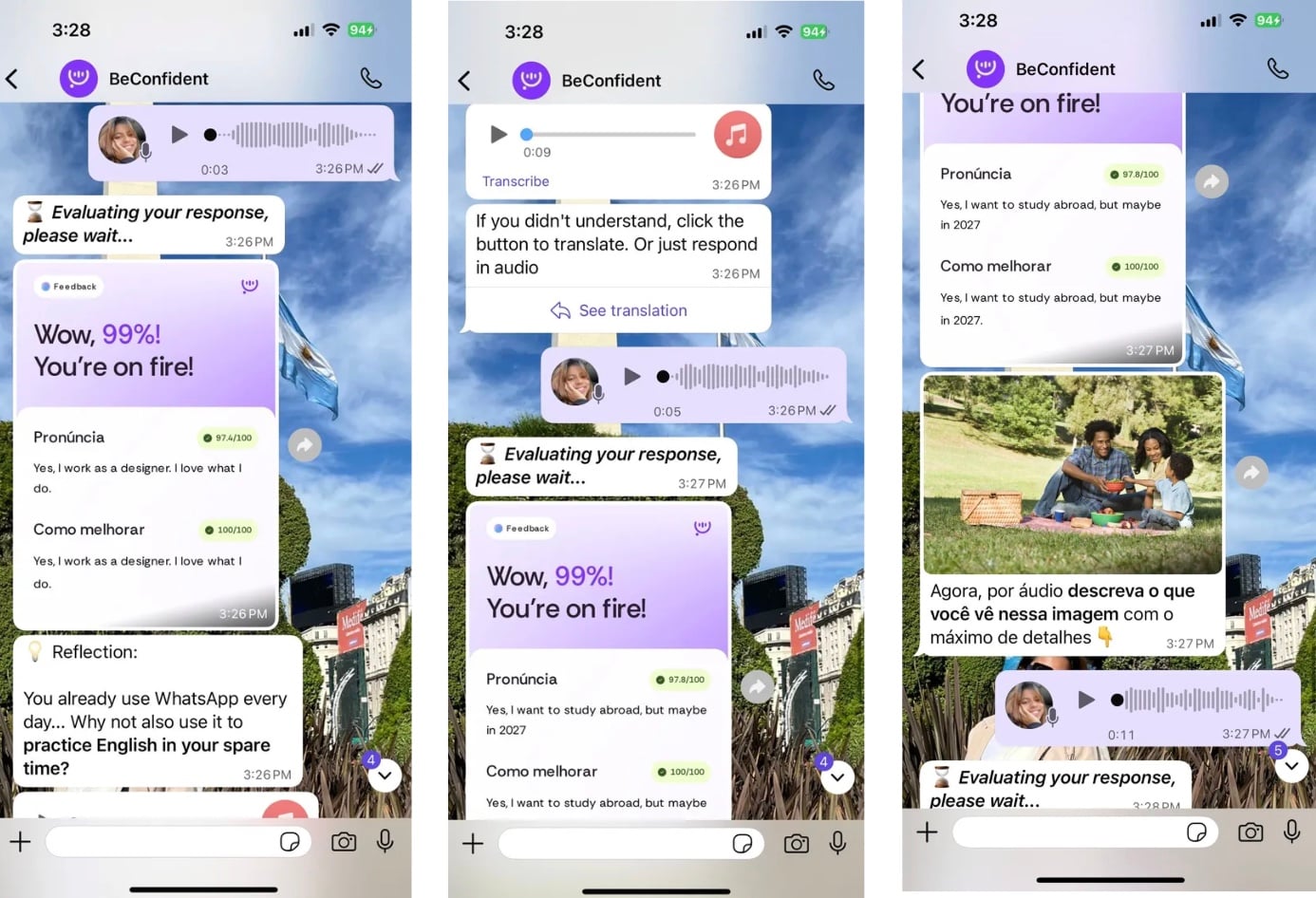
BeConfident offers AI tutors with authentic native accents, available 24/7 on the app, WhatsApp, or smartwatch. The platform serves over 200,000 students, has an RA1000 reputation on Reclame Aqui, and delivers instant, personalized feedback for listening and pronunciation.
Method | Cost | Availability | Accents | Feedback |
Traditional schools | High | Fixed hours | Limited | Weekly |
Duolingo | Low | 24/7 | Basic | Automatic |
Cambly | Per minute | Scheduled | Variable | Human |
BeConfident | Affordable | 24/7 | Multiple native speakers | Instant AI |
Real testimonials:
"I had a lot of trouble speaking, even though I could read and listen well. I started using BeConfident and, within a month, I was already speaking more naturally without freezing up."
"Constant practice with the AI reduced my frustration of forgetting words in important moments. The AI also taught me English expressions in context."
Take the free trial and start learning English today.
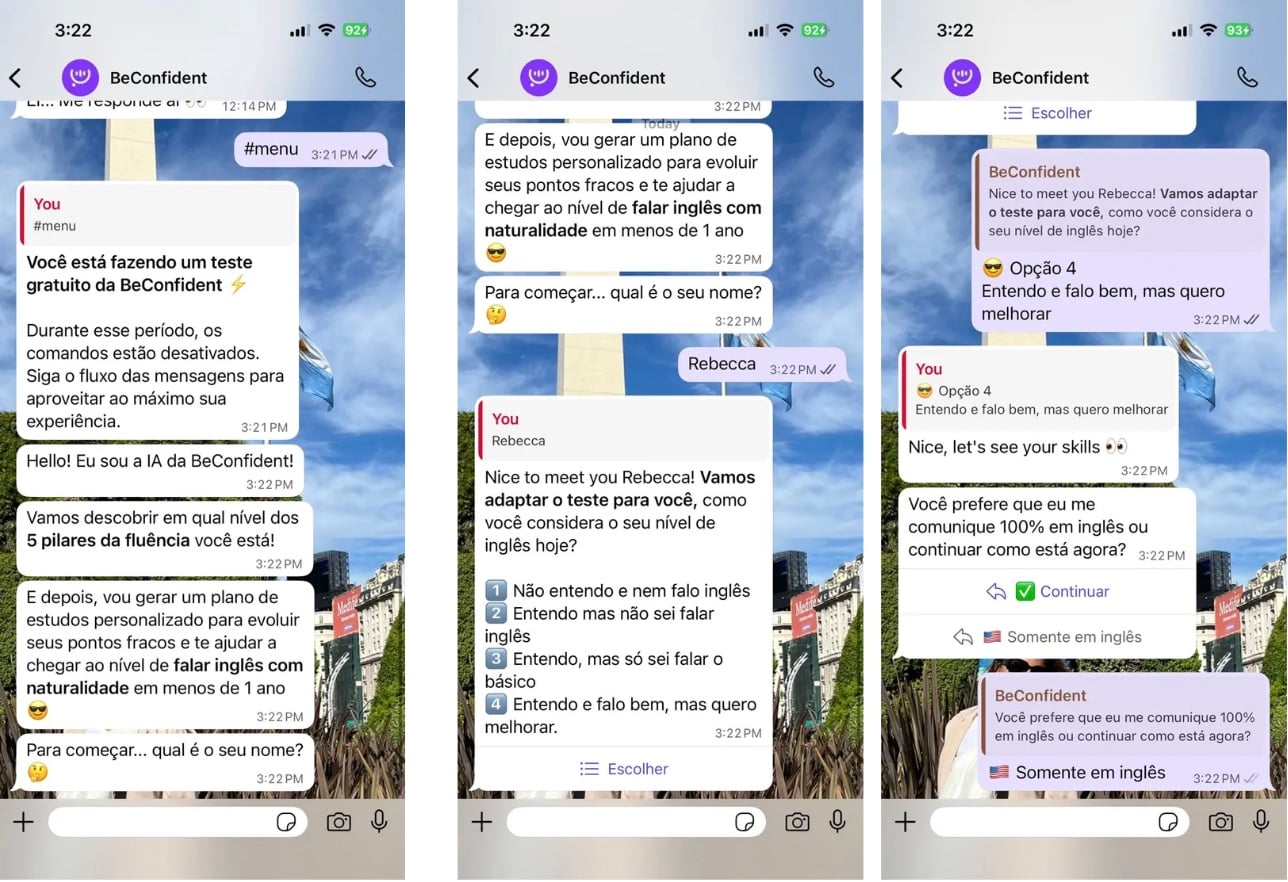
Step 6: Use conversational practice with AI
Active conversation with AI accelerates listening because you need to understand and respond in real-time. Use the "Tell me something new" feature on BeConfident to expand vocabulary while training comprehension of unexpected topics.
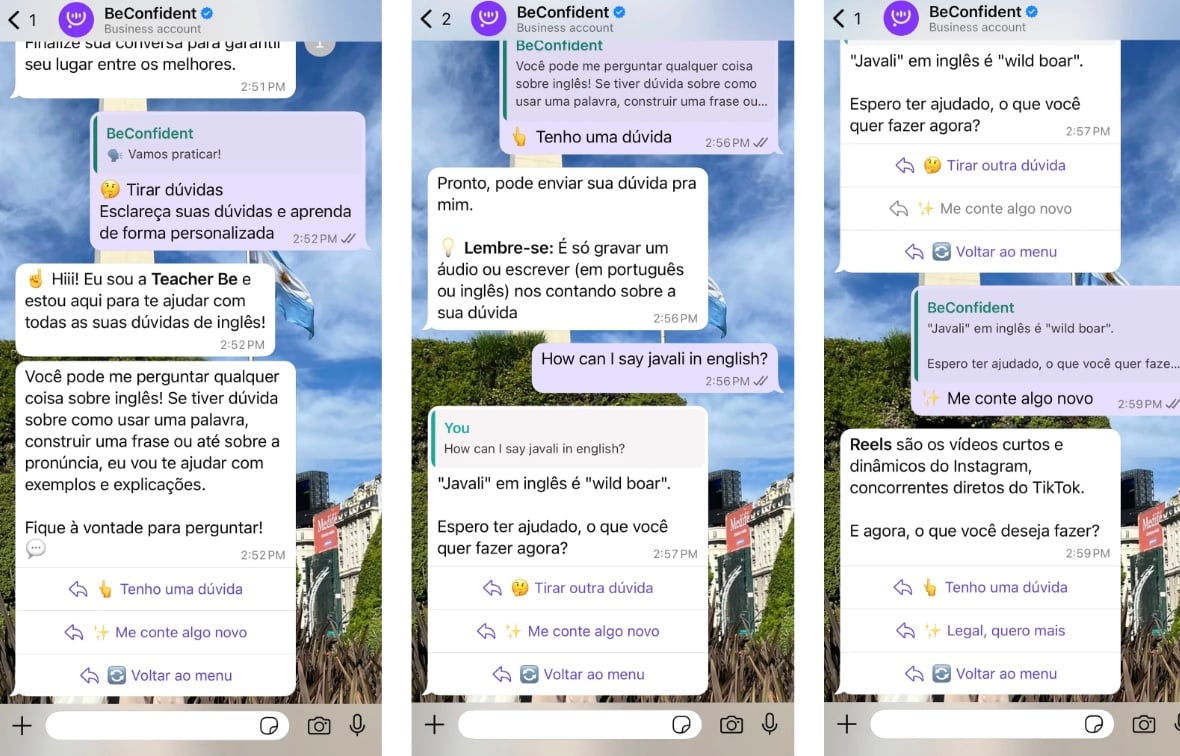
During conversations, ask the AI to repeat sentences at different speeds, explain reductions you didn't understand, or switch accents. This flexibility doesn't exist with pre-recorded audio.
Conversational strategies for listening:
Ask for stories about specific topics.
Request explanations of idiomatic expressions.
Practice dialogues for real-life situations, like at airport and restaurant.
Use the "phone call" feature to simulate phone conversations.
Step 7: Track your progress
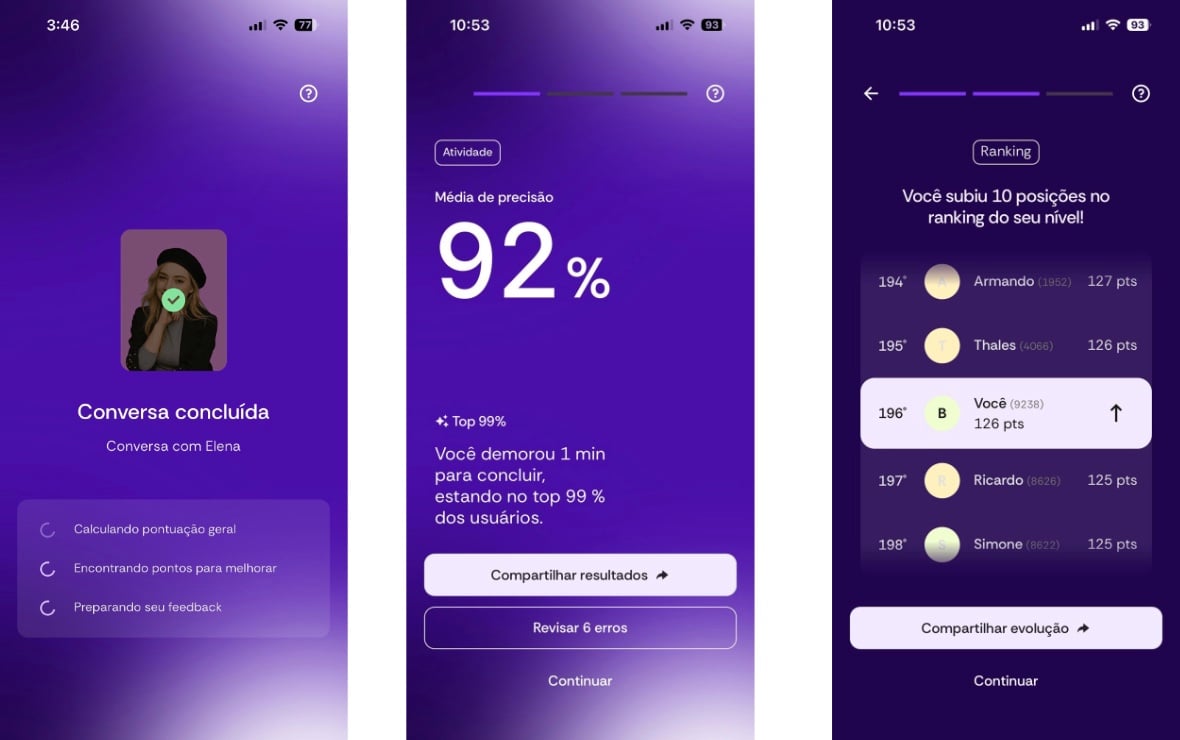
Measuring progress objectively maintains motivation and guides strategy adjustments. Useful metrics include accuracy, which is the percentage of correct answers, WPM tolerance, which is the number of words per minute with at least 80% accuracy, and feature spotting, which is the identification of reductions per minute.
30-day tracking template:
Week 1: Measure baseline of comprehension percentage on a 5-minute podcast.
Week 2: Identify at least 5 common reductions in native audio.
Week 3: Watch content without subtitles for 10 minutes with reasonable comprehension.
Week 4: Maintain a fluid conversation for 15 minutes.
Benchmarks for levels B1 and B2:
B1: 70% accuracy in controlled audio and ability to identify the main idea.
B2: 80% accuracy in native audio and understanding of specific details.
Use BeConfident's "My Evolution Menu" to track daily streak, practice hours, and certificates. This gamification helps maintain consistency, which is the key factor for results.
Expert tips and common mistakes
Advanced tips:
Record your own voice repeating native audio to compare pronunciation.
Use the "Review mistakes" feature to focus on specific points.
Practice in environments with background noise to simulate real-world situations.
Combine multiple accents in the same session.
Mistakes that sabotage progress:
Focusing only on speed without working on reductions.
Skipping steps, since each step builds on the previous one.
Practicing always with a single accent.
Ignoring the objective measurement of progress.
Interrupting the routine before 30 days, which is the period when results start becoming clear.
Frequently Asked Questions (FAQ)
Is it possible to learn English just by listening?
Learning English just by listening requires strategy. Passive exposure increases familiarity, but you need to combine this habit with active shadowing, conversational practice, and corrective feedback. Studies show that immersion combined with targeted techniques yields significant gains in about 30 days. BeConfident gathers these elements into a single platform.
How long does it take for me to understand natives fluently?
With consistent practice of 20 to 30 minutes a day using the 7 steps, Brazilian B1-B2 speakers usually notice clear improvements in 2 to 4 weeks. More stable listening fluency tends to emerge between 3 and 6 months, depending on prior exposure and regularity. BeConfident's AI accelerates this process by offering 24/7 personalized feedback.
How can I use AI to improve listening better than ChatGPT?
Specialized platforms like BeConfident offer audio with authentic native accents, real-time pronunciation feedback, and simulated conversations designed for language teaching. BeConfident's AI was trained for English teaching with a focus on listening and pronunciation for Portuguese speakers.
Which accent should I focus on first?
It's worth starting with the American accent, which appears most frequently in media and business, and then including the British accent. Australian and other accents can be introduced into your routine after you gain confidence with those two. BeConfident offers tutors with all major accents, making a gradual transition easy.
Does shadowing really work for Brazilians?
Shadowing works well for Brazilians. The musicality of Portuguese helps reproduce the rhythm and intonation of English. The technique is especially useful for dealing with reductions and linking sounds that do not exist in Portuguese. Practicing 10 to 15 minutes a day usually yields results in about two weeks.
Conclusion: Apply the 7 steps and unlock your hearing
Training your ear to understand native English speakers depends on applying proven techniques consistently. The 7 steps presented help Brazilians move from slow comprehension to more natural listening fluency.
Combine daily exposure, active shadowing, mastery of reductions, and AI practice to get results in about 30 days. BeConfident supports every stage with 24/7 native tutors, personalized feedback, and automatic progress tracking.
Your professional and personal goals require clear comprehension of English. Start building this skill today.
Try BeConfident for free now and start unlocking your hearing in the coming weeks.
Written by: Luan Cavallaro, Founder & CMO, BeConfident
Key takeaways from this article
Daily exposure to native audio for 20 minutes builds familiarity with natural rhythm and intonation, even without understanding 100% at first.
Practicing active shadowing, repeating audio simultaneously, improves synchronization and pronunciation, especially with short, progressive clips.
Gradually transitioning from Portuguese subtitles to English and then to none over 30 days increases listening independence, using familiar series.
Mastering chunks and reductions like "gonna", "wanna", and elisions is essential for understanding fast native speech.
Using an AI like BeConfident accelerates the process with varied accents, 24/7 instant feedback, and progress tracking; try it free now.
Step 1: Create daily exposure to native audio
Daily exposure is the foundation for training your ear. Set aside 20 minutes a day to listen to authentic content like the BBC's "6 Minute English" podcast, TED Talks, or YouTube conversations. Consistency matters more than duration. Start with familiar topics to build confidence and then move on to new subjects.
Practical tips:
Set a fixed time, such as in the morning or during your commute to work.
Use headphones for better sound quality.
Avoid aiming for 100% comprehension; focus on rhythm, intonation, and keywords.
Common mistake: pausing all the time to translate every single word. This breaks the natural flow and delays the development of global comprehension.
Step 2: Practice active shadowing
Shadowing, which is repeating aloud at the same time as you listen, is one of the most effective techniques to improve listening comprehension. Select 30- to 60-second clips and repeat each one 5 times. Start by whispering along with the audio and gradually increase the volume. The goal is to keep up with the natural rhythm, not to speak perfectly.
Practical example: listen to "I'm gonna go to the store" and repeat right after, mimicking intonation and speed. Notice how "going to" becomes "gonna". This reduction appears all the time in native speech.
Recommended progression:
Weeks 1 and 2: 15- to 30-second clips.
Weeks 3 and 4: 45- to 60-second clips.
After 30 days: full paragraphs.
Step 3: Use English subtitles until you reach zero
Making a planned transition with subtitles helps build listening independence. Start with Portuguese subtitles, then switch to English, and finally watch without subtitles.
This progression allows the brain to associate sounds with written words and strengthens neural connections. Use series you are already familiar with. When the story is familiar, you can focus more on the audio.
Suggested schedule:
Days 1 to 10: Portuguese subtitles.
Days 11 to 20: English subtitles.
Days 21 to 30: no subtitles.
If you feel a total loss of comprehension, go back one stage. The goal is to maintain a level of challenge that does not cause excessive frustration.
Step 4: Master chunks and reductions of native English
Reductions appear all the time in native speech and change sounds significantly. Phonetic phenomena include "for" reduced to /fer/, "him" as /im/, and forms like "shoulda" for "should have".
Top 10 essential reductions:
"going to" → "gonna"
"want to" → "wanna"
"should have" → "shoulda"
"could have" → "coulda"
"would have" → "woulda"
"for" → "fer"
"him/her" → "im/er" (h-dropping)
"not at all" → "notatall" (linking)
"next day" → "neks day" (elision of "t")
"old man" → "ol' man" (elision of "d")
Include a focused listening routine for these forms. Whenever you recognize a reduction in a dialogue, pause, repeat it out loud a few times, and lock the phrase into your auditory memory.
Step 5: Train with different English accents
Exposure to various accents prepares your ear for real-life work, travel, and study situations. Start with the American accent, which appears most in media and business, then move on to British and Australian.
Resources by accent:
American: CNN, podcasts like "This American Life".
British: BBC, "The Guardian" podcasts.
Australian: ABC Australia and Australian YouTube channels.
Set aside at least a week for each accent and then mix them. Artificial intelligence helps at this point because it offers practice with multiple accents in the same session.
The tool that accelerates the process: BeConfident
BeConfident offers AI tutors with authentic native accents, available 24/7 on the app, WhatsApp, or smartwatch. The platform serves over 200,000 students, has an RA1000 reputation on Reclame Aqui, and delivers instant, personalized feedback for listening and pronunciation.
Method | Cost | Availability | Accents | Feedback |
Traditional schools | High | Fixed hours | Limited | Weekly |
Duolingo | Low | 24/7 | Basic | Automatic |
Cambly | Per minute | Scheduled | Variable | Human |
BeConfident | Affordable | 24/7 | Multiple native speakers | Instant AI |
Real testimonials:
"I had a lot of trouble speaking, even though I could read and listen well. I started using BeConfident and, within a month, I was already speaking more naturally without freezing up."
"Constant practice with the AI reduced my frustration of forgetting words in important moments. The AI also taught me English expressions in context."
Take the free trial and start learning English today.
Step 6: Use conversational practice with AI
Active conversation with AI accelerates listening because you need to understand and respond in real-time. Use the "Tell me something new" feature on BeConfident to expand vocabulary while training comprehension of unexpected topics.
During conversations, ask the AI to repeat sentences at different speeds, explain reductions you didn't understand, or switch accents. This flexibility doesn't exist with pre-recorded audio.
Conversational strategies for listening:
Ask for stories about specific topics.
Request explanations of idiomatic expressions.
Practice dialogues for real-life situations, like at airport and restaurant.
Use the "phone call" feature to simulate phone conversations.
Step 7: Track your progress
Measuring progress objectively maintains motivation and guides strategy adjustments. Useful metrics include accuracy, which is the percentage of correct answers, WPM tolerance, which is the number of words per minute with at least 80% accuracy, and feature spotting, which is the identification of reductions per minute.
30-day tracking template:
Week 1: Measure baseline of comprehension percentage on a 5-minute podcast.
Week 2: Identify at least 5 common reductions in native audio.
Week 3: Watch content without subtitles for 10 minutes with reasonable comprehension.
Week 4: Maintain a fluid conversation for 15 minutes.
Benchmarks for levels B1 and B2:
B1: 70% accuracy in controlled audio and ability to identify the main idea.
B2: 80% accuracy in native audio and understanding of specific details.
Use BeConfident's "My Evolution Menu" to track daily streak, practice hours, and certificates. This gamification helps maintain consistency, which is the key factor for results.
Expert tips and common mistakes
Advanced tips:
Record your own voice repeating native audio to compare pronunciation.
Use the "Review mistakes" feature to focus on specific points.
Practice in environments with background noise to simulate real-world situations.
Combine multiple accents in the same session.
Mistakes that sabotage progress:
Focusing only on speed without working on reductions.
Skipping steps, since each step builds on the previous one.
Practicing always with a single accent.
Ignoring the objective measurement of progress.
Interrupting the routine before 30 days, which is the period when results start becoming clear.
Frequently Asked Questions (FAQ)
Is it possible to learn English just by listening?
Learning English just by listening requires strategy. Passive exposure increases familiarity, but you need to combine this habit with active shadowing, conversational practice, and corrective feedback. Studies show that immersion combined with targeted techniques yields significant gains in about 30 days. BeConfident gathers these elements into a single platform.
How long does it take for me to understand natives fluently?
With consistent practice of 20 to 30 minutes a day using the 7 steps, Brazilian B1-B2 speakers usually notice clear improvements in 2 to 4 weeks. More stable listening fluency tends to emerge between 3 and 6 months, depending on prior exposure and regularity. BeConfident's AI accelerates this process by offering 24/7 personalized feedback.
How can I use AI to improve listening better than ChatGPT?
Specialized platforms like BeConfident offer audio with authentic native accents, real-time pronunciation feedback, and simulated conversations designed for language teaching. BeConfident's AI was trained for English teaching with a focus on listening and pronunciation for Portuguese speakers.
Which accent should I focus on first?
It's worth starting with the American accent, which appears most frequently in media and business, and then including the British accent. Australian and other accents can be introduced into your routine after you gain confidence with those two. BeConfident offers tutors with all major accents, making a gradual transition easy.
Does shadowing really work for Brazilians?
Shadowing works well for Brazilians. The musicality of Portuguese helps reproduce the rhythm and intonation of English. The technique is especially useful for dealing with reductions and linking sounds that do not exist in Portuguese. Practicing 10 to 15 minutes a day usually yields results in about two weeks.
Conclusion: Apply the 7 steps and unlock your hearing
Training your ear to understand native English speakers depends on applying proven techniques consistently. The 7 steps presented help Brazilians move from slow comprehension to more natural listening fluency.
Combine daily exposure, active shadowing, mastery of reductions, and AI practice to get results in about 30 days. BeConfident supports every stage with 24/7 native tutors, personalized feedback, and automatic progress tracking.
Your professional and personal goals require clear comprehension of English. Start building this skill today.
Try BeConfident for free now and start unlocking your hearing in the coming weeks.