




Difference between English levels: A1, A2, B1, and B2 explained
Difference between English levels: A1, A2, B1, and B2 explained
Difference between English levels: A1, A2, B1, and B2 explained
Written by: Luan Cavallaro, Founder & CMO, BeConfident
Key Takeaways from This Article
The A1 level allows for basic survival communication, such as introducing oneself and asking simple questions, but depends on slow speech from the interlocutor.
The A2 level covers daily routines like shopping, family, and basic travel, allowing one to handle simple situations clearly.
The B1 level marks independence for travel, work, and expressing opinions on familiar topics, with natural conversations in known contexts.
The B2 level represents conversational fluency for complex debates and professional interactions with native speakers, and became required for UK visas starting in 2026.
Daily conversational practice accelerates progression. Use the BeConfident free test to find out your CEFR level and receive a personalized plan.
Comparative Table of A1, A2, B1, and B2 Levels
Skill | A1 (Basic) | A2 (Elementary) | B1 (Intermediate) | B2 (Upper Intermediate) |
Speaking | Introduce oneself and ask basic questions | Talk about family routine and do simple shopping | Describe experiences and give opinions on familiar topics | Participate in complex debates with natural fluency with native speakers |
Listening | Recognize familiar words in very slow speech | Understand phrases about family and work | Identify main points on familiar topics | Follow lectures, movies, and technical conversations |
Reading | Read names, signs, and very simple texts | Read short texts about routine | Read texts about personal interests | Read articles, reports, and contemporary literature |
Writing | Fill out basic forms and write postcards | Write simple notes and personal letters | Write texts about experiences and dreams | Produce essays, detailed reports, and arguments |
For Brazilian professionals, a B1 level is sufficient for basic meetings. The UK raised the requirement for work visas to B2 starting January 2026, which reflects the demand for greater fluency in international corporate environments.
A1 English Level: The Foundation for Survival Situations
The A1 level allows for very basic communication in survival situations. At this level, a person can introduce themselves, ask for directions, or place simple orders in restaurants, but still needs the speaker to speak slowly and be willing to repeat themselves.
What you can do at A1:
Introduce yourself with basic information, such as name, nationality, and profession
Ask simple questions about people and places
Understand basic instructions and signs
Ask for help in emergency situations
What is still difficult at A1:
Maintain conversations beyond very basic exchanges
Understand speech at normal speed
Express more complex opinions or feelings
Example of an A1 dialogue:
English: "Hello, my name is João. I live in São Paulo. I am an engineer. Where is the bathroom, please?"
Portuguese: "Olá, meu nome é João. Eu moro em São Paulo. Eu sou engenheiro. Onde fica o banheiro, por favor?"
A2 English Level: Simple Routine and Basic Travel
The A2 level expands the ability to handle daily situations. At this stage, a person talks about family, hobbies, does shopping, and handles basic travel situations, as long as the conversation partner speaks clearly and slowly.
Situations you master at A2:
Describe your daily routine and your family
Shop and ask for prices
Book a hotel and ask for tourist information
Talk about simple past experiences
Example of an A2 dialogue:
English: "Excuse me, how much is this shirt? I need a medium size. Do you accept credit cards? I'm visiting Brazil for two weeks."
Portuguese: "Com licença, quanto custa esta camisa? Eu preciso do tamanho médio. Vocês aceitam cartão de crédito? Estou visitando o Brasil por duas semanas."
B1 English Level: Independence in Real Situations
The B1 level represents a milestone of linguistic independence. At this level, a person handles most travel situations, describes experiences, and expresses opinions on familiar topics. Conversations about work, hobbies, and future plans become more natural.
Achievements at B1 level:
Participate in meetings on known topics
Resolve issues during international travel
Express opinions and justify points of view
Tell stories and describe dreams and ambitions
Example of a B1 dialogue:
English: "I've been working as a software developer for three years. I really enjoy the creative problem-solving aspect, but I think remote work can be challenging for team collaboration. What's your experience with that?"
Portuguese: "Trabalho como desenvolvedor de software há três anos. Gosto do aspecto criativo de resolver problemas, mas acho que o trabalho remoto pode ser desafiador para a colaboração em equipe. Qual é sua experiência com isso?"
B2 English Level: Upper-Intermediate Fluency
The B2 level marks the entry into consistent conversational fluency. At this stage, a person speaks naturally and fluidly, pausing only to choose a better word or example. This is the level required for UK work visas from 2026 onwards.
Typical mastery at B2:
Debate abstract topics like politics and culture
Participate in technical meetings in your area of expertise
Speak fluently with native speakers without mutual effort
Present complex arguments clearly
Example of a B2 dialogue:
English: "I believe artificial intelligence will fundamentally reshape the job market, but I'm optimistic about the opportunities it creates. While automation might eliminate routine tasks, it simultaneously generates demand for roles requiring creativity, emotional intelligence, and complex problem-solving. What's your perspective on balancing technological advancement with workforce adaptation?"
Portuguese: "Acredito que a inteligência artificial vai remodelar fundamentalmente o mercado de trabalho, mas sou otimista sobre as oportunidades que ela cria. Embora a automação possa eliminar tarefas rotineiras, ao mesmo tempo gera demanda por funções que exigem criatividade, inteligência emocional e resolução de problemas complexos. Qual é sua perspectiva sobre equilibrar o avanço tecnológico com a adaptação da força de trabalho?"
Frequently Asked Questions About CEFR Levels
What does A1, A2, B1, and B2 mean in English?
A1, A2, B1, and B2 are levels of the Common European Framework of Reference (CEFR) that standardize language proficiency. A1 and A2 represent basic users. B1 and B2 represent independent users. Each level defines specific skills in speaking, listening, reading, and writing and serves as a global reference for certification and proficiency assessment.
Is a B1 English level good?
The B1 level is considered a solid intermediate level and allows for independence in most everyday situations and some basic professional settings. At this level, a person can travel alone, participate in meetings on familiar topics, and express opinions. For many contexts, this level is sufficient, but international corporate environments and immigration processes for countries like the UK have started to require a B2 level.
What is the difference between B1 and B2?
The main difference lies in fluency and the complexity of communication. At B1, a person communicates well on familiar topics but still hesitates in complex discussions. At B2, a person can debate virtually any topic with natural fluency, participate in technical meetings, and speak with native speakers without mutual effort. B2 also allows for understanding academic texts and producing more sophisticated arguments.
What is A2 English sufficient for?
The A2 level is sufficient for basic tourism and simple everyday situations. At this stage, a person can shop, ask for directions, and talk about family and hobbies. While the A2 level suffices for short trips, it cannot sustain international work, study abroad, or professional conversations. For career growth or immigration, it is necessary to advance to B1 or B2.
How long does it take to reach B2?
The time to reach B2 varies based on dedication and study method. With daily conversational practice of 20 to 30 minutes, many people can progress from A2 to B1 in 3 to 4 months and from B1 to B2 in 4 to 6 months. Traditional methods focused on grammar tend to take years, while approaches centered on conversation with AI accelerate this process.
Self-Assessment and Free Test with BeConfident
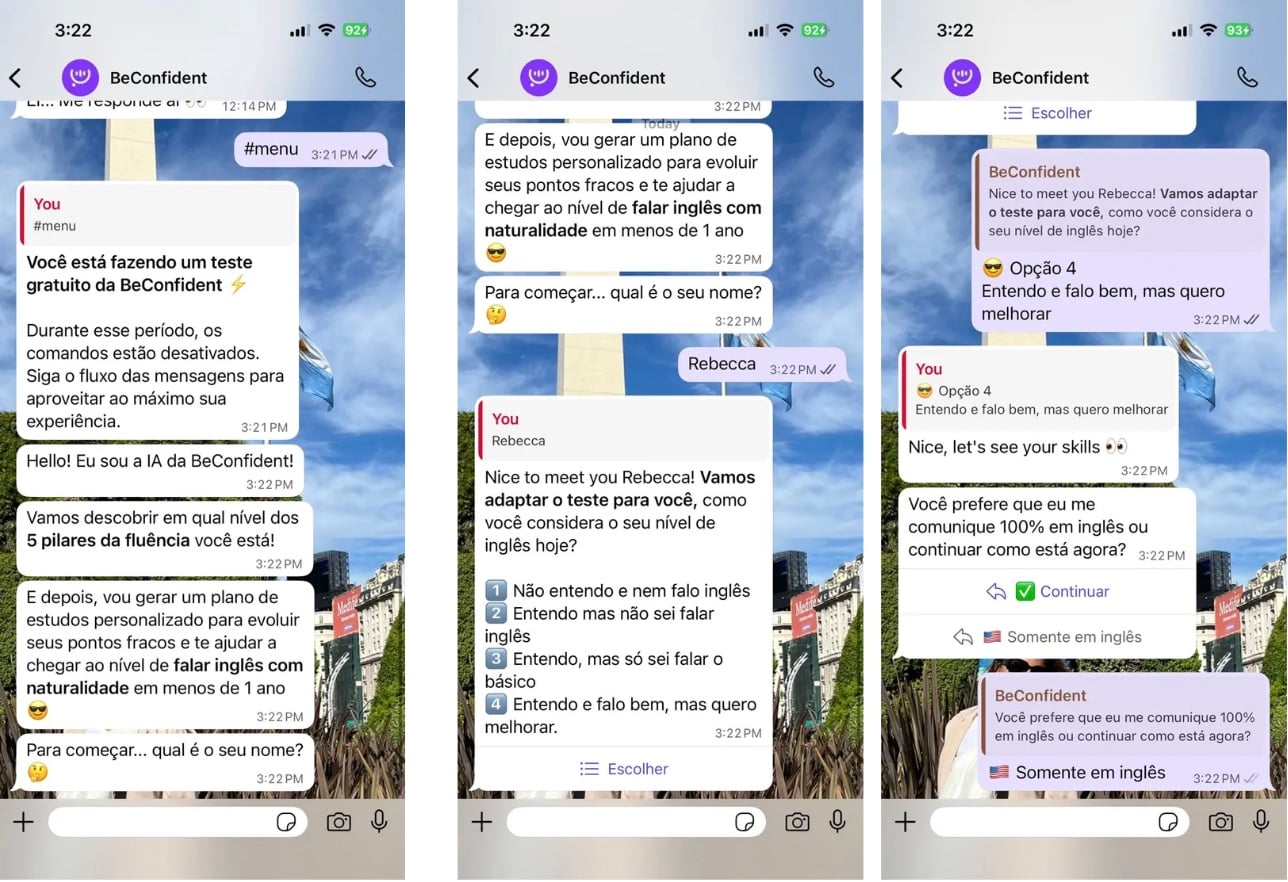
Identifying your current level is the first step to building an effective study plan. BeConfident offers a free test that evaluates your conversational skills in real-life situations, rather than just theoretical grammar.
Quick self-assessment quiz:
Can you introduce yourself and talk about your routine in English?
Can you maintain conversations about work and hobbies for more than 5 minutes?
Do you express opinions and justify your viewpoints?
Do you debate complex topics like technology or politics?
Do you converse naturally with native speakers without mutual effort?
If you answered "yes" only to the first question, you are likely between A1 and A2. Three "yes" answers indicate a B1 level. Five "yes" answers suggest a B2 level or higher.
Take the free CEFR English levels test with BeConfident. Answer in Portuguese and English, receive a detailed analysis of your CEFR level, and get a personalized plan to accelerate your conversational fluency.
Progression Roadmap with BeConfident
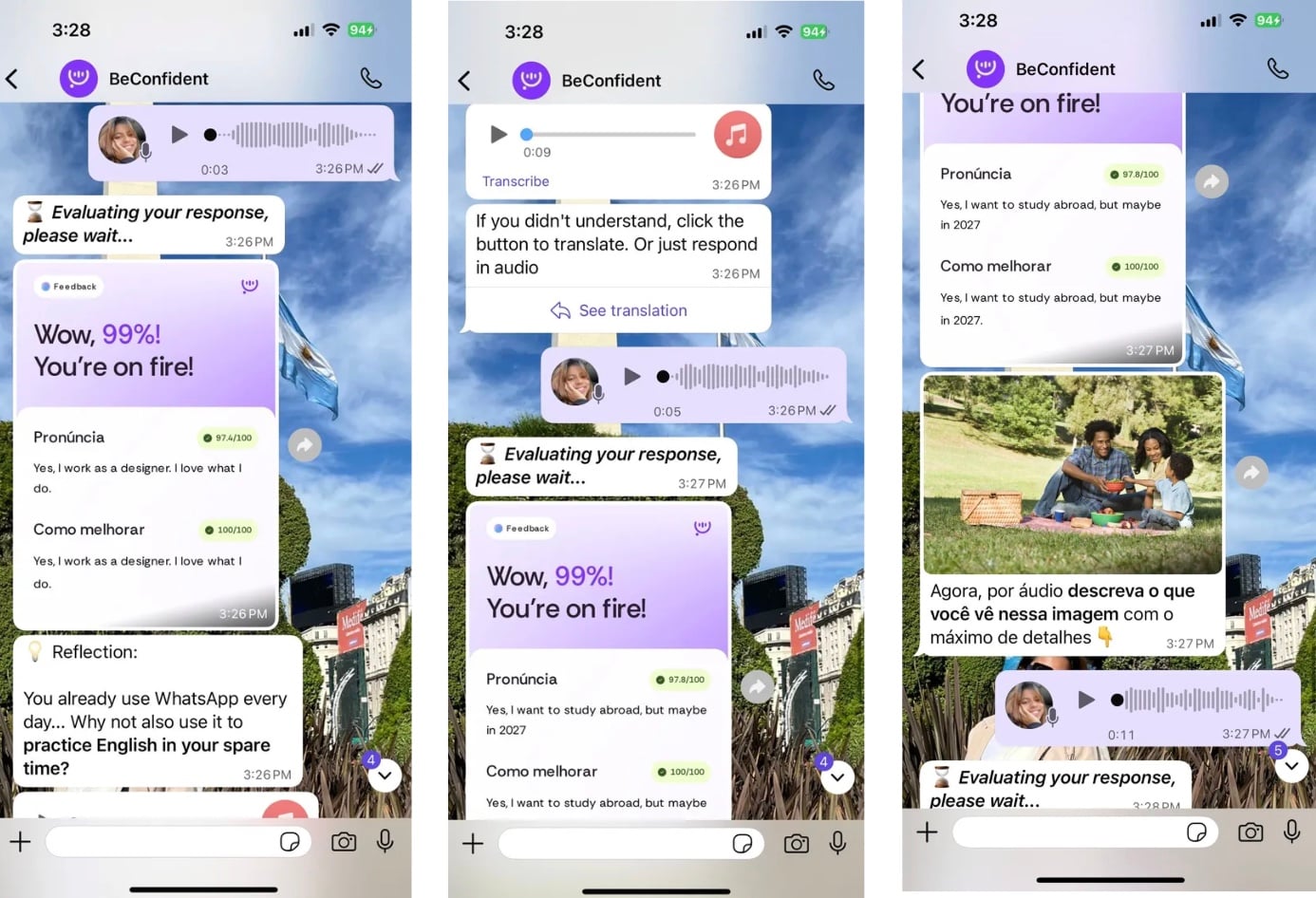
Progressing between CEFR levels becomes faster with constant conversational practice. Educational technology trends for 2025 show that using AI in education provides instant feedback and personalized adaptation, which reshapes how languages are learned.
Progression | Average Time | Traditional Method | BeConfident |
A2 → B1 | 3 to 4 months | 6 to 12 months | 3 months, with 20 minutes a day |
B1 → B2 | 4 to 6 months | 12 to 18 months | 4 months, with 20 minutes a day |
Monthly Cost | Variable | R$ 300 to R$ 800 | Fraction of this cost |
Flexibility | Availability | Fixed schedules | App, WhatsApp, and smartwatch |
BeConfident reduces the limitations of traditional methods by using AI tutors with distinct personalities and native accents, such as American, British, and Australian. In 2026, voice AI consolidates as the dominant interface with improvements in accuracy and real-time response, allowing for natural conversation without judgment.
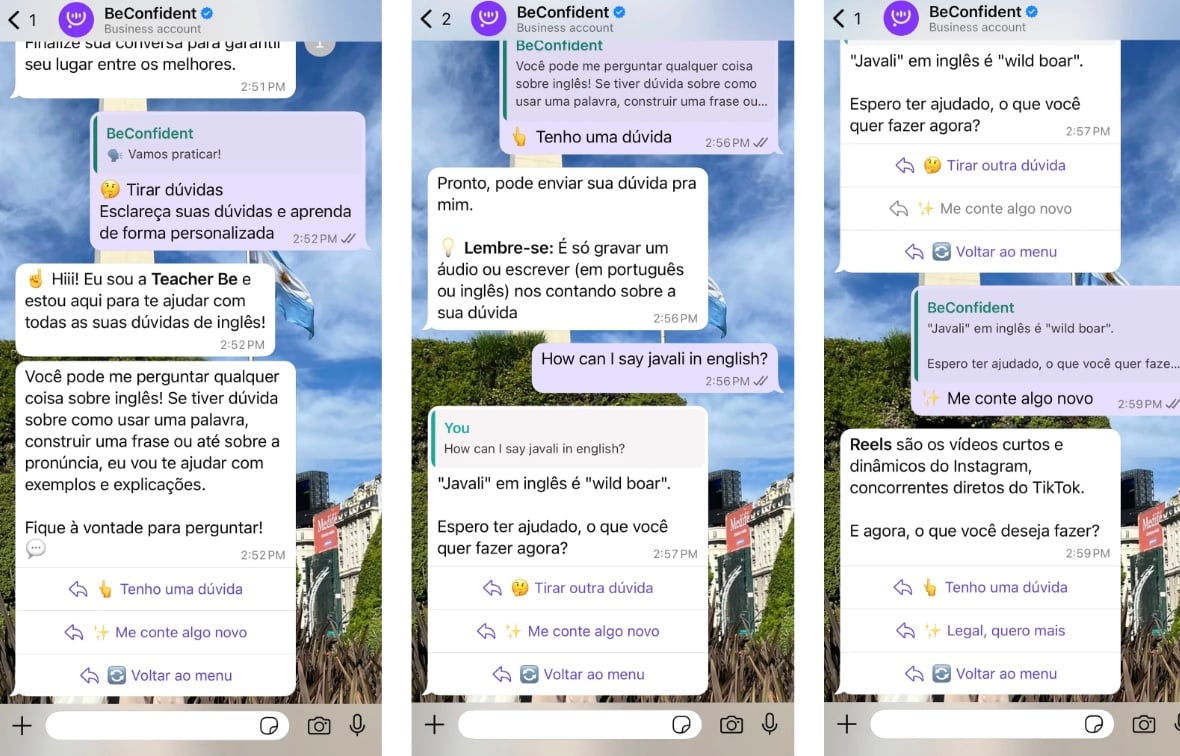
BeConfident offers structured paths by CEFR level, instant feedback on pronunciation and grammar, and unlimited practice that adapts to your routine.
Conclusion
The difference between English levels A1, A2, B1, and B2 defines clear milestones on the journey toward conversational fluency. Levels A1 and A2 cover basic needs. Level B1 marks linguistic independence. Level B2 represents professional fluency for international contexts.
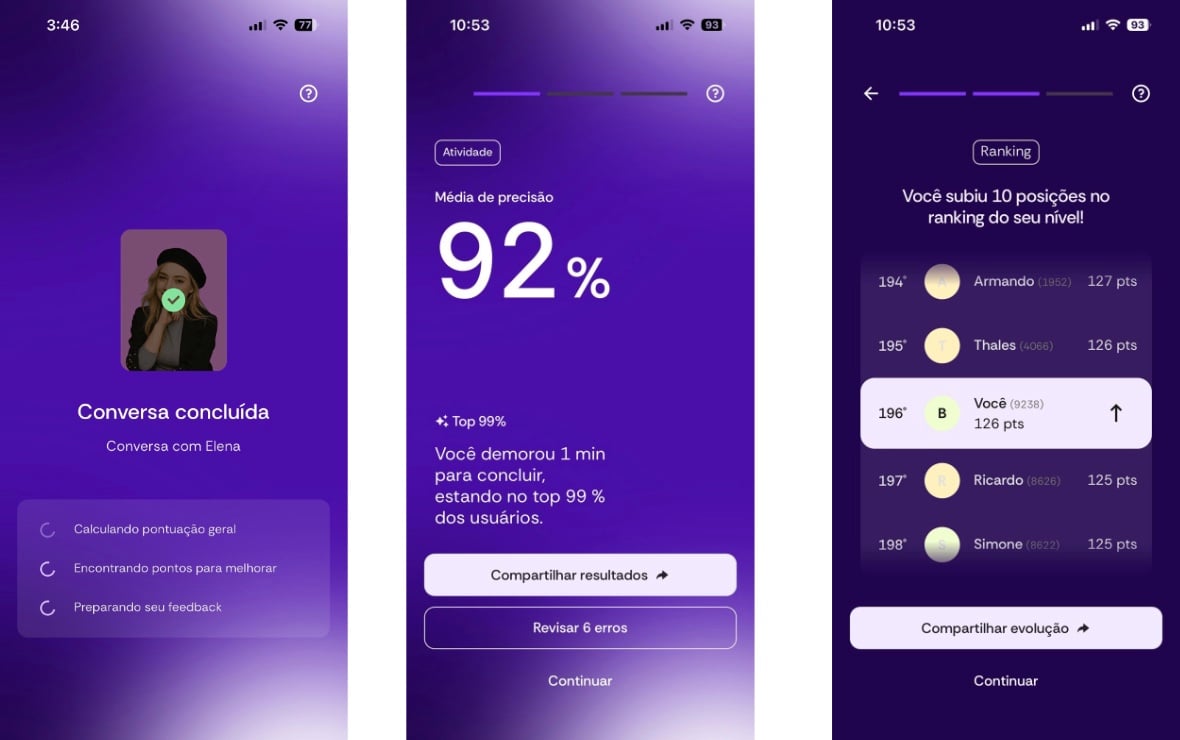
Constant conversational practice accelerates progression much faster than theoretical study alone. BeConfident removes barriers such as embarrassment, fixed schedules, and high costs, with AI tutors available 24 hours a day for personalized practice.
Take the free CEFR English levels test with BeConfident and begin your evolution in conversation. Discover your current level and start speaking English with more confidence in just a few weeks.
Written by: Luan Cavallaro, Founder & CMO, BeConfident
Key Takeaways from This Article
The A1 level allows for basic survival communication, such as introducing oneself and asking simple questions, but depends on slow speech from the interlocutor.
The A2 level covers daily routines like shopping, family, and basic travel, allowing one to handle simple situations clearly.
The B1 level marks independence for travel, work, and expressing opinions on familiar topics, with natural conversations in known contexts.
The B2 level represents conversational fluency for complex debates and professional interactions with native speakers, and became required for UK visas starting in 2026.
Daily conversational practice accelerates progression. Use the BeConfident free test to find out your CEFR level and receive a personalized plan.
Comparative Table of A1, A2, B1, and B2 Levels
Skill | A1 (Basic) | A2 (Elementary) | B1 (Intermediate) | B2 (Upper Intermediate) |
Speaking | Introduce oneself and ask basic questions | Talk about family routine and do simple shopping | Describe experiences and give opinions on familiar topics | Participate in complex debates with natural fluency with native speakers |
Listening | Recognize familiar words in very slow speech | Understand phrases about family and work | Identify main points on familiar topics | Follow lectures, movies, and technical conversations |
Reading | Read names, signs, and very simple texts | Read short texts about routine | Read texts about personal interests | Read articles, reports, and contemporary literature |
Writing | Fill out basic forms and write postcards | Write simple notes and personal letters | Write texts about experiences and dreams | Produce essays, detailed reports, and arguments |
For Brazilian professionals, a B1 level is sufficient for basic meetings. The UK raised the requirement for work visas to B2 starting January 2026, which reflects the demand for greater fluency in international corporate environments.
A1 English Level: The Foundation for Survival Situations
The A1 level allows for very basic communication in survival situations. At this level, a person can introduce themselves, ask for directions, or place simple orders in restaurants, but still needs the speaker to speak slowly and be willing to repeat themselves.
What you can do at A1:
Introduce yourself with basic information, such as name, nationality, and profession
Ask simple questions about people and places
Understand basic instructions and signs
Ask for help in emergency situations
What is still difficult at A1:
Maintain conversations beyond very basic exchanges
Understand speech at normal speed
Express more complex opinions or feelings
Example of an A1 dialogue:
English: "Hello, my name is João. I live in São Paulo. I am an engineer. Where is the bathroom, please?"
Portuguese: "Olá, meu nome é João. Eu moro em São Paulo. Eu sou engenheiro. Onde fica o banheiro, por favor?"
A2 English Level: Simple Routine and Basic Travel
The A2 level expands the ability to handle daily situations. At this stage, a person talks about family, hobbies, does shopping, and handles basic travel situations, as long as the conversation partner speaks clearly and slowly.
Situations you master at A2:
Describe your daily routine and your family
Shop and ask for prices
Book a hotel and ask for tourist information
Talk about simple past experiences
Example of an A2 dialogue:
English: "Excuse me, how much is this shirt? I need a medium size. Do you accept credit cards? I'm visiting Brazil for two weeks."
Portuguese: "Com licença, quanto custa esta camisa? Eu preciso do tamanho médio. Vocês aceitam cartão de crédito? Estou visitando o Brasil por duas semanas."
B1 English Level: Independence in Real Situations
The B1 level represents a milestone of linguistic independence. At this level, a person handles most travel situations, describes experiences, and expresses opinions on familiar topics. Conversations about work, hobbies, and future plans become more natural.
Achievements at B1 level:
Participate in meetings on known topics
Resolve issues during international travel
Express opinions and justify points of view
Tell stories and describe dreams and ambitions
Example of a B1 dialogue:
English: "I've been working as a software developer for three years. I really enjoy the creative problem-solving aspect, but I think remote work can be challenging for team collaboration. What's your experience with that?"
Portuguese: "Trabalho como desenvolvedor de software há três anos. Gosto do aspecto criativo de resolver problemas, mas acho que o trabalho remoto pode ser desafiador para a colaboração em equipe. Qual é sua experiência com isso?"
B2 English Level: Upper-Intermediate Fluency
The B2 level marks the entry into consistent conversational fluency. At this stage, a person speaks naturally and fluidly, pausing only to choose a better word or example. This is the level required for UK work visas from 2026 onwards.
Typical mastery at B2:
Debate abstract topics like politics and culture
Participate in technical meetings in your area of expertise
Speak fluently with native speakers without mutual effort
Present complex arguments clearly
Example of a B2 dialogue:
English: "I believe artificial intelligence will fundamentally reshape the job market, but I'm optimistic about the opportunities it creates. While automation might eliminate routine tasks, it simultaneously generates demand for roles requiring creativity, emotional intelligence, and complex problem-solving. What's your perspective on balancing technological advancement with workforce adaptation?"
Portuguese: "Acredito que a inteligência artificial vai remodelar fundamentalmente o mercado de trabalho, mas sou otimista sobre as oportunidades que ela cria. Embora a automação possa eliminar tarefas rotineiras, ao mesmo tempo gera demanda por funções que exigem criatividade, inteligência emocional e resolução de problemas complexos. Qual é sua perspectiva sobre equilibrar o avanço tecnológico com a adaptação da força de trabalho?"
Frequently Asked Questions About CEFR Levels
What does A1, A2, B1, and B2 mean in English?
A1, A2, B1, and B2 are levels of the Common European Framework of Reference (CEFR) that standardize language proficiency. A1 and A2 represent basic users. B1 and B2 represent independent users. Each level defines specific skills in speaking, listening, reading, and writing and serves as a global reference for certification and proficiency assessment.
Is a B1 English level good?
The B1 level is considered a solid intermediate level and allows for independence in most everyday situations and some basic professional settings. At this level, a person can travel alone, participate in meetings on familiar topics, and express opinions. For many contexts, this level is sufficient, but international corporate environments and immigration processes for countries like the UK have started to require a B2 level.
What is the difference between B1 and B2?
The main difference lies in fluency and the complexity of communication. At B1, a person communicates well on familiar topics but still hesitates in complex discussions. At B2, a person can debate virtually any topic with natural fluency, participate in technical meetings, and speak with native speakers without mutual effort. B2 also allows for understanding academic texts and producing more sophisticated arguments.
What is A2 English sufficient for?
The A2 level is sufficient for basic tourism and simple everyday situations. At this stage, a person can shop, ask for directions, and talk about family and hobbies. While the A2 level suffices for short trips, it cannot sustain international work, study abroad, or professional conversations. For career growth or immigration, it is necessary to advance to B1 or B2.
How long does it take to reach B2?
The time to reach B2 varies based on dedication and study method. With daily conversational practice of 20 to 30 minutes, many people can progress from A2 to B1 in 3 to 4 months and from B1 to B2 in 4 to 6 months. Traditional methods focused on grammar tend to take years, while approaches centered on conversation with AI accelerate this process.
Self-Assessment and Free Test with BeConfident
Identifying your current level is the first step to building an effective study plan. BeConfident offers a free test that evaluates your conversational skills in real-life situations, rather than just theoretical grammar.
Quick self-assessment quiz:
Can you introduce yourself and talk about your routine in English?
Can you maintain conversations about work and hobbies for more than 5 minutes?
Do you express opinions and justify your viewpoints?
Do you debate complex topics like technology or politics?
Do you converse naturally with native speakers without mutual effort?
If you answered "yes" only to the first question, you are likely between A1 and A2. Three "yes" answers indicate a B1 level. Five "yes" answers suggest a B2 level or higher.
Take the free CEFR English levels test with BeConfident. Answer in Portuguese and English, receive a detailed analysis of your CEFR level, and get a personalized plan to accelerate your conversational fluency.
Progression Roadmap with BeConfident
Progressing between CEFR levels becomes faster with constant conversational practice. Educational technology trends for 2025 show that using AI in education provides instant feedback and personalized adaptation, which reshapes how languages are learned.
Progression | Average Time | Traditional Method | BeConfident |
A2 → B1 | 3 to 4 months | 6 to 12 months | 3 months, with 20 minutes a day |
B1 → B2 | 4 to 6 months | 12 to 18 months | 4 months, with 20 minutes a day |
Monthly Cost | Variable | R$ 300 to R$ 800 | Fraction of this cost |
Flexibility | Availability | Fixed schedules | App, WhatsApp, and smartwatch |
BeConfident reduces the limitations of traditional methods by using AI tutors with distinct personalities and native accents, such as American, British, and Australian. In 2026, voice AI consolidates as the dominant interface with improvements in accuracy and real-time response, allowing for natural conversation without judgment.
BeConfident offers structured paths by CEFR level, instant feedback on pronunciation and grammar, and unlimited practice that adapts to your routine.
Conclusion
The difference between English levels A1, A2, B1, and B2 defines clear milestones on the journey toward conversational fluency. Levels A1 and A2 cover basic needs. Level B1 marks linguistic independence. Level B2 represents professional fluency for international contexts.
Constant conversational practice accelerates progression much faster than theoretical study alone. BeConfident removes barriers such as embarrassment, fixed schedules, and high costs, with AI tutors available 24 hours a day for personalized practice.
Take the free CEFR English levels test with BeConfident and begin your evolution in conversation. Discover your current level and start speaking English with more confidence in just a few weeks.